Introduction
API Aggregators help software teams connect to many third-party applications through one unified API instead of building every integration separately. In simple terms, they reduce the work needed to connect with tools like CRMs, HR systems, accounting platforms, payroll apps, ecommerce systems, calendars, email platforms, and payment services.
API Aggregators matter now because modern SaaS products must integrate quickly, securely, and reliably. Buyers expect native integrations, developers want fewer maintenance headaches, and enterprises need secure data movement across many systems.
Real-World Use Cases
- Connecting a SaaS product to multiple CRM platforms
- Syncing HR, payroll, and employee data
- Building accounting and finance integrations
- Adding ecommerce and marketplace integrations
- Managing unified customer, ticket, or document data
Evaluation Criteria for Buyers
- API coverage
- Data model quality
- Authentication handling
- Sync reliability
- Webhook support
- Security controls
- Developer documentation
- Pricing flexibility
- Rate limit management
- Integration maintenance support
Best for: SaaS companies, product teams, developers, integration engineers, fintechs, HR tech vendors, ecommerce platforms, and B2B software companies that need many third-party integrations quickly.
Not ideal for: Very small teams needing only one or two simple integrations, businesses with highly custom workflows, or teams that prefer fully custom direct API builds.
Key Trends in API Aggregators
- Unified APIs are becoming product infrastructure, not just developer shortcuts.
- AI-assisted integration mapping is helping teams normalize fields faster.
- Real-time sync and event-driven updates are replacing slow batch syncs.
- Security reviews are stricter, especially around data storage, audit logs, SSO, and RBAC.
- Vertical API aggregators are growing, especially in HR, fintech, accounting, commerce, and healthcare.
- Open-source integration frameworks are gaining interest among developer-first teams.
- Embedded integration marketplaces are becoming common in B2B SaaS products.
- Pricing is shifting toward usage-based and connection-based models.
- Data residency and compliance controls are becoming important for enterprise buyers.
- Observability is now critical, including logs, retries, sync status, and error monitoring.
How We Selected These Tools
- Market recognition among SaaS, fintech, HR tech, and developer teams
- Breadth and depth of third-party API coverage
- Strength of unified data models
- Reliability of sync, webhooks, authentication, and error handling
- Security posture signals such as RBAC, audit logs, SSO, and encryption
- Developer experience, documentation quality, and sandbox availability
- Fit across startups, SMBs, mid-market, and enterprise teams
- Ecosystem maturity, support quality, and integration flexibility
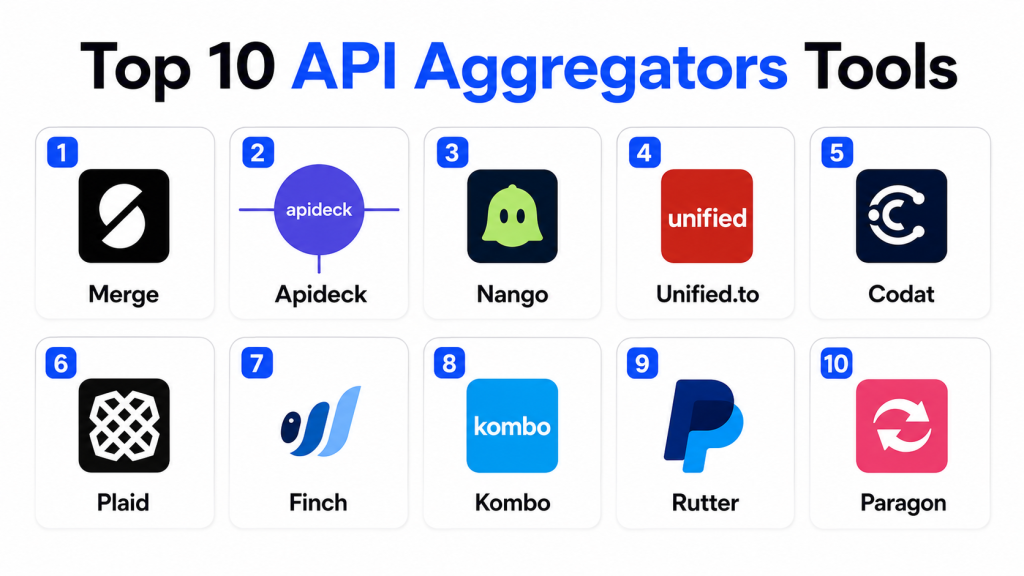
Top 10 API Aggregators Tools
1- Merge
Short description:
Merge is a unified API platform designed for B2B SaaS companies that need to integrate with multiple business applications across categories such as HRIS, ATS, CRM, accounting, ticketing, and file storage. It helps product and engineering teams build integrations faster by offering normalized data models, managed authentication, sync infrastructure, and observability tools. Merge is especially useful for SaaS vendors that need customer-facing integrations at scale. Its strength is broad category coverage combined with enterprise-friendly integration management. Teams use it to reduce maintenance work and ship integrations without building every connector from scratch.
Key Features
- Unified APIs across multiple software categories
- Normalized data models
- Managed authentication
- Sync monitoring and logs
- Webhooks and incremental sync support
- Developer documentation and API tools
- Enterprise integration management
Pros
- Strong fit for B2B SaaS integration roadmaps
- Broad category coverage
- Good developer experience
Cons
- Can be expensive for early-stage teams
- Less flexible than fully custom direct integrations
- Some edge cases may require workarounds
Platforms / Deployment
- Web
- Cloud
Security & Compliance
- SSO/SAML
- RBAC
- Audit logs
- Encryption
- Additional certifications: Not publicly stated
Integrations & Ecosystem
Merge connects SaaS products with business systems across HR, recruiting, accounting, CRM, ticketing, file storage, and more.
- HRIS platforms
- ATS systems
- CRM tools
- Accounting software
- Ticketing platforms
- File storage systems
Support & Community
Merge provides developer documentation, onboarding support, support channels, and resources for engineering teams. Enterprise support options may vary by plan.
2- Apideck
Short description:
Apideck is a unified API and integration platform that helps SaaS teams connect to multiple third-party applications through standardized APIs. It supports categories such as accounting, CRM, HRIS, ecommerce, file storage, and issue tracking. Apideck is useful for teams that want to launch integrations quickly while keeping the developer experience simple. It also offers integration marketplace capabilities for companies that want to display available integrations to users. The platform is popular among teams looking for a practical balance of API coverage, documentation, and implementation speed.
Key Features
- Unified APIs for multiple SaaS categories
- Real-time API access approach
- Integration marketplace tools
- Developer-friendly documentation
- Authentication handling
- Webhook support
- API monitoring capabilities
Pros
- Strong developer experience
- Useful integration marketplace features
- Good fit for SaaS product teams
Cons
- Coverage varies by category
- Advanced needs may require direct API customization
- Pricing may not fit very small projects
Platforms / Deployment
- Web
- Cloud
Security & Compliance
- Encryption
- API authentication controls
- Additional details: Not publicly stated
Integrations & Ecosystem
Apideck supports integrations across accounting, CRM, HRIS, ecommerce, file storage, and related SaaS ecosystems.
- Accounting tools
- CRM platforms
- HR systems
- Ecommerce platforms
- File storage tools
- Issue tracking systems
Support & Community
Apideck offers documentation, developer resources, onboarding materials, and support options. Community depth varies by use case.
3- Nango
Short description:
Nango is an open-source and developer-first integration platform for building, managing, and scaling SaaS integrations. It focuses on OAuth, API authentication, sync logic, and integration infrastructure. Nango is well suited for engineering teams that want more flexibility than a traditional closed unified API. Developers can customize integration logic while still using managed building blocks for authentication and sync. It is a strong option for teams that want control, transparency, and extensibility.
Key Features
- Open-source integration framework
- OAuth and authentication management
- Custom sync scripts
- API connection management
- Developer-first workflows
- Logs and monitoring
- Flexible deployment options
Pros
- Strong flexibility for developers
- Open-source option available
- Good for custom integration logic
Cons
- Requires more engineering involvement
- Less plug-and-play than some unified APIs
- Business teams may need developer support
Platforms / Deployment
- Web
- Cloud / Self-hosted / Hybrid
Security & Compliance
- Encryption
- Access controls
- Additional certifications: Not publicly stated
Integrations & Ecosystem
Nango works well for teams building integrations across SaaS platforms where customization is important.
- OAuth-based SaaS apps
- CRM platforms
- Productivity tools
- Internal apps
- Custom APIs
- Developer workflows
Support & Community
Nango has developer documentation, open-source community activity, and commercial support options. Support levels vary by plan.
4- Unified.to
Short description:
Unified.to provides a unified API platform that helps developers connect with multiple SaaS applications through common endpoints. It covers several business software categories and is aimed at teams that want to reduce integration complexity. The platform handles authentication, normalized objects, and connectivity across different app ecosystems. It is useful for SaaS teams that need broad integration coverage without maintaining every connector individually. Unified.to is often considered by teams evaluating developer-friendly API aggregation options.
Key Features
- Unified API across business software categories
- Common data models
- Authentication support
- Developer documentation
- Multiple SaaS connectors
- API-based integration workflows
- Integration maintenance support
Pros
- Broad integration approach
- Useful for SaaS products
- Reduces direct API maintenance
Cons
- Coverage depth may vary by category
- Advanced customization may be limited
- Enterprise features may depend on plan
Platforms / Deployment
- Web
- Cloud
Security & Compliance
- Encryption
- Access control features
- Additional details: Not publicly stated
Integrations & Ecosystem
Unified.to supports a wide range of SaaS integrations across business application categories.
- CRM tools
- HR platforms
- Accounting apps
- Productivity tools
- Ticketing systems
- Commerce tools
Support & Community
Documentation and support are available. Enterprise onboarding and support depth may vary by plan.
5- Codat
Short description:
Codat is an API aggregation platform focused heavily on financial data connectivity. It helps fintechs, lenders, banks, accounting platforms, and business finance products connect with accounting, banking, commerce, and payments systems. Codat is especially useful for companies that need reliable access to small business financial data. It supports use cases such as lending automation, cash flow analysis, business verification, and embedded finance. Its strength is financial data normalization and fintech-focused workflows.
Key Features
- Accounting data APIs
- Banking and commerce connectivity
- Financial data normalization
- Business data sync
- Lending workflow support
- Embedded finance use cases
- API documentation and developer tools
Pros
- Strong fintech and accounting focus
- Useful for lending and finance workflows
- Good financial data structure
Cons
- Less broad outside financial use cases
- May be too specialized for generic SaaS
- Implementation requires domain understanding
Platforms / Deployment
- Web
- Cloud
Security & Compliance
- Encryption
- Access controls
- Additional certifications: Not publicly stated
Integrations & Ecosystem
Codat is best known for financial data integrations across accounting, banking, commerce, and payment ecosystems.
- Accounting platforms
- Banking data sources
- Commerce systems
- Payment platforms
- Lending systems
- Fintech workflows
Support & Community
Codat provides documentation, developer tools, onboarding support, and commercial support for financial technology teams.
6- Plaid
Short description:
Plaid is a financial API platform that connects applications with bank accounts and financial data. While it is not a general-purpose API aggregator, it is one of the most recognized aggregators in financial connectivity. Fintech apps, lenders, budgeting tools, payment platforms, and financial services companies use Plaid to access bank data, verify accounts, support payments, and build money movement experiences. It is best suited for products where secure financial data access is core to the business model.
Key Features
- Bank account connectivity
- Account verification
- Transaction data access
- Identity and income data support
- Payment initiation capabilities
- Developer APIs
- Financial data infrastructure
Pros
- Strong financial connectivity ecosystem
- Widely adopted in fintech
- Mature developer tools
Cons
- Not suitable for non-financial SaaS categories
- Pricing may scale with usage
- Regional coverage may vary
Platforms / Deployment
- Web
- Cloud
Security & Compliance
- Encryption
- Access controls
- Additional certifications: Not publicly stated
Integrations & Ecosystem
Plaid integrates with financial institutions, fintech applications, payment systems, and banking workflows.
- Banks
- Fintech platforms
- Payment apps
- Lending products
- Personal finance apps
- Business finance tools
Support & Community
Plaid offers strong developer documentation, implementation resources, and support programs. Enterprise support varies by plan.
7- Finch
Short description:
Finch is an API platform focused on employment, payroll, HR, and benefits data connectivity. It helps companies connect with payroll and HR systems through a unified API. Finch is useful for benefits providers, insurance platforms, HR tech companies, workforce management tools, and fintech products that need reliable employment data. It reduces the complexity of integrating with many payroll providers separately. Its focused category depth makes it valuable for companies building around employee and employer data.
Key Features
- Payroll API connectivity
- HRIS data access
- Employment data normalization
- Benefits data workflows
- Authentication handling
- Developer APIs
- Employer data infrastructure
Pros
- Strong payroll and HR focus
- Useful for benefits and workforce platforms
- Reduces payroll integration complexity
Cons
- Narrower category coverage
- Not suited for general SaaS integrations
- May require careful data permission design
Platforms / Deployment
- Web
- Cloud
Security & Compliance
- Encryption
- Access controls
- Additional certifications: Not publicly stated
Integrations & Ecosystem
Finch focuses on payroll, HR, benefits, and employment data ecosystems.
- Payroll systems
- HRIS platforms
- Benefits platforms
- Insurance workflows
- Workforce tools
- Employer data systems
Support & Community
Finch provides developer documentation, onboarding resources, and support for teams building employment-data products.
8- Kombo
Short description:
Kombo is a unified API platform focused on HR, ATS, and recruiting integrations. It helps SaaS vendors connect their products with HR systems, applicant tracking systems, and related workforce platforms. Kombo is useful for HR tech startups, recruiting tools, assessment platforms, onboarding tools, and workforce software companies. Its category focus allows it to provide more specialized coverage for HR and recruitment use cases. Teams choose it when they need faster integration delivery in the people-tech ecosystem.
Key Features
- ATS integrations
- HRIS integrations
- Unified data models
- Authentication handling
- Webhooks and sync support
- Developer documentation
- HR-focused integration workflows
Pros
- Strong HR and recruiting focus
- Useful for HR tech vendors
- Reduces ATS integration workload
Cons
- Limited outside HR categories
- May not fit broad SaaS integration needs
- Advanced custom workflows may need extra development
Platforms / Deployment
- Web
- Cloud
Security & Compliance
- Encryption
- Access controls
- Additional certifications: Not publicly stated
Integrations & Ecosystem
Kombo connects with HRIS, ATS, recruiting, and workforce-related applications.
- ATS platforms
- HRIS tools
- Recruiting systems
- Assessment platforms
- Onboarding tools
- Workforce applications
Support & Community
Kombo provides documentation, developer support, and onboarding assistance for HR tech integration use cases.
9- Rutter
Short description:
Rutter is an API platform focused on commerce, accounting, payments, and financial data connectivity. It helps SaaS companies, fintechs, and commerce platforms connect to ecommerce storefronts, marketplaces, accounting systems, and payment providers. Rutter is useful for businesses building lending, cash flow, analytics, reconciliation, or embedded finance products for merchants. Its strength is commerce and financial data aggregation. It is a good fit for teams working with merchant data and business financial operations.
Key Features
- Ecommerce platform connectivity
- Accounting integrations
- Payment data access
- Merchant data APIs
- Financial data normalization
- Sync infrastructure
- Developer documentation
Pros
- Strong commerce and fintech alignment
- Useful for merchant-focused products
- Good data aggregation capabilities
Cons
- Specialized category focus
- Not ideal for HR or CRM-heavy use cases
- Advanced workflows may require custom logic
Platforms / Deployment
- Web
- Cloud
Security & Compliance
- Encryption
- Access controls
- Additional certifications: Not publicly stated
Integrations & Ecosystem
Rutter supports integrations across commerce, payment, accounting, and merchant data ecosystems.
- Ecommerce platforms
- Payment providers
- Accounting systems
- Marketplaces
- Merchant analytics tools
- Fintech products
Support & Community
Rutter offers developer documentation and support resources. Support depth may vary by plan and customer segment.
10- Paragon
Short description:
Paragon is an embedded integration platform that helps SaaS companies build and manage customer-facing integrations. While it is more of an embedded iPaaS than a pure unified API, it is highly relevant for teams comparing API aggregation options. Paragon allows product teams to create integration workflows, manage authentication, and embed integration experiences inside their applications. It is useful for teams that need flexible workflow-based integrations rather than only standardized unified endpoints. SaaS companies often use it when integrations are part of the customer product experience.
Key Features
- Embedded integration platform
- Workflow builder
- Managed authentication
- Customer-facing integration UI
- API and webhook support
- Integration monitoring
- SaaS product integration management
Pros
- Strong embedded integration experience
- Useful for workflow-driven integrations
- Good fit for SaaS product teams
Cons
- Not a pure unified API aggregator
- May require more setup than simple API aggregation
- Pricing may be better suited for growing teams
Platforms / Deployment
- Web
- Cloud
Security & Compliance
- SSO/SAML
- RBAC
- Audit logs
- Encryption
- Additional certifications: Not publicly stated
Integrations & Ecosystem
Paragon supports SaaS integrations and embedded workflows across common business applications.
- CRM platforms
- Productivity tools
- Communication apps
- Project management tools
- Customer support platforms
- Custom APIs
Support & Community
Paragon provides documentation, onboarding, developer resources, and customer support. Enterprise support options may vary.
Comparison Table
| Tool Name | Best For | Platform(s) Supported | Deployment | Standout Feature | Public Rating |
|---|---|---|---|---|---|
| Merge | B2B SaaS unified APIs | Web | Cloud | Broad multi-category unified API | N/A |
| Apideck | SaaS integration marketplaces | Web | Cloud | Unified APIs with marketplace tools | N/A |
| Nango | Developer-first custom integrations | Web | Cloud / Self-hosted / Hybrid | Open-source integration framework | N/A |
| Unified.to | Broad SaaS API aggregation | Web | Cloud | Unified endpoints across SaaS categories | N/A |
| Codat | Fintech and accounting data | Web | Cloud | Financial data connectivity | N/A |
| Plaid | Bank and financial data access | Web | Cloud | Bank account connectivity | N/A |
| Finch | Payroll and employment data | Web | Cloud | Unified employment data API | N/A |
| Kombo | HR and recruiting integrations | Web | Cloud | ATS and HRIS unified API | N/A |
| Rutter | Commerce and merchant data | Web | Cloud | Commerce and payments aggregation | N/A |
| Paragon | Embedded SaaS integrations | Web | Cloud | Customer-facing integration workflows | N/A |
Evaluation & Scoring of API Aggregators
| Tool Name | Core (25%) | Ease (15%) | Integrations (15%) | Security (10%) | Performance (10%) | Support (10%) | Value (15%) | Weighted Total |
|---|---|---|---|---|---|---|---|---|
| Merge | 9 | 8 | 9 | 8 | 9 | 8 | 7 | 8.30 |
| Apideck | 8 | 9 | 8 | 8 | 8 | 8 | 8 | 8.15 |
| Nango | 8 | 7 | 8 | 8 | 8 | 7 | 9 | 7.95 |
| Unified.to | 8 | 8 | 8 | 7 | 8 | 7 | 8 | 7.80 |
| Codat | 9 | 8 | 8 | 8 | 8 | 8 | 7 | 8.10 |
| Plaid | 9 | 8 | 9 | 8 | 9 | 8 | 7 | 8.35 |
| Finch | 8 | 8 | 8 | 8 | 8 | 8 | 7 | 7.85 |
| Kombo | 8 | 8 | 8 | 8 | 8 | 8 | 8 | 8.00 |
| Rutter | 8 | 8 | 8 | 7 | 8 | 7 | 8 | 7.75 |
| Paragon | 8 | 8 | 8 | 8 | 8 | 8 | 7 | 7.85 |
Scoring is comparative and should not be treated as a universal ranking. A tool with a lower total may still be the best choice for a specific category such as payroll, banking, ecommerce, or HR. Enterprise buyers should prioritize security, scalability, and support. Startups may prioritize speed, pricing, developer experience, and flexibility.
Which API Aggregator Tool Is Right for You?
Solo / Freelancer
Solo developers usually do not need a large enterprise API aggregation platform. Nango can be useful if you want flexibility and open-source control. Apideck or Unified.to may also work if you need faster access to common SaaS integrations.
SMB
SMBs should choose tools that reduce engineering workload and provide predictable implementation. Apideck, Unified.to, Kombo, and Rutter are good options depending on the category. If your use case is financial data, Codat or Plaid may be more relevant.
Mid-Market
Mid-market SaaS companies often need reliability, observability, and category coverage. Merge, Apideck, Paragon, Codat, and Finch are strong options depending on the integration roadmap. Teams should validate sync performance, API limits, and customer-facing integration experience.
Enterprise
Enterprise teams should prioritize security, auditability, support, reliability, and data governance. Merge, Plaid, Codat, Paragon, and Apideck are strong candidates depending on business use case. Enterprises should request detailed security documentation before procurement.
Budget vs Premium
Budget-focused teams may prefer Nango, Unified.to, or category-specific providers with flexible plans. Premium buyers may prefer Merge, Plaid, Codat, or Paragon when reliability, support, and scale matter more than lowest cost.
Feature Depth vs Ease of Use
If ease of use matters most, Apideck and Unified.to are practical options. If feature depth and category coverage matter more, Merge, Codat, Plaid, and Paragon may be better choices. Nango is ideal when engineering control matters more than plug-and-play simplicity.
Integrations & Scalability
For broad SaaS coverage, Merge and Apideck are strong options. For financial connectivity, Plaid and Codat stand out. For payroll and HR, Finch and Kombo are better aligned. For embedded workflows, Paragon may be the right fit.
Security & Compliance Needs
Security-focused buyers should evaluate encryption, SSO, RBAC, audit logs, data storage model, retention policies, access controls, and compliance documentation. Do not rely only on marketing claims. Validate security documents, API permissions, and data processing requirements before signing.
Frequently Asked Questions
1- What is an API Aggregator?
An API Aggregator connects multiple third-party APIs through one standardized API layer. Instead of building separate integrations for every vendor, developers build once and access many systems through normalized endpoints.
2- How is an API Aggregator different from an iPaaS?
An API Aggregator usually focuses on developer-facing unified APIs and normalized data models. An iPaaS often focuses more on workflow automation, business-user connectors, and integration orchestration.
3- Are API Aggregators only for SaaS companies?
No. Fintechs, HR platforms, ecommerce tools, banks, marketplaces, and enterprise software teams also use API Aggregators. However, B2B SaaS companies are among the most common users.
4- What pricing models are common?
Pricing commonly varies by number of connected accounts, API usage, integration category, sync volume, or enterprise contract. Exact pricing depends on the vendor, usage level, and support requirements.
5- How long does implementation take?
Implementation can take days to several weeks depending on API complexity, data mapping, authentication, testing, and customer-facing UI needs. Enterprise implementations may take longer due to security reviews.
6- What are common mistakes when choosing an API Aggregator?
Common mistakes include selecting based only on connector count, ignoring data model quality, underestimating sync complexity, skipping security review, and not testing real customer workflows before launch.
7- Do API Aggregators store customer data?
Some platforms store synced data, while others use pass-through models or store limited metadata. Buyers should review each vendor’s data storage, retention, encryption, and compliance documentation carefully.
8- Can API Aggregators replace custom integrations?
They can replace many standard integrations, but not every custom workflow. Highly specialized use cases, unusual data models, or deeply customized enterprise systems may still require direct API development.
9- Are API Aggregators scalable?
Yes, many are designed for scale, but scalability depends on rate limits, sync architecture, webhook reliability, monitoring, and vendor infrastructure. Always test performance using realistic data volumes.
10- What should buyers test during a pilot?
Test authentication, data mapping, sync reliability, error handling, webhooks, permissions, customer experience, logging, and support response. A pilot should validate both technical performance and business fit.
Conclusion
API Aggregators help software teams launch integrations faster, reduce maintenance work, and create better connected product experiences. The best choice depends on your category, customer needs, technical resources, security requirements, and budget. Merge and Apideck are strong broad SaaS options, Nango is attractive for developer-first flexibility, Codat and Plaid fit financial data use cases, Finch and Kombo support HR and payroll needs, while Paragon is useful for embedded integration workflows. Start by shortlisting two or three tools, run a pilot with real customer scenarios, validate security and integration coverage, and then choose the platform that best matches your roadmap.
