Introduction
Dependency vulnerability scanners help organizations identify security risks in third-party libraries, open-source packages, frameworks, containers, and software components used inside applications. In plain English, these tools scan project dependencies and tell teams whether any package has known vulnerabilities, outdated versions, license risks, or unsafe transitive dependencies.
These tools matter now because modern applications depend heavily on open-source components, package managers, APIs, containers, and automated build pipelines. A single vulnerable dependency can expose an application to data breaches, supply chain attacks, compliance issues, or production outages.
Real-world use cases include:
- Scanning open-source libraries in application code
- Detecting vulnerable packages in CI/CD pipelines
- Monitoring container image dependencies
- Managing Software Bill of Materials visibility
- Prioritizing fixes based on exploitability and business risk
What buyers should evaluate:
- Package ecosystem coverage
- Vulnerability database quality
- Accuracy and false positive control
- CI/CD integration
- Developer remediation guidance
- License compliance support
- SBOM support
- Container scanning
- Policy enforcement
- Enterprise reporting and governance
Best for: DevSecOps teams, AppSec teams, platform engineering teams, software companies, SaaS providers, enterprises, regulated industries, and development teams using open-source packages at scale.
Not ideal for: Very small teams with minimal software development, organizations not using third-party dependencies, or companies that only need occasional manual open-source checks instead of continuous scanning.
Key Trends in Dependency Vulnerability Scanners
- Software supply chain security is now a board-level concern as organizations depend heavily on open-source ecosystems.
- SBOM adoption is becoming more important for visibility into software components and downstream risk.
- AI-assisted remediation is gaining traction through suggested upgrades, patch guidance, and pull request automation.
- Exploitability-based prioritization is replacing basic severity-only scoring because teams cannot fix every alert immediately.
- Container and cloud-native dependency scanning are becoming standard in modern application security programs.
- License compliance and security scanning are converging as legal, security, and engineering teams need shared visibility.
- Developer-first remediation workflows are critical because noisy alerts can slow engineering productivity.
- CI/CD-native scanning is expected so vulnerable packages can be detected before release.
- Transitive dependency visibility is now essential because many risks come from indirect packages.
- Enterprise buyers want governance dashboards for compliance, risk ownership, audit evidence, and remediation tracking.
How We Selected These Tools
- We selected tools with strong recognition in dependency scanning, software composition analysis, and DevSecOps.
- We included a mix of enterprise platforms, developer-first tools, cloud-native scanners, and open-source options.
- We evaluated package ecosystem coverage across major languages and package managers.
- We considered CI/CD, Git repository, container, and IDE integration depth.
- We looked at remediation guidance, automated pull requests, policy controls, and alert prioritization.
- We considered security posture signals such as RBAC, audit logs, SSO, and governance capabilities where confidently known.
- We evaluated suitability for solo developers, SMBs, mid-market teams, and large enterprises.
- We avoided guessed ratings or unsupported certifications, using “N/A” and “Not publicly stated” where required.
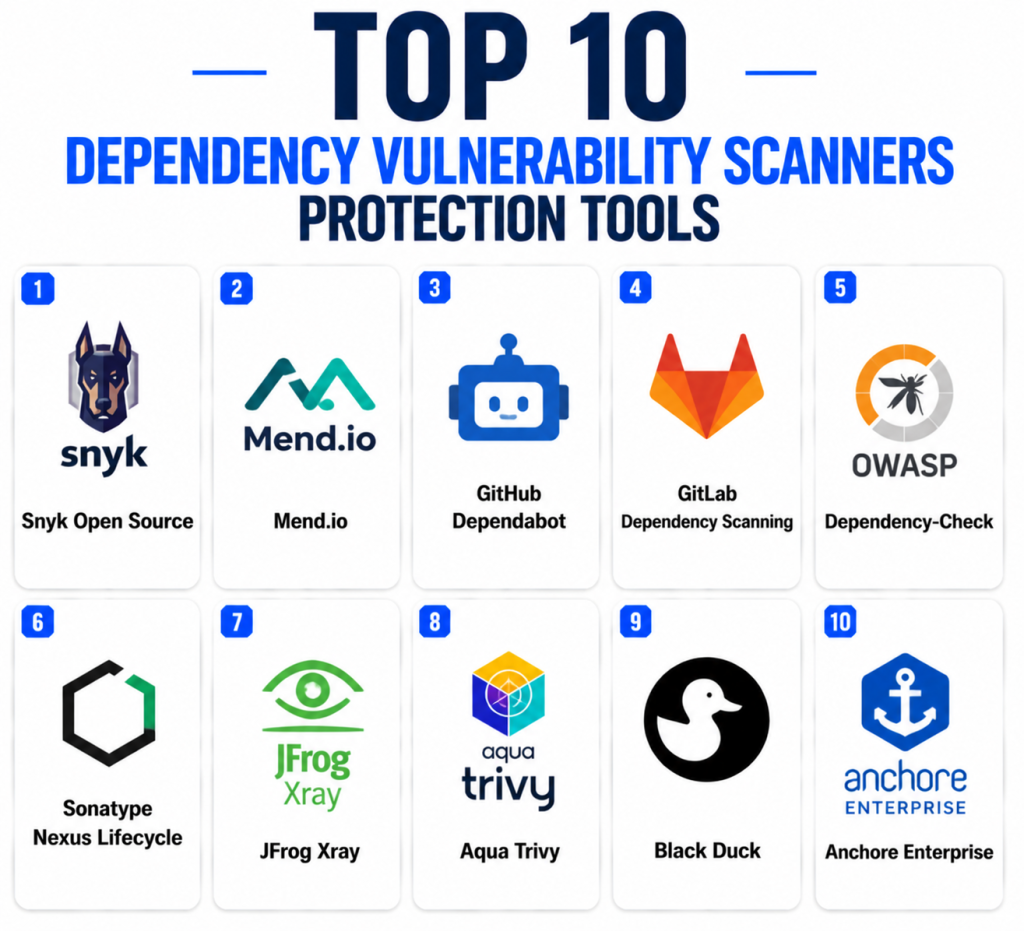
Top 10 Dependency Vulnerability Scanners Protection Tools
1 — Snyk Open Source
Short description:
Snyk Open Source is a developer-first dependency vulnerability scanner designed to detect vulnerable open-source packages across application projects. It helps teams identify direct and transitive dependency risks, receive remediation advice, and integrate scanning into developer workflows. Snyk is widely used by teams that want security findings to appear inside repositories, IDEs, pull requests, and CI/CD pipelines. It is especially useful for organizations that want developers to fix dependency issues without waiting for separate security reviews. Snyk also connects dependency scanning with broader application, container, and cloud security workflows. It fits startups, SMBs, mid-market companies, and enterprises that want a modern DevSecOps approach.
Key Features
- Open-source dependency vulnerability scanning
- Direct and transitive dependency analysis
- Developer remediation guidance
- Pull request and repository workflow support
- CI/CD pipeline integration
- License risk visibility
- Broad language and package ecosystem coverage
Pros
- Developer-friendly user experience
- Strong remediation guidance and workflow integration
- Useful across code, containers, and broader AppSec programs
Cons
- Advanced features may depend on subscription tier
- Alert volume can require policy tuning
- Teams wanting only basic scanning may find it broader than needed
Platforms / Deployment
- Web / Windows / macOS / Linux
- Cloud / Hybrid
Security & Compliance
- SSO/SAML may be available by plan
- RBAC
- Audit logs may be available by plan
- MFA support depends on configuration
- Compliance certifications: Not publicly stated here
Integrations & Ecosystem
Snyk integrates deeply into developer and security workflows, making it suitable for teams that want dependency scanning close to code.
- GitHub
- GitLab
- Bitbucket
- Azure DevOps
- Jenkins
- IDE workflows
Support & Community
Snyk provides extensive documentation, onboarding resources, support tiers, and a strong developer security community. Support depth varies by plan.
2 — Mend.io
Short description:
Mend.io, formerly known as WhiteSource, is a software composition analysis platform focused on open-source security, license compliance, and dependency risk management. It helps organizations identify vulnerable components, manage remediation, and enforce open-source policies across development pipelines. Mend.io is especially useful for enterprises that need governance, compliance reporting, and visibility across many applications. It supports software teams that want to manage both security and legal risk from third-party components. The platform is suitable for organizations with mature DevSecOps, compliance, and application security programs. It is often considered when dependency scanning must scale across many teams and repositories.
Key Features
- Dependency vulnerability scanning
- Open-source license compliance
- Policy enforcement
- Remediation recommendations
- Repository and CI/CD integrations
- Inventory and reporting dashboards
- Enterprise governance workflows
Pros
- Strong enterprise governance focus
- Useful for both security and license compliance
- Good fit for large development portfolios
Cons
- May be more complex than lightweight scanners
- Commercial pricing may not fit smaller teams
- Requires process maturity for best results
Platforms / Deployment
- Web
- Cloud / Hybrid
Security & Compliance
- SSO/SAML may be available
- RBAC
- Audit logging may be available
- Compliance certifications: Not publicly stated here
Integrations & Ecosystem
Mend.io integrates with source code, CI/CD, issue tracking, and developer tools to support enterprise-scale open-source governance.
- GitHub
- GitLab
- Bitbucket
- Azure DevOps
- Jenkins
- Jira
Support & Community
Mend.io provides commercial documentation, onboarding, and enterprise support. Community strength is primarily vendor-led rather than open-source-driven.
3 — GitHub Dependabot
Short description:
GitHub Dependabot is a native GitHub feature that helps detect vulnerable dependencies and create automated update pull requests. It is especially useful for teams already using GitHub repositories. Dependabot monitors dependency files and alerts teams when known vulnerabilities affect packages in their projects. It can also open pull requests to update vulnerable or outdated dependencies. This makes it a practical starting point for dependency security because it fits directly into GitHub workflows. It is best for GitHub-based teams that want simple, built-in dependency scanning and update automation.
Key Features
- Native GitHub dependency alerts
- Automated dependency update pull requests
- Vulnerability detection for supported ecosystems
- Repository-level security visibility
- Pull request-based remediation
- Integration with GitHub security workflows
- Basic dependency maintenance automation
Pros
- Easy adoption for GitHub users
- Automated pull requests reduce manual update work
- No separate tool required for basic workflows
Cons
- Best suited for GitHub environments
- Limited value for teams using multiple repository platforms
- Advanced enterprise governance may require additional tools
Platforms / Deployment
- Web
- Cloud
Security & Compliance
- GitHub permissions and access controls
- MFA support through GitHub account configuration
- Audit logs depend on GitHub plan
- Compliance certifications: Not publicly stated here
Integrations & Ecosystem
Dependabot works directly inside GitHub and fits naturally into pull request, repository, and security alert workflows.
- GitHub repositories
- GitHub Actions
- Pull requests
- Security alerts
- Package manifests
- Code review workflows
Support & Community
GitHub provides documentation and platform support depending on the plan. Community adoption is strong because Dependabot is built into GitHub workflows.
4 — GitLab Dependency Scanning
Short description:
GitLab Dependency Scanning is a native GitLab security capability that helps identify vulnerable dependencies inside projects and pipelines. It is useful for teams already using GitLab for source control, CI/CD, security dashboards, and DevSecOps workflows. Dependency findings can appear within GitLab’s security features depending on configuration and plan. The tool helps developers detect vulnerable packages during the software delivery process. It is especially practical for organizations that want fewer separate security tools and prefer integrated DevSecOps workflows. GitLab Dependency Scanning is best evaluated as part of GitLab’s broader security and compliance platform.
Key Features
- Native GitLab CI/CD integration
- Dependency vulnerability detection
- Security dashboard visibility
- Merge request security feedback
- Package ecosystem support
- Pipeline-based scanning
- Integration with broader GitLab DevSecOps features
Pros
- Strong fit for GitLab users
- Reduces tool fragmentation
- Works naturally with GitLab CI/CD pipelines
Cons
- Best value inside GitLab ecosystem
- Advanced features may vary by plan
- Less useful for teams using multiple source control platforms
Platforms / Deployment
- Web / Linux
- Cloud / Self-hosted / Hybrid
Security & Compliance
- GitLab RBAC and permissions
- SSO/SAML may be available by plan
- MFA support
- Audit logs may be available by plan
- Compliance certifications: Not publicly stated here
Integrations & Ecosystem
GitLab Dependency Scanning integrates with GitLab repositories, pipelines, merge requests, and security dashboards.
- GitLab CI/CD
- GitLab repositories
- Merge requests
- Security dashboards
- Issue workflows
- Container and code scanning workflows
Support & Community
GitLab provides documentation, community resources, and commercial support depending on the plan. It is a strong option for organizations standardized on GitLab.
5 — OWASP Dependency-Check
Short description:
OWASP Dependency-Check is a popular open-source software composition analysis tool that identifies publicly known vulnerabilities in project dependencies. It is commonly used in CI/CD pipelines, build processes, and security testing workflows. Dependency-Check supports multiple ecosystems and is often selected by teams that want a free and transparent scanning option. It is especially useful for organizations beginning dependency vulnerability management without buying a commercial platform. The tool can generate reports and help teams identify risky libraries before release. It works best when paired with strong remediation processes and regular vulnerability review.
Key Features
- Open-source dependency vulnerability scanning
- Known vulnerability database matching
- Build and CI/CD integration
- Report generation
- Multi-language ecosystem support
- Command-line operation
- Plugin support for common build tools
Pros
- Open-source and widely recognized
- Good starting point for dependency scanning
- Useful in CI/CD and build workflows
Cons
- False positives may require review
- No native enterprise remediation workflow
- Reporting and governance require additional process
Platforms / Deployment
- Windows / macOS / Linux
- Self-hosted
Security & Compliance
- Local and pipeline-based scanning
- Auditability depends on CI/CD and reporting setup
- Compliance certifications: Not publicly stated
Integrations & Ecosystem
OWASP Dependency-Check can be integrated into common build systems and CI/CD workflows.
- Maven
- Gradle
- Jenkins
- GitHub Actions
- GitLab CI
- Command-line workflows
Support & Community
Dependency-Check has strong open-source documentation and community usage. Support is community-driven unless handled internally by the organization.
6 — Sonatype Nexus Lifecycle
Short description:
Sonatype Nexus Lifecycle is an enterprise software composition analysis platform focused on open-source governance, dependency risk management, and policy enforcement. It helps organizations identify vulnerable, outdated, or non-compliant components across the software development lifecycle. The platform is often used by enterprises that need automated policy controls, repository management alignment, and open-source risk visibility. Sonatype is especially relevant for organizations using Nexus Repository or managing large open-source dependency portfolios. It supports security, engineering, and compliance teams that need shared visibility into component risk. It is best for mature teams with formal software supply chain security programs.
Key Features
- Open-source component intelligence
- Dependency vulnerability scanning
- Policy enforcement
- License compliance support
- Repository manager alignment
- Remediation guidance
- Enterprise reporting and governance
Pros
- Strong enterprise open-source governance
- Good fit for organizations using Nexus ecosystem
- Useful for security and license compliance programs
Cons
- May be more than smaller teams need
- Commercial licensing can be a factor
- Requires governance process maturity
Platforms / Deployment
- Web
- Cloud / Self-hosted / Hybrid
Security & Compliance
- RBAC
- SSO/SAML may be available
- Audit logs may be available
- Compliance certifications: Not publicly stated here
Integrations & Ecosystem
Sonatype integrates with development, build, repository, and CI/CD workflows for enterprise component governance.
- Nexus Repository
- Jenkins
- GitHub
- GitLab
- Maven
- Gradle
Support & Community
Sonatype provides enterprise support, documentation, onboarding, and professional services. Community strength is also supported by its long presence in open-source component governance.
7 — JFrog Xray
Short description:
JFrog Xray is a software composition analysis and security scanning tool that integrates closely with the JFrog platform. It helps teams scan artifacts, dependencies, containers, and packages for vulnerabilities and license issues. Xray is especially useful for organizations that use JFrog Artifactory as a central artifact repository. It provides visibility across binaries and build artifacts, not only source-level dependency manifests. This makes it valuable for teams managing complex software supply chains. It fits mid-market and enterprise organizations that need artifact-centric security and governance.
Key Features
- Dependency vulnerability scanning
- Artifact and package analysis
- Container image scanning
- License compliance visibility
- Policy enforcement
- Integration with JFrog Artifactory
- Software supply chain risk visibility
Pros
- Strong artifact and repository-level visibility
- Good fit for JFrog ecosystem users
- Useful for binary and container scanning
Cons
- Best value inside JFrog ecosystem
- May require setup and governance planning
- Commercial licensing may be a factor
Platforms / Deployment
- Web / Linux
- Cloud / Self-hosted / Hybrid
Security & Compliance
- RBAC
- SSO/SAML may be available
- Audit logging may be available
- Compliance certifications: Not publicly stated here
Integrations & Ecosystem
JFrog Xray works closely with artifact repositories, CI/CD systems, and software delivery pipelines.
- JFrog Artifactory
- Jenkins
- GitHub
- GitLab
- Kubernetes
- Docker workflows
Support & Community
JFrog provides commercial support, documentation, onboarding, and an established ecosystem. Support depth depends on subscription and deployment model.
8 — Aqua Trivy
Short description:
Aqua Trivy is a widely used open-source scanner for vulnerabilities, misconfigurations, secrets, containers, Kubernetes, and Infrastructure as Code. For dependency vulnerability scanning, Trivy is especially popular in container and cloud-native environments. It can scan container images, file systems, Git repositories, and software packages. Trivy is lightweight, fast, and easy to integrate into CI/CD pipelines. It is a strong choice for teams that want a practical open-source scanner with broad cloud-native coverage. It works well for startups, platform teams, Kubernetes teams, and security engineers who need flexible scanning.
Key Features
- Dependency vulnerability scanning
- Container image scanning
- Filesystem and repository scanning
- Kubernetes and IaC scanning capabilities
- Secret scanning support
- CI/CD integration
- Lightweight command-line usage
Pros
- Open-source and easy to adopt
- Strong fit for containers and Kubernetes
- Broad scanning capabilities beyond dependencies
Cons
- Enterprise governance requires additional tooling
- Alert prioritization may need process support
- Advanced reporting may require commercial ecosystem tools
Platforms / Deployment
- Windows / macOS / Linux
- Self-hosted / Hybrid
Security & Compliance
- Local and pipeline-based scanning
- Auditability depends on implementation
- Compliance certifications: Not publicly stated
Integrations & Ecosystem
Trivy integrates well with cloud-native development and CI/CD workflows.
- Docker
- Kubernetes
- GitHub Actions
- GitLab CI
- Jenkins
- Container registries
Support & Community
Trivy has strong open-source adoption, active community usage, and broad documentation. Commercial support may be available through Aqua’s broader platform offerings.
9 — Black Duck
Short description:
Black Duck is an enterprise software composition analysis platform used for open-source security, license compliance, and software supply chain governance. It helps organizations identify vulnerable and non-compliant components across applications and development portfolios. Black Duck is often used by enterprises with strict legal, compliance, and security requirements. It provides visibility into open-source usage and helps teams manage risk across large software environments. The platform is especially relevant for organizations needing formal governance, policy enforcement, and reporting. It fits regulated industries, large enterprises, and teams managing complex third-party software risk.
Key Features
- Open-source vulnerability scanning
- License compliance management
- Component inventory
- Policy enforcement
- Risk reporting
- Enterprise governance workflows
- Software supply chain visibility
Pros
- Strong enterprise governance capabilities
- Useful for both security and legal compliance
- Good fit for regulated environments
Cons
- May be complex for small teams
- Commercial licensing required
- Requires mature processes for best outcomes
Platforms / Deployment
- Web
- Cloud / Self-hosted / Hybrid
Security & Compliance
- RBAC
- SSO/SAML may be available
- Audit logs may be available
- Compliance certifications: Not publicly stated here
Integrations & Ecosystem
Black Duck integrates with development, CI/CD, repository, and governance workflows.
- GitHub
- GitLab
- Jenkins
- Azure DevOps
- Jira
- Build systems
Support & Community
Black Duck provides enterprise documentation, onboarding, and commercial support. Community strength is primarily enterprise and vendor-driven.
10 — Anchore Enterprise
Short description:
Anchore Enterprise is a container and software supply chain security platform that includes dependency vulnerability scanning, SBOM management, policy enforcement, and image analysis. It is especially useful for organizations building and deploying containerized applications. Anchore helps security and platform teams inspect container contents, identify vulnerable packages, enforce policies, and maintain visibility across container images. It is often used in regulated or security-conscious environments where software component transparency matters. Anchore is a good fit for teams that prioritize containers, Kubernetes, and SBOM workflows. It can complement source-level dependency scanners by adding image-level visibility.
Key Features
- Container dependency vulnerability scanning
- SBOM generation and analysis
- Policy enforcement
- Image scanning
- Compliance reporting
- CI/CD integration
- Kubernetes and registry workflow support
Pros
- Strong container and SBOM focus
- Useful for regulated and cloud-native environments
- Good policy enforcement capabilities
Cons
- Best suited for container-heavy teams
- May be broader than needed for source-only scanning
- Commercial deployment requires planning
Platforms / Deployment
- Web / Linux
- Cloud / Self-hosted / Hybrid
Security & Compliance
- RBAC
- SSO/SAML may be available
- Audit logs may be available
- Compliance certifications: Not publicly stated here
Integrations & Ecosystem
Anchore integrates with container registries, CI/CD pipelines, Kubernetes workflows, and security processes.
- Docker
- Kubernetes
- Jenkins
- GitHub Actions
- GitLab CI
- Container registries
Support & Community
Anchore provides commercial documentation, support, and onboarding. It also has community visibility in container security and SBOM-focused workflows.
Comparison Table
| Tool Name | Best For | Platform(s) Supported | Deployment | Standout Feature | Public Rating |
|---|---|---|---|---|---|
| Snyk Open Source | Developer-first dependency security | Web / Windows / macOS / Linux | Cloud / Hybrid | Developer remediation guidance | N/A |
| Mend.io | Enterprise SCA governance | Web | Cloud / Hybrid | Security plus license compliance | N/A |
| GitHub Dependabot | GitHub-native dependency updates | Web | Cloud | Automated update pull requests | N/A |
| GitLab Dependency Scanning | GitLab DevSecOps teams | Web / Linux | Cloud / Self-hosted / Hybrid | Native GitLab pipeline scanning | N/A |
| OWASP Dependency-Check | Open-source vulnerability scanning | Windows / macOS / Linux | Self-hosted | Build pipeline scanning | N/A |
| Sonatype Nexus Lifecycle | Enterprise open-source governance | Web | Cloud / Self-hosted / Hybrid | Policy enforcement for components | N/A |
| JFrog Xray | Artifact and container security | Web / Linux | Cloud / Self-hosted / Hybrid | Artifact-level vulnerability analysis | N/A |
| Aqua Trivy | Cloud-native open-source scanning | Windows / macOS / Linux | Self-hosted / Hybrid | Container and dependency scanning | N/A |
| Black Duck | Enterprise license and security compliance | Web | Cloud / Self-hosted / Hybrid | Open-source governance | N/A |
| Anchore Enterprise | Container and SBOM security | Web / Linux | Cloud / Self-hosted / Hybrid | SBOM and container policy enforcement | N/A |
Evaluation & Scoring of Dependency Vulnerability Scanners
| Tool Name | Core (25%) | Ease (15%) | Integrations (15%) | Security (10%) | Performance (10%) | Support (10%) | Value (15%) | Weighted Total |
| Snyk Open Source | 9 | 9 | 9 | 8 | 8 | 9 | 8 | 8.65 |
| Mend.io | 9 | 8 | 9 | 9 | 8 | 9 | 7 | 8.40 |
| GitHub Dependabot | 7 | 10 | 8 | 8 | 8 | 8 | 9 | 8.15 |
| GitLab Dependency Scanning | 8 | 8 | 9 | 8 | 8 | 8 | 8 | 8.15 |
| OWASP Dependency-Check | 7 | 7 | 7 | 7 | 7 | 7 | 10 | 7.45 |
| Sonatype Nexus Lifecycle | 9 | 7 | 9 | 9 | 8 | 9 | 7 | 8.25 |
| JFrog Xray | 8 | 7 | 9 | 8 | 8 | 8 | 7 | 7.85 |
| Aqua Trivy | 8 | 8 | 8 | 7 | 9 | 8 | 10 | 8.30 |
| Black Duck | 9 | 7 | 8 | 9 | 8 | 9 | 7 | 8.10 |
| Anchore Enterprise | 8 | 7 | 8 | 9 | 8 | 8 | 7 | 7.85 |
These scores are comparative and should be interpreted based on your environment. A GitHub-first team may find Dependabot more valuable than a heavier enterprise SCA platform. A container-heavy organization may prioritize Trivy, JFrog Xray, or Anchore. Enterprises with legal and compliance needs may value Mend.io, Sonatype Nexus Lifecycle, or Black Duck more highly. Open-source tools can offer excellent value but require stronger internal ownership for governance, reporting, and remediation tracking.
Which Dependency Vulnerability Scanner Is Right for You?
Solo / Freelancer
Solo developers usually need lightweight tools that are easy to set up and do not require enterprise governance. GitHub Dependabot, OWASP Dependency-Check, and Aqua Trivy are practical options. If you use GitHub, Dependabot is a simple starting point because it fits directly into repository workflows.
SMB
Small and medium-sized businesses should prioritize ease of use, CI/CD integration, and actionable remediation. Snyk Open Source, GitHub Dependabot, GitLab Dependency Scanning, and Aqua Trivy are strong options. If license compliance is important, Mend.io or Sonatype may be worth evaluating.
Mid-Market
Mid-market teams usually need better visibility across multiple applications, teams, and package ecosystems. Snyk, Mend.io, GitLab Dependency Scanning, Sonatype Nexus Lifecycle, and JFrog Xray are useful options. The best choice depends on whether the organization prioritizes developer workflows, open-source governance, artifact security, or container scanning.
Enterprise
Enterprises should prioritize governance, RBAC, audit logs, reporting, policy enforcement, license compliance, SBOM support, and integration with ticketing or SIEM systems. Mend.io, Sonatype Nexus Lifecycle, Black Duck, Snyk, JFrog Xray, and Anchore Enterprise are strong candidates. Large companies should run a pilot across multiple languages and teams before standardizing.
Budget vs Premium
Budget-conscious teams should consider OWASP Dependency-Check, Aqua Trivy, GitHub Dependabot, and GitLab Dependency Scanning if they already use GitLab. Premium tools such as Snyk, Mend.io, Sonatype, Black Duck, JFrog Xray, and Anchore provide stronger governance, support, reporting, and enterprise workflows.
Feature Depth vs Ease of Use
Dependabot is easy to adopt but narrower than full SCA platforms. Snyk provides a strong balance of usability and depth. Mend.io, Sonatype, and Black Duck provide deeper governance but may require more setup. Trivy is flexible and fast, especially for cloud-native teams.
Integrations & Scalability
For repository and developer workflow integration, Snyk, GitHub Dependabot, GitLab Dependency Scanning, and Mend.io are strong. For artifact and container ecosystems, JFrog Xray, Aqua Trivy, and Anchore Enterprise are practical. Enterprises should validate support for package managers, CI/CD tools, registries, ticketing systems, and reporting exports.
Security & Compliance Needs
Security and compliance teams should evaluate vulnerability intelligence quality, license policy controls, SBOM support, audit trails, access controls, remediation evidence, and policy enforcement. Regulated organizations may prefer enterprise SCA platforms that provide clearer reporting and governance workflows. Open-source tools can help, but compliance evidence often needs additional process design.
Frequently Asked Questions
1- What is a dependency vulnerability scanner?
A dependency vulnerability scanner checks third-party libraries, packages, frameworks, and software components for known security vulnerabilities. It helps teams identify risky dependencies before they cause production or compliance issues.
2- Why are dependency scanners important?
Modern applications rely heavily on open-source packages. If one package contains a known vulnerability, attackers may exploit it even if your own application code is well written.
3- What is the difference between direct and transitive dependencies?
Direct dependencies are packages your project explicitly uses. Transitive dependencies are packages pulled in by your direct dependencies, and they can also contain vulnerabilities.
4- Are open-source scanners enough?
Open-source tools like OWASP Dependency-Check and Aqua Trivy can be effective, especially for smaller teams. Enterprises may need commercial platforms for governance, reporting, license compliance, and support.
5- What is software composition analysis?
Software composition analysis is the process of identifying open-source components, vulnerabilities, license risks, and dependency relationships inside software applications.
6- Do dependency scanners support CI/CD pipelines?
Yes. Most modern scanners integrate with CI/CD pipelines so vulnerabilities can be detected before code reaches production. This helps teams shift security earlier in the development lifecycle.
7- Can dependency scanners fix vulnerabilities automatically?
Some tools can create automated pull requests or provide upgrade recommendations. However, teams should still test updates because dependency changes can break application behavior.
8- What are common implementation mistakes?
Common mistakes include ignoring transitive dependencies, treating all vulnerabilities equally, failing to test upgrades, not assigning ownership, and scanning only once instead of continuously.
9- How should teams prioritize vulnerability fixes?
Teams should consider severity, exploitability, application exposure, affected environment, available fix, and business impact. Severity alone is not always enough for prioritization.
10- What is an SBOM?
An SBOM, or Software Bill of Materials, is an inventory of software components used in an application. It helps teams understand what dependencies exist and where risk may be present.
Conclusion
Dependency vulnerability scanners are now essential for secure software delivery because modern applications depend on thousands of open-source packages, frameworks, containers, and transitive components. The right tool helps teams detect known vulnerabilities, understand dependency risk, automate updates, manage license exposure, and support supply chain security programs. Snyk is strong for developer-first security, while Mend.io, Sonatype Nexus Lifecycle, and Black Duck are better suited for enterprise governance and compliance. GitHub Dependabot and GitLab Dependency Scanning are practical for platform-native workflows, while OWASP Dependency-Check and Aqua Trivy provide strong open-source value. JFrog Xray and Anchore Enterprise are especially useful for artifact, container, and SBOM-focused environments. The best choice depends on your code hosting platform, language ecosystem, compliance needs, container strategy, budget, and internal security maturity. A smart is to shortlist two or three tools, run a pilot across active repositories and containers, compare false positives, validate remediation workflows, and confirm integration with your CI/CD and security reporting processes.
