Introduction
Runtime Application Self-Protection (RASP) tools are security solutions that operate inside or alongside running applications to detect and block attacks in real time. Unlike traditional perimeter defenses that focus on network traffic, RASP solutions monitor application behavior, user interactions, and runtime events to identify threats as they occur.
As organizations continue adopting cloud-native architectures, APIs, microservices, containers, and distributed applications, traditional security controls often struggle to provide complete visibility. RASP technology helps security teams detect SQL injection, remote code execution, deserialization attacks, cross-site scripting, account takeover attempts, and other threats directly within the application environment.
Real-World Use Cases
- Protecting customer-facing web applications
- Securing APIs and microservices
- Preventing runtime exploitation of application vulnerabilities
- Supporting DevSecOps and shift-left security initiatives
- Meeting compliance requirements for sensitive applications
What Buyers Should Evaluate
- Runtime threat detection capabilities
- Application performance impact
- Cloud-native compatibility
- API and microservices protection
- Integration with SIEM and SOC platforms
- Incident response automation
- Deployment flexibility
- Compliance and audit capabilities
- Scalability across environments
- Developer and security team usability
Best for: Enterprises, SaaS providers, fintech companies, healthcare organizations, e-commerce platforms, government agencies, DevSecOps teams, and application security professionals managing business-critical applications.
Not ideal for: Very small organizations with limited application exposure, static websites, or environments where basic WAF protection provides sufficient security coverage.
Key Trends in Runtime Application Self-Protection Tools
- AI-driven threat detection is improving runtime attack identification accuracy.
- Cloud-native RASP solutions are becoming standard for Kubernetes and containerized applications.
- API protection capabilities are increasingly integrated into RASP platforms.
- Runtime security is merging with Application Security Posture Management platforms.
- DevSecOps integration is becoming a core purchasing requirement.
- Agentless deployment models are gaining popularity.
- Automated incident response and remediation workflows are expanding.
- Compliance reporting and audit automation are becoming more sophisticated.
- Integration with Extended Detection and Response platforms is increasing.
- Security vendors are consolidating RASP, WAF, API security, and runtime protection into unified platforms.
How We Selected These Tools (Methodology)
The following tools were selected using a balanced evaluation approach:
- Strong market adoption and enterprise visibility
- Proven runtime application protection capabilities
- Broad deployment flexibility
- Security innovation and threat detection maturity
- Cloud-native and container support
- API protection capabilities
- Integration ecosystem strength
- Suitability for SMB, mid-market, and enterprise organizations
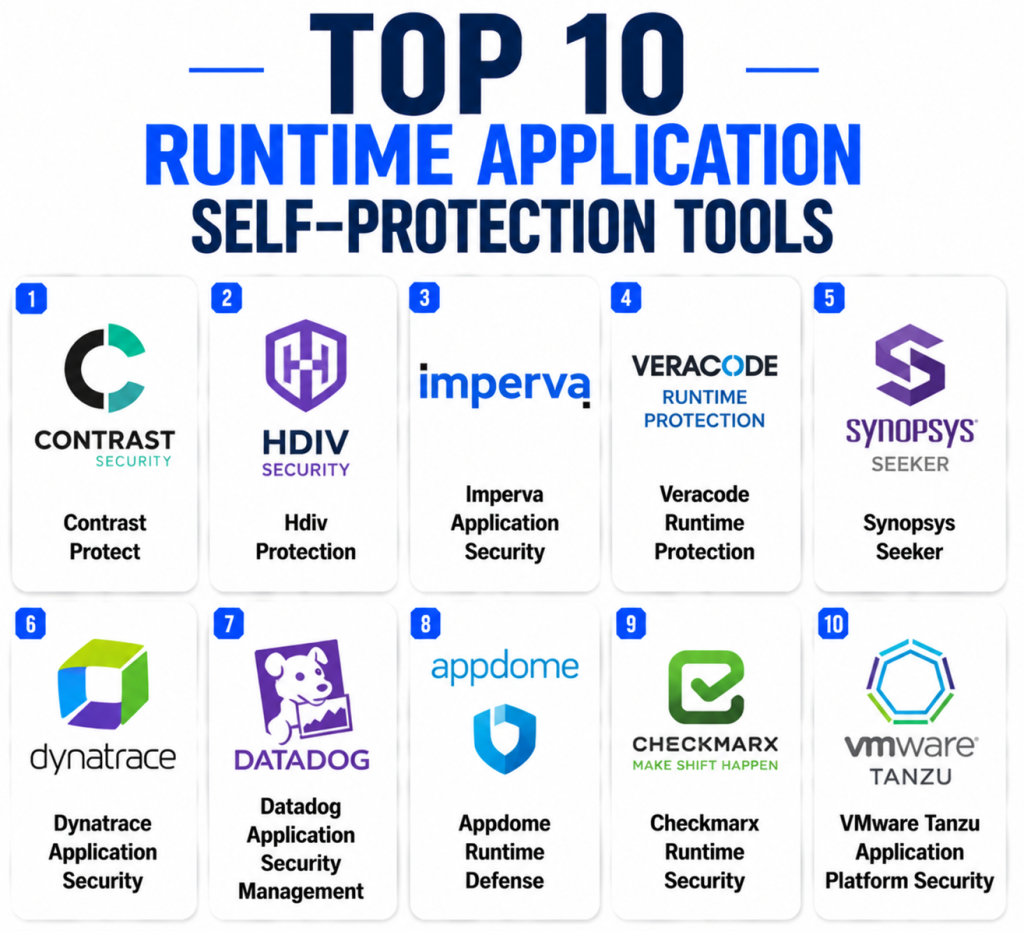
Top 10 Runtime Application Self-Protection Tools
1- Contrast Protect
Short Description:
Contrast Protect is one of the most recognized RASP solutions in the market. It embeds security instrumentation within applications and provides real-time protection against exploitation attempts. The platform is particularly popular among organizations adopting DevSecOps practices. It helps security teams detect vulnerabilities and block attacks without requiring extensive code modifications. Contrast Protect supports modern application architectures and provides deep visibility into runtime behavior. Large enterprises frequently deploy it to secure mission-critical applications.
Key Features
- Runtime attack prevention
- Interactive Application Security Testing integration
- Vulnerability prioritization
- Real-time threat monitoring
- Application instrumentation
- DevSecOps workflow integration
- Detailed attack analytics
Pros
- Strong runtime visibility
- Mature DevSecOps ecosystem
- Effective attack blocking
Cons
- Initial deployment may require tuning
- Enterprise-focused pricing
Platforms / Deployment
- Windows
- Linux
- Cloud
- Hybrid
Security & Compliance
- RBAC
- MFA
- Audit logging
- Encryption
Integrations & Ecosystem
Contrast integrates with major CI/CD pipelines, SIEM platforms, and developer workflows.
- Jenkins
- GitHub
- GitLab
- Splunk
- ServiceNow
- Jira
Support & Community
Strong enterprise support, extensive documentation, training resources, and active customer community.
2- Hdiv Protection
Short Description:
Hdiv Protection provides application runtime protection through embedded security controls. It focuses on preventing application attacks before they can reach sensitive business logic. The solution is widely used for protecting web applications and APIs. Organizations value its low false-positive rates and developer-friendly deployment approach. Hdiv also supports secure software development initiatives through runtime visibility and attack analytics.
Key Features
- Runtime attack prevention
- API security
- Web application protection
- Attack analytics
- Session protection
- Risk scoring
- Compliance support
Pros
- Low operational complexity
- Strong API security support
- Effective threat detection
Cons
- Smaller ecosystem than major vendors
- Limited brand recognition
Platforms / Deployment
- Cloud
- Hybrid
Security & Compliance
- Audit logs
- Encryption
- RBAC
Integrations & Ecosystem
Supports integration with modern security and development tools.
- SIEM tools
- CI/CD platforms
- Security dashboards
- Custom APIs
Support & Community
Responsive vendor support and growing customer community.
3- Imperva Application Security
Short Description:
Imperva delivers comprehensive application protection combining WAF, API security, and runtime threat detection capabilities. It is commonly deployed in enterprises requiring layered application security. The platform provides extensive visibility into application attacks and supports both cloud and hybrid deployments. Organizations benefit from Imperva’s strong security research and threat intelligence capabilities.
Key Features
- Runtime protection
- Advanced WAF
- API security
- Threat intelligence
- Bot mitigation
- Compliance reporting
- Attack analytics
Pros
- Strong enterprise capabilities
- Comprehensive protection stack
- Mature threat intelligence
Cons
- Can be complex to configure
- Premium pricing
Platforms / Deployment
- Cloud
- Hybrid
Security & Compliance
- SSO
- MFA
- RBAC
- Audit logging
Integrations & Ecosystem
Broad integration ecosystem suitable for large enterprises.
- Splunk
- QRadar
- ServiceNow
- AWS
- Azure
Support & Community
Comprehensive enterprise support and extensive documentation.
4- Veracode Runtime Protection
Short Description:
Veracode extends its application security portfolio into runtime protection by helping organizations monitor and protect applications during execution. The solution aligns closely with secure software development programs and supports vulnerability management initiatives. Enterprises leverage Veracode for continuous security monitoring across application lifecycles.
Key Features
- Runtime threat detection
- Vulnerability correlation
- Application monitoring
- Security analytics
- Risk prioritization
- Compliance reporting
- DevSecOps integration
Pros
- Strong AppSec ecosystem
- Developer-friendly workflows
- Comprehensive reporting
Cons
- Some features require broader platform adoption
- Enterprise-focused licensing
Platforms / Deployment
- Cloud
Security & Compliance
- RBAC
- MFA
- Audit logs
Integrations & Ecosystem
Supports extensive application security integrations.
- Jenkins
- GitHub
- Azure DevOps
- Jira
Support & Community
Strong training resources and enterprise customer support.
5- Synopsys Seeker
Short Description:
Seeker combines application security testing with runtime protection capabilities. The platform provides deep application insights and identifies vulnerabilities during execution. Security teams use Seeker to understand exploitability and prioritize remediation efforts. Its visibility into application behavior makes it valuable for complex enterprise environments.
Key Features
- Runtime analysis
- Attack detection
- Vulnerability correlation
- Application monitoring
- Security analytics
- Risk assessment
- Compliance support
Pros
- Excellent application visibility
- Strong vulnerability context
- Useful analytics
Cons
- Learning curve for new users
- Enterprise-oriented deployment
Platforms / Deployment
- Cloud
- Hybrid
Security & Compliance
- RBAC
- Encryption
- Audit logging
Integrations & Ecosystem
Supports DevSecOps and security operations workflows.
- Jenkins
- Jira
- SIEM platforms
- CI/CD systems
Support & Community
Enterprise support with strong documentation resources.
6- Dynatrace Application Security
Short Description:
Dynatrace Application Security combines observability and runtime security into a unified platform. Organizations benefit from deep runtime visibility and automated threat detection capabilities. The platform is particularly attractive for cloud-native and Kubernetes environments where observability and security converge.
Key Features
- Runtime threat detection
- Cloud-native security
- Kubernetes visibility
- Vulnerability analytics
- Automated discovery
- Application mapping
- Security monitoring
Pros
- Excellent observability integration
- Strong cloud-native support
- Automated insights
Cons
- Best value when using broader Dynatrace platform
- Licensing complexity
Platforms / Deployment
- Cloud
- Hybrid
Security & Compliance
- RBAC
- Audit logging
- Encryption
Integrations & Ecosystem
Broad cloud and observability integrations.
- AWS
- Azure
- Google Cloud
- Kubernetes
- ServiceNow
Support & Community
Large enterprise user base and strong vendor support.
7- Datadog Application Security Management
Short Description:
Datadog extends observability into application security with runtime protection and threat detection capabilities. The platform helps organizations monitor applications, identify vulnerabilities, and respond to attacks in real time. It is particularly appealing to organizations already using Datadog observability products.
Key Features
- Runtime threat detection
- Vulnerability management
- Application monitoring
- Security analytics
- API protection
- Cloud security
- Incident investigation
Pros
- Unified observability and security
- Easy deployment
- Strong analytics
Cons
- Cost can increase with scale
- Some advanced features require premium plans
Platforms / Deployment
- Cloud
Security & Compliance
- RBAC
- MFA
- Audit logs
Integrations & Ecosystem
Large cloud and DevOps integration ecosystem.
- AWS
- Azure
- Kubernetes
- GitHub
- ServiceNow
Support & Community
Extensive documentation and active customer community.
8- Appdome Runtime Defense
Short Description:
Appdome focuses heavily on mobile application runtime protection. It enables organizations to secure mobile applications against tampering, malware, fraud, and runtime attacks. Mobile-first organizations often select Appdome for its specialized protection capabilities and automation features.
Key Features
- Mobile runtime protection
- Anti-tampering
- Fraud prevention
- Malware defense
- Mobile threat detection
- No-code security integration
- Runtime analytics
Pros
- Strong mobile security focus
- Fast implementation
- Broad mobile protection
Cons
- Less suitable for traditional web applications
- Specialized use cases
Platforms / Deployment
- Cloud
Security & Compliance
- Encryption
- Audit logging
- Access controls
Integrations & Ecosystem
Supports mobile development and security workflows.
- Android
- iOS
- CI/CD platforms
- Mobile DevOps tools
Support & Community
Strong vendor support and mobile-focused expertise.
9- Checkmarx Runtime Security
Short Description:
Checkmarx is expanding beyond traditional application security testing into runtime protection and cloud-native security. Organizations leverage Checkmarx to connect development security activities with runtime visibility. The platform helps prioritize exploitable vulnerabilities and improve security posture.
Key Features
- Runtime visibility
- Vulnerability prioritization
- Threat analytics
- DevSecOps integration
- Cloud-native security
- Security reporting
- Risk management
Pros
- Strong AppSec heritage
- Good developer integration
- Comprehensive visibility
Cons
- Some features still evolving
- Enterprise-focused pricing
Platforms / Deployment
- Cloud
- Hybrid
Security & Compliance
- RBAC
- MFA
- Audit logging
Integrations & Ecosystem
Extensive DevSecOps integration support.
- GitHub
- GitLab
- Jenkins
- Azure DevOps
Support & Community
Strong training resources and enterprise support.
10- VMware Tanzu Application Platform Security
Short Description:
VMware Tanzu provides runtime security capabilities within its broader cloud-native application platform. Organizations using Kubernetes and modern application architectures benefit from integrated runtime protection, policy enforcement, and operational visibility. It is particularly relevant for enterprise cloud modernization initiatives.
Key Features
- Kubernetes security
- Runtime protection
- Policy management
- Application visibility
- Container security
- Cloud-native governance
- Compliance monitoring
Pros
- Strong Kubernetes alignment
- Enterprise scalability
- Integrated platform approach
Cons
- Best suited for Tanzu environments
- Platform complexity
Platforms / Deployment
- Cloud
- Hybrid
Security & Compliance
- RBAC
- SSO
- Audit logging
Integrations & Ecosystem
Strong integration across modern cloud-native environments.
- Kubernetes
- VMware ecosystem
- AWS
- Azure
- Google Cloud
Support & Community
Enterprise-grade support and strong cloud-native ecosystem.
Comparison Table
| Tool Name | Best For | Platform(s) Supported | Deployment | Standout Feature | Public Rating |
|---|---|---|---|---|---|
| Contrast Protect | Enterprise AppSec | Windows, Linux | Hybrid | Deep Runtime Instrumentation | N/A |
| Hdiv Protection | API Security | Web | Cloud | Low False Positives | N/A |
| Imperva Application Security | Large Enterprises | Multi-platform | Hybrid | Integrated WAF + Runtime Security | N/A |
| Veracode Runtime Protection | DevSecOps Teams | Web | Cloud | Security Lifecycle Integration | N/A |
| Synopsys Seeker | Security Analytics | Multi-platform | Hybrid | Runtime Vulnerability Context | N/A |
| Dynatrace Application Security | Cloud-Native Teams | Multi-platform | Hybrid | Security + Observability | N/A |
| Datadog ASM | Modern DevOps Teams | Multi-platform | Cloud | Unified Monitoring and Security | N/A |
| Appdome Runtime Defense | Mobile Applications | Android, iOS | Cloud | Mobile Runtime Security | N/A |
| Checkmarx Runtime Security | Secure Development Teams | Multi-platform | Hybrid | Developer-Centric Security | N/A |
| VMware Tanzu Security | Kubernetes Environments | Multi-platform | Hybrid | Cloud-Native Governance | N/A |
Evaluation & Scoring of Runtime Application Self-Protection Tools
| Tool Name | Core | Ease | Integrations | Security | Performance | Support | Value | Weighted Total |
|---|---|---|---|---|---|---|---|---|
| Contrast Protect | 9.5 | 8.5 | 9.0 | 9.5 | 9.0 | 9.0 | 8.0 | 8.98 |
| Hdiv Protection | 8.5 | 8.5 | 7.5 | 8.5 | 8.5 | 8.0 | 8.5 | 8.28 |
| Imperva | 9.5 | 8.0 | 9.0 | 9.5 | 9.0 | 9.0 | 7.5 | 8.88 |
| Veracode | 8.8 | 8.5 | 8.8 | 9.0 | 8.5 | 8.8 | 8.0 | 8.61 |
| Synopsys Seeker | 8.8 | 8.0 | 8.5 | 9.0 | 8.5 | 8.5 | 8.0 | 8.48 |
| Dynatrace | 9.2 | 8.5 | 9.2 | 9.0 | 9.5 | 8.8 | 8.0 | 8.86 |
| Datadog ASM | 9.0 | 9.0 | 9.2 | 8.8 | 9.2 | 8.5 | 8.2 | 8.81 |
| Appdome | 8.5 | 9.0 | 8.0 | 9.0 | 8.8 | 8.5 | 8.5 | 8.56 |
| Checkmarx | 8.8 | 8.3 | 8.8 | 9.0 | 8.5 | 8.5 | 8.0 | 8.54 |
| VMware Tanzu | 8.8 | 7.8 | 8.8 | 9.0 | 9.0 | 8.8 | 7.8 | 8.49 |
These scores are comparative rather than absolute. A higher score indicates stronger overall capability across evaluated categories. Organizations should prioritize criteria based on their specific requirements. Enterprises often place greater emphasis on security, integrations, and scalability, while smaller organizations may focus more heavily on usability and value. The best-performing tool for one organization may not be the ideal choice for another.
Which Runtime Application Self-Protection Tool Is Right for You?
Solo / Freelancer
Most freelancers do not require enterprise-grade RASP solutions. Lightweight application monitoring and managed cloud security services may be sufficient.
SMB
Datadog ASM and Hdiv Protection offer good balances between usability, deployment simplicity, and security capabilities.
Mid-Market
Contrast Protect, Veracode, and Dynatrace provide strong security capabilities without requiring massive enterprise security teams.
Enterprise
Imperva, Contrast Protect, Dynatrace, and VMware Tanzu offer the scalability, governance, and compliance capabilities required by large organizations.
Budget vs Premium
Budget-conscious organizations should consider Hdiv Protection or Appdome. Premium buyers often favor Imperva, Contrast, and Dynatrace.
Feature Depth vs Ease of Use
Datadog provides excellent usability, while Contrast and Imperva offer deeper security capabilities for mature security teams.
Integrations & Scalability
Dynatrace, Datadog, VMware Tanzu, and Contrast provide extensive integration ecosystems and strong scalability.
Security & Compliance Needs
Highly regulated industries should prioritize Imperva, Contrast Protect, Veracode, and Dynatrace due to their enterprise-focused security capabilities.
Frequently Asked Questions (FAQs)
1. What is Runtime Application Self-Protection?
RASP is a security technology that operates inside running applications and monitors application behavior in real time. It can detect and block attacks while providing contextual information that traditional perimeter security solutions may miss.
2. How is RASP different from a Web Application Firewall?
A WAF inspects network traffic before it reaches an application, while RASP operates inside the application itself. This provides deeper visibility into application logic, execution paths, and runtime behavior.
3. Is RASP suitable for cloud-native applications?
Yes. Modern RASP platforms are increasingly designed to support containers, Kubernetes environments, APIs, serverless workloads, and microservices architectures.
4. Does RASP impact application performance?
Most modern RASP solutions are optimized to minimize performance overhead. However, actual impact depends on deployment architecture, monitoring depth, and application complexity.
5. Which industries benefit most from RASP?
Financial services, healthcare, e-commerce, SaaS providers, government agencies, and organizations handling sensitive customer information benefit significantly from runtime protection.
6. Can RASP replace vulnerability scanning tools?
No. RASP complements vulnerability scanning, static analysis, and penetration testing. It focuses on runtime protection rather than vulnerability discovery alone.
7. How difficult is RASP implementation?
Implementation complexity varies by vendor and application architecture. Cloud-native platforms generally offer simpler deployments than traditional enterprise environments.
8. Can RASP protect APIs?
Yes. Many modern RASP solutions include API security features that help detect abuse, attacks, and suspicious runtime behavior targeting APIs.
9. What are common mistakes when adopting RASP?
Organizations often underestimate integration planning, ignore performance testing, fail to tune detection policies, and neglect collaboration between development and security teams.
10. How should organizations evaluate RASP vendors?
Evaluate runtime detection quality, deployment flexibility, cloud-native support, performance impact, integration capabilities, compliance features, and overall operational efficiency.
Conclusion
Runtime Application Self-Protection has evolved into a critical component of modern application security strategies. As organizations continue adopting cloud-native architectures, APIs, containers, and distributed applications, runtime visibility becomes increasingly important for detecting and stopping attacks that traditional perimeter controls may miss. While solutions such as Contrast Protect, Imperva, Dynatrace, and Datadog lead in different areas, there is no universal winner. The right choice depends on your security maturity, application architecture, compliance requirements, operational capabilities, and budget. Start by shortlisting two or three platforms that align with your environment, run a proof-of-concept deployment, evaluate integration requirements, and validate security outcomes before making a long-term investment decision.
