Introduction
Cloud-Native Application Protection Platform (CNAPP) suites combine multiple cloud security capabilities into a unified platform. Instead of using separate tools for cloud security posture management, workload protection, vulnerability management, identity security, and compliance monitoring, CNAPP platforms provide a centralized approach to securing modern cloud environments.
As organizations increasingly adopt multi-cloud architectures, containers, Kubernetes, serverless applications, and Infrastructure as Code, CNAPP solutions have become critical for maintaining visibility and reducing risk. Modern security teams need platforms that can identify misconfigurations, prioritize threats, automate remediation, and provide continuous compliance monitoring across dynamic cloud environments.
Common real-world use cases include:
- Securing AWS, Azure, and Google Cloud environments
- Monitoring Kubernetes clusters and container workloads
- Identifying cloud misconfigurations before exploitation
- Continuous compliance and audit preparation
- Infrastructure as Code security scanning
- Cloud identity and entitlement management
- Runtime threat detection and response
When evaluating CNAPP solutions, buyers should consider:
- Cloud platform coverage
- CSPM capabilities
- CWPP functionality
- CIEM support
- Kubernetes security features
- DevSecOps integrations
- Compliance reporting
- Threat detection quality
- Automation capabilities
- Pricing and scalability
Best for: Enterprises, cloud-native organizations, DevSecOps teams, security operations centers, financial institutions, healthcare providers, SaaS companies, and organizations operating in multi-cloud environments.
Not ideal for: Small businesses with limited cloud infrastructure, organizations running only on-premises workloads, or teams seeking only basic vulnerability scanning without broader cloud security requirements.
Key Trends in Security Posture Management (CNAPP) Suites Protection Tools
- AI-powered risk prioritization is becoming a standard capability across leading CNAPP platforms.
- Unified exposure management is replacing fragmented cloud security tools.
- Agentless security approaches continue gaining popularity due to easier deployment.
- Cloud identity security and entitlement management are increasingly integrated into CNAPP suites.
- Runtime protection is becoming tightly coupled with posture management.
- Infrastructure as Code scanning is shifting earlier into development workflows.
- Multi-cloud governance and policy standardization are growing priorities.
- Automated remediation and workflow orchestration are reducing manual security operations.
- Software supply chain security is becoming a key component of cloud protection strategies.
- Security teams are demanding contextual risk analysis rather than isolated alerts.
How We Selected These Tools (Methodology)
The following tools were selected using a consistent evaluation framework:
- Strong market adoption and industry recognition
- Comprehensive CNAPP feature coverage
- Cloud provider compatibility and breadth
- Security innovation and roadmap maturity
- Scalability for enterprise deployments
- Integration ecosystem and API capabilities
- DevSecOps workflow compatibility
- Operational reliability and customer adoption signals
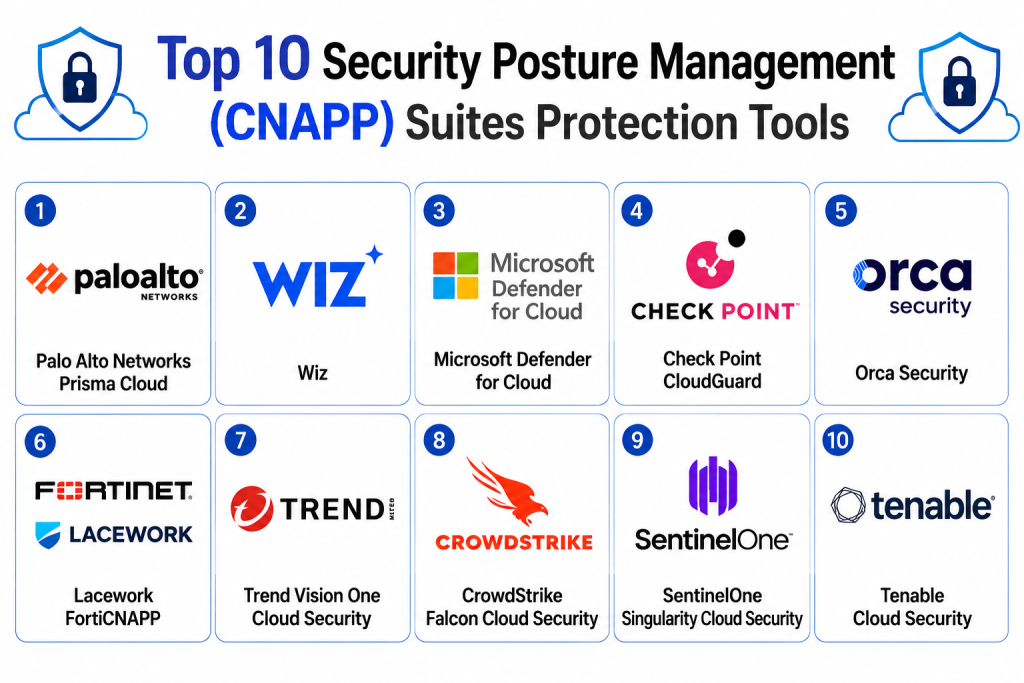
Top 10 Security Posture Management (CNAPP) Suites Protection Tools
1 — Palo Alto Networks Prisma Cloud
Short description :
Prisma Cloud is one of the most comprehensive CNAPP platforms available today. It combines CSPM, CWPP, CIEM, container security, IaC security, and runtime protection into a unified platform. Large enterprises frequently adopt Prisma Cloud for securing complex multi-cloud environments. The platform provides extensive visibility into cloud assets, vulnerabilities, identities, and workloads. Its broad cloud coverage makes it suitable for organizations operating across AWS, Azure, Google Cloud, and Kubernetes environments. It is particularly popular among security teams seeking centralized governance and compliance.
Key Features
- Cloud Security Posture Management
- Cloud Workload Protection
- Cloud Infrastructure Entitlement Management
- Kubernetes Security
- Runtime Threat Detection
- Infrastructure as Code Scanning
- Compliance Monitoring
Pros
- Comprehensive CNAPP coverage
- Strong multi-cloud support
- Advanced threat detection capabilities
Cons
- Complex deployment for smaller teams
- Premium pricing
- Learning curve for new users
Platforms / Deployment
- Cloud
- Hybrid
Security & Compliance
- RBAC
- MFA
- SSO/SAML
- Audit Logging
- Encryption
- Compliance frameworks supported
Integrations & Ecosystem
Prisma Cloud integrates with major cloud providers, DevOps pipelines, ticketing platforms, and SIEM solutions.
- AWS
- Azure
- Google Cloud
- Kubernetes
- Jenkins
- ServiceNow
Support & Community
Strong enterprise support offerings, extensive documentation, training resources, and an active customer ecosystem.
2 — Wiz
Short description :
Wiz has rapidly become one of the most recognized CNAPP platforms due to its agentless architecture and simplified user experience. The platform provides cloud visibility, vulnerability management, identity security, compliance monitoring, and risk prioritization. Organizations appreciate Wiz for its quick deployment and ability to generate actionable cloud security insights. It is particularly attractive to fast-growing cloud-native businesses.
Key Features
- Agentless Cloud Security
- CSPM
- CIEM
- Vulnerability Management
- Kubernetes Security
- Risk Graph Analysis
- Compliance Monitoring
Pros
- Rapid deployment
- User-friendly interface
- Strong risk prioritization
Cons
- Advanced customization may require expertise
- Enterprise licensing costs
- Less runtime depth than some competitors
Platforms / Deployment
- Cloud
Security & Compliance
- SSO
- MFA
- RBAC
- Encryption
- Audit Logs
Integrations & Ecosystem
Supports major cloud platforms and DevOps tools.
- AWS
- Azure
- Google Cloud
- GitHub
- Jira
- ServiceNow
Support & Community
Strong customer success programs and growing community adoption.
3 — Microsoft Defender for Cloud
Short description :
Microsoft Defender for Cloud provides CNAPP capabilities tightly integrated with Microsoft’s cloud ecosystem. It offers posture management, workload protection, vulnerability assessment, and compliance reporting. Organizations already invested in Microsoft environments often find Defender for Cloud attractive due to seamless integration and centralized management capabilities. It also supports hybrid and multi-cloud environments.
Key Features
- CSPM
- Workload Protection
- Compliance Monitoring
- Threat Detection
- Container Security
- Security Recommendations
- Hybrid Cloud Security
Pros
- Strong Microsoft ecosystem integration
- Good compliance coverage
- Unified management experience
Cons
- Best experience within Microsoft environments
- Complex licensing structure
- Advanced features may require additional services
Platforms / Deployment
- Cloud
- Hybrid
Security & Compliance
- MFA
- RBAC
- SSO
- Audit Logging
Integrations & Ecosystem
- Azure
- Microsoft Sentinel
- GitHub
- Kubernetes
- Microsoft Security Stack
Support & Community
Extensive documentation and enterprise support.
4 — Check Point CloudGuard
Short description :
CloudGuard delivers cloud security posture management, workload protection, compliance monitoring, and threat prevention. The platform helps organizations secure cloud resources while maintaining visibility across complex environments. Enterprises frequently use CloudGuard to strengthen governance and automate compliance management.
Key Features
- CSPM
- CWPP
- Compliance Management
- Threat Prevention
- Container Security
- IaC Scanning
- Risk Analysis
Pros
- Strong compliance capabilities
- Mature security controls
- Broad cloud coverage
Cons
- User interface can be complex
- Deployment planning required
- Enterprise-focused pricing
Platforms / Deployment
- Cloud
- Hybrid
Security & Compliance
- RBAC
- MFA
- Audit Logs
- Encryption
Integrations & Ecosystem
- AWS
- Azure
- Google Cloud
- Kubernetes
- SIEM Platforms
Support & Community
Strong enterprise support and professional services.
5 — Orca Security
Short description :
Orca Security is known for its agentless cloud security architecture. It provides visibility into assets, vulnerabilities, identities, and cloud risks without deploying agents across workloads. The platform is designed to simplify cloud security operations while delivering comprehensive risk analysis and compliance monitoring.
Key Features
- Agentless Security
- CSPM
- Vulnerability Management
- Compliance Monitoring
- Identity Security
- Asset Discovery
- Risk Prioritization
Pros
- Fast deployment
- Minimal operational overhead
- Comprehensive asset visibility
Cons
- Limited customization in some scenarios
- Enterprise-oriented pricing
- Smaller ecosystem than larger vendors
Platforms / Deployment
- Cloud
Security & Compliance
- RBAC
- SSO
- MFA
- Audit Logging
Integrations & Ecosystem
- AWS
- Azure
- Google Cloud
- ServiceNow
- Jira
Support & Community
Growing customer base and strong vendor support.
6 — Lacework FortiCNAPP
Short description :
Lacework FortiCNAPP combines cloud security posture management, workload protection, threat detection, and behavioral analytics. The platform is widely recognized for its anomaly detection capabilities and contextual security insights across cloud environments.
Key Features
- Behavioral Analytics
- CSPM
- CWPP
- Threat Detection
- Compliance Reporting
- Container Security
- Vulnerability Management
Pros
- Strong behavioral detection
- Comprehensive analytics
- Cloud-native architecture
Cons
- Advanced features require tuning
- Learning curve
- Pricing complexity
Platforms / Deployment
- Cloud
Security & Compliance
- SSO
- RBAC
- MFA
- Encryption
Integrations & Ecosystem
- AWS
- Azure
- Google Cloud
- Kubernetes
- SIEM Tools
Support & Community
Good documentation and enterprise support services.
7 — Trend Vision One Cloud Security
Short description :
Trend Vision One Cloud Security offers a unified cloud protection platform that combines workload security, posture management, compliance monitoring, and threat detection. The solution is designed for organizations seeking centralized visibility across cloud infrastructure and workloads.
Key Features
- CSPM
- CWPP
- Compliance Monitoring
- Container Security
- Threat Intelligence
- Vulnerability Management
- Runtime Protection
Pros
- Unified security platform
- Mature threat intelligence
- Strong cloud coverage
Cons
- Feature-rich interface may overwhelm new users
- Enterprise-focused deployment
- Licensing considerations
Platforms / Deployment
- Cloud
Security & Compliance
- RBAC
- MFA
- SSO
- Audit Logs
Integrations & Ecosystem
- AWS
- Azure
- Google Cloud
- Kubernetes
- DevOps Tools
Support & Community
Global support organization and mature documentation.
8 — CrowdStrike Falcon Cloud Security
Short description :
CrowdStrike Falcon Cloud Security extends the company’s security platform into cloud environments. It combines posture management, workload protection, vulnerability assessment, and threat detection capabilities. Organizations already using CrowdStrike often benefit from platform consolidation.
Key Features
- CSPM
- CWPP
- Threat Intelligence
- Vulnerability Assessment
- Compliance Monitoring
- Runtime Security
- Risk Analysis
Pros
- Unified CrowdStrike ecosystem
- Strong threat intelligence
- Good visibility
Cons
- Premium pricing
- Enterprise-focused
- Advanced deployment planning required
Platforms / Deployment
- Cloud
Security & Compliance
- RBAC
- MFA
- Audit Logs
- Encryption
Integrations & Ecosystem
- AWS
- Azure
- Google Cloud
- Falcon Platform
- SIEM Tools
Support & Community
Strong customer support and enterprise adoption.
9 — SentinelOne Singularity Cloud Security
Short description :
SentinelOne delivers cloud-native security capabilities through its Singularity platform. The solution combines cloud posture management, workload protection, and threat detection with AI-assisted security analytics. It is designed for organizations seeking autonomous security operations.
Key Features
- CSPM
- AI-Assisted Analytics
- Threat Detection
- Vulnerability Management
- Compliance Monitoring
- Workload Protection
- Risk Prioritization
Pros
- Strong automation capabilities
- AI-driven insights
- Unified platform approach
Cons
- Newer CNAPP offering than some competitors
- Enterprise pricing
- Feature depth varies by deployment
Platforms / Deployment
- Cloud
Security & Compliance
- SSO
- MFA
- RBAC
- Audit Logging
Integrations & Ecosystem
- AWS
- Azure
- Google Cloud
- DevOps Platforms
- Security Tools
Support & Community
Growing ecosystem and enterprise support programs.
10 — Tenable Cloud Security
Short description :
Tenable Cloud Security provides posture management, exposure management, compliance monitoring, and cloud asset visibility. Organizations frequently use it to improve risk management and maintain compliance across cloud environments. The platform leverages Tenable’s extensive security expertise.
Key Features
- CSPM
- Exposure Management
- Compliance Reporting
- Asset Discovery
- Vulnerability Management
- Risk Prioritization
- Multi-Cloud Visibility
Pros
- Strong exposure management
- Good compliance support
- Established security vendor
Cons
- Enterprise-focused pricing
- Feature depth varies across modules
- Learning curve for advanced functions
Platforms / Deployment
- Cloud
Security & Compliance
- RBAC
- MFA
- SSO
- Audit Logs
Integrations & Ecosystem
- AWS
- Azure
- Google Cloud
- Ticketing Platforms
- SIEM Solutions
Support & Community
Comprehensive documentation and enterprise-grade support.
Comparison Table (Top 10)
| Tool Name | Best For | Platform(s) Supported | Deployment | Standout Feature | Public Rating |
|---|---|---|---|---|---|
| Prisma Cloud | Large Enterprises | Multi-Cloud | Cloud/Hybrid | Full CNAPP Coverage | N/A |
| Wiz | Cloud-Native Teams | Multi-Cloud | Cloud | Agentless Security | N/A |
| Microsoft Defender for Cloud | Microsoft Customers | Multi-Cloud | Cloud/Hybrid | Azure Integration | N/A |
| CloudGuard | Compliance-Focused Enterprises | Multi-Cloud | Cloud/Hybrid | Governance Controls | N/A |
| Orca Security | Fast Deployment | Multi-Cloud | Cloud | Agentless Visibility | N/A |
| Lacework FortiCNAPP | Threat Analytics | Multi-Cloud | Cloud | Behavioral Analytics | N/A |
| Trend Vision One | Unified Security | Multi-Cloud | Cloud | Threat Intelligence | N/A |
| Falcon Cloud Security | CrowdStrike Users | Multi-Cloud | Cloud | Threat Intelligence | N/A |
| SentinelOne Singularity | AI Security Operations | Multi-Cloud | Cloud | Autonomous Analytics | N/A |
| Tenable Cloud Security | Exposure Management | Multi-Cloud | Cloud | Risk Prioritization | N/A |
Evaluation & Scoring of Security Posture Management (CNAPP) Suites
| Tool | Core | Ease | Integrations | Security | Performance | Support | Value | Weighted Total |
|---|---|---|---|---|---|---|---|---|
| Prisma Cloud | 10 | 8 | 10 | 10 | 9 | 9 | 7 | 9.00 |
| Wiz | 9 | 10 | 9 | 9 | 9 | 9 | 8 | 9.00 |
| Defender for Cloud | 9 | 8 | 9 | 9 | 9 | 9 | 8 | 8.75 |
| CloudGuard | 9 | 7 | 8 | 9 | 8 | 8 | 7 | 8.10 |
| Orca Security | 8 | 9 | 8 | 8 | 9 | 8 | 8 | 8.30 |
| Lacework FortiCNAPP | 8 | 8 | 8 | 8 | 8 | 8 | 7 | 7.95 |
| Trend Vision One | 8 | 8 | 8 | 8 | 8 | 8 | 8 | 8.00 |
| Falcon Cloud Security | 8 | 8 | 8 | 9 | 9 | 8 | 7 | 8.10 |
| SentinelOne | 8 | 8 | 8 | 8 | 8 | 8 | 8 | 8.00 |
| Tenable Cloud Security | 8 | 8 | 8 | 8 | 8 | 8 | 8 | 8.00 |
These scores are comparative rather than absolute measurements. Organizations should prioritize criteria based on their business needs. Enterprise buyers may value security depth and integrations more heavily, while smaller teams may prioritize ease of use and operational efficiency. Running proof-of-concept evaluations remains the most reliable way to validate platform fit.
Which Security Posture Management (CNAPP) Tool Is Right for You?
Solo / Freelancer
Most solo users do not require a full CNAPP platform. Lightweight cloud security tools or cloud-native provider services are usually more cost-effective.
SMB
Wiz and Orca Security are attractive options for SMBs due to rapid deployment and simplified operations. Their agentless approaches reduce management overhead.
Mid-Market
Microsoft Defender for Cloud, Trend Vision One, and SentinelOne provide a balance between security depth and operational simplicity.
Enterprise
Prisma Cloud, CloudGuard, CrowdStrike Falcon Cloud Security, and Lacework FortiCNAPP are strong choices for large organizations with complex cloud environments.
Budget vs Premium
- Budget-conscious organizations should evaluate Microsoft Defender for Cloud.
- Premium buyers seeking maximum coverage should consider Prisma Cloud or Wiz.
Feature Depth vs Ease of Use
- Feature Depth: Prisma Cloud, CloudGuard
- Ease of Use: Wiz, Orca Security
Integrations & Scalability
- Highest scalability: Prisma Cloud
- Strong ecosystem support: Microsoft Defender for Cloud
- Developer-friendly integration model: Wiz
Security & Compliance Needs
Organizations with strict compliance requirements should prioritize Prisma Cloud, Defender for Cloud, and CloudGuard due to their extensive governance capabilities.
Frequently Asked Questions (FAQs)
1. What is a CNAPP platform?
A CNAPP platform combines multiple cloud security capabilities into a unified solution. It helps organizations secure cloud infrastructure, workloads, identities, containers, and applications while simplifying security operations.
2. Why are CNAPP solutions becoming popular?
Cloud environments have become increasingly complex. CNAPP platforms reduce tool sprawl by providing posture management, threat detection, vulnerability management, and compliance capabilities within a single platform.
3. How long does implementation typically take?
Implementation timelines vary. Agentless platforms may be operational within days, while enterprise-wide deployments with extensive integrations can require several weeks or months.
4. Are CNAPP tools only for large enterprises?
No. Many modern CNAPP vendors offer solutions suitable for SMBs and mid-sized organizations. However, feature requirements and pricing should be evaluated carefully.
5. What is the difference between CSPM and CNAPP?
CSPM focuses primarily on cloud posture management and configuration monitoring. CNAPP expands coverage to include workload protection, identity security, vulnerability management, and runtime protection.
6. Can CNAPP platforms support multi-cloud environments?
Yes. Most leading CNAPP solutions support AWS, Microsoft Azure, and Google Cloud environments simultaneously, allowing centralized visibility and governance.
7. Do CNAPP platforms help with compliance?
Yes. Most CNAPP solutions provide compliance dashboards, policy checks, reporting, and continuous monitoring against various regulatory and industry frameworks.
8. What are common mistakes when selecting a CNAPP platform?
Common mistakes include focusing only on feature lists, ignoring integration requirements, underestimating operational complexity, and failing to validate deployment models.
9. How important is runtime protection?
Runtime protection helps detect and respond to active threats after deployment. Organizations with high-security requirements often consider runtime protection a critical capability.
10. Should organizations replace existing security tools with CNAPP?
Not necessarily. Many organizations initially deploy CNAPP alongside existing tools. Over time, some consolidate platforms as confidence in CNAPP capabilities increases.
Conclusion
Security Posture Management and CNAPP platforms have become essential for securing modern cloud environments. The leading vendors now provide capabilities that extend beyond posture management into workload protection, identity security, vulnerability management, compliance monitoring, and runtime defense. Prisma Cloud and Wiz remain strong leaders for comprehensive cloud security coverage, while Microsoft Defender for Cloud offers compelling value for Microsoft-centric organizations. Orca Security and SentinelOne provide modern approaches focused on simplicity and automation. Ultimately, the best CNAPP solution depends on your cloud architecture, compliance requirements, security maturity, operational resources, and budget. Before making a final decision, shortlist two or three platforms, conduct a proof-of-concept deployment, validate integrations with your existing security stack, and confirm that the solution aligns with your long-term cloud security strategy.
