Introduction
Influencer marketing platforms are centralized software solutions that help brands discover, manage, collaborate with, and measure the performance of social media influencers across channels like Instagram, YouTube, TikTok, and emerging creator networks. In simple terms, they act as a “control center” for influencer campaigns—bringing discovery, outreach, contracts, payments, analytics, and reporting into one system.
In and beyond, influencer marketing has evolved from a branding experiment into a data-driven performance channel. AI-powered creator matching, fraud detection, and ROI attribution are now core requirements rather than optional features. Brands are no longer asking “Should we use influencers?” but instead “Which platform gives us the most measurable return at scale?”
Common real-world use cases include:
- E-commerce brands running affiliate-driven influencer campaigns
- SaaS companies using creators for product-led growth
- Fashion and beauty brands scaling multi-region influencer programs
- Agencies managing hundreds of creator relationships simultaneously
- Enterprises needing compliance, approvals, and audit-ready reporting
Buyers evaluating these platforms typically focus on:
- Creator discovery accuracy and database size
- Audience authenticity and fraud detection
- Campaign workflow automation
- ROI tracking and attribution models
- Integration with CRM, e-commerce, and analytics tools
- Payment handling and contract management
- Ease of onboarding creators and internal teams
- Compliance, reporting, and governance controls
- Scalability across markets and channels
- AI-driven insights and recommendations
Best for: Marketing teams, D2C/e-commerce brands, influencer agencies, and enterprise brand marketing departments that need structured creator campaigns with measurable ROI and automation.
Not ideal for: Very small businesses running occasional one-off influencer collaborations or creators managing their own content without campaign structure. In such cases, lightweight tools or direct social platform outreach may be more efficient.
H2: Key Trends in Influencer Marketing Platforms
- AI-driven creator discovery replacing manual hashtag-based searches
- Strong focus on fraud detection (fake followers, engagement manipulation, bot traffic)
- Unified “creator CRM” systems replacing spreadsheets and manual tracking
- Performance-based influencer pricing models (CPA, affiliate, revenue share)
- Deep integration with e-commerce platforms for real-time sales attribution
- Expansion into TikTok Shop, Instagram Shopping, and live commerce ecosystems
- Creator marketplaces evolving into full-stack talent ecosystems
- Automated content licensing and rights management for cross-channel reuse
- Predictive analytics for campaign success probability scoring
- Increased enterprise demand for governance, compliance, and audit trails
How We Selected These Tools (Methodology)
- Evaluated global market adoption and brand recognition in influencer marketing
- Prioritized platforms with end-to-end campaign management capabilities
- Assessed strength of creator discovery and database coverage
- Reviewed fraud detection and audience authenticity systems
- Considered integrations with e-commerce, CRM, and analytics ecosystems
- Included platforms supporting both SMB and enterprise use cases
- Focused on tools offering measurable ROI tracking features
- Selected tools with strong workflow automation and collaboration features
- Ensured inclusion of AI-driven and next-gen influencer intelligence platforms
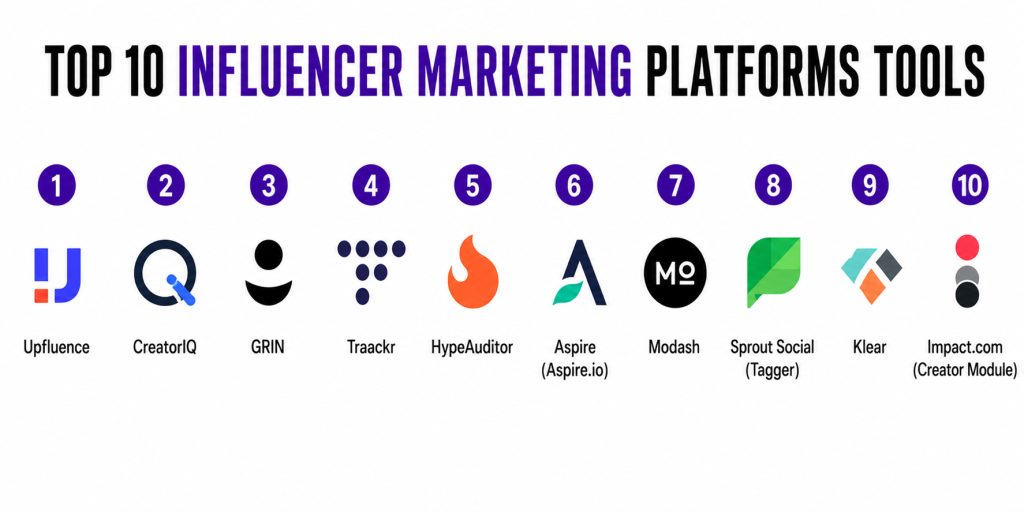
Top 10 Influencer Marketing Platforms Tools
1 — Upfluence
Short description:
Upfluence is a full-stack influencer marketing platform designed for e-commerce and D2C brands that want to identify, recruit, and manage influencers while directly tying campaigns to sales performance. It is widely used for Shopify and Amazon-driven influencer programs.
Key Features
- Influencer discovery database with advanced filtering
- AI-powered creator recommendations
- Direct integration with e-commerce platforms
- Affiliate tracking and revenue attribution
- Email outreach automation for influencer recruitment
- Campaign management dashboard
- Performance analytics and ROI tracking
Pros
- Strong e-commerce integration capabilities
- End-to-end influencer lifecycle management
- Good ROI tracking and affiliate support
Cons
- Can feel complex for beginners
- Pricing may be high for small teams
Platforms / Deployment
- Web / Cloud
Security & Compliance
- Not publicly stated (common enterprise controls include role-based access and secure authentication)
Integrations & Ecosystem
Upfluence integrates with major e-commerce and marketing tools:
- Shopify
- Amazon
- WooCommerce
- HubSpot (varies by setup)
- Google Analytics
Support & Community
Offers onboarding support, documentation, and account management for enterprise clients. Community size is moderate but professional-focused.
2 — CreatorIQ
Short description:
CreatorIQ is an enterprise-grade influencer marketing platform used by global brands to manage large-scale creator ecosystems with advanced analytics and governance.
Key Features
- AI-powered creator discovery engine
- Enterprise campaign management workflows
- Advanced fraud detection and audience quality scoring
- Custom reporting dashboards
- Brand safety and compliance controls
- Multi-market campaign management
- API-first architecture for integrations
Pros
- Highly scalable for enterprise organizations
- Strong analytics and governance features
- Trusted by global brands
Cons
- High complexity for small teams
- Longer implementation cycles
Platforms / Deployment
- Web / Cloud
Security & Compliance
- Not publicly stated (enterprise-grade security expected including SSO and RBAC)
Integrations & Ecosystem
- Salesforce
- Shopify
- Google Analytics
- TikTok API integrations
- Custom API support
Support & Community
Strong enterprise onboarding, dedicated success teams, and structured training programs.
3 — GRIN
Short description:
GRIN is an influencer relationship management platform designed specifically for D2C and e-commerce brands focusing on creator-driven sales growth.
Key Features
- Influencer CRM and relationship tracking
- Affiliate link and discount tracking
- Product seeding and order management
- Campaign automation workflows
- Content library for influencer assets
- ROI-based reporting dashboards
Pros
- Excellent for direct-to-consumer brands
- Strong creator relationship management
- Deep e-commerce integration
Cons
- Limited flexibility outside e-commerce use cases
- Pricing can scale quickly
Platforms / Deployment
- Web / Cloud
Security & Compliance
- Not publicly stated
Integrations & Ecosystem
- Shopify
- Magento
- WooCommerce
- Klaviyo
- Stripe (for payments)
Support & Community
Strong onboarding support with dedicated customer success teams.
4 — Traackr
Short description:
Traackr is a data-driven influencer marketing platform focused on global brands that need advanced analytics, benchmarking, and influencer relationship intelligence.
Key Features
- Influencer performance benchmarking
- Global creator database
- Campaign measurement and ROI tracking
- Brand health analytics
- Competitive influencer insights
- Workflow automation tools
- Budget allocation optimization
Pros
- Strong analytics and benchmarking tools
- Great for global enterprise brands
- Deep influencer intelligence
Cons
- Not ideal for small teams
- Interface may feel data-heavy
Platforms / Deployment
- Web / Cloud
Security & Compliance
- Not publicly stated
Integrations & Ecosystem
- CRM systems (varies)
- Analytics platforms
- Marketing automation tools
Support & Community
Enterprise-level onboarding and strategic consulting support.
5 — HypeAuditor
Short description:
HypeAuditor specializes in influencer analytics and fraud detection, helping brands validate creator authenticity before running campaigns.
Key Features
- Fake follower and engagement detection
- Audience quality scoring
- Influencer discovery engine
- Competitive analysis tools
- Campaign tracking and reporting
- Market trend analysis
- Social media auditing
Pros
- Excellent fraud detection capabilities
- Strong analytics for influencer vetting
- Useful for pre-campaign validation
Cons
- Less focused on full campaign management
- Limited workflow automation compared to others
Platforms / Deployment
- Web / Cloud
Security & Compliance
- Not publicly stated
Integrations & Ecosystem
- Social media APIs
- Marketing analytics tools
- Export-based integrations
Support & Community
Standard documentation and enterprise support options.
6 — Aspire (Aspire.io)
Short description:
Aspire is a creator marketing platform designed to help brands build long-term influencer relationships and run scalable ambassador programs.
Key Features
- Creator discovery and recruitment tools
- Influencer CRM system
- Campaign automation workflows
- Content approval systems
- Affiliate tracking and performance reporting
- Product gifting and seeding management
- UGC collection tools
Pros
- Strong for ambassador programs
- Good content workflow management
- Easy-to-use interface
Cons
- Some advanced analytics require upgrades
- Not fully enterprise-heavy
Platforms / Deployment
- Web / Cloud
Security & Compliance
- Not publicly stated
Integrations & Ecosystem
- Shopify
- Klaviyo
- HubSpot
- E-commerce platforms
Support & Community
Good onboarding and mid-market support structure.
7 — Modash
Short description:
Modash is a creator discovery and analytics platform focused on scalable influencer search with deep audience insights.
Key Features
- Large influencer discovery database
- Audience demographic analysis
- Fake follower detection
- Campaign tracking tools
- API access for scaling workflows
- Influencer filtering engine
- Export-ready campaign lists
Pros
- Very strong discovery capabilities
- Affordable compared to enterprise tools
- Easy to use
Cons
- Limited end-to-end campaign workflows
- Lacks advanced CRM features
Platforms / Deployment
- Web / Cloud
Security & Compliance
- Not publicly stated
Integrations & Ecosystem
- API-based integrations
- Marketing dashboards
- Export tools
Support & Community
Fast-growing support ecosystem with responsive documentation.
8 — Sprout Social (Tagger)
Short description:
Tagger, part of Sprout Social, is a robust influencer marketing solution integrated into a broader social media management ecosystem.
Key Features
- Influencer discovery engine
- Social listening integration
- Campaign management dashboards
- Performance analytics
- Audience insights
- Content planning and reporting
- Brand safety tools
Pros
- Strong integration with social media management
- Unified analytics with Sprout ecosystem
- Reliable enterprise reporting
Cons
- Higher pricing tier
- Best value realized within full Sprout ecosystem
Platforms / Deployment
- Web / Cloud
Security & Compliance
- Not publicly stated
Integrations & Ecosystem
- Sprout Social suite
- Social platforms (Instagram, TikTok, YouTube)
- Analytics tools
Support & Community
Strong enterprise support and onboarding resources.
9 — Klear
Short description:
Klear is an influencer marketing platform known for its strong analytics, influencer discovery, and campaign tracking capabilities.
Key Features
- Influencer search engine
- Audience analysis tools
- Campaign tracking dashboards
- Competitive benchmarking
- Relationship management tools
- Reporting automation
- Social listening features
Pros
- Strong analytics and reporting
- Easy influencer discovery
- Good for mid-market teams
Cons
- UI feels slightly traditional
- Limited advanced automation
Platforms / Deployment
- Web / Cloud
Security & Compliance
- Not publicly stated
Integrations & Ecosystem
- Social platforms
- Marketing analytics tools
Support & Community
Standard enterprise support and documentation.
10 — Impact.com (Creator Module)
Short description:
Impact.com is a partnership management platform that includes influencer marketing capabilities within a broader affiliate and performance marketing ecosystem.
Key Features
- Influencer and affiliate tracking in one system
- Partnership lifecycle management
- Automated contract and payment workflows
- Attribution and conversion tracking
- Campaign performance dashboards
- Fraud detection tools
- Multi-channel partner management
Pros
- Strong affiliate + influencer hybrid model
- Excellent attribution tracking
- Highly scalable platform
Cons
- Can be complex to configure
- Broad scope may overwhelm influencer-only users
Platforms / Deployment
- Web / Cloud
Security & Compliance
- Not publicly stated
Integrations & Ecosystem
- Shopify
- Salesforce
- Google Analytics
- Payment gateways
- Marketing automation tools
Support & Community
Strong enterprise-level onboarding and global support.
Comparison Table (Top 10)
| Tool Name | Best For | Platform(s) Supported | Deployment | Standout Feature | Public Rating |
|---|---|---|---|---|---|
| Upfluence | E-commerce brands | Web | Cloud | Affiliate + influencer ROI tracking | N/A |
| CreatorIQ | Enterprise brands | Web | Cloud | Enterprise-grade governance | N/A |
| GRIN | D2C brands | Web | Cloud | Influencer CRM for e-commerce | N/A |
| Traackr | Global enterprises | Web | Cloud | Benchmarking & analytics | N/A |
| HypeAuditor | Fraud detection | Web | Cloud | Audience authenticity scoring | N/A |
| Aspire | SMB & mid-market | Web | Cloud | Ambassador program automation | N/A |
| Modash | Discovery-heavy teams | Web | Cloud | Large influencer database | N/A |
| Sprout Social (Tagger) | Social-first teams | Web | Cloud | Integrated social + influencer analytics | N/A |
| Klear | Mid-market analytics | Web | Cloud | Influencer performance insights | N/A |
| Impact.com | Performance marketing | Web | Cloud | Affiliate + influencer hybrid tracking | N/A |
Evaluation & Scoring of Influencer Marketing Platforms
| Tool Name | Core (25%) | Ease (15%) | Integrations (15%) | Security (10%) | Performance (10%) | Support (10%) | Value (15%) | Weighted Total |
|---|---|---|---|---|---|---|---|---|
| Upfluence | 9 | 7 | 9 | 8 | 9 | 8 | 8 | 8.4 |
| CreatorIQ | 10 | 6 | 10 | 9 | 9 | 9 | 7 | 8.6 |
| GRIN | 9 | 8 | 8 | 8 | 8 | 8 | 8 | 8.2 |
| Traackr | 9 | 6 | 8 | 9 | 9 | 8 | 7 | 8.1 |
| HypeAuditor | 8 | 8 | 7 | 8 | 8 | 7 | 9 | 8.0 |
| Aspire | 8 | 8 | 8 | 7 | 8 | 8 | 8 | 8.0 |
| Modash | 8 | 9 | 7 | 7 | 8 | 7 | 9 | 8.1 |
| Sprout Tagger | 9 | 7 | 9 | 9 | 9 | 8 | 7 | 8.3 |
| Klear | 8 | 8 | 7 | 7 | 8 | 7 | 8 | 7.8 |
| Impact.com | 10 | 7 | 10 | 9 | 9 | 9 | 8 | 8.7 |
Interpretation Guide:
- Scores are comparative, not absolute industry benchmarks
- Higher scores indicate stronger end-to-end influencer marketing capability
- Enterprise tools score higher in security and integrations
- Mid-market tools often score higher in ease of use and value
- Final selection should depend on company size and use case complexity
Which Influencer Marketing Platform Tool Is Right for You?
Solo / Freelancer
Best suited tools:
- Modash
- HypeAuditor
Focus on affordability, discovery, and quick validation rather than full campaign systems.
SMB
Best suited tools:
- Aspire
- GRIN
Focus on ease of use, creator relationship management, and simple ROI tracking. - Mid-Market
Best suited tools:
- Upfluence
- Klear
- Sprout Social (Tagger)
Focus on scaling campaigns, integrations, and analytics.
Enterprise
Best suited tools:
- CreatorIQ
- Traackr
- Impact.com
Focus on governance, scalability, compliance, and advanced attribution.
Budget vs Premium
- Budget: Modash, Aspire
- Premium: CreatorIQ, Traackr, Impact.com
Feature Depth vs Ease of Use
- Deep features: CreatorIQ, Impact.com
- Easy adoption: Aspire, Modash
Integrations & Scalability
- Best integrations: Upfluence, Impact.com
- Best scalability: CreatorIQ
Security & Compliance Needs
- Strong enterprise controls: CreatorIQ, Traackr, Impact.com
- Mid-level controls: GRIN, Aspire
Frequently Asked Questions (FAQs)
1 — What is an influencer marketing platform used for?
It helps brands discover influencers, manage campaigns, track performance, and handle payments in a centralized system.
It replaces manual spreadsheets and fragmented outreach workflows.
2 — Are influencer marketing platforms only for large companies?
No, SMBs and startups also use them. Many tools offer scalable pricing and simplified workflows.
However, enterprise platforms may be too complex for small teams.
3 — How do these platforms measure ROI?
They track engagement, clicks, conversions, affiliate sales, and attribution models.
Some integrate directly with e-commerce systems for revenue tracking.
4 — Do these platforms help detect fake influencers?
Yes, many tools include fraud detection systems that analyze follower authenticity and engagement patterns.
This helps avoid wasted marketing spend.
5 — Can I manage payments through these platforms?
Yes, several platforms support automated payments, contracts, and tax documentation workflows.
However, not all tools include full payment automation.
6 — Do influencer platforms integrate with Shopify or WooCommerce?
Yes, many leading tools integrate with major e-commerce platforms.
This enables direct sales attribution from influencer campaigns.
7 — What is the difference between affiliate and influencer marketing?
Affiliate marketing is performance-based (pay per sale), while influencer marketing focuses on content and engagement.
Many platforms now combine both models.
8 — How long does implementation usually take?
It depends on complexity—SMB tools may take days, while enterprise platforms may take weeks.
Integration and onboarding requirements affect timelines.
9 — Are influencer marketing platforms secure?
Most platforms offer role-based access and secure authentication.
Advanced compliance certifications vary and are often not publicly stated.
10 — What are the main alternatives to these platforms?
Alternatives include manual influencer outreach, agencies, and social media management tools.
However, they lack automation and scalability.
Conclusion
Influencer marketing platforms have become essential infrastructure for modern digital marketing teams. They unify creator discovery, campaign execution, analytics, and ROI tracking into a single system, making influencer marketing more measurable and scalable than ever before.
However, there is no universal “best” platform. Enterprise teams may prioritize governance and scalability, while SMBs often value ease of use and affordability. E-commerce brands typically need deep attribution, while agencies focus on multi-client management.The most effective approach is to shortlist platforms based on company size and campaign complexity, then run a pilot to evaluate integrations, usability, and reporting accuracy. As influencer marketing continues evolving with AI, automation, and performance-based models, selecting the right platform becomes a strategic advantage rather than just a tooling decision.
