Introduction
Security Data Lakes are centralized storage and analytics environments where organizations collect, normalize, retain, search, and analyze security data at scale. In simple terms, they help security teams bring logs, endpoint telemetry, cloud events, network data, identity activity, application logs, and threat intelligence into one place for investigation, detection, compliance, and long-term retention.
Security Data Lakes matter because modern security teams generate massive volumes of data from cloud platforms, SaaS tools, endpoints, firewalls, identity systems, containers, and applications. Traditional SIEM-only models can become expensive or limited when organizations need long retention, flexible querying, AI-ready datasets, and cross-tool analytics. A security data lake helps teams store more data, keep it longer, and use it across threat hunting, detection engineering, incident response, audit, and risk reporting.
Common use cases include cloud security monitoring, threat hunting, SIEM cost optimization, long-term log retention, compliance evidence storage, incident investigation, AI-driven security analytics, and data enrichment for SOC workflows.
Buyers should evaluate:
- Data ingestion and normalization support
- Log retention and storage cost flexibility
- Query speed and analytics performance
- Native security schemas and open formats
- SIEM, SOAR, EDR, XDR, and cloud integrations
- Threat hunting and investigation workflows
- AI, ML, and automation readiness
- Access controls, encryption, audit logs, and governance
- Data residency, compliance, and retention controls
- Ease of administration and operational scalability
Best for: SOC teams, cloud security teams, threat hunters, detection engineers, security architects, compliance teams, managed security providers, and enterprises managing large volumes of security telemetry.
Not ideal for: very small teams with limited security data, organizations that only need basic alerting, or teams without the skills to manage data pipelines, storage policies, query design, and access governance. In those cases, a simpler SIEM, MDR service, or managed security platform may be a better starting point.
Key Trends in Security Data Lakes
- Security data volumes are growing quickly: Cloud, identity, endpoint, SaaS, network, and application telemetry are expanding faster than many legacy SIEM models can manage affordably.
- Open schemas are becoming more important: Security teams increasingly prefer normalized formats and open schemas so data can be reused across SIEM, analytics, AI, and compliance workflows.
- AI-ready security data is a major priority: Security teams want clean, well-governed data that can support AI-assisted investigations, automated summaries, anomaly detection, and advanced analytics.
- SIEM and data lake architectures are converging: Many organizations now use SIEM for high-priority detection and a data lake for long-term storage, hunting, compliance, and advanced analytics.
- Cloud-native data lakes are gaining adoption: Security teams are using AWS, Azure, Google Cloud, Snowflake, Databricks, and similar platforms to centralize large-scale telemetry.
- Data pipeline control is becoming critical: Teams need tools to route, filter, enrich, redact, transform, and replay security data before it reaches storage or analytics systems.
- Cost optimization is a key driver: Buyers are trying to reduce expensive SIEM ingestion by storing lower-priority data in cheaper long-term storage while keeping high-value detections active.
- Threat hunting needs longer retention: Modern attacks can unfold slowly, so teams need months of searchable telemetry to investigate dwell time, lateral movement, and persistence.
- Governance and privacy controls are now mandatory: Security data can contain sensitive user, customer, network, and system information, so RBAC, encryption, audit logs, masking, and retention policies matter.
- Ecosystem interoperability is a major buying factor: Teams want security data lakes that connect with SIEMs, EDR/XDR tools, SOAR platforms, threat intelligence, notebooks, BI tools, and data science workflows.
How We Selected These Tools Methodology
The tools below were selected based on their relevance to security data storage, security analytics, log retention, threat hunting, data pipeline management, SIEM integration, and cloud-scale investigation workflows.
- Market adoption and recognition among SOC, cloud security, detection engineering, and enterprise data teams
- Feature completeness for security data ingestion, storage, normalization, search, and analytics
- Support for security-focused schemas, open formats, APIs, and data sharing
- Reliability and performance signals for high-volume security telemetry workloads
- Security posture signals such as RBAC, encryption, audit logs, identity controls, and governance
- Integration strength with SIEM, SOAR, EDR, XDR, cloud, identity, and observability tools
- Suitability for SMB, mid-market, enterprise, cloud-native, and open-platform teams
- Practical value for threat hunting, compliance retention, investigation, and cost optimization
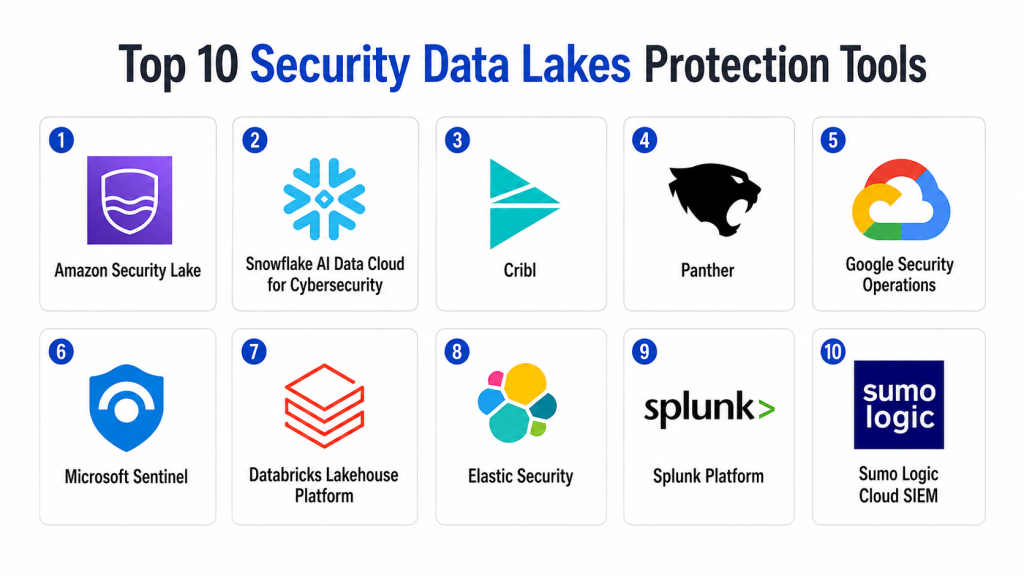
Top 10 Security Data Lakes Protection Tools
1- Amazon Security Lake
Short description:
Amazon Security Lake is a managed security data lake service designed to centralize security data from AWS environments and supported external sources.
It uses open security schema concepts to normalize security logs and events for analysis, investigation, and tool interoperability.
The platform is useful for AWS-heavy organizations that want security data stored in their own cloud environment.
It is best suited for cloud security, SOC, compliance, and threat hunting teams using AWS at scale.
Key Features
- Centralized security log collection for AWS environments
- Normalization using open cybersecurity schema concepts
- Storage in customer-controlled cloud storage
- Support for multi-account and multi-region security data strategies
- Subscriber access for downstream tools and analytics
- Integration with AWS security services
- Useful for threat hunting, compliance, and long-term retention
Pros
- Strong fit for AWS-native security teams
- Helps standardize and centralize security telemetry
- Useful for reducing fragmentation across AWS security logs
Cons
- Best value is for AWS-heavy environments
- External data sources may require additional configuration
- Teams still need analytics, detection, and investigation tools around the lake
Platforms / Deployment
Web
Cloud
Security & Compliance
Supports AWS identity, access control, encryption, logging, and governance capabilities depending on configuration. Specific compliance coverage should be validated based on region, account setup, and AWS service use.
Integrations & Ecosystem
Amazon Security Lake works best inside the AWS ecosystem and can support downstream analytics, SIEM, security tools, and custom workflows. It is useful when teams want a centralized security data foundation that other services can consume.
- AWS security services
- CloudTrail, VPC, and security event sources
- SIEM and analytics subscribers
- Custom data sources
- Data lake analytics tools
- APIs and AWS-native automation
Support & Community
AWS provides documentation, enterprise support options, partner resources, and cloud architecture guidance. Organizations with AWS security expertise can adopt the platform more effectively.
2- Snowflake AI Data Cloud for Cybersecurity
Short description:
Snowflake provides a cloud data platform that organizations can use as a security data lake for analytics, threat hunting, investigation, and compliance workloads.
It helps teams consolidate security data and run scalable queries across large datasets.
The platform is useful for organizations that already use Snowflake for analytics and want to extend that model to security operations.
It is best suited for enterprises that need flexible analytics, data sharing, and security data collaboration.
Key Features
- Scalable cloud data platform for security analytics
- Support for structured and semi-structured security data
- Separation of storage and compute for workload flexibility
- Data sharing and collaboration capabilities
- Integration with security apps and analytics workflows
- Support for AI and ML-driven analytics patterns
- Useful for long-term retention and investigation data
Pros
- Strong analytics foundation for security data
- Useful for organizations already invested in Snowflake
- Good fit for data science and security analytics teams
Cons
- Not a complete SIEM by itself
- Requires pipeline, schema, and governance design
- Security teams may need data engineering support
Platforms / Deployment
Web
Cloud
Security & Compliance
Supports enterprise-grade access controls, encryption, governance, and audit-related capabilities. Specific certifications and compliance coverage should be validated by edition, region, and contract.
Integrations & Ecosystem
Snowflake has a broad data and security ecosystem. It works well when security teams want to combine telemetry with analytics, data science, external enrichment, and business context.
- SIEM and security analytics tools
- Cloud storage and data pipelines
- Threat intelligence enrichment
- BI and reporting tools
- Data science and AI workflows
- Marketplace and native app ecosystem
Support & Community
Snowflake provides documentation, enterprise support, partner services, training, and a large data engineering community. Security-specific success often depends on strong architecture and governance planning.
3- Cribl
Short description:
Cribl is a data engine for IT and security teams that helps collect, route, enrich, reduce, replay, and manage observability and security data.
It is not only a storage layer; it is often used to build and control the pipelines that feed security data lakes, SIEMs, and analytics platforms.
Cribl is useful for organizations that want to reduce data waste, control ingestion costs, and send the right telemetry to the right destinations.
It is best suited for enterprises with high-volume log and telemetry pipelines.
Key Features
- Collection, routing, filtering, and enrichment of security data
- Support for sending data to SIEMs, storage, and analytics platforms
- Replay and search capabilities in supported products
- Data reduction and cost optimization workflows
- Vendor-neutral data pipeline strategy
- Support for observability and security telemetry
- Flexible integrations with many sources and destinations
Pros
- Strong for controlling security data pipelines
- Helps reduce SIEM ingestion waste
- Useful for multi-tool and multi-destination environments
Cons
- Not a complete SIEM or detection platform by itself
- Requires pipeline planning and operational discipline
- Teams need to design governance and retention separately
Platforms / Deployment
Web / Linux
Cloud / Self-hosted / Hybrid
Security & Compliance
Supports enterprise access control and data-management security features depending on deployment. Specific certifications and compliance details should be validated with the vendor.
Integrations & Ecosystem
Cribl is designed to connect many data sources and destinations, making it valuable for organizations building security data lakes across multiple platforms.
- SIEM platforms
- Cloud storage destinations
- Observability tools
- Security analytics platforms
- Data lakes and warehouses
- APIs, collectors, and routing pipelines
Support & Community
Cribl provides documentation, enterprise support, training resources, and a growing community of IT, security, and observability practitioners. Teams with strong pipeline skills can gain significant value.
4- Panther
Short description:
Panther is a cloud security monitoring and AI SOC platform that uses a data lake-centered architecture for detection, investigation, and response workflows.
It helps teams collect logs, normalize security data, write detections, investigate alerts, and connect findings back into detection logic.
The platform is useful for cloud-native security teams that want SIEM-style detection with strong data lake access and automation.
It is best suited for modern SOC teams, detection engineers, and cloud security teams.
Key Features
- Cloud-native security monitoring
- Data lake-centered detection and investigation model
- Detection-as-code workflows
- Log normalization and structured security data
- AI-assisted triage in supported capabilities
- Cloud and SaaS security data integrations
- Alerting, investigation, and response workflows
Pros
- Strong fit for cloud-native security teams
- Useful detection-as-code and data lake architecture
- Helps connect triage outcomes with detection improvement
Cons
- Best suited for teams comfortable with detection engineering
- May not replace every legacy SIEM use case
- Requires thoughtful data source onboarding
Platforms / Deployment
Web
Cloud
Security & Compliance
Supports enterprise security controls such as access management, audit-related capabilities, and data protection features. Specific certifications and compliance details should be validated by contract.
Integrations & Ecosystem
Panther connects with cloud, SaaS, identity, security, and data lake environments. Its ecosystem is practical for teams that want detections, investigations, and data lake access in one workflow.
- AWS, cloud, and SaaS logs
- Identity and access data
- Detection-as-code workflows
- Alerting and notification tools
- Security analytics data sources
- APIs and custom integrations
Support & Community
Panther provides documentation, support resources, detection examples, and customer success guidance. It is especially relevant for teams with modern cloud security and engineering-oriented SOC practices.
5- Google Security Operations
Short description:
Google Security Operations is a cloud-native security operations platform designed for large-scale security analytics, threat detection, investigation, and response.
It gives teams fast search and analysis across large volumes of security telemetry.
The platform is useful for organizations that need scalable detection, threat hunting, curated analytics, and security data workflows.
It is best suited for enterprises and cloud-native SOC teams handling high-volume security data.
Key Features
- Cloud-native security analytics and investigation
- Large-scale search across security telemetry
- Detection engineering with rule-based workflows
- Threat intelligence enrichment
- Security operations case and investigation support
- Integration with cloud and third-party data sources
- Support for scalable SOC analytics use cases
Pros
- Strong for high-volume security telemetry analysis
- Useful for cloud-native and data-heavy SOCs
- Benefits from security analytics and threat intelligence context
Cons
- Requires data onboarding and normalization planning
- Teams must learn platform-specific workflows
- May be more advanced than small teams require
Platforms / Deployment
Web
Cloud
Security & Compliance
Supports enterprise cloud security controls, access management, and governance capabilities. Specific certifications, data residency, and compliance coverage should be verified directly.
Integrations & Ecosystem
Google Security Operations can ingest and analyze security data from cloud, enterprise, and third-party sources. It fits teams that need high-scale investigation and analytics.
- Google Cloud data sources
- Third-party security telemetry
- Threat intelligence feeds
- SIEM and security analytics workflows
- Detection rules and response workflows
- APIs and data pipelines
Support & Community
Google provides documentation, support plans, training resources, and partner support. Teams using Google Cloud or large-scale analytics may find strong ecosystem alignment.
6- Microsoft Sentinel
Short description:
Microsoft Sentinel is a cloud-native SIEM and SOAR platform that can support security data lake-style architectures through Microsoft cloud analytics and storage integrations.
It helps teams collect, detect, investigate, hunt, and respond across Microsoft and third-party security data.
The platform is useful for organizations using Microsoft Defender, Microsoft Entra ID, Azure, and Microsoft 365.
It is best suited for Microsoft-centric SOC teams that need integrated security analytics and automation.
Key Features
- Cloud-native SIEM and SOAR capabilities
- Security data collection and analytics
- Threat hunting using query-based workflows
- Automation playbooks and incident response
- Integration with Microsoft Defender and Entra ID
- Workbooks, dashboards, and investigation tools
- Connectors for Microsoft and third-party data sources
Pros
- Strong fit for Microsoft security ecosystems
- Combines SIEM, SOAR, hunting, and automation
- Useful for cloud-based SOC modernization
Cons
- Costs depend on data ingestion and retention
- Best value is for Microsoft-heavy environments
- Requires query and analytics skills for advanced use
Platforms / Deployment
Web
Cloud
Security & Compliance
Supports Microsoft identity, access control, encryption, audit, governance, and compliance-related capabilities. Specific details depend on tenant configuration, region, and licensing.
Integrations & Ecosystem
Microsoft Sentinel integrates deeply with Microsoft security services and also supports many third-party data sources. It is practical for organizations that want security data, hunting, automation, and investigation in one cloud-native environment.
- Microsoft Defender products
- Microsoft Entra ID
- Azure services
- Third-party security connectors
- SOAR playbooks
- APIs and automation workflows
Support & Community
Microsoft provides documentation, learning resources, support plans, partner services, and a large security practitioner community. Query examples and playbook resources are widely available.
7- Databricks Lakehouse Platform
Short description:
Databricks Lakehouse Platform can be used by security teams to build scalable security analytics, log retention, threat hunting, and AI-driven investigation workflows.
It combines data engineering, data lake storage patterns, analytics, notebooks, machine learning, and governance capabilities.
The platform is useful for organizations that want security analytics connected with data science, AI, and large-scale telemetry processing.
It is best suited for enterprises with mature data engineering and security analytics teams.
Key Features
- Lakehouse architecture for large-scale data analytics
- Support for structured, semi-structured, and streaming data
- Notebooks and collaborative analytics workflows
- AI and ML support for advanced security analytics
- Data engineering pipelines for security telemetry
- Governance and access management capabilities
- Integration with cloud storage and enterprise data platforms
Pros
- Strong for AI-driven and data science-based security analytics
- Useful for long-term retention and large data workloads
- Flexible for custom security analytics programs
Cons
- Not a turnkey SIEM
- Requires data engineering and security analytics skills
- Detection workflows must be designed and operationalized
Platforms / Deployment
Web
Cloud / Hybrid
Security & Compliance
Supports enterprise data governance, access control, encryption, and audit-related capabilities depending on configuration. Specific compliance claims should be validated by cloud provider, region, and contract.
Integrations & Ecosystem
Databricks fits security teams that want to combine telemetry, AI, ML, notebooks, and large-scale analytics. It often works alongside SIEM, EDR, cloud storage, and data pipelines.
- Cloud storage platforms
- Data engineering pipelines
- SIEM and security data exports
- BI and analytics tools
- Machine learning workflows
- APIs and notebook-based analysis
Support & Community
Databricks provides documentation, training, support options, partner services, and a strong data engineering community. Security use cases require collaboration between SOC and data teams.
8- Elastic Security
Short description:
Elastic Security provides SIEM, endpoint security, log analytics, detection, and threat hunting capabilities built on the Elastic Stack.
It can function as a searchable security data lake for teams that want flexible ingestion, open queries, dashboards, and long-term analysis.
The platform is useful for organizations that need control over security telemetry, storage, search, and detection logic.
It is best suited for technical teams that value transparency, customization, and cloud or self-managed deployment.
Key Features
- SIEM and security analytics capabilities
- Search-driven threat hunting across logs and telemetry
- Endpoint security and detection rules
- Dashboards, alerts, and investigation timelines
- Flexible ingestion and data pipelines
- Cloud, self-hosted, and hybrid deployment options
- Open ecosystem and query flexibility
Pros
- Strong search and analytics foundation
- Flexible deployment and data control
- Good fit for open and customizable security programs
Cons
- Requires storage and retention planning
- Advanced tuning needs skilled users
- May require more administration than fully managed platforms
Platforms / Deployment
Web / Windows / macOS / Linux
Cloud / Self-hosted / Hybrid
Security & Compliance
Supports enterprise controls such as RBAC, encryption, authentication options, and audit-related features depending on plan and deployment. Specific compliance coverage should be verified directly.
Integrations & Ecosystem
Elastic integrates with cloud platforms, endpoint agents, application logs, network sources, and custom pipelines. It is useful for organizations that want to search and analyze security data with flexibility.
- Elastic Agent and Beats
- Cloud and infrastructure logs
- Endpoint telemetry
- Network and application logs
- OpenTelemetry and pipelines
- APIs and custom integrations
Support & Community
Elastic has strong documentation, training resources, commercial support, and an active community. Large-scale deployments require operational planning and strong data management practices.
9- Splunk Platform
Short description:
Splunk is a widely used platform for machine data, log analytics, security operations, threat hunting, and incident investigation.
It can support security data lake patterns through scalable ingestion, search, indexing, retention, federation, and integrations with security tools.
The platform is useful for enterprises that need flexible search, SIEM workflows, detection engineering, and long-term security analytics.
It is best suited for mature SOCs, large IT environments, and data-heavy security programs.
Key Features
- Log analytics and security data search
- SIEM support through Splunk Enterprise Security
- Flexible indexing and search capabilities
- Threat hunting and investigation workflows
- Dashboards, alerts, and correlation searches
- Integrations with security and infrastructure tools
- Data management and federation capabilities in supported offerings
Pros
- Strong for broad log search and detection engineering
- Mature ecosystem for enterprise security operations
- Flexible for custom analytics and investigations
Cons
- Data ingestion and retention can be costly
- Requires skilled administrators and analysts
- Complex environments need careful architecture planning
Platforms / Deployment
Web
Cloud / Self-hosted / Hybrid
Security & Compliance
Supports enterprise controls such as RBAC, audit logs, encryption, identity integration, and access governance depending on deployment. Specific certifications and compliance coverage should be validated by product and contract.
Integrations & Ecosystem
Splunk has a large ecosystem of apps, add-ons, integrations, and data connectors. It is useful when security data must be collected from many systems and analyzed by SOC teams.
- SIEM and SOAR workflows
- Endpoint and network telemetry
- Cloud and infrastructure logs
- Threat intelligence sources
- Identity and access data
- APIs, apps, and add-ons
Support & Community
Splunk offers documentation, training, certification paths, enterprise support, partner services, and a large user community. Internal Splunk expertise is important for long-term success.
10- Sumo Logic Cloud SIEM
Short description:
Sumo Logic Cloud SIEM is a cloud-native security analytics platform that helps teams collect, analyze, detect, and investigate threats across cloud and enterprise environments.
It supports centralized log analytics, security monitoring, and investigation workflows for modern SOC teams.
The platform is useful for teams that want cloud-native security analytics without managing heavy infrastructure.
It is best suited for cloud-first organizations, mid-market teams, and enterprises looking for managed security analytics.
Key Features
- Cloud-native log analytics and SIEM capabilities
- Security data ingestion and correlation
- Threat detection and investigation workflows
- Dashboards, alerts, and security analytics
- Cloud and SaaS monitoring support
- Integration with security and IT tools
- Useful for managed and scalable security operations
Pros
- Cloud-native and easier to operate than self-managed stacks
- Good fit for cloud-first security teams
- Useful for centralized security analytics and detection
Cons
- Pricing may depend on data volume and retention
- Advanced customization may vary by package
- Teams should validate integrations for their specific stack
Platforms / Deployment
Web
Cloud
Security & Compliance
Supports enterprise security controls such as access management, encryption, audit-related capabilities, and governance features depending on configuration. Specific certifications and compliance coverage should be verified by contract.
Integrations & Ecosystem
Sumo Logic integrates with cloud platforms, infrastructure tools, security products, DevOps systems, and alerting workflows. It works well for teams that want cloud-native analytics connected to operational and security telemetry.
- AWS, Azure, and Google Cloud
- Security and infrastructure tools
- DevOps and observability systems
- SIEM and alert workflows
- APIs and collectors
- Dashboards and reporting tools
Support & Community
Sumo Logic provides documentation, customer support, training resources, and onboarding guidance. It is practical for teams that want managed cloud analytics without operating a full self-hosted platform.
Comparison Table Top 10
| Tool Name | Best For | Platforms Supported | Deployment | Standout Feature | Public Rating |
|---|---|---|---|---|---|
| Amazon Security Lake | AWS-native security data centralization | Web | Cloud | Managed AWS security data lake | N/A |
| Snowflake AI Data Cloud for Cybersecurity | Enterprise security analytics and data sharing | Web | Cloud | Scalable analytics and data collaboration | N/A |
| Cribl | Security data pipeline control | Web / Linux | Cloud / Self-hosted / Hybrid | Routing, filtering, and replaying telemetry | N/A |
| Panther | Cloud-native detection and data lake SOC workflows | Web | Cloud | Detection-as-code with data lake access | N/A |
| Google Security Operations | Large-scale cloud-native security analytics | Web | Cloud | Scalable security telemetry search | N/A |
| Microsoft Sentinel | Microsoft-centric SIEM and data analytics | Web | Cloud | SIEM, SOAR, and hunting integration | N/A |
| Databricks Lakehouse Platform | AI-driven security analytics and data science | Web | Cloud / Hybrid | Lakehouse analytics for security data | N/A |
| Elastic Security | Search-driven security data lake workflows | Web / Windows / macOS / Linux | Cloud / Self-hosted / Hybrid | Flexible search and open analytics | N/A |
| Splunk Platform | Enterprise log analytics and SIEM workflows | Web | Cloud / Self-hosted / Hybrid | Mature security search ecosystem | N/A |
| Sumo Logic Cloud SIEM | Cloud-native SIEM and security analytics | Web | Cloud | Managed cloud security analytics | N/A |
Evaluation & Scoring of Security Data Lakes
| Tool Name | Core 25% | Ease 15% | Integrations 15% | Security 10% | Performance 10% | Support 10% | Value 15% | Weighted Total 0–10 |
| Amazon Security Lake | 8.8 | 8.2 | 8.5 | 9.0 | 8.7 | 8.3 | 8.3 | 8.54 |
| Snowflake AI Data Cloud for Cybersecurity | 8.6 | 8.0 | 8.7 | 8.8 | 9.0 | 8.5 | 7.8 | 8.43 |
| Cribl | 8.7 | 8.0 | 9.2 | 8.4 | 8.8 | 8.4 | 8.5 | 8.59 |
| Panther | 8.6 | 8.3 | 8.4 | 8.5 | 8.5 | 8.2 | 8.0 | 8.38 |
| Google Security Operations | 8.8 | 7.8 | 8.6 | 8.8 | 9.0 | 8.4 | 7.8 | 8.42 |
| Microsoft Sentinel | 8.7 | 8.1 | 8.8 | 8.9 | 8.6 | 8.5 | 8.0 | 8.51 |
| Databricks Lakehouse Platform | 8.3 | 7.5 | 8.6 | 8.7 | 9.0 | 8.3 | 7.8 | 8.28 |
| Elastic Security | 8.2 | 7.8 | 8.6 | 8.2 | 8.4 | 8.0 | 8.6 | 8.27 |
| Splunk Platform | 8.8 | 7.4 | 9.0 | 8.8 | 8.6 | 8.8 | 7.2 | 8.31 |
| Sumo Logic Cloud SIEM | 8.1 | 8.2 | 8.2 | 8.3 | 8.4 | 8.1 | 8.0 | 8.18 |
These scores are comparative and should be treated as a buying guide, not as universal ratings. A higher score means the tool is broadly strong across the weighted criteria, but the best fit depends on your cloud provider, data volume, retention goals, analytics skills, and SIEM strategy. For example, Amazon Security Lake fits AWS-heavy teams, Microsoft Sentinel fits Microsoft environments, Cribl is strong for data routing, Snowflake and Databricks fit data-driven analytics teams, and Elastic or Splunk fit search-heavy SOC workflows.
Which Security Data Lake Tool Is Right for You?
Solo / Freelancer
Solo consultants and independent security practitioners usually do not need a large enterprise security data lake unless they manage client environments or run advanced research. Elastic Security and Wazuh-style open security stacks may be practical for learning, labs, and smaller investigations, while cloud-native services can be useful for client-specific projects. If the goal is scalable client work, choosing a flexible platform with strong export and query capabilities is important. Solo users should avoid complex enterprise deployments unless they have enough data volume and business need.
SMB
Small and midsize businesses should focus on simplicity, cost control, and fast security value. Microsoft Sentinel, Sumo Logic Cloud SIEM, Elastic Security, and cloud-native options can be good starting points depending on the existing environment. AWS-heavy SMBs may consider Amazon Security Lake if they have enough cloud security telemetry and analytics capability. Teams with limited staff should consider managed detection, SIEM, or MDR services before building a full data lake architecture.
Mid-Market
Mid-market organizations often need better retention, stronger analytics, and lower SIEM ingestion pressure. Cribl, Microsoft Sentinel, Panther, Elastic Security, Sumo Logic, Snowflake, and Amazon Security Lake are strong options depending on architecture. If the main challenge is data volume and routing, Cribl should be evaluated. If the team needs cloud-native detection and analytics, Panther, Sentinel, or Sumo Logic may be stronger. If the organization has a data team, Snowflake or Databricks can support advanced analytics.
Enterprise
Enterprises should prioritize scalability, governance, access control, data residency, schema strategy, long-term retention, and interoperability. Amazon Security Lake, Snowflake, Cribl, Google Security Operations, Microsoft Sentinel, Databricks, Splunk, and Elastic are all strong enterprise candidates. Large organizations may use more than one platform, such as Cribl for pipelines, cloud storage for retention, a SIEM for detection, and Snowflake or Databricks for analytics. The best architecture is often a layered ecosystem, not a single tool.
Budget vs Premium
Budget-conscious teams should evaluate ingestion, storage, compute, retention, support, and engineering cost together. A cheaper storage layer may still become expensive if queries, pipelines, or staffing requirements are high. Elastic and cloud storage-based models can provide flexibility, but require technical skill. Premium platforms such as Splunk, Snowflake, Google Security Operations, or managed SIEM tools may cost more but can reduce operational burden and improve analyst productivity.
Feature Depth vs Ease of Use
Teams that need turnkey detection and investigation should consider Microsoft Sentinel, Panther, Sumo Logic, Google Security Operations, Splunk, or Elastic Security. Teams that need data lake infrastructure and analytics flexibility may prefer Snowflake, Databricks, or Amazon Security Lake. Teams that need pipeline control should consider Cribl. Feature-rich platforms are powerful, but they require clear architecture, ownership, governance, and tuning.
Integrations & Scalability
A security data lake must connect with cloud platforms, identity systems, endpoint tools, network logs, SIEM, SOAR, threat intelligence, ticketing tools, and analytics workflows. Cribl, Splunk, Elastic, Sentinel, Snowflake, and Google Security Operations are strong for integration-heavy environments. Buyers should validate API support, connector availability, data formats, schema mapping, and export options. Scalability should be tested with realistic event volume, retention periods, and query workloads.
Security & Compliance Needs
Security data lakes store sensitive information, including user activity, system logs, identity events, network metadata, and potentially regulated data. Buyers should evaluate RBAC, SSO, MFA, encryption, audit logs, data masking, retention controls, legal hold, data residency, and least-privilege access. Regulated organizations should confirm compliance documentation directly with vendors. Governance should be designed before large-scale data ingestion begins.
Frequently Asked Questions FAQs
1- What is a Security Data Lake?
A Security Data Lake is a centralized environment for storing and analyzing security telemetry from many systems.
It can include logs, endpoint events, cloud activity, identity data, network traffic, application logs, and threat intelligence.
The goal is to support investigation, threat hunting, compliance, and long-term retention.
It helps teams use security data beyond short-term alerting.
2- How is a Security Data Lake different from a SIEM?
A SIEM focuses on detection, alerting, correlation, and security operations workflows.
A Security Data Lake focuses on scalable storage, flexible analytics, long-term retention, and broad data reuse.
Many organizations use both together.
The SIEM handles active detections, while the data lake supports deeper analysis and historical investigations.
3- What pricing models do Security Data Lakes use?
Pricing may depend on ingestion volume, storage, compute usage, retention, query activity, users, modules, or support level.
Cloud-native platforms often separate storage and compute costs.
SIEM-like platforms may charge by data volume or events.
Buyers should model realistic usage before committing.
4- How long does implementation take?
Implementation can take a few weeks for a focused cloud use case and several months for enterprise-wide security data programs.
The timeline depends on data sources, schemas, pipelines, permissions, retention policies, and analytics requirements.
Teams should start with high-value data first.
A phased rollout is safer than trying to ingest every source immediately.
5- What are common mistakes when building a Security Data Lake?
Common mistakes include ingesting too much low-value data, skipping schema design, ignoring governance, and failing to define use cases.
Some teams also underestimate compute costs and query performance needs.
Another mistake is building storage without clear detection or investigation workflows.
A good data lake starts with clear security outcomes.
6- Are Security Data Lakes secure?
Security Data Lakes can be secure when designed with encryption, RBAC, SSO, MFA, audit logs, data masking, and least-privilege access.
However, security depends heavily on architecture and configuration.
Teams must also manage retention, data residency, and access reviews.
Sensitive security telemetry should never be treated as ordinary log data.
7- Can small businesses use Security Data Lakes?
Small businesses can use security data lake concepts, but they may not need a full enterprise architecture.
A managed SIEM, cloud-native security service, or lightweight log analytics platform may be enough.
Security data lakes become more valuable as data volume, retention needs, and investigation complexity grow.
Small teams should avoid tools that require heavy daily administration.
8- Which integrations matter most?
Important integrations include cloud platforms, identity providers, endpoint tools, firewalls, SaaS applications, SIEM, SOAR, ticketing tools, and threat intelligence feeds.
Data pipeline integrations are also important for filtering, enrichment, and routing.
APIs and export options help avoid vendor lock-in.
The best integrations depend on your detection and investigation workflows.
9- Is a Security Data Lake useful for threat hunting?
Yes, security data lakes are very useful for threat hunting because they can store large amounts of historical telemetry.
Threat hunters can search across long time windows, compare behavior, enrich events, and build custom queries.
This is especially valuable for investigating stealthy attacks and long dwell-time intrusions.
Retention and query performance are key success factors.
10- Can a Security Data Lake reduce SIEM costs?
A Security Data Lake can reduce SIEM pressure by storing lower-priority or long-retention data outside expensive SIEM ingestion paths.
High-value alerts and detection rules can remain in the SIEM, while raw or historical data stays in cheaper storage.
However, cost savings depend on architecture, query patterns, and storage design.
Teams should calculate total cost, not just storage cost.
Conclusion
Security Data Lakes help organizations centralize, retain, normalize, and analyze security telemetry at scale. They are especially valuable for threat hunting, long-term investigations, compliance retention, SIEM cost optimization, cloud security monitoring, and AI-ready security analytics. Amazon Security Lake, Snowflake, Cribl, Panther, Google Security Operations, Microsoft Sentinel, Databricks, Elastic Security, Splunk, and Sumo Logic all approach the problem from different angles, so the best choice depends on your current architecture, security maturity, data volume, and operational goals.The right is to shortlist two or three platforms based on your highest-priority use cases, such as AWS security centralization, SIEM cost reduction, cloud-native detection, long-term retention, AI analytics, or pipeline control. Run a pilot with real telemetry, test ingestion and query performance, validate integrations, review access controls and retention policies, and compare total cost across storage, compute, support, and administration before making a final decision.
