Introduction
Agent Simulation & Sandboxing Tools have become a critical part of modern AI agent development. As organizations increasingly deploy autonomous agents capable of making decisions, invoking tools, accessing enterprise systems, writing code, and executing workflows, the need for safe testing environments has grown significantly. Before deploying agents into production, teams must validate behavior, measure performance, identify failure modes, test security controls, and evaluate decision-making under realistic conditions.
Simulation and sandboxing platforms provide controlled environments where AI agents can interact with virtual systems, synthetic users, mock APIs, simulated enterprise applications, and realistic scenarios without affecting production resources. These platforms help organizations reduce risk, improve reliability, and accelerate agent development cycles.
Modern agent simulation solutions go beyond traditional testing. They increasingly support multi-agent environments, adversarial testing, reinforcement learning evaluations, tool usage validation, red teaming, security assessments, human-in-the-loop testing, and autonomous workflow verification.
Real-World Use Cases
- AI agent validation before production deployment
- Multi-agent collaboration testing
- Autonomous workflow simulation
- Security and red-team testing
- Prompt injection resilience testing
- Customer service agent evaluation
- Software engineering agent validation
- Tool-calling workflow testing
- Enterprise governance verification
- Reinforcement learning experimentation
Evaluation Criteria for Buyers
When evaluating Agent Simulation & Sandboxing Tools, consider:
- Simulation realism
- Multi-agent support
- Environment customization
- Security isolation
- Evaluation capabilities
- Workflow testing support
- Enterprise scalability
- Observability and monitoring
- Integration ecosystem
- Governance controls
Best for: AI platform teams, agent developers, enterprise architects, AI governance teams, security engineers, and organizations deploying production AI agents.
Not ideal for: Small proof-of-concept projects with minimal operational risk.
What’s Changed
The rapid growth of autonomous AI systems has transformed simulation requirements.
Key developments include:
- Agent-native simulation environments
- Multi-agent virtual ecosystems
- Automated evaluation frameworks
- AI red teaming environments
- Synthetic user simulation
- Tool execution testing
- Reinforcement learning sandboxes
- Enterprise governance validation
Quick Buyer Checklist
Before selecting an Agent Simulation & Sandboxing platform, ask:
- Can agents safely execute tools?
- Does it support multi-agent testing?
- Are realistic environments available?
- Is security isolation built in?
- Can performance metrics be collected?
- Are governance policies testable?
- Does it support adversarial testing?
- Can it integrate with existing agent frameworks?
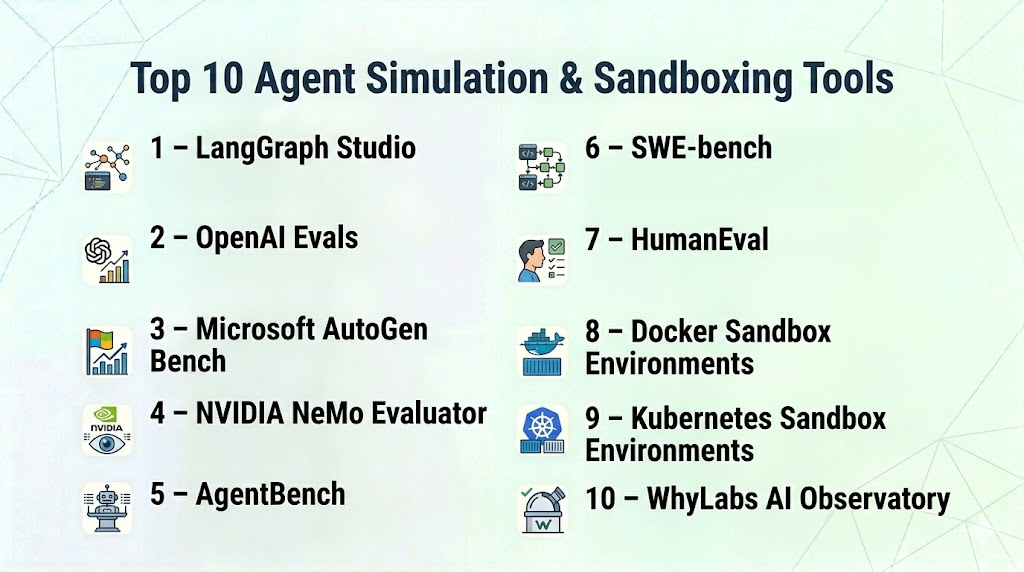
Top 10 Agent Simulation & Sandboxing Tools
1- LangGraph Studio
One-line Verdict
Best overall platform for testing and debugging agent workflows.
Short Description
LangGraph Studio provides a visual environment for designing, simulating, monitoring, and debugging complex AI agent workflows. Developers can inspect reasoning paths, workflow transitions, memory interactions, and tool execution behaviors before deployment.
Standout Capabilities
- Workflow visualization
- Agent debugging
- State inspection
- Execution tracing
- Multi-step workflow testing
AI-Specific Depth
Designed specifically for agent workflow development and simulation.
Pros
- Excellent observability
- Strong developer tooling
- Production-oriented design
Cons
- Requires LangGraph ecosystem familiarity
- More workflow-focused than environment-focused
Security & Compliance
Depends on deployment environment.
Deployment & Platforms
- Cloud
- Self-hosted
Integrations & Ecosystem
Strong LangChain and AI ecosystem support.
Pricing Model
Commercial and open ecosystem support.
Best-Fit Scenarios
- Agent workflow testing
- Debugging autonomous systems
- Enterprise agent development
2- OpenAI Evals
One-line Verdict
Best for systematic agent performance evaluation.
Short Description
OpenAI Evals enables organizations to benchmark, test, and evaluate agent performance across diverse tasks, workflows, and reasoning scenarios.
Standout Capabilities
- Evaluation pipelines
- Performance benchmarking
- Scenario testing
- Regression detection
- Task scoring
AI-Specific Depth
Optimized for AI behavior measurement and validation.
Pros
- Structured evaluation framework
- Repeatable testing
- Large community adoption
Cons
- Primarily evaluation-focused
- Limited environment simulation
Security & Compliance
Depends on deployment.
Deployment & Platforms
- Cloud
- Self-hosted
Integrations & Ecosystem
Broad AI model compatibility.
Pricing Model
Open-source.
Best-Fit Scenarios
- Agent benchmarking
- Performance validation
- Regression testing
3- Microsoft AutoGen Bench
One-line Verdict
Best for multi-agent simulation and collaboration testing.
Short Description
AutoGen Bench enables testing and evaluation of agent-to-agent interactions, collaborative workflows, reasoning systems, and autonomous task execution.
Standout Capabilities
- Multi-agent simulation
- Collaboration testing
- Agent benchmarking
- Workflow evaluation
- Conversation analysis
AI-Specific Depth
Specifically built for multi-agent ecosystems.
Pros
- Strong multi-agent capabilities
- Research-backed framework
- Flexible experimentation
Cons
- Learning curve
- Research-oriented design
Security & Compliance
Depends on implementation.
Deployment & Platforms
- Cloud
- Self-hosted
Integrations & Ecosystem
Works with major AI frameworks.
Pricing Model
Open-source.
Best-Fit Scenarios
- Multi-agent systems
- Collaborative workflows
- Agent research
4- NVIDIA NeMo Evaluator
One-line Verdict
Best enterprise-grade simulation and evaluation framework.
Short Description
NVIDIA NeMo Evaluator supports large-scale testing, validation, benchmarking, and governance evaluation for AI agents and enterprise AI systems.
Standout Capabilities
- Enterprise evaluations
- Governance testing
- Large-scale benchmarking
- Safety validation
- Performance monitoring
Pros
- Enterprise-ready
- Strong governance support
- Scalable infrastructure
Cons
- Enterprise complexity
- Higher setup requirements
Security & Compliance
Enterprise-grade controls.
Deployment & Platforms
- Cloud
- Hybrid
- On-premises
Integrations & Ecosystem
Strong NVIDIA AI ecosystem.
Pricing Model
Commercial and enterprise offerings.
Best-Fit Scenarios
- Enterprise AI validation
- Governance testing
- Production readiness assessments
5- AgentBench
One-line Verdict
Best benchmark suite for autonomous agents.
Short Description
AgentBench provides a collection of realistic environments and tasks for evaluating AI agent performance across different domains.
Standout Capabilities
- Standardized benchmarks
- Agent evaluation
- Domain-specific testing
- Comparative analysis
- Performance scoring
Pros
- Widely recognized benchmarks
- Research credibility
- Broad task coverage
Cons
- Less enterprise tooling
- Primarily evaluation-focused
Security & Compliance
Not publicly stated.
Deployment & Platforms
- Self-hosted
- Research environments
Integrations & Ecosystem
Compatible with various agent frameworks.
Pricing Model
Open-source.
Best-Fit Scenarios
- Research projects
- Agent benchmarking
- Comparative evaluations
6- SWE-bench
One-line Verdict
Best for software engineering agent evaluation.
Short Description
SWE-bench measures how effectively AI agents solve real software engineering issues using actual code repositories and bug-fixing tasks.
Standout Capabilities
- Code evaluation
- Repository testing
- Bug-fixing validation
- Development workflows
- Agent benchmarking
Pros
- Real-world software scenarios
- High relevance for coding agents
- Strong community adoption
Cons
- Focused on software engineering
- Limited broader simulations
Platforms / Deployment
- Cloud
- Self-hosted
Security & Compliance
Depends on deployment.
Integrations & Ecosystem
Developer ecosystem support.
Pricing Model
Open-source.
Best-Fit Scenarios
- Coding agents
- Software automation
- Development workflow testing
7- HumanEval
One-line Verdict
Best lightweight sandbox for coding agent assessments.
Short Description
HumanEval provides structured coding tasks that help teams measure reasoning quality, code generation accuracy, and agent execution performance.
Standout Capabilities
- Coding benchmarks
- Execution validation
- Performance scoring
- Task-based evaluation
- Lightweight deployment
Pros
- Easy implementation
- Clear metrics
- Broad adoption
Cons
- Narrow use case
- Limited enterprise workflows
Platforms / Deployment
- Self-hosted
Security & Compliance
Depends on implementation.
Integrations & Ecosystem
Works with coding-focused AI frameworks.
Pricing Model
Open-source.
Best-Fit Scenarios
- Code assistants
- Engineering agents
- Benchmark testing
8- Docker Sandbox Environments
One-line Verdict
Best for secure tool execution and isolation.
Short Description
Docker-based sandboxing provides isolated execution environments where agents can safely run commands, test workflows, interact with tools, and perform automation tasks without affecting production infrastructure.
Standout Capabilities
- Environment isolation
- Tool execution
- Secure testing
- Workflow validation
- Resource controls
Pros
- Mature technology
- Strong isolation
- Broad industry adoption
Cons
- Not AI-specific
- Requires infrastructure expertise
Platforms / Deployment
- Cloud
- On-premises
- Hybrid
Security & Compliance
Strong isolation controls available.
Integrations & Ecosystem
Massive ecosystem support.
Pricing Model
Open-source.
Best-Fit Scenarios
- Tool execution testing
- Security validation
- Agent workflow simulation
9- Kubernetes Sandbox Environments
One-line Verdict
Best for large-scale enterprise agent testing.
Short Description
Kubernetes environments enable organizations to create scalable testing ecosystems for AI agents, workflows, tool integrations, and multi-agent deployments.
Standout Capabilities
- Scalable environments
- Resource isolation
- Multi-agent testing
- Enterprise orchestration
- Deployment simulation
Pros
- Enterprise scalability
- Strong operational controls
- Production-like environments
Cons
- High complexity
- Operational overhead
Platforms / Deployment
- Cloud
- Hybrid
- On-premises
Security & Compliance
Enterprise-grade controls available.
Integrations & Ecosystem
Broad cloud-native ecosystem.
Pricing Model
Open-source platform.
Best-Fit Scenarios
- Enterprise AI testing
- Production simulation
- Large-scale deployments
10- WhyLabs AI Observatory
One-line Verdict
Best for runtime monitoring and simulation analysis.
Short Description
WhyLabs provides observability, behavior analysis, anomaly detection, and evaluation capabilities that help organizations monitor agent behavior during testing and production simulations.
Standout Capabilities
- AI observability
- Runtime analysis
- Risk detection
- Performance monitoring
- Governance insights
Pros
- Strong monitoring capabilities
- Enterprise visibility
- Detailed analytics
Cons
- More monitoring-focused
- Requires complementary simulation tools
Platforms / Deployment
- Cloud
Security & Compliance
Enterprise controls available.
Integrations & Ecosystem
Broad AI ecosystem support.
Pricing Model
Commercial.
Best-Fit Scenarios
- AI operations teams
- Runtime validation
- Governance monitoring
Comparison Table
| Tool | Best For | Multi-Agent Support | Enterprise Ready | Open Source |
|---|---|---|---|---|
| LangGraph Studio | Workflow Simulation | Yes | Yes | Partial |
| OpenAI Evals | Agent Evaluation | Limited | Yes | Yes |
| AutoGen Bench | Multi-Agent Testing | Yes | Moderate | Yes |
| NVIDIA NeMo Evaluator | Enterprise Validation | Yes | Yes | Partial |
| AgentBench | Agent Benchmarking | Yes | Moderate | Yes |
| SWE-bench | Coding Agents | Limited | Moderate | Yes |
| HumanEval | Code Evaluation | Limited | Moderate | Yes |
| Docker Sandbox | Tool Isolation | Moderate | Yes | Yes |
| Kubernetes Sandbox | Enterprise Simulation | Yes | Yes | Yes |
| WhyLabs | Runtime Monitoring | Moderate | Yes | No |
Evaluation & Scoring Table
| Tool | Core | Ease | Integrations | Security | Performance | Support | Value | Total |
|---|---|---|---|---|---|---|---|---|
| LangGraph Studio | 9.6 | 8.7 | 9.2 | 8.8 | 9.2 | 9.0 | 9.1 | 9.1 |
| OpenAI Evals | 9.1 | 9.0 | 8.8 | 8.5 | 8.9 | 9.1 | 9.2 | 8.9 |
| AutoGen Bench | 9.2 | 8.3 | 8.7 | 8.5 | 8.9 | 8.8 | 8.8 | 8.8 |
| NVIDIA NeMo Evaluator | 9.4 | 8.1 | 9.1 | 9.4 | 9.2 | 9.0 | 8.7 | 9.0 |
| AgentBench | 9.0 | 8.5 | 8.4 | 8.2 | 8.7 | 8.5 | 9.0 | 8.6 |
| SWE-bench | 9.1 | 8.7 | 8.3 | 8.4 | 8.8 | 8.8 | 9.1 | 8.7 |
| HumanEval | 8.7 | 9.1 | 8.0 | 8.3 | 8.6 | 8.6 | 9.2 | 8.6 |
| Docker Sandbox | 8.9 | 8.4 | 9.5 | 9.6 | 9.1 | 9.5 | 9.3 | 9.2 |
| Kubernetes Sandbox | 9.2 | 7.8 | 9.6 | 9.5 | 9.4 | 9.4 | 8.8 | 9.1 |
| WhyLabs | 8.8 | 8.9 | 8.9 | 9.0 | 9.1 | 8.8 | 8.7 | 8.9 |
Which Agent Simulation & Sandboxing Tool Is Right for You?
For Production Agent Development
Choose LangGraph Studio if you need detailed workflow debugging, execution tracing, and agent behavior analysis.
For Enterprise AI Validation
Choose NVIDIA NeMo Evaluator or Kubernetes Sandbox Environments for large-scale testing and governance verification.
For Multi-Agent Systems
Choose AutoGen Bench to evaluate collaboration, delegation, and agent-to-agent communication.
For Coding Agents
Choose SWE-bench or HumanEval to validate software engineering performance and code-generation quality.
For Secure Tool Execution
Choose Docker Sandbox Environments to safely test agent actions, tool usage, and automation workflows.
For Continuous Monitoring
Choose WhyLabs AI Observatory to monitor agent performance, risks, and operational behavior during simulations and production deployments.
Frequently Asked Questions
1- What are Agent Simulation & Sandboxing Tools?
These tools provide controlled environments where AI agents can be tested, evaluated, monitored, and validated before deployment into production systems.
2- Why are simulation environments important for AI agents?
Simulation environments reduce operational risk by allowing teams to identify failures, security issues, reasoning problems, and workflow errors before agents interact with real users or systems.
3- What is the difference between simulation and sandboxing?
Simulation focuses on recreating realistic environments and scenarios, while sandboxing focuses on isolating execution to prevent unintended impacts on production systems.
4- Can simulation tools improve agent safety?
Yes. Simulation environments allow teams to test edge cases, adversarial scenarios, policy compliance, and failure recovery mechanisms before deployment.
5- What are multi-agent simulations?
Multi-agent simulations test how multiple AI agents collaborate, communicate, delegate tasks, and coordinate actions within shared environments.
6- Why is secure tool execution important?
Agents often interact with APIs, databases, cloud systems, and enterprise applications. Sandboxing ensures these actions can be tested safely without affecting real infrastructure.
7- Are Docker and Kubernetes suitable for AI sandboxing?
Yes. Both technologies provide strong isolation, resource control, and scalable environments that support safe agent experimentation and testing.
8- What role does observability play in simulations?
Observability helps teams understand agent decisions, tool usage, workflow execution, failures, and performance metrics throughout testing.
9- Can simulation platforms support compliance testing?
Many enterprise simulation environments allow organizations to validate governance policies, approval workflows, and regulatory requirements before production deployment.
10- What should organizations prioritize when selecting a simulation platform?
Organizations should evaluate realism, scalability, observability, security isolation, integration flexibility, governance support, and compatibility with their agent architecture.
Conclusion
Agent Simulation & Sandboxing Tools are becoming essential components of enterprise AI development pipelines. As organizations deploy increasingly autonomous agents capable of interacting with customers, enterprise systems, and business processes, thorough testing and validation are critical for reducing risk and ensuring reliability. LangGraph Studio leads in workflow-focused agent development, while AutoGen Bench excels in multi-agent testing. NVIDIA NeMo Evaluator provides enterprise-scale validation capabilities, and Docker-based sandboxes remain one of the most effective approaches for secure tool execution testing. The most successful organizations combine simulation environments, benchmarking frameworks, observability platforms, and governance controls to create a comprehensive validation strategy. By investing in robust simulation and sandboxing capabilities, teams can accelerate AI adoption while maintaining security, compliance, and operational confidence.
