Introduction
Agent Observability & Tracing Tools help teams understand what AI agents are doing behind the scenes. As AI systems become more autonomous, organizations need visibility into prompts, tool calls, reasoning chains, memory usage, retrieval operations, model responses, latency, costs, and failure points. These platforms provide tracing, monitoring, debugging, evaluation, and governance capabilities for AI applications and agentic workflows.
In modern AI environments, observability is no longer optional. Enterprises are deploying multi-agent systems, retrieval-augmented generation pipelines, multimodal workflows, and autonomous agents that interact with business systems. Without proper observability, debugging failures, identifying hallucinations, controlling costs, and ensuring compliance becomes extremely difficult.
Real-world use cases include:
- Monitoring customer support AI agents
- Debugging multi-agent orchestration workflows
- Tracking RAG retrieval quality
- Measuring model costs and token consumption
- Auditing regulated AI applications
- Optimizing latency and reliability in production
Evaluation criteria buyers should consider:
- Trace visibility and granularity
- Multi-model support
- Evaluation capabilities
- Cost monitoring
- Latency analytics
- Security controls
- Governance features
- Integration ecosystem
- Open-source flexibility
- Deployment options
- Collaboration features
- Scalability
Best for: AI engineers, platform teams, MLOps engineers, LLMOps teams, CTOs, enterprise architects, AI product teams, financial services, healthcare, technology providers, and organizations deploying AI agents at scale.
Not ideal for: Small teams running a few prompts manually, organizations with no production AI systems, or projects where simple application logging provides sufficient visibility.
What’s Changed in Agent Observability & Tracing Tools
- Multi-agent tracing is becoming a core requirement.
- Tool-call visibility is now expected rather than optional.
- Token-level cost attribution is increasingly important.
- Enterprise buyers demand prompt version tracking.
- Evaluation frameworks are merging with observability platforms.
- Multimodal tracing is becoming mainstream.
- Governance and audit logging requirements continue growing.
- Guardrail monitoring is now integrated into many platforms.
- Real-time agent debugging has improved significantly.
- OpenTelemetry adoption is expanding across AI infrastructure.
- Model routing visibility is becoming a critical capability.
- Retrieval quality monitoring is increasingly important for RAG systems.
Quick Buyer Checklist
Before shortlisting a platform, verify:
- □ Supports multiple foundation models
- □ Tracks prompts, completions, and tool calls
- □ Provides end-to-end agent traces
- □ Offers cost and token monitoring
- □ Supports evaluation workflows
- □ Includes latency analytics
- □ Provides audit logs
- □ Supports RBAC controls
- □ Offers retention management
- □ Integrates with vector databases
- □ Supports RAG monitoring
- □ Includes guardrail monitoring
- □ Supports BYO models
- □ Provides API access
- □ Minimizes vendor lock-in risks
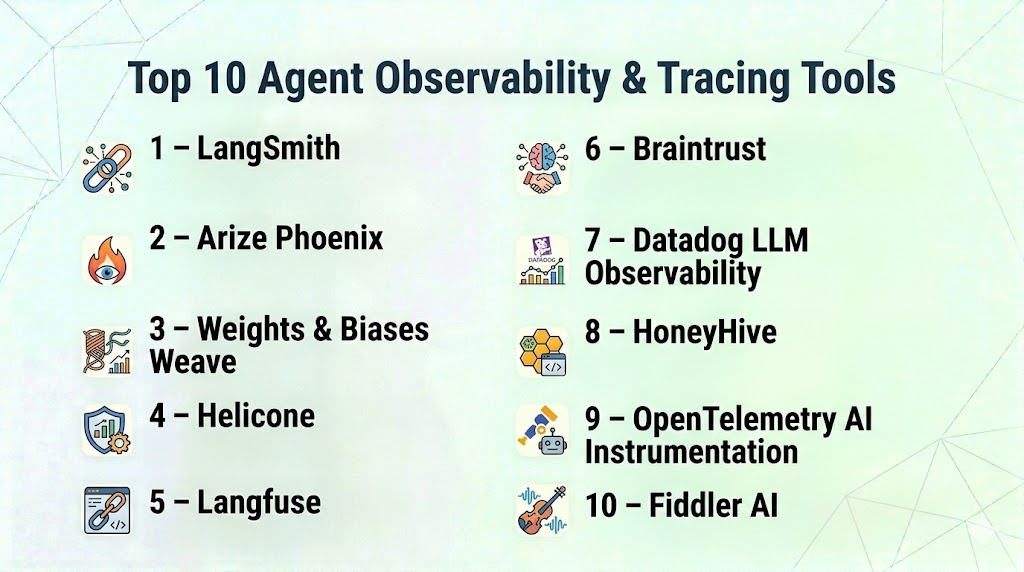
Top 10 Agent Observability & Tracing Tools
1- LangSmith
One-line verdict: Best for teams building production AI applications using the LangChain ecosystem.
Short description:
LangSmith is a specialized observability, evaluation, and debugging platform for LLM applications and AI agents. It provides detailed traces, testing workflows, and production monitoring capabilities.
Standout Capabilities
- End-to-end trace visualization
- Agent execution monitoring
- Prompt debugging
- Dataset management
- Evaluation workflows
- Regression testing
- Human feedback collection
- Production analytics
AI-Specific Depth
- Model support: Multi-model, BYO model
- RAG / knowledge integration: Vector database compatible
- Evaluation: Automated and human evaluation workflows
- Guardrails: Basic workflow validation
- Observability: Detailed traces, token tracking, latency monitoring
Pros
- Strong developer experience
- Deep LangChain integration
- Comprehensive evaluation capabilities
Cons
- Best experience within LangChain ecosystem
- Advanced enterprise features may require higher tiers
- Less neutral than some platform-agnostic solutions
Security & Compliance
SSO, RBAC, audit capabilities, encryption, and retention controls vary by deployment tier. Additional certifications are not publicly stated.
Deployment & Platforms
- Web interface
- Cloud deployment
- Enterprise deployment options vary
Integrations & Ecosystem
Strong integration with LangChain, APIs, SDKs, evaluation workflows, and model providers.
- LangChain
- OpenAI
- Anthropic
- Vector databases
- Python SDK
- APIs
Pricing Model
Tiered SaaS with enterprise options.
Best-Fit Scenarios
- LangChain applications
- Agent debugging
- Production evaluation pipelines
2- Arize Phoenix
One-line verdict: Excellent for teams seeking open-source AI observability and evaluation capabilities.
Short description:
Phoenix is an open-source observability platform focused on LLMs, agents, and RAG systems. It provides tracing, evaluation, and debugging tools.
Standout Capabilities
- Open-source deployment
- Trace visualization
- RAG analysis
- Hallucination detection workflows
- Embedding analysis
- Evaluation support
- Dataset inspection
- Root-cause analysis
AI-Specific Depth
- Model support: Multi-model
- RAG / knowledge integration: Strong RAG monitoring
- Evaluation: Extensive evaluation workflows
- Guardrails: Limited native guardrails
- Observability: Traces, latency, token analytics
Pros
- Open-source flexibility
- Strong RAG visibility
- Active community
Cons
- Requires operational expertise
- Enterprise workflows may require additional tooling
- Smaller ecosystem than some commercial vendors
Security & Compliance
Depends on deployment configuration.
Deployment & Platforms
- Cloud
- Self-hosted
- Hybrid
Integrations & Ecosystem
Supports modern AI stacks and observability ecosystems.
- OpenTelemetry
- LangChain
- LlamaIndex
- OpenAI
- Anthropic
- Vector databases
Pricing Model
Open-source with enterprise offerings.
Best-Fit Scenarios
- Self-hosted environments
- RAG systems
- Open-source-first organizations
3- Weights & Biases Weave
One-line verdict: Strong choice for organizations already using W&B for AI development.
Short description:
Weave extends experiment tracking into LLM and agent observability with tracing, evaluations, and workflow debugging.
Standout Capabilities
- Experiment tracking integration
- Trace visualization
- Evaluation management
- Workflow comparison
- Prompt tracking
- Model monitoring
- Collaborative debugging
- Production insights
AI-Specific Depth
- Model support: Multi-model
- RAG / knowledge integration: Supported
- Evaluation: Strong evaluation tooling
- Guardrails: Limited native controls
- Observability: Tracing, metrics, cost tracking
Pros
- Mature ML ecosystem
- Strong evaluation workflows
- Excellent collaboration
Cons
- Learning curve
- May be more than needed for smaller teams
- Some features focus heavily on ML workflows
Security & Compliance
Varies by deployment tier.
Deployment & Platforms
- Cloud
- Enterprise deployment options
Integrations & Ecosystem
- W&B ecosystem
- APIs
- SDKs
- ML frameworks
- Model providers
Pricing Model
Tiered SaaS.
Best-Fit Scenarios
- ML teams
- AI research groups
- Enterprise experimentation
4- Helicone
One-line verdict: Best for lightweight AI observability with rapid implementation.
Short description:
Helicone focuses on monitoring, tracing, and analytics for LLM applications with minimal setup overhead.
Standout Capabilities
- Fast deployment
- Request monitoring
- Cost tracking
- User analytics
- Session visibility
- Request replay
- Performance analytics
- Open-source options
AI-Specific Depth
- Model support: Multi-model
- RAG / knowledge integration: Basic support
- Evaluation: Limited
- Guardrails: N/A
- Observability: Cost, latency, traces
Pros
- Easy adoption
- Developer-friendly
- Strong cost analytics
Cons
- Less comprehensive evaluation tooling
- Limited governance features
- Smaller enterprise footprint
Security & Compliance
Varies by deployment.
Deployment & Platforms
- Cloud
- Self-hosted
Integrations & Ecosystem
- OpenAI
- Anthropic
- APIs
- SDKs
- Open-source tooling
Pricing Model
Usage-based and open-source options.
Best-Fit Scenarios
- Startups
- MVP deployments
- Cost optimization
5- Langfuse
One-line verdict: Excellent open-source observability platform for production AI applications.
Short description:
Langfuse provides tracing, analytics, evaluations, prompt management, and monitoring for AI applications.
Standout Capabilities
- Open-source architecture
- Prompt management
- Production monitoring
- Tracing workflows
- Evaluation support
- Cost analytics
- User feedback collection
- Version tracking
AI-Specific Depth
- Model support: Multi-model
- RAG / knowledge integration: Supported
- Evaluation: Integrated evaluation workflows
- Guardrails: Limited
- Observability: Comprehensive tracing and metrics
Pros
- Strong open-source option
- Active ecosystem
- Enterprise flexibility
Cons
- Requires management when self-hosted
- Governance depth varies
- Advanced features may require customization
Security & Compliance
Depends on deployment configuration.
Deployment & Platforms
- Cloud
- Self-hosted
- Hybrid
Integrations & Ecosystem
- LangChain
- LlamaIndex
- APIs
- SDKs
- Vector databases
- OpenAI
Pricing Model
Open-source and enterprise offerings.
Best-Fit Scenarios
- Production AI applications
- Self-hosted environments
- Platform engineering teams
6- Braintrust
One-line verdict: Best for organizations prioritizing evaluation-driven AI development.
Short description:
Braintrust combines observability with evaluation workflows, helping teams measure and improve AI quality.
Standout Capabilities
- Evaluation-first design
- Trace analytics
- Human review workflows
- Dataset management
- Experiment tracking
- Prompt testing
- Quality measurement
- Regression analysis
AI-Specific Depth
- Model support: Multi-model
- RAG / knowledge integration: Supported
- Evaluation: Extensive
- Guardrails: Basic monitoring
- Observability: Tracing and analytics
Pros
- Strong quality focus
- Evaluation maturity
- Good collaboration
Cons
- Newer ecosystem
- Smaller community
- Some enterprise capabilities still evolving
Security & Compliance
Varies by deployment.
Deployment & Platforms
- Cloud
- Enterprise options
Integrations & Ecosystem
- APIs
- SDKs
- Model providers
- Evaluation frameworks
Pricing Model
Tiered SaaS.
Best-Fit Scenarios
- AI quality improvement
- Evaluation-centric teams
- Enterprise pilots
7- Datadog LLM Observability
One-line verdict: Best for enterprises already standardized on Datadog observability.
Short description:
Datadog extends traditional observability into AI workloads, offering visibility into LLM and agent operations.
Standout Capabilities
- Unified observability
- Infrastructure correlation
- AI performance analytics
- Distributed tracing
- Cost visibility
- Alerting workflows
- Incident response integration
- Enterprise governance
AI-Specific Depth
- Model support: Multi-model
- RAG / knowledge integration: Limited
- Evaluation: Basic
- Guardrails: Limited
- Observability: Enterprise-grade tracing
Pros
- Enterprise maturity
- Existing operational workflows
- Strong scalability
Cons
- Can be expensive
- AI-specific depth not as specialized
- Complex deployment environments
Security & Compliance
Enterprise security controls available. Certifications vary by service.
Deployment & Platforms
- Cloud
- Enterprise environments
Integrations & Ecosystem
- Infrastructure monitoring
- APM
- Logging
- Cloud platforms
- APIs
Pricing Model
Usage-based enterprise pricing.
Best-Fit Scenarios
- Large enterprises
- Existing Datadog users
- Unified observability strategies
8- HoneyHive
One-line verdict: Strong platform for evaluating and monitoring agent performance at scale.
Short description:
HoneyHive focuses on evaluation, experimentation, tracing, and monitoring for modern AI systems.
Standout Capabilities
- Agent monitoring
- Evaluation workflows
- Experiment tracking
- Prompt analysis
- Quality metrics
- Human review
- Dataset management
- Performance analytics
AI-Specific Depth
- Model support: Multi-model
- RAG / knowledge integration: Supported
- Evaluation: Extensive
- Guardrails: Limited
- Observability: Agent traces and metrics
Pros
- Strong AI focus
- Good evaluation workflows
- Modern architecture
Cons
- Smaller ecosystem
- Limited enterprise adoption compared to leaders
- Growing platform
Security & Compliance
Varies by deployment.
Deployment & Platforms
- Cloud
- Enterprise options
Integrations & Ecosystem
- APIs
- SDKs
- Model providers
- Agent frameworks
Pricing Model
Tiered SaaS.
Best-Fit Scenarios
- AI startups
- Agent platforms
- Evaluation-heavy environments
9- OpenTelemetry AI Instrumentation
One-line verdict: Best for organizations seeking vendor-neutral observability foundations.
Short description:
OpenTelemetry is becoming the standard foundation for telemetry collection across AI and agent ecosystems.
Standout Capabilities
- Open standard
- Vendor neutrality
- Distributed tracing
- Large ecosystem
- Extensible architecture
- Cross-platform support
- Community-driven innovation
- Interoperability
AI-Specific Depth
- Model support: Multi-model
- RAG / knowledge integration: Varies
- Evaluation: N/A
- Guardrails: N/A
- Observability: Strong tracing foundation
Pros
- No vendor lock-in
- Broad adoption
- Flexible architecture
Cons
- Requires implementation effort
- Not a complete product
- Limited built-in evaluation
Security & Compliance
Depends on deployment architecture.
Deployment & Platforms
- Cloud
- Self-hosted
- Hybrid
Integrations & Ecosystem
- Observability vendors
- Cloud platforms
- APIs
- SDKs
- Monitoring tools
Pricing Model
Open-source.
Best-Fit Scenarios
- Custom platforms
- Enterprise architectures
- Vendor-neutral strategies
10- Fiddler AI
One-line verdict: Best for enterprises needing governance, monitoring, and observability together.
Short description:
Fiddler AI combines model monitoring, observability, explainability, and governance capabilities.
Standout Capabilities
- Model monitoring
- Explainability
- Governance workflows
- Drift detection
- Audit capabilities
- AI quality monitoring
- Enterprise reporting
- Risk management
AI-Specific Depth
- Model support: Multi-model
- RAG / knowledge integration: Varies
- Evaluation: Supported
- Guardrails: Governance-focused controls
- Observability: Monitoring and tracing capabilities
Pros
- Strong governance
- Enterprise focus
- Risk visibility
Cons
- Less developer-centric
- Enterprise-oriented complexity
- Higher adoption effort
Security & Compliance
Enterprise-grade controls available. Certifications vary by offering.
Deployment & Platforms
- Cloud
- Enterprise deployment options
Integrations & Ecosystem
- APIs
- ML platforms
- Governance workflows
- Enterprise systems
Pricing Model
Enterprise-focused licensing.
Best-Fit Scenarios
- Regulated industries
- Governance initiatives
- Enterprise AI programs
Comparison Table
| Tool Name | Best For | Deployment | Model Flexibility | Strength | Watch-Out | Public Rating |
|---|---|---|---|---|---|---|
| LangSmith | LangChain teams | Cloud | Multi-model | Deep agent tracing | Ecosystem dependence | N/A |
| Arize Phoenix | Open-source users | Hybrid | Multi-model | RAG observability | Requires expertise | N/A |
| Weave | ML teams | Cloud | Multi-model | Evaluation workflows | Learning curve | N/A |
| Helicone | Startups | Cloud/Self-hosted | Multi-model | Fast deployment | Limited governance | N/A |
| Langfuse | Platform teams | Hybrid | Multi-model | Open-source flexibility | Self-hosting overhead | N/A |
| Braintrust | Evaluation teams | Cloud | Multi-model | Quality measurement | Smaller ecosystem | N/A |
| Datadog | Enterprises | Cloud | Multi-model | Unified monitoring | Cost complexity | N/A |
| HoneyHive | AI startups | Cloud | Multi-model | Agent evaluation | Growing platform | N/A |
| OpenTelemetry | DIY builders | Hybrid | Open-source | Vendor neutrality | Engineering effort | N/A |
| Fiddler AI | Regulated sectors | Cloud | Multi-model | Governance | Enterprise complexity | N/A |
Scoring & Evaluation
The following scores are comparative rather than absolute. They reflect relative strengths across observability, evaluation, governance, integrations, operational maturity, and AI-specific capabilities. Different organizations will prioritize different criteria depending on scale, compliance requirements, and engineering resources.
| Tool | Core | Reliability/Eval | Guardrails | Integrations | Ease | Perf/Cost | Security/Admin | Support | Weighted Total |
|---|---|---|---|---|---|---|---|---|---|
| LangSmith | 9 | 9 | 7 | 9 | 9 | 8 | 8 | 8 | 8.5 |
| Arize Phoenix | 8 | 9 | 6 | 8 | 7 | 8 | 7 | 7 | 7.8 |
| Weave | 8 | 9 | 6 | 8 | 8 | 8 | 8 | 8 | 8.0 |
| Helicone | 7 | 6 | 5 | 7 | 9 | 9 | 6 | 7 | 7.1 |
| Langfuse | 8 | 8 | 6 | 8 | 8 | 8 | 8 | 8 | 7.9 |
| Braintrust | 8 | 9 | 6 | 8 | 8 | 8 | 7 | 7 | 7.9 |
| Datadog | 9 | 7 | 6 | 10 | 7 | 7 | 9 | 9 | 8.2 |
| HoneyHive | 8 | 8 | 6 | 7 | 8 | 8 | 7 | 7 | 7.6 |
| OpenTelemetry | 7 | 6 | 5 | 10 | 5 | 9 | 7 | 9 | 7.3 |
| Fiddler AI | 8 | 8 | 8 | 7 | 7 | 7 | 9 | 8 | 7.9 |
Top 3 for Enterprise
- LangSmith
- Datadog LLM Observability
- Fiddler AI
Top 3 for SMB
- Langfuse
- Helicone
- Arize Phoenix
Top 3 for Developers
- LangSmith
- Langfuse
- Arize Phoenix
Which Agent Observability & Tracing Tool Is Right for You?
Solo / Freelancer
Helicone and Langfuse provide strong observability without significant operational overhead. OpenTelemetry may work for technically advanced developers.
SMB
Langfuse, Arize Phoenix, and Braintrust offer strong functionality while maintaining reasonable complexity.
Mid-Market
LangSmith, Braintrust, and HoneyHive balance observability, evaluation, and scalability.
Enterprise
LangSmith, Datadog, and Fiddler AI provide governance, scalability, and enterprise controls.
Regulated Industries
Fiddler AI and Datadog are strong candidates where governance, auditability, and risk management matter.
Budget vs Premium
Budget-conscious teams should consider OpenTelemetry, Langfuse, and Phoenix. Premium buyers may benefit from LangSmith, Datadog, or Fiddler AI.
Build vs Buy
Build with OpenTelemetry when you have dedicated platform engineering resources and require full control. Buy a commercial platform when speed, support, and enterprise governance are priorities.
Implementation Playbook (30 / 60 / 90 Days)
First 30 Days
- Instrument core AI workflows
- Define success metrics
- Capture traces and latency baselines
- Establish prompt version control
- Create evaluation datasets
- Launch pilot environment
First 60 Days
- Implement RBAC policies
- Configure audit logging
- Establish regression evaluations
- Conduct prompt injection testing
- Add incident response workflows
- Roll out to additional teams
First 90 Days
- Optimize model routing
- Reduce latency bottlenecks
- Implement governance workflows
- Improve evaluation automation
- Build executive dashboards
- Scale monitoring across all agents
Common Mistakes & How to Avoid Them
- Deploying agents without tracing
- Ignoring evaluation workflows
- Not tracking token costs
- Missing retrieval quality monitoring
- Overlooking latency bottlenecks
- Skipping prompt version control
- Retaining data indefinitely
- No incident response process
- Over-automation without review
- Lack of governance controls
- Weak access management
- Vendor lock-in without abstraction
- No red-team testing
- Failure to monitor hallucinations
FAQs
What is agent observability?
Agent observability provides visibility into AI agent behavior, including prompts, tool calls, retrieval operations, latency, costs, and outcomes.
Why is tracing important for AI agents?
Tracing helps teams understand why agents behave a certain way, making debugging and optimization significantly easier.
Do these tools work with multiple models?
Most modern platforms support multiple foundation models and allow organizations to monitor heterogeneous AI environments.
Can I self-host observability platforms?
Several solutions such as Langfuse, Phoenix, and OpenTelemetry support self-hosted deployments.
Are observability and evaluation the same thing?
No. Observability focuses on visibility and monitoring, while evaluation measures quality, reliability, and performance.
Do these platforms help reduce hallucinations?
They help identify hallucination patterns and provide evaluation workflows, but they do not eliminate hallucinations completely.
How important is RAG monitoring?
Very important. Poor retrieval quality often causes inaccurate outputs even when the underlying model performs well.
What security controls should enterprises require?
Organizations should evaluate RBAC, audit logs, encryption, retention controls, and access governance capabilities.
Can these tools monitor multi-agent systems?
Many leading platforms now support complex agent workflows and multi-agent tracing.
Is OpenTelemetry enough by itself?
OpenTelemetry provides a strong telemetry foundation but often requires additional tooling for AI-specific evaluation and governance.
How can observability reduce costs?
By identifying expensive prompts, inefficient workflows, excessive tool usage, and suboptimal model routing.
How difficult is migration between platforms?
Migration complexity varies. Open standards, APIs, and OpenTelemetry compatibility can reduce switching effort.
Conclusion
Agent Observability & Tracing Tools have become foundational infrastructure for modern AI systems. As organizations move from simple chatbots to autonomous agents, multi-agent workflows, and enterprise-scale AI applications, visibility into behavior, costs, reliability, and governance becomes essential. The strongest platforms now combine tracing, evaluation, monitoring, governance, and cost analytics into a unified operational layer. LangSmith currently leads for agent-native observability, Langfuse and Arize Phoenix are excellent open-source choices, Datadog appeals to enterprises seeking unified monitoring, and Fiddler AI stands out for governance-heavy environments. The right choice ultimately depends on your architecture, compliance requirements, team expertise, and scale. Start by shortlisting two or three platforms, run a controlled pilot with real production workloads, validate security and evaluation requirements, and then scale observability across your AI ecosystem with governance and cost optimization built in from day one.
