Introduction
Agent Test & Replay Frameworks help teams validate, debug, reproduce, and improve AI agent behavior before and after deployment. Unlike traditional software testing tools, these platforms focus on AI-specific challenges such as prompt changes, model updates, hallucinations, tool-calling failures, memory inconsistencies, retrieval errors, and multi-agent coordination issues. They allow teams to capture agent executions, replay them against new models or prompts, compare outcomes, run regression tests, and measure quality over time.
As AI agents become responsible for customer support, workflow automation, research, software development, document processing, and decision assistance, testing is becoming as important as observability. A small prompt modification or model upgrade can significantly change behavior. Agent Test & Replay Frameworks provide the infrastructure needed to maintain reliability, governance, and trust in production AI systems.
Real-world use cases include:
- Regression testing AI agents before releases
- Comparing model versions and prompts
- Replaying production failures for debugging
- Evaluating RAG system quality
- Testing tool-calling workflows
- Validating multi-agent orchestration systems
What buyers should evaluate
- Replay accuracy
- Evaluation capabilities
- Dataset management
- Prompt versioning
- Multi-model support
- Agent workflow visibility
- RAG testing capabilities
- Security controls
- CI/CD integration
- Scalability
- Human review workflows
- Cost monitoring
Best for: AI engineers, platform teams, MLOps teams, LLMOps engineers, AI product teams, enterprises deploying production agents, regulated industries, and organizations operating multiple AI applications.
Not ideal for: Teams running simple chatbots with limited production exposure, organizations without AI deployment pipelines, or projects where manual testing remains sufficient.
What’s Changed in Agent Test & Replay Frameworks
- Agent replay is becoming a standard requirement for production AI.
- Multi-agent testing capabilities are rapidly expanding.
- Evaluation frameworks are increasingly integrated with replay systems.
- Prompt version control is becoming mandatory.
- Synthetic dataset generation is improving test coverage.
- RAG-specific replay testing is gaining adoption.
- Tool-calling validation is now a core feature.
- Guardrail testing is becoming more automated.
- Enterprise governance requirements continue increasing.
- Model upgrade simulations are becoming common.
- Human-in-the-loop evaluation workflows are maturing.
- OpenTelemetry-based replay architectures are emerging.
Quick Buyer Checklist
Before selecting a platform, verify:
- □ Supports agent replay and execution reconstruction
- □ Handles prompt version comparisons
- □ Supports multiple foundation models
- □ Provides regression testing
- □ Supports RAG evaluation
- □ Includes human review workflows
- □ Tracks latency and cost metrics
- □ Integrates with CI/CD pipelines
- □ Supports synthetic test generation
- □ Provides audit logs
- □ Includes RBAC controls
- □ Supports tool-calling validation
- □ Offers API access
- □ Supports production-scale datasets
- □ Minimizes vendor lock-in
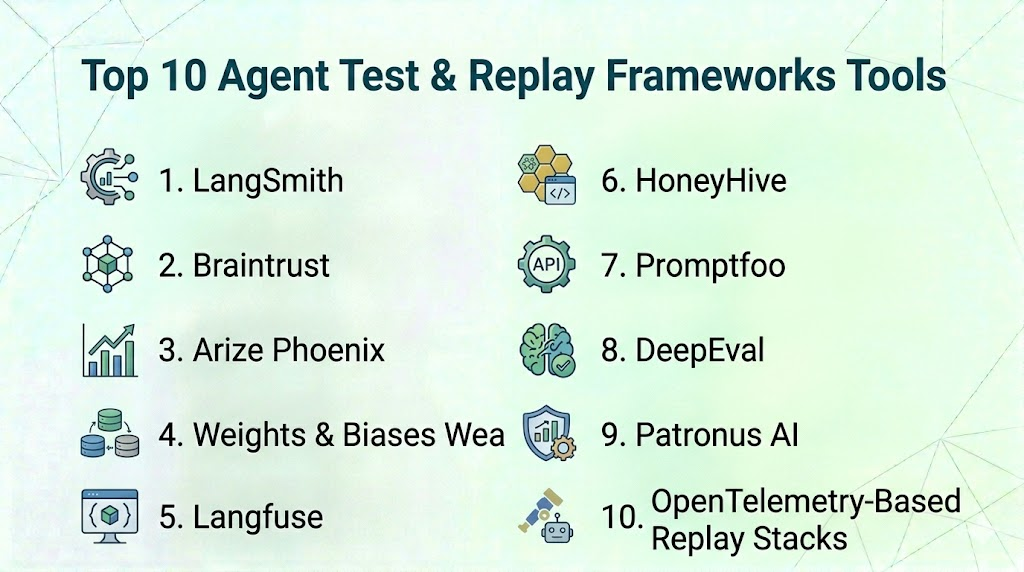
Top 10 Agent Test & Replay Frameworks Tools
1- LangSmith
One-line verdict: Best overall platform for testing, replaying, and evaluating LangChain-based AI agents.
Short description:
LangSmith combines tracing, replay, testing, and evaluation capabilities for AI applications. It enables teams to reproduce executions, compare versions, and identify regressions before deployment.
Standout Capabilities
- Agent execution replay
- Prompt version comparison
- Regression testing
- Dataset management
- Human feedback collection
- Automated evaluations
- Trace inspection
- Experiment tracking
AI-Specific Depth
- Model support: Multi-model and BYO model
- RAG / knowledge integration: Strong support
- Evaluation: Offline and online evaluations
- Guardrails: Workflow validation capabilities
- Observability: Full trace replay, token analytics, latency tracking
Pros
- Comprehensive testing workflows
- Strong LangChain ecosystem integration
- Mature evaluation capabilities
Cons
- Best suited for LangChain users
- Some enterprise features may require premium plans
- Less framework-neutral than some alternatives
Security & Compliance
SSO, RBAC, audit controls, retention controls, and encryption support vary by deployment tier. Additional certifications are not publicly stated.
Deployment & Platforms
- Web-based platform
- Cloud deployment
- Enterprise deployment options
Integrations & Ecosystem
Strong integration with modern AI development stacks.
- LangChain
- OpenAI
- Anthropic
- APIs
- SDKs
- Vector databases
Pricing Model
Tiered SaaS with enterprise options.
Best-Fit Scenarios
- Production AI agents
- Regression testing pipelines
- Prompt optimization initiatives
2- Braintrust
One-line verdict: Excellent for evaluation-driven testing and replay workflows across production AI systems.
Short description:
Braintrust focuses heavily on AI evaluation, experimentation, and replay testing. It enables organizations to compare prompts, models, and workflows while tracking quality improvements.
Standout Capabilities
- Experiment management
- Replay testing
- Human evaluations
- Dataset versioning
- Prompt comparisons
- Regression analysis
- Quality scoring
- Workflow validation
AI-Specific Depth
- Model support: Multi-model
- RAG / knowledge integration: Supported
- Evaluation: Extensive
- Guardrails: Basic validation
- Observability: Replay and trace analytics
Pros
- Strong evaluation-first approach
- Good workflow comparisons
- Collaborative testing capabilities
Cons
- Smaller ecosystem
- Growing enterprise footprint
- Advanced governance features still evolving
Security & Compliance
Varies by deployment model.
Deployment & Platforms
- Cloud
- Enterprise deployment options
Integrations & Ecosystem
- APIs
- SDKs
- Foundation models
- Agent frameworks
Pricing Model
Tiered SaaS.
Best-Fit Scenarios
- Evaluation-heavy teams
- Model benchmarking
- AI quality improvement programs
3- Arize Phoenix
One-line verdict: Best open-source option for replay, testing, evaluation, and RAG debugging.
Short description:
Phoenix provides open-source tooling for tracing, replaying, evaluating, and debugging AI systems with a strong focus on RAG applications.
Standout Capabilities
- Open-source deployment
- Replay workflows
- Trace inspection
- Hallucination analysis
- Retrieval evaluation
- Embedding analysis
- Dataset testing
- Root-cause investigation
AI-Specific Depth
- Model support: Multi-model
- RAG / knowledge integration: Strong support
- Evaluation: Extensive
- Guardrails: Limited native controls
- Observability: Replay, traces, latency monitoring
Pros
- Open-source flexibility
- Excellent RAG visibility
- Active developer community
Cons
- Requires operational expertise
- Enterprise workflows may need additional tools
- More engineering effort than SaaS platforms
Security & Compliance
Depends on deployment configuration.
Deployment & Platforms
- Cloud
- Self-hosted
- Hybrid
Integrations & Ecosystem
- OpenTelemetry
- LangChain
- LlamaIndex
- Vector databases
- APIs
Pricing Model
Open-source with enterprise offerings.
Best-Fit Scenarios
- RAG testing
- Open-source deployments
- Internal AI platforms
4- Weights & Biases Weave
One-line verdict: Strong replay and experimentation platform for ML and AI engineering teams.
Short description:
Weave extends experiment tracking into AI application testing and replay workflows, enabling version comparisons and quality evaluations.
Standout Capabilities
- Experiment replay
- Trace comparison
- Evaluation workflows
- Prompt testing
- Dataset management
- Team collaboration
- Workflow debugging
- Version tracking
AI-Specific Depth
- Model support: Multi-model
- RAG / knowledge integration: Supported
- Evaluation: Strong
- Guardrails: Limited
- Observability: Replay and trace monitoring
Pros
- Mature ecosystem
- Excellent experiment management
- Strong collaboration features
Cons
- Learning curve
- ML-focused heritage
- Can be complex for smaller teams
Security & Compliance
Varies by deployment option.
Deployment & Platforms
- Cloud
- Enterprise environments
Integrations & Ecosystem
- W&B ecosystem
- AI frameworks
- APIs
- SDKs
Pricing Model
Tiered SaaS.
Best-Fit Scenarios
- AI research teams
- Enterprise AI programs
- Evaluation-driven development
5- Langfuse
One-line verdict: Excellent open-source platform combining tracing, replay, testing, and prompt management.
Short description:
Langfuse offers production-grade observability, replay testing, evaluation workflows, and prompt management for AI systems.
Standout Capabilities
- Trace replay
- Prompt versioning
- Evaluation workflows
- Production monitoring
- Cost analytics
- User feedback collection
- Dataset analysis
- Workflow debugging
AI-Specific Depth
- Model support: Multi-model
- RAG / knowledge integration: Supported
- Evaluation: Integrated
- Guardrails: Limited
- Observability: Strong tracing and replay capabilities
Pros
- Open-source flexibility
- Active ecosystem
- Strong production focus
Cons
- Self-hosting management overhead
- Governance depth varies
- Advanced enterprise features may require customization
Security & Compliance
Depends on deployment model.
Deployment & Platforms
- Cloud
- Self-hosted
- Hybrid
Integrations & Ecosystem
- LangChain
- LlamaIndex
- APIs
- SDKs
- Vector databases
Pricing Model
Open-source plus enterprise plans.
Best-Fit Scenarios
- Platform engineering
- Production AI systems
- Self-hosted environments
6- HoneyHive
One-line verdict: Strong choice for testing, replay, and evaluation of modern agent systems.
Short description:
HoneyHive provides monitoring, replay, experimentation, and testing capabilities focused on agent reliability and quality measurement.
Standout Capabilities
- Agent replay
- Evaluation workflows
- Prompt comparisons
- Dataset management
- Performance testing
- Human review
- Experiment tracking
- Workflow analytics
AI-Specific Depth
- Model support: Multi-model
- RAG / knowledge integration: Supported
- Evaluation: Extensive
- Guardrails: Limited
- Observability: Replay, traces, metrics
Pros
- AI-native design
- Strong evaluation workflows
- Modern architecture
Cons
- Smaller ecosystem
- Growing enterprise presence
- Fewer integrations than leaders
Security & Compliance
Varies by deployment.
Deployment & Platforms
- Cloud
- Enterprise options
Integrations & Ecosystem
- APIs
- SDKs
- Model providers
- Agent frameworks
Pricing Model
Tiered SaaS.
Best-Fit Scenarios
- Agent development teams
- Startup AI platforms
- Evaluation-heavy environments
7- Promptfoo
One-line verdict: Best open-source framework for prompt testing and automated regression validation.
Short description:
Promptfoo is a developer-focused open-source framework designed to evaluate prompts, compare models, and automate AI testing workflows.
Standout Capabilities
- Prompt testing
- Model comparisons
- Regression testing
- Automated evaluations
- CI/CD integration
- Open-source workflows
- Benchmarking
- Custom scoring
AI-Specific Depth
- Model support: Multi-model
- RAG / knowledge integration: Basic support
- Evaluation: Strong
- Guardrails: Basic validation
- Observability: Limited compared with full observability platforms
Pros
- Developer-friendly
- Open-source
- Excellent CI integration
Cons
- Less observability depth
- Limited enterprise governance
- Smaller user interface capabilities
Security & Compliance
Depends on deployment.
Deployment & Platforms
- CLI
- Self-hosted
- Local environments
Integrations & Ecosystem
- GitHub
- CI/CD systems
- Foundation models
- APIs
Pricing Model
Open-source.
Best-Fit Scenarios
- Prompt engineering
- Automated testing pipelines
- Developer teams
8- DeepEval
One-line verdict: Strong framework for automated LLM evaluation and replay validation.
Short description:
DeepEval focuses on measuring AI application quality through evaluation-driven testing and validation workflows.
Standout Capabilities
- Automated evaluations
- Regression testing
- Quality scoring
- Benchmarking
- Replay analysis
- Custom metrics
- Test suites
- CI integration
AI-Specific Depth
- Model support: Multi-model
- RAG / knowledge integration: Supported
- Evaluation: Extensive
- Guardrails: Basic testing support
- Observability: Limited compared to observability-first tools
Pros
- Evaluation-focused
- Open-source
- Strong testing framework
Cons
- Less production observability
- Requires engineering effort
- Smaller ecosystem
Security & Compliance
Depends on deployment.
Deployment & Platforms
- Self-hosted
- Local development
- CI environments
Integrations & Ecosystem
- LangChain
- LlamaIndex
- APIs
- CI/CD platforms
Pricing Model
Open-source.
Best-Fit Scenarios
- Evaluation pipelines
- Regression testing
- Quality assurance teams
9- Patronus AI
One-line verdict: Best for AI reliability validation and risk-focused replay testing.
Short description:
Patronus AI emphasizes AI reliability, safety evaluation, and quality assurance through automated testing frameworks.
Standout Capabilities
- Reliability testing
- Safety evaluation
- Hallucination detection
- Risk assessment
- Replay validation
- Quality scoring
- Compliance workflows
- Automated monitoring
AI-Specific Depth
- Model support: Multi-model
- RAG / knowledge integration: Supported
- Evaluation: Strong
- Guardrails: Safety-focused controls
- Observability: Quality monitoring and replay analytics
Pros
- Reliability-centric
- Safety evaluation focus
- Enterprise appeal
Cons
- Narrower scope than observability platforms
- Growing ecosystem
- Specialized use cases
Security & Compliance
Varies by deployment.
Deployment & Platforms
- Cloud
- Enterprise options
Integrations & Ecosystem
- APIs
- Evaluation pipelines
- Foundation models
Pricing Model
Enterprise-focused.
Best-Fit Scenarios
- High-risk AI systems
- Safety testing
- Compliance initiatives
10- OpenTelemetry-Based Replay Stacks
One-line verdict: Best for organizations building custom replay infrastructure with maximum flexibility.
Short description:
OpenTelemetry-based architectures allow teams to create customized replay and testing systems while maintaining vendor neutrality.
Standout Capabilities
- Vendor neutrality
- Custom replay pipelines
- Distributed tracing
- Open standards
- Extensible architecture
- Multi-vendor support
- Large ecosystem
- Long-term flexibility
AI-Specific Depth
- Model support: Multi-model
- RAG / knowledge integration: Varies
- Evaluation: N/A
- Guardrails: N/A
- Observability: Strong tracing foundation
Pros
- No vendor lock-in
- Highly flexible
- Large ecosystem
Cons
- Significant engineering effort
- Not a complete product
- Requires internal expertise
Security & Compliance
Depends entirely on deployment architecture.
Deployment & Platforms
- Cloud
- Self-hosted
- Hybrid
Integrations & Ecosystem
- Observability platforms
- APIs
- SDKs
- Monitoring tools
- Cloud providers
Pricing Model
Open-source.
Best-Fit Scenarios
- Large enterprises
- Platform teams
- Custom observability strategies
Comparison Table
| Tool Name | Best For | Deployment | Model Flexibility | Strength | Watch-Out | Public Rating |
|---|---|---|---|---|---|---|
| LangSmith | Agent testing | Cloud | Multi-model | Replay + evaluation | LangChain-centric | N/A |
| Braintrust | AI quality | Cloud | Multi-model | Evaluation workflows | Smaller ecosystem | N/A |
| Arize Phoenix | Open-source teams | Hybrid | Multi-model | RAG replay | Operational effort | N/A |
| Weave | ML organizations | Cloud | Multi-model | Experiment replay | Learning curve | N/A |
| Langfuse | Production AI | Hybrid | Multi-model | Open-source flexibility | Self-hosting overhead | N/A |
| HoneyHive | Agent platforms | Cloud | Multi-model | Agent evaluation | Growing ecosystem | N/A |
| Promptfoo | Prompt testing | Self-hosted | Multi-model | CI testing | Limited observability | N/A |
| DeepEval | Quality testing | Self-hosted | Multi-model | Evaluation automation | Less production focus | N/A |
| Patronus AI | Reliability testing | Cloud | Multi-model | Safety evaluation | Specialized focus | N/A |
| OpenTelemetry | DIY builders | Hybrid | Open-source | Vendor neutrality | Engineering effort | N/A |
Scoring & Evaluation
The scores below are comparative rather than absolute. Organizations should prioritize criteria based on their deployment scale, governance requirements, and engineering capabilities.
| Tool | Core | Reliability/Eval | Guardrails | Integrations | Ease | Perf/Cost | Security/Admin | Support | Weighted Total |
|---|---|---|---|---|---|---|---|---|---|
| LangSmith | 9 | 9 | 7 | 9 | 9 | 8 | 8 | 8 | 8.5 |
| Braintrust | 8 | 9 | 7 | 8 | 8 | 8 | 7 | 7 | 8.0 |
| Arize Phoenix | 8 | 9 | 6 | 8 | 7 | 8 | 7 | 7 | 7.8 |
| Weave | 8 | 8 | 6 | 8 | 8 | 8 | 8 | 8 | 8.0 |
| Langfuse | 8 | 8 | 6 | 8 | 8 | 8 | 8 | 8 | 7.9 |
| HoneyHive | 8 | 8 | 6 | 7 | 8 | 8 | 7 | 7 | 7.6 |
| Promptfoo | 7 | 8 | 6 | 7 | 8 | 9 | 6 | 8 | 7.5 |
| DeepEval | 7 | 9 | 6 | 7 | 7 | 8 | 6 | 7 | 7.4 |
| Patronus AI | 8 | 9 | 8 | 7 | 7 | 7 | 8 | 7 | 7.9 |
| OpenTelemetry | 7 | 6 | 5 | 10 | 5 | 9 | 7 | 9 | 7.3 |
Which Agent Test & Replay Framework Is Right for You?
Solo / Freelancer
Promptfoo and DeepEval offer affordable, developer-friendly testing workflows without requiring large infrastructure investments.
SMB
Langfuse, Arize Phoenix, and HoneyHive provide balanced functionality with manageable operational complexity.
Mid-Market
LangSmith, Braintrust, and Weave offer strong replay, testing, and evaluation capabilities while supporting growing AI teams.
Enterprise
LangSmith, Patronus AI, and Braintrust provide governance, quality assurance, and scalability required for enterprise AI deployments.
Regulated Industries (Finance, Healthcare, Public Sector)
Patronus AI and LangSmith are strong candidates where auditability, reliability, and controlled testing workflows are important.
Budget vs Premium
Budget-conscious organizations should evaluate Promptfoo, DeepEval, Arize Phoenix, and Langfuse. Premium buyers may benefit from LangSmith, Braintrust, and Patronus AI.
Build vs Buy (When to DIY)
Organizations with strong platform engineering teams may benefit from OpenTelemetry-based architectures. Most enterprises will achieve faster value through commercial solutions with built-in replay, testing, and evaluation capabilities.
Common Mistakes & How to Avoid Them
- Deploying agents without replay capability
- Ignoring regression testing
- Failing to version prompts
- No evaluation framework
- Missing RAG quality checks
- No tool-call validation
- Overlooking latency impacts
- Ignoring token costs
- Weak governance controls
- No human review process
- Excessive production experimentation
- Vendor lock-in without abstraction
- Lack of observability integration
- Skipping red-team testing
FAQs
What is an Agent Test & Replay Framework?
It is a platform that allows teams to reproduce agent executions, validate behavior, compare versions, and identify regressions before deployment.
Why is replay important for AI agents?
Replay enables developers to reproduce failures consistently, making debugging and optimization much faster.
How does replay differ from observability?
Observability helps understand what happened, while replay allows teams to rerun scenarios and validate changes.
Do these tools support multiple models?
Most leading platforms support multiple foundation models and allow side-by-side comparisons.
Can replay frameworks test RAG systems?
Yes. Many platforms can evaluate retrieval quality, context relevance, and answer accuracy.
Are these tools suitable for production systems?
Yes. Modern replay frameworks are designed for production AI deployments and continuous improvement workflows.
Do I need observability and replay together?
In most production environments, both capabilities complement each other and provide a more complete reliability strategy.
Can these frameworks reduce hallucinations?
They help identify and measure hallucination patterns, enabling teams to improve reliability over time.
Is self-hosting available?
Several open-source options such as Langfuse, Phoenix, Promptfoo, and DeepEval support self-hosted deployments.
How do replay frameworks help with compliance?
They provide reproducibility, auditability, testing records, and evaluation evidence for governance initiatives.
What role does human review play?
Human review remains critical for evaluating nuanced outputs, safety concerns, and business-specific requirements.
Can I integrate testing into CI/CD pipelines?
Yes. Many modern frameworks support automated testing and regression validation as part of deployment workflows.
Conclusion
Agent Test & Replay Frameworks are rapidly becoming essential infrastructure for organizations deploying AI agents at scale. As agent workflows become more autonomous, complex, and business-critical, the ability to reproduce behavior, compare changes, validate quality, and prevent regressions is becoming a core operational requirement. LangSmith currently offers one of the most comprehensive replay and evaluation experiences, while Langfuse and Arize Phoenix provide strong open-source alternatives. Braintrust excels in evaluation-driven development, and Promptfoo remains a favorite among developers seeking automated testing. Ultimately, the best platform depends on your architecture, governance requirements, budget, and engineering maturity. Start by identifying critical agent workflows, build a reliable evaluation dataset, pilot two or three platforms, verify security and testing capabilities, and then scale replay-driven quality assurance across your AI ecosystem.
