Introduction
Model Serving Platforms are the production layer of AI systems that make trained machine learning and large language models available for real-time or batch inference. They handle the critical job of deploying models behind APIs, managing traffic, scaling inference, optimizing latency, and ensuring reliability across production environments., AI systems are no longer experimental—they are mission-critical infrastructure powering recommendations, copilots, fraud detection, autonomous agents, and real-time decision-making systems. As a result, model serving has evolved from simple REST APIs into highly optimized inference orchestration layers supporting multi-model routing, GPU scaling, edge deployment, and LLM inference optimization.
Modern model serving platforms also integrate observability, A/B testing, canary deployments, cost controls, and safety guardrails, making them essential for production-grade AI systems.
Real-World Use Cases
- Real-time LLM inference APIs (chatbots, copilots)
- Recommendation system serving at scale
- Fraud detection and risk scoring APIs
- Image and video inference pipelines
- Autonomous agent tool execution
- Predictive analytics APIs
- Edge AI deployments (IoT, mobile, robotics)
Evaluation Criteria for Buyers
When evaluating Model Serving Platforms, consider:
- Low-latency inference performance
- GPU/CPU scaling efficiency
- Multi-model deployment support
- LLM optimization capabilities
- Autoscaling and traffic management
- Observability and monitoring
- Canary and A/B deployment support
- API flexibility (REST, gRPC, WebSockets)
- Cost optimization and batching
- Security and access control
- Cloud, hybrid, and edge support
- Integration with MLOps/LLMOps stacks
Best for: AI engineering teams, enterprises deploying production AI, SaaS companies embedding AI features, cloud-native AI platforms, and startups scaling inference-heavy applications.
Not ideal for: Early-stage experimentation, notebook-only workflows, or teams not deploying models into production systems.
What’s Changed in Model Serving Platforms
- LLM inference optimization is now a core feature (not optional)
- Multi-model routing across providers is standard
- Serverless GPU inference is widely adopted
- Edge model serving is becoming mainstream
- Token-level billing and cost observability are built-in
- Streaming inference APIs are standard for LLMs
- Model caching layers significantly reduce latency
- AI gateways now sit in front of serving platforms
- Auto-scaling is based on token load, not just requests
- Model safety filtering is integrated into serving layers
- Observability includes latency, drift, and quality scoring
- Hybrid deployment (cloud + edge) is increasingly common
Quick Buyer Checklist
Before selecting a model serving platform, verify:
- □ Low-latency inference support
- □ GPU scaling and optimization
- □ Multi-model routing capability
- □ LLM-specific inference optimization
- □ Autoscaling policies
- □ API flexibility (REST/gRPC/streaming)
- □ Observability and tracing tools
- □ A/B testing and canary deployments
- □ Cost monitoring and optimization
- □ Security (auth, RBAC, encryption)
- □ Edge deployment support
- □ Integration with MLOps/LLMOps tools
- □ High availability architecture
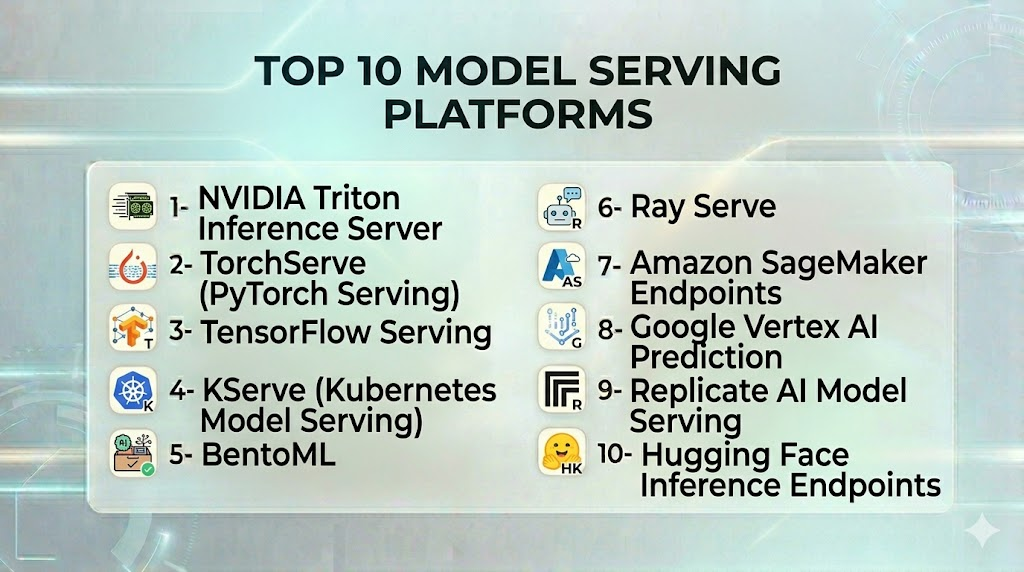
Top 10 Model Serving Platforms
1- NVIDIA Triton Inference Server
One-line verdict: Best high-performance inference engine for GPU-accelerated AI workloads.
Short description:
Triton is a production-grade inference server designed for high-throughput, low-latency model serving across GPUs and CPUs, widely used in enterprise AI systems.
Standout Capabilities
- Multi-framework model serving
- GPU-optimized inference
- Dynamic batching
- Concurrent model execution
- TensorRT optimization
- Multi-model deployment
- High-throughput APIs
AI-Specific Depth
- Model support: TensorFlow, PyTorch, ONNX, XGBoost
- RAG integration: External system required
- Evaluation: External observability tools
- Guardrails: Not built-in
- Observability: Metrics + logging APIs
Pros
- Extremely fast inference
- GPU optimized
- Enterprise scalability
Cons
- Complex setup
- Requires ML engineering expertise
- Not LLM-native by default
Security & Compliance
Depends on deployment environment.
Deployment & Platforms
- Cloud
- On-prem
- Edge
Integrations & Ecosystem
- Kubernetes
- TensorRT
- PyTorch
- TensorFlow
- ONNX ecosystem
Pricing Model
Open-source.
Best-Fit Scenarios
- High-performance ML inference
- Computer vision systems
- GPU-heavy AI workloads
2- TorchServe (PyTorch Serving)
One-line verdict: Best native PyTorch model deployment platform.
Short description:
TorchServe provides an easy way to deploy PyTorch models into scalable production APIs with built-in metrics and logging.
Standout Capabilities
- PyTorch-native serving
- Multi-model endpoints
- REST APIs
- Logging and metrics
- Model archiving
- Batch inference
- Scalable deployment
AI-Specific Depth
- Model support: PyTorch only
- RAG integration: External systems
- Evaluation: External tools required
- Guardrails: Not built-in
- Observability: Basic metrics
Pros
- Simple PyTorch deployment
- Easy integration
- Lightweight
Cons
- PyTorch-only limitation
- Limited LLM optimization
- Basic production features
Security & Compliance
Varies by deployment.
Deployment & Platforms
- Cloud
- Self-hosted
Integrations & Ecosystem
- PyTorch ecosystem
- Kubernetes
- AWS/GCP/Azure
Pricing Model
Open-source.
Best-Fit Scenarios
- PyTorch applications
- Research-to-production pipelines
- Lightweight serving needs
3- TensorFlow Serving
One-line verdict: Best stable serving system for TensorFlow-based models.
Short description:
TensorFlow Serving is a mature production system designed for deploying TensorFlow models at scale with high reliability.
Standout Capabilities
- TensorFlow model deployment
- Versioned models
- High-performance serving
- REST/gRPC APIs
- Model management
- Batch + real-time inference
- Scalable architecture
AI-Specific Depth
- Model support: TensorFlow only
- RAG integration: External
- Evaluation: External tools
- Guardrails: Not built-in
- Observability: Basic monitoring
Pros
- Stable and mature
- High performance
- Strong TensorFlow integration
Cons
- TensorFlow lock-in
- Limited flexibility
- Not LLM-optimized
Security & Compliance
Depends on deployment configuration.
Deployment & Platforms
- Cloud
- On-prem
Integrations & Ecosystem
- TensorFlow ecosystem
- Kubernetes
- Cloud platforms
Pricing Model
Open-source.
Best-Fit Scenarios
- TensorFlow production systems
- Enterprise ML pipelines
- Stable inference workloads
4- KServe (Kubernetes Model Serving)
One-line verdict: Best Kubernetes-native model serving platform for scalable ML systems.
Short description:
KServe provides a Kubernetes-based model inference platform supporting autoscaling, multi-framework models, and production-grade deployment patterns.
Standout Capabilities
- Kubernetes-native serving
- Autoscaling inference
- Multi-framework support
- Canary deployments
- A/B testing
- GPU scheduling
- Model pipelines
AI-Specific Depth
- Model support: Multi-framework
- RAG integration: External systems
- Evaluation: External tools
- Guardrails: Kubernetes policies
- Observability: Prometheus + logging
Pros
- Cloud-native architecture
- Highly scalable
- Flexible deployment
Cons
- Requires Kubernetes expertise
- Complex setup
- Operational overhead
Security & Compliance
Kubernetes RBAC and policy controls.
Deployment & Platforms
- Kubernetes
- Cloud
- Hybrid
Integrations & Ecosystem
- Kubernetes ecosystem
- Istio
- Prometheus
- ML frameworks
Pricing Model
Open-source.
Best-Fit Scenarios
- Cloud-native AI systems
- Enterprise Kubernetes workloads
- Scalable inference systems
5- BentoML
One-line verdict: Best developer-friendly model serving framework for rapid deployment.
Short description:
BentoML simplifies packaging and deploying ML models into production APIs with built-in serving, packaging, and scaling tools.
Standout Capabilities
- Model packaging
- API generation
- Multi-model serving
- Deployment pipelines
- Cloud export support
- Batch + real-time inference
- Python-native workflows
AI-Specific Depth
- Model support: Multi-framework
- RAG integration: External systems
- Evaluation: External tools
- Guardrails: Basic support
- Observability: Built-in logs
Pros
- Very easy to use
- Fast deployment
- Developer-friendly
Cons
- Limited enterprise governance
- Not deeply optimized for LLMs
- Requires scaling tools
Security & Compliance
Varies by deployment.
Deployment & Platforms
- Cloud
- Self-hosted
Integrations & Ecosystem
- Kubernetes
- AWS/GCP/Azure
- ML frameworks
- APIs
Pricing Model
Open-source + enterprise offering.
Best-Fit Scenarios
- Startup ML APIs
- Rapid prototyping
- Developer-first serving
6- Ray Serve
One-line verdict: Best distributed model serving system for scalable AI workloads.
Short description:
Ray Serve provides a scalable distributed system for deploying ML models and LLMs across clusters.
Standout Capabilities
- Distributed inference
- Auto-scaling workloads
- Multi-model pipelines
- LLM serving support
- Actor-based architecture
- Load balancing
- Streaming inference
AI-Specific Depth
- Model support: Multi-framework
- RAG integration: External systems
- Evaluation: External tools
- Guardrails: Custom implementation
- Observability: Ray dashboard
Pros
- Highly scalable
- Flexible architecture
- Strong LLM support
Cons
- Complex setup
- Requires distributed systems knowledge
- Operational overhead
Security & Compliance
Depends on cluster configuration.
Deployment & Platforms
- Cloud
- Kubernetes
- On-prem
Integrations & Ecosystem
- Ray ecosystem
- Kubernetes
- ML frameworks
- LLM pipelines
Pricing Model
Open-source.
Best-Fit Scenarios
- LLM inference systems
- Distributed AI workloads
- Scalable APIs
7- Amazon SageMaker Endpoints
One-line verdict: Best fully managed model serving for AWS-native AI workloads.
Short description:
SageMaker Endpoints provide scalable, managed inference infrastructure with autoscaling, monitoring, and deployment pipelines.
Standout Capabilities
- Managed model hosting
- Autoscaling endpoints
- A/B testing
- Shadow deployments
- Monitoring and logging
- Multi-model endpoints
- Batch inference
AI-Specific Depth
- Model support: AWS-supported frameworks
- RAG integration: AWS ecosystem
- Evaluation: Cloud tools
- Guardrails: IAM policies
- Observability: CloudWatch
Pros
- Fully managed
- Scalable infrastructure
- Strong AWS integration
Cons
- AWS lock-in
- Cost complexity
- Limited flexibility
Security & Compliance
Enterprise AWS security model.
Deployment & Platforms
- Cloud (AWS)
Integrations & Ecosystem
- AWS Lambda
- S3
- SageMaker Studio
- Bedrock
Pricing Model
Usage-based pricing.
Best-Fit Scenarios
- AWS ML systems
- Enterprise inference APIs
- Production AI services
8- Google Vertex AI Prediction
One-line verdict: Best for scalable model serving in Google Cloud ecosystem.
Short description:
Vertex AI Prediction provides managed endpoints for deploying ML models with autoscaling and monitoring.
Standout Capabilities
- Managed inference endpoints
- Auto-scaling
- Model versioning
- Batch prediction
- Multi-model deployment
- Monitoring tools
- Feature integration
AI-Specific Depth
- Model support: Multi-framework
- RAG integration: BigQuery + GCP tools
- Evaluation: Vertex AI tools
- Guardrails: IAM policies
- Observability: Cloud logging
Pros
- Strong GCP integration
- Managed infrastructure
- Scalable design
Cons
- GCP lock-in
- Pricing complexity
- Limited customization
Security & Compliance
Google Cloud enterprise security.
Deployment & Platforms
- Cloud (GCP)
Integrations & Ecosystem
- BigQuery
- GCS
- Vertex AI pipelines
- APIs
Pricing Model
Usage-based.
Best-Fit Scenarios
- GCP-native ML systems
- Enterprise AI apps
- Scalable prediction APIs
9- Replicate AI Model Serving
One-line verdict: Best serverless model serving platform for developers.
Short description:
Replicate provides simple API-based model deployment with serverless scaling for ML and LLM models.
Standout Capabilities
- Serverless inference
- API-based model hosting
- LLM and diffusion support
- Easy deployment
- Auto-scaling
- Open model ecosystem
- Pay-per-use execution
AI-Specific Depth
- Model support: Multi-framework + open models
- RAG integration: External systems
- Evaluation: Not built-in
- Guardrails: Minimal
- Observability: Basic logs
Pros
- Extremely easy to use
- Serverless architecture
- Great for prototypes
Cons
- Limited enterprise features
- Not suitable for high-scale production
- Limited customization
Security & Compliance
Not publicly stated.
Deployment & Platforms
- Cloud
Integrations & Ecosystem
- APIs
- Open-source models
- LLM tools
Pricing Model
Pay-per-inference usage.
Best-Fit Scenarios
- AI prototypes
- Developer tools
- LLM experiments
10- Hugging Face Inference Endpoints
One-line verdict: Best for deploying open-source LLMs and ML models at scale.
Short description:
Hugging Face provides managed inference endpoints for deploying open-source models with scalable infrastructure.
Standout Capabilities
- Managed model hosting
- LLM deployment
- Auto-scaling endpoints
- Model versioning
- GPU support
- Multi-model serving
- API endpoints
AI-Specific Depth
- Model support: Hugging Face + custom models
- RAG integration: External systems
- Evaluation: External tools
- Guardrails: Limited built-in
- Observability: Basic monitoring
Pros
- Strong open-source ecosystem
- Easy deployment
- Good LLM support
Cons
- Limited enterprise controls
- Pricing at scale can increase
- Less customization than Kubernetes systems
Security & Compliance
Enterprise options available.
Deployment & Platforms
- Cloud
Integrations & Ecosystem
- Hugging Face Hub
- Transformers library
- APIs
- Cloud providers
Pricing Model
Usage-based + enterprise plans.
Best-Fit Scenarios
- Open-source LLM deployment
- Research + production mix
- Developer-friendly serving
Comparison Table
| Tool Name | Best For | Deployment | Model Flexibility | Strength | Watch-Out | Public Rating |
|---|---|---|---|---|---|---|
| NVIDIA Triton | GPU inference | Cloud/On-prem | Multi-framework | Performance | Complexity | N/A |
| TorchServe | PyTorch serving | Cloud | PyTorch only | Simplicity | Limited scope | N/A |
| TensorFlow Serving | TF production | Cloud/On-prem | TensorFlow only | Stability | Lock-in | N/A |
| KServe | Kubernetes serving | Kubernetes | Multi-model | Scalability | K8s complexity | N/A |
| BentoML | Dev-first serving | Cloud | Multi-framework | Ease of use | Limited governance | N/A |
| Ray Serve | Distributed serving | Cloud/K8s | Multi-model | Distributed scale | Operational overhead | N/A |
| SageMaker Endpoints | AWS ML serving | Cloud | Multi-model | Managed infra | AWS lock-in | N/A |
| Vertex AI Prediction | GCP serving | Cloud | Multi-model | GCP integration | Lock-in | N/A |
| Replicate | Serverless serving | Cloud | Multi-model | Simplicity | Not enterprise-grade | N/A |
| Hugging Face | Open model hosting | Cloud | Open-source models | Ecosystem | Limited governance | N/A |
Scoring & Evaluation
| Tool | Core | Reliability | Guardrails | Integrations | Ease | Perf/Cost | Security | Support | Weighted Total |
|---|---|---|---|---|---|---|---|---|---|
| NVIDIA Triton | 9 | 9 | 7 | 8 | 6 | 9 | 8 | 8 | 8.1 |
| TorchServe | 8 | 8 | 7 | 8 | 9 | 8 | 7 | 8 | 7.9 |
| TensorFlow Serving | 8 | 9 | 7 | 8 | 8 | 8 | 8 | 8 | 8.0 |
| KServe | 9 | 9 | 8 | 9 | 6 | 8 | 9 | 8 | 8.3 |
| BentoML | 8 | 8 | 7 | 8 | 9 | 8 | 7 | 8 | 8.0 |
| Ray Serve | 9 | 9 | 8 | 9 | 7 | 8 | 8 | 8 | 8.3 |
| SageMaker | 9 | 9 | 9 | 9 | 8 | 8 | 9 | 8 | 8.7 |
| Vertex AI | 9 | 9 | 9 | 9 | 8 | 8 | 9 | 8 | 8.7 |
| Replicate | 7 | 7 | 6 | 7 | 9 | 9 | 7 | 7 | 7.6 |
| Hugging Face | 8 | 8 | 7 | 8 | 9 | 8 | 8 | 8 | 8.1 |
Which Model Serving Platform Is Right for You?
Solo / Freelancer
Replicate and BentoML offer fast, simple deployment options.
SMB
BentoML and Hugging Face provide scalable yet simple serving systems.
Mid-Market
Ray Serve and KServe support distributed and scalable inference workloads.
Enterprise
SageMaker, Vertex AI, and Triton provide fully managed, high-performance serving.
Regulated Industries
Prioritize audit logs, security controls, and hybrid deployment capabilities.
Budget vs Premium
Open-source tools are cost-efficient; managed cloud platforms provide scalability.
Build vs Buy
uild when you need custom inference optimization; buy when you need managed scalability.
Common Mistakes & How to Avoid Them
- Ignoring latency optimization
- Not using batching strategies
- Poor GPU utilization
- Lack of observability
- Overloading single endpoints
- No autoscaling configuration
- Missing fallback models
- Weak security controls
- No cost tracking
- Vendor lock-in risks
- Poor traffic routing design
- No load testing before production
FAQs
1- What is a Model Serving Platform?
It deploys machine learning models into production so they can serve real-time predictions via APIs.
2- Why is model serving important?
It bridges the gap between training and real-world AI usage.
3- What is low-latency inference?
It is fast model response time critical for real-time applications.
4- Do these platforms support LLMs?
Yes, most modern platforms support LLM inference optimization.
5- What is autoscaling?
It automatically adjusts compute resources based on demand.
6- What is GPU serving?
It uses GPUs to accelerate model inference.
7- Are these platforms cloud-only?
No, many support hybrid and on-prem deployments.
8- What is batching in inference?
It processes multiple requests together for efficiency.
9- What is model routing?
It directs requests to different models based on rules.
10- Are open-source serving tools production-ready?
Yes, but they require engineering expertise.
11- What is edge model serving?
Running models on local devices or edge infrastructure.
12- What is the future of model serving?
It will become serverless, multi-model, and AI-optimized with real-time routing.
Conclusion
Model Serving Platforms are the execution backbone of modern AI systems, enabling scalable, low-latency, and reliable inference across ML and LLM applications. From high-performance engines like NVIDIA Triton and Ray Serve to managed cloud platforms like SageMaker and Vertex AI, the ecosystem offers solutions for every scale and complexity.
