Introduction
Batch Feature Store Platforms are systems that store, process, and serve historical (offline) machine learning features used for training models, analytics, and large-scale inference pipelines. Unlike online feature stores that focus on real-time low-latency access, batch feature stores are optimized for high-volume data processing, correctness, reproducibility, and large-scale feature computation.
batch feature stores have become even more important because most enterprise AI systems rely on hybrid architectures—where batch features power model training, periodic scoring, reporting systems, and backtesting workflows. They are also the foundation of reproducible ML pipelines, ensuring that models trained today can be exactly reproduced tomorrow using consistent feature snapshots.
Modern batch feature store platforms integrate tightly with data lakes, warehouses, and distributed processing engines like Spark, Snowflake, BigQuery, and Databricks.
Real-World Use Cases
- Model training datasets for ML pipelines
- Credit scoring model training and backtesting
- Fraud detection historical analysis
- Recommendation system training datasets
- Customer segmentation and analytics
- Demand forecasting and inventory optimization
- Risk modeling in finance and insurance
- Offline LLM feature augmentation pipelines
Evaluation Criteria for Buyers
When evaluating Batch Feature Store Platforms, consider:
- Large-scale batch processing performance
- Integration with data warehouses and lakes
- Feature versioning and reproducibility
- Data lineage tracking
- Compatibility with ML pipelines
- Support for Spark / SQL / distributed compute
- Offline dataset generation speed
- Governance and access control
- Cost efficiency at scale
- Schema evolution handling
- Integration with MLOps/LLMOps stacks
- Support for feature transformations
Best for: Data engineering teams, ML engineering teams, enterprise AI platforms, analytics-heavy organizations, fintech companies, and ML research teams.
Not ideal for: Real-time inference systems, low-latency APIs, or lightweight ML projects with minimal data volume.
What’s Changed in Batch Feature Store Platforms
- Batch + streaming systems are now unified in most platforms
- Data lakehouse architectures dominate batch feature storage
- Feature versioning is mandatory for reproducibility
- SQL-based feature engineering is replacing custom pipelines
- AI-driven feature generation is emerging
- Vector + structured feature hybrid pipelines are increasing
- Distributed compute optimization is heavily automated
- Data lineage tracking is now a compliance requirement
- Feature reuse across models is standard practice
- Cost-aware batch processing engines are widely adopted
- Integration with LLM training pipelines is increasing
- Data governance layers are deeply embedded
Quick Buyer Checklist
Before selecting a batch feature store platform, verify:
- □ Large-scale batch processing support
- □ Integration with data warehouses/lakes
- □ Feature versioning and reproducibility
- □ Data lineage tracking
- □ SQL and Spark compatibility
- □ Pipeline orchestration support
- □ Cost optimization for large datasets
- □ Schema evolution handling
- □ ML pipeline integration
- □ Security and governance controls
- □ Multi-cloud or hybrid support
- □ High-performance data processing engine
- □ Support for feature transformations
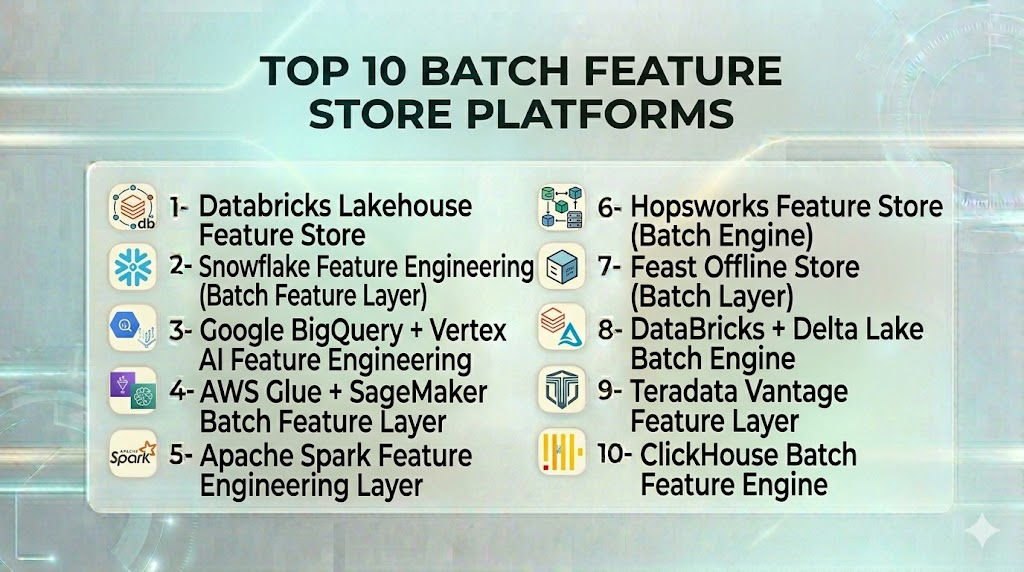
Top 10 Batch Feature Store Platforms
1- Databricks Lakehouse Feature Store
One-line verdict: Best unified batch feature store for large-scale lakehouse architectures.
Short description:
Databricks provides a deeply integrated batch feature store built on Delta Lake and Spark, enabling scalable feature engineering and ML dataset creation.
Standout Capabilities
- Batch feature computation at scale
- Delta Lake integration
- Spark-based feature engineering
- Feature versioning and lineage
- Unified data + ML workflows
- MLflow integration
- Collaborative notebooks
AI-Specific Depth
- Model support: Multi-framework ML support
- RAG integration: Lakehouse + external vector systems
- Evaluation: MLflow-based evaluation
- Guardrails: Workspace policies
- Observability: Unified telemetry
Pros
- Strong scalability
- Unified data + ML platform
- Excellent ecosystem integration
Cons
- Vendor lock-in risk
- Cost complexity
- Requires Databricks ecosystem
Security & Compliance
Enterprise RBAC, encryption, governance controls.
Deployment & Platforms
- Cloud
- Hybrid
Integrations & Ecosystem
- Spark
- Delta Lake
- MLflow
- Cloud data warehouses
Pricing Model
Usage-based enterprise pricing.
Best-Fit Scenarios
- Large-scale ML training pipelines
- Enterprise analytics + ML systems
- Lakehouse architectures
2- Snowflake Feature Engineering (Batch Feature Layer)
One-line verdict: Best SQL-native batch feature store for enterprise data warehouses.
Short description:
Snowflake enables batch feature creation using SQL-based transformations inside a scalable data warehouse environment.
Standout Capabilities
- SQL-based feature engineering
- Scalable batch processing
- Data versioning support
- Secure data sharing
- High-performance queries
- Integration with ML tools
- Governance and access control
AI-Specific Depth
- Model support: Multi-framework
- RAG integration: Warehouse-based retrieval
- Evaluation: External tools required
- Guardrails: Role-based access
- Observability: Query logs
Pros
- Easy SQL workflows
- Strong governance
- High scalability
Cons
- Not a dedicated feature store
- Limited real-time capability
- Cost at scale can increase
Security & Compliance
Enterprise-grade data governance.
Deployment & Platforms
- Cloud
Integrations & Ecosystem
- BI tools
- ML pipelines
- Data engineering tools
Pricing Model
Usage-based.
Best-Fit Scenarios
- Warehouse-driven ML pipelines
- Analytics-heavy organizations
- SQL-first teams
3- Google BigQuery + Vertex AI Feature Engineering
One-line verdict: Best for large-scale batch feature processing in GCP ecosystems.
Short description:
Google BigQuery enables massive batch feature computation integrated with Vertex AI pipelines for ML workflows.
Standout Capabilities
- SQL-based batch processing
- Serverless compute engine
- Feature engineering pipelines
- Scalable data transformations
- Integration with ML pipelines
- Real-time + batch hybrid support
- Data governance tools
AI-Specific Depth
- Model support: Multi-framework
- RAG integration: BigQuery + GCP services
- Evaluation: Vertex AI tools
- Guardrails: IAM-based controls
- Observability: Cloud monitoring
Pros
- Serverless scalability
- Strong GCP integration
- High performance
Cons
- GCP lock-in
- Cost variability
- Complex optimization
Security & Compliance
Enterprise Google Cloud security and IAM.
Deployment & Platforms
- Cloud (GCP)
Integrations & Ecosystem
- Vertex AI
- Dataflow
- BigQuery ML
- Cloud Storage
Pricing Model
Usage-based.
Best-Fit Scenarios
- GCP-native ML pipelines
- Large-scale data processing
- Enterprise analytics systems
4- AWS Glue + SageMaker Batch Feature Layer
One-line verdict: Best AWS-native batch feature pipeline system.
Short description:
AWS Glue and SageMaker together provide scalable batch feature engineering and ML dataset creation pipelines.
Standout Capabilities
- ETL-based feature engineering
- Batch processing pipelines
- Data catalog integration
- Feature transformation workflows
- ML dataset preparation
- Serverless compute
- Integration with AWS ML stack
AI-Specific Depth
- Model support: AWS ML ecosystem
- RAG integration: AWS data services
- Evaluation: External tools
- Guardrails: IAM policies
- Observability: CloudWatch logs
Pros
- Fully managed AWS system
- Scalable batch processing
- Strong integration
Cons
- AWS lock-in
- Complex architecture
- Cost management challenges
Security & Compliance
Enterprise AWS security model.
Deployment & Platforms
- Cloud (AWS)
Integrations & Ecosystem
- S3
- Glue
- SageMaker
- Athena
Pricing Model
Usage-based.
Best-Fit Scenarios
- AWS ML pipelines
- Enterprise batch processing
- Data engineering teams
5- Apache Spark Feature Engineering Layer
One-line verdict: Best open-source distributed batch processing engine for feature engineering.
Short description:
Apache Spark is widely used for large-scale batch feature computation and dataset generation for ML systems.
Standout Capabilities
- Distributed batch processing
- Large-scale data transformations
- Feature engineering pipelines
- SQL + DataFrame APIs
- Streaming support
- MLlib integration
- Cluster-based computation
AI-Specific Depth
- Model support: Multi-framework
- RAG integration: External systems
- Evaluation: External tools
- Guardrails: Not built-in
- Observability: External logging tools
Pros
- Highly scalable
- Open-source flexibility
- Strong ecosystem
Cons
- Complex setup
- Requires engineering expertise
- Resource-heavy
Security & Compliance
Depends on deployment environment.
Deployment & Platforms
- Cloud
- On-prem
- Kubernetes
Integrations & Ecosystem
- Hadoop
- Databricks
- Data lakes
- ML pipelines
Pricing Model
Open-source.
Best-Fit Scenarios
- Large-scale ML datasets
- Custom batch pipelines
- Enterprise data engineering
6- Hopsworks Feature Store (Batch Engine)
One-line verdict: Best open-source feature store with strong batch + ML integration.
Short description:
Hopsworks provides a feature store that supports batch feature computation with strong ML lifecycle integration.
Standout Capabilities
- Batch feature pipelines
- Feature versioning
- Data lineage tracking
- ML pipeline integration
- Feature validation
- Collaborative workflows
- Data engineering tools
AI-Specific Depth
- Model support: Multi-framework
- RAG integration: External systems
- Evaluation: Feature validation tools
- Guardrails: Policy controls
- Observability: Feature monitoring
Pros
- Open-source flexibility
- Strong ML integration
- Good governance features
Cons
- Operational complexity
- Smaller ecosystem
- Setup effort required
Security & Compliance
Varies by deployment.
Deployment & Platforms
- Cloud
- On-prem
- Kubernetes
Integrations & Ecosystem
- Spark
- Kafka
- Python ML stack
Pricing Model
Open-source + enterprise version.
Best-Fit Scenarios
- ML research teams
- Batch-heavy ML pipelines
- Custom feature systems
7- Feast Offline Store (Batch Layer)
One-line verdict: Best lightweight batch feature store for flexible ML pipelines.
Short description:
Feast provides a powerful offline feature store layer for batch feature generation and ML training datasets.
Standout Capabilities
- Offline feature storage
- Batch feature retrieval
- Feature versioning
- Multi-data source support
- ML pipeline integration
- Data transformation pipelines
- Cloud-agnostic design
AI-Specific Depth
- Model support: Multi-framework
- RAG integration: External systems
- Evaluation: External tools
- Guardrails: Not built-in
- Observability: External logging
Pros
- Flexible architecture
- Open-source ecosystem
- Easy integration
Cons
- Requires setup effort
- No full platform capabilities
- Needs external tools
Security & Compliance
Depends on deployment.
Deployment & Platforms
- Cloud
- Self-hosted
Integrations & Ecosystem
- Spark
- BigQuery
- Snowflake
- Databricks
Pricing Model
Open-source.
Best-Fit Scenarios
- Custom ML pipelines
- Startup ML systems
- Flexible batch workflows
8- DataBricks + Delta Lake Batch Engine
One-line verdict: Best unified batch processing and feature engineering lakehouse system.
Short description:
Delta Lake provides high-performance batch processing and feature computation in a lakehouse architecture.
Standout Capabilities
- ACID-compliant data lakes
- Batch transformations
- Feature engineering pipelines
- Time travel for data versioning
- Scalable storage engine
- Unified analytics
- ML integration
AI-Specific Depth
- Model support: Multi-framework
- RAG integration: Lakehouse + vector systems
- Evaluation: MLflow integration
- Guardrails: Workspace policies
- Observability: Unified logs
Pros
- High reliability
- Strong scalability
- Unified architecture
Cons
- Vendor dependency
- Cost complexity
- Requires Databricks ecosystem
Security & Compliance
Enterprise-grade governance and encryption.
Deployment & Platforms
- Cloud
- Hybrid
Integrations & Ecosystem
- Spark
- MLflow
- Databricks ecosystem
Pricing Model
Usage-based.
Best-Fit Scenarios
- Enterprise ML pipelines
- Data lakehouse systems
- Batch-heavy analytics
9- Teradata Vantage Feature Layer
One-line verdict: Best for enterprise data warehouse batch feature engineering.
Short description:
Teradata provides large-scale SQL-based batch feature processing for enterprise analytics and ML systems.
Standout Capabilities
- SQL-based feature engineering
- High-performance analytics
- Batch processing pipelines
- Enterprise governance
- Scalable compute engine
- Data integration tools
- ML-ready datasets
AI-Specific Depth
- Model support: Multi-framework
- RAG integration: External systems
- Evaluation: External tools
- Guardrails: Enterprise controls
- Observability: Query tracking
Pros
- Strong enterprise performance
- Mature system
- High scalability
Cons
- Expensive
- Legacy system complexity
- Less flexible than cloud-native tools
Security & Compliance
Enterprise-grade compliance controls.
Deployment & Platforms
- Cloud
- On-prem
Integrations & Ecosystem
- BI tools
- ML frameworks
- ETL systems
Pricing Model
Enterprise licensing.
Best-Fit Scenarios
- Legacy enterprise systems
- Data warehouse ML pipelines
- Large-scale analytics
10- ClickHouse Batch Feature Engine
One-line verdict: Best high-speed analytical batch feature engine for real-time analytics systems.
Short description:
ClickHouse is a high-performance analytical database often used for batch feature computation and fast data aggregation.
Standout Capabilities
- High-speed batch queries
- Columnar storage engine
- Feature aggregation pipelines
- Real-time analytics support
- Scalable distributed architecture
- SQL-based transformations
- Low-latency analytics
AI-Specific Depth
- Model support: Multi-framework
- RAG integration: External systems
- Evaluation: External tools
- Guardrails: Not built-in
- Observability: Query monitoring
Pros
- Extremely fast queries
- Cost-efficient analytics
- Strong scalability
Cons
- Not a full feature store
- Requires engineering effort
- Limited ML-specific tooling
Security & Compliance
Depends on deployment.
Deployment & Platforms
- Cloud
- Self-hosted
Integrations & Ecosystem
- Kafka
- Data lakes
- BI tools
- ML pipelines
Pricing Model
Open-source + enterprise options.
Best-Fit Scenarios
- High-speed batch analytics
- Feature aggregation systems
- Real-time analytics pipelines
Comparison Table
| Tool Name | Best For | Deployment | Batch Performance | Strength | Watch-Out | Public Rating |
|---|---|---|---|---|---|---|
| Databricks | Lakehouse ML | Cloud/Hybrid | Very high | Unified platform | Cost | N/A |
| Snowflake | SQL feature engineering | Cloud | High | SQL simplicity | Not full feature store | N/A |
| BigQuery | GCP batch ML | Cloud | Very high | Serverless scale | GCP lock-in | N/A |
| AWS Glue | AWS batch ML | Cloud | High | AWS integration | Complexity | N/A |
| Spark | Distributed batch | Cloud/on-prem | Very high | Flexibility | Engineering effort | N/A |
| Hopsworks | Open feature store | Cloud/on-prem | High | ML integration | Setup complexity | N/A |
| Feast | Offline feature store | Cloud/self-hosted | High | Flexibility | Requires stack | N/A |
| Delta Lake | Lakehouse batch | Cloud | Very high | Reliability | Ecosystem lock-in | N/A |
| Teradata | Enterprise DW | Cloud/on-prem | High | Performance | Expensive | N/A |
| ClickHouse | Fast analytics | Cloud/self-hosted | Very high | Speed | Not full feature store | N/A |
Scoring & Evaluation
| Tool | Core | Reliability | Guardrails | Integrations | Ease | Perf/Cost | Security | Support | Weighted Total |
|---|---|---|---|---|---|---|---|---|---|
| Databricks | 9 | 9 | 8 | 9 | 8 | 8 | 9 | 8 | 8.5 |
| Snowflake | 8 | 9 | 7 | 9 | 9 | 8 | 9 | 8 | 8.4 |
| BigQuery | 9 | 9 | 8 | 9 | 8 | 8 | 9 | 8 | 8.6 |
| AWS Glue | 8 | 8 | 7 | 8 | 7 | 8 | 9 | 8 | 8.0 |
| Spark | 9 | 9 | 7 | 9 | 6 | 9 | 8 | 8 | 8.2 |
| Hopsworks | 8 | 8 | 8 | 8 | 7 | 8 | 8 | 8 | 8.0 |
| Feast | 8 | 8 | 7 | 8 | 8 | 8 | 7 | 8 | 8.0 |
| Delta Lake | 9 | 9 | 8 | 9 | 8 | 8 | 9 | 8 | 8.5 |
| Teradata | 8 | 9 | 8 | 8 | 7 | 8 | 9 | 8 | 8.3 |
| ClickHouse | 9 | 8 | 7 | 8 | 8 | 9 | 8 | 8 | 8.2 |
Which Batch Feature Store Platform Is Right for You?
Solo / Freelancer
ClickHouse or Feast for lightweight batch feature engineering.
SMB
Feast and Hopsworks provide flexible batch feature pipelines.
Mid-Market
Databricks, Snowflake, and BigQuery support scalable batch ML systems.
Enterprise
BigQuery, Databricks, and AWS Glue provide governed, scalable batch infrastructure.
Regulated Industries
Prioritize lineage tracking, versioning, and auditability.
Budget vs Premium
Open-source systems are cost-efficient; cloud systems offer scalability.
Build vs Buy
Build when you need full customization; buy when scalability and governance matter.
Common Mistakes & How to Avoid Them
- Ignoring feature versioning
- Poor data lineage tracking
- No reproducibility strategy
- Overcomplicated pipelines
- Missing data validation
- Weak governance controls
- Inefficient batch jobs
- Not optimizing compute costs
- Lack of integration with ML systems
- No monitoring or observability
- Poor schema evolution handling
- Treating batch as real-time system
FAQs
1- What is a batch feature store?
It is a system that stores and processes historical ML features for training and analytics.
2- Why are batch feature stores important?
They ensure reproducibility and consistency in ML training datasets.
3- What is the difference between batch and online feature stores?
Batch stores handle offline data; online stores serve real-time inference.
4- Do batch feature stores support streaming?
Some platforms support hybrid batch + streaming pipelines.
5- Is Spark a feature store?
No, but it is widely used for batch feature engineering.
6- What is feature versioning?
Tracking changes in feature definitions over time.
7- Can batch feature stores support LLMs?
Yes, they provide structured training data for LLM systems.
8- Are they cloud-only?
No, many support hybrid and on-prem deployments.
9- What is data lineage?
Tracking origin and transformations of features.
10- Why use a lakehouse for features?
It unifies storage, compute, and ML pipelines.
11- What is feature reuse?
Using the same features across multiple ML models.
12- What is the future of batch feature stores?
They will integrate tightly with real-time AI and agentic systems.
Conclusion
Batch Feature Store Platforms are the backbone of scalable and reproducible machine learning systems. They ensure that high-quality, versioned, and well-governed features power model training and analytics workflows across enterprises.
