Introduction
Model Registry & Artifact Stores are foundational components of modern MLOps and LLMOps platforms that manage the lifecycle of machine learning models, datasets, evaluation outputs, and training artifacts. A model registry tracks model versions, metadata, lineage, and deployment stages, while an artifact store manages files such as model binaries, checkpoints, datasets, logs, and evaluation reports.
these systems are no longer optional—they are critical infrastructure for any organization deploying AI in production. As AI systems scale across multiple models, environments, and teams, organizations need strong governance, reproducibility, and traceability. Model registries ensure that every deployed model can be traced back to its training data, code version, and evaluation metrics.
Artifact stores complement this by handling large-scale storage and retrieval of ML artifacts, enabling collaboration, rollback, auditing, and compliance.
Real-World Use Cases
- Versioning and deployment of ML and LLM models
- Tracking experiments and model lineage
- Storing training datasets and checkpoints
- Managing evaluation reports and metrics
- Reproducible ML pipelines
- Governance for regulated industries (finance, healthcare)
- CI/CD pipelines for AI systems
Evaluation Criteria for Buyers
When evaluating Model Registry & Artifact Stores, consider:
- Model versioning and lifecycle management
- Metadata tracking and lineage support
- Artifact storage scalability
- Integration with MLOps/LLMOps pipelines
- CI/CD automation support
- Multi-environment deployment (dev/stage/prod)
- Access control and security governance
- Model rollback and promotion workflows
- Compatibility with ML frameworks
- Storage cost optimization
- API and SDK usability
- Observability and auditability
Best for: ML engineering teams, enterprise AI platforms, SaaS companies deploying AI models, research labs, and regulated industries requiring auditability.
Not ideal for: Small-scale ML experiments, notebook-only workflows, or teams not deploying models into production systems.
What’s Changed in Model Registry & Artifact Stores
- Model registries now unify ML + LLM + multimodal model tracking
- Artifact stores support structured + unstructured AI assets
- Versioning now includes prompts, embeddings, and RAG pipelines
- Git-style model workflows (branching, rollback, tagging) are standard
- Real-time model deployment tracking is built-in
- AI governance layers are deeply integrated
- Automated evaluation gates are part of deployment pipelines
- Metadata tracking now includes cost, latency, and quality metrics
- Cross-cloud model registries are emerging
- Artifact stores are increasingly object-storage-native
- Model lineage tracking is mandatory for compliance
- Agentic AI systems now store memory artifacts in registries
Quick Buyer Checklist
Before selecting a platform, verify:
- □ Model versioning and lifecycle tracking
- □ Artifact storage scalability
- □ Lineage tracking and metadata management
- □ CI/CD integration for ML pipelines
- □ Multi-environment deployment support
- □ Access control and governance (RBAC/IAM)
- □ Rollback and model promotion workflows
- □ API/SDK availability
- □ Integration with MLOps/LLMOps tools
- □ Storage cost efficiency
- □ Audit logs and compliance tracking
- □ Support for ML + LLM artifacts
- □ Cross-cloud or hybrid support
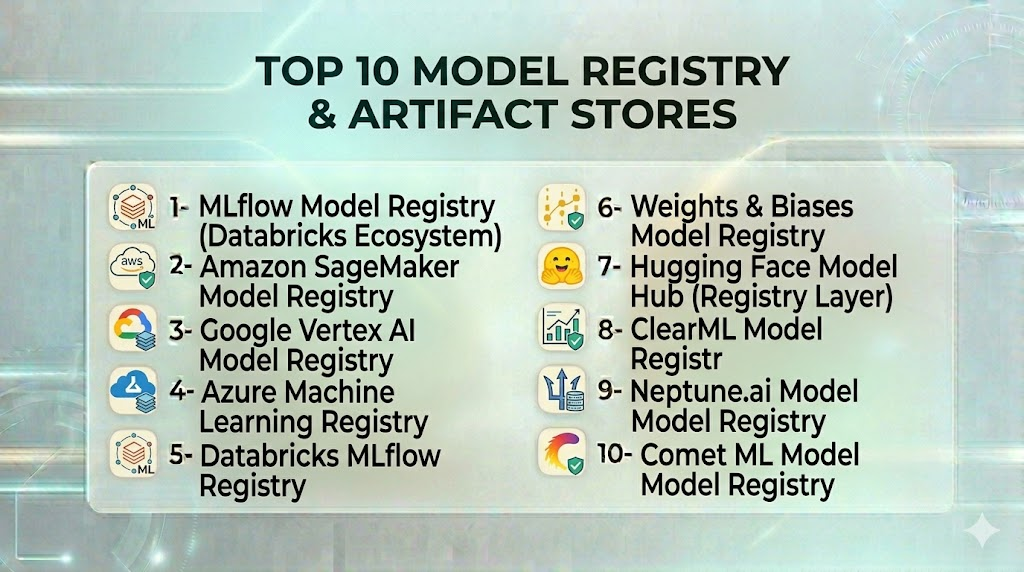
Top 10 Model Registry & Artifact Stores
1- MLflow Model Registry (Databricks Ecosystem)
One-line verdict: Best open-standard model registry for ML lifecycle tracking and deployment.
Short description:
MLflow Model Registry provides versioning, lifecycle management, and deployment tracking for ML models across environments.
Standout Capabilities
- Model versioning and tagging
- Stage transitions (dev/staging/prod)
- Metadata tracking
- Model lineage support
- Deployment tracking
- Experiment integration
- CI/CD compatibility
AI-Specific Depth
- Model support: Multi-framework (ML + DL + LLM integrations)
- Artifact integration: MLflow tracking server
- Evaluation: External tools (or MLflow metrics)
- Governance: Role-based access via integrations
- Observability: Experiment + model tracking
Pros
- Industry standard
- Flexible and extensible
- Strong ecosystem adoption
Cons
- Requires external storage setup
- Limited built-in governance
- Needs integration for full MLOps stack
Security & Compliance
Depends on deployment and enterprise configuration.
Deployment & Platforms
- Cloud
- Self-hosted
- Hybrid
Integrations & Ecosystem
- Databricks
- Kubernetes
- AWS/GCP/Azure
- Airflow
- Spark
Pricing Model
Open-source + enterprise Databricks integration.
Best-Fit Scenarios
- ML experimentation
- Model lifecycle tracking
- Custom MLOps pipelines
2- Amazon SageMaker Model Registry
One-line verdict: Best fully managed model registry for AWS-native AI systems.
Short description:
SageMaker Model Registry enables versioning, approval workflows, and deployment tracking within AWS MLOps pipelines.
Standout Capabilities
- Model version control
- Approval workflows
- Deployment tracking
- Model lineage
- CI/CD integration
- Metadata storage
- Model governance
AI-Specific Depth
- Model support: AWS-supported frameworks
- Artifact integration: S3 storage
- Evaluation: SageMaker pipelines
- Governance: IAM policies
- Observability: CloudWatch integration
Pros
- Fully managed service
- Strong governance controls
- Deep AWS integration
Cons
- AWS lock-in
- Complex pricing model
- Limited portability
Security & Compliance
Enterprise AWS security, IAM, encryption, audit logging.
Deployment & Platforms
- Cloud (AWS)
Integrations & Ecosystem
- SageMaker
- S3
- Lambda
- AWS ML pipelines
Pricing Model
Usage-based.
Best-Fit Scenarios
- AWS ML workloads
- Enterprise model governance
- Production AI systems
3- Google Vertex AI Model Registry
One-line verdict: Best model registry for Google Cloud-native ML systems.
Short description:
Vertex AI Model Registry provides centralized tracking, versioning, and deployment management for ML models in GCP.
Standout Capabilities
- Model versioning
- Deployment endpoints tracking
- Metadata management
- Pipeline integration
- Model monitoring
- Approval workflows
- Artifact linking
AI-Specific Depth
- Model support: Multi-framework
- Artifact integration: GCP storage systems
- Evaluation: Vertex AI pipelines
- Governance: IAM-based controls
- Observability: Cloud logging
Pros
- Strong GCP integration
- Scalable infrastructure
- Managed service
Cons
- GCP lock-in
- Limited flexibility
- Cost complexity
Security & Compliance
Enterprise Google Cloud security and IAM.
Deployment & Platforms
- Cloud (GCP)
Integrations & Ecosystem
- BigQuery
- Vertex AI pipelines
- Cloud Storage
- Dataflow
Pricing Model
Usage-based.
Best-Fit Scenarios
- GCP ML pipelines
- Enterprise AI systems
- Data-heavy ML workflows
4- Azure Machine Learning Registry
One-line verdict: Best enterprise model registry for Microsoft ecosystem integration.
Short description:
Azure ML Registry provides centralized management for ML models with strong governance and deployment tracking.
Standout Capabilities
- Model versioning
- Deployment tracking
- Metadata management
- CI/CD integration
- Approval workflows
- Model lineage
- Artifact linking
AI-Specific Depth
- Model support: Multi-framework
- Artifact integration: Azure Storage
- Evaluation: Azure ML pipelines
- Governance: Azure AD integration
- Observability: Azure Monitor
Pros
- Strong enterprise governance
- Microsoft ecosystem integration
- Hybrid support
Cons
- Azure dependency
- Complex setup
- Cost variability
Security & Compliance
Enterprise Azure security, identity, and compliance controls.
Deployment & Platforms
- Cloud
- Hybrid
Integrations & Ecosystem
- Azure ML
- Databricks
- Power BI
- Azure Data Factory
Pricing Model
Usage-based + enterprise licensing.
Best-Fit Scenarios
- Microsoft ecosystem users
- Enterprise ML systems
- Regulated industries
5- Databricks MLflow Registry
One-line verdict: Best unified model registry for lakehouse-based AI systems.
Short description:
Databricks MLflow Registry extends MLflow with enterprise-grade governance and lakehouse integration.
Standout Capabilities
- Model versioning
- Lifecycle management
- Experiment tracking integration
- Metadata and lineage
- Deployment workflows
- CI/CD integration
- Collaboration features
AI-Specific Depth
- Model support: Multi-framework
- Artifact integration: Delta Lake
- Evaluation: MLflow metrics
- Governance: Workspace policies
- Observability: Unified telemetry
Pros
- Strong ecosystem integration
- Unified data + ML stack
- Scalable architecture
Cons
- Vendor lock-in
- Cost complexity
- Requires Databricks ecosystem
Security & Compliance
Enterprise RBAC, encryption, audit logs.
Deployment & Platforms
- Cloud
- Hybrid
Integrations & Ecosystem
- Databricks
- Spark
- Delta Lake
- MLflow
Pricing Model
Usage-based enterprise pricing.
Best-Fit Scenarios
- Lakehouse ML systems
- Enterprise AI pipelines
- Data-heavy ML workflows
6- Weights & Biases Model Registry
One-line verdict: Best experiment-to-production model tracking and registry system.
Short description:
W&B provides a powerful model registry tightly integrated with experiment tracking and ML lifecycle workflows.
Standout Capabilities
- Model versioning
- Experiment tracking integration
- Artifact storage
- Dataset tracking
- Deployment linking
- Evaluation tracking
- Collaboration tools
AI-Specific Depth
- Model support: Multi-framework
- Artifact integration: W&B Artifacts system
- Evaluation: Strong evaluation tooling
- Governance: Role-based access
- Observability: Full experiment tracing
Pros
- Excellent ML experimentation tools
- Strong collaboration features
- Developer-friendly
Cons
- Not fully standalone registry
- Requires ecosystem adoption
- Enterprise governance varies
Security & Compliance
Enterprise features available depending on plan.
Deployment & Platforms
- Cloud
- Self-hosted
Integrations & Ecosystem
- ML frameworks
- Kubernetes
- CI/CD tools
- LLM pipelines
Pricing Model
Freemium + enterprise plans.
Best-Fit Scenarios
- ML experimentation teams
- Research organizations
- Model lifecycle tracking
7- Hugging Face Model Hub (Registry Layer)
One-line verdict: Best open model registry for LLMs and open-source AI models.
Short description:
Hugging Face Hub acts as a model registry for open-source ML and LLM models with versioning and metadata tracking.
Standout Capabilities
- Model versioning
- Public/private model hosting
- Dataset storage
- Model cards
- Metadata tracking
- Deployment integration
- Community ecosystem
AI-Specific Depth
- Model support: LLMs + ML models
- Artifact integration: Model + dataset storage
- Evaluation: External tools required
- Governance: Access control policies
- Observability: Basic tracking
Pros
- Massive open-source ecosystem
- Easy model sharing
- Strong LLM support
Cons
- Limited enterprise governance
- Not full MLOps registry
- Requires external pipeline tools
Security & Compliance
Enterprise Hub offers advanced controls.
Deployment & Platforms
- Cloud
- Self-hosted options
Integrations & Ecosystem
- Transformers library
- PyTorch
- TensorFlow
- APIs
Pricing Model
Freemium + enterprise plans.
Best-Fit Scenarios
- Open-source AI systems
- LLM development
- Research and experimentation
8- ClearML Model Registry
One-line verdict: Best open-source end-to-end ML registry and artifact management system.
Short description:
ClearML provides model registry, artifact tracking, and experiment management in a unified open-source platform.
Standout Capabilities
- Model versioning
- Artifact storage
- Pipeline tracking
- Deployment linking
- Dataset management
- Experiment tracking
- Automation workflows
AI-Specific Depth
- Model support: Multi-framework
- Artifact integration: Built-in storage system
- Evaluation: Experiment metrics
- Governance: Role-based access
- Observability: Full pipeline tracking
Pros
- Fully open-source
- End-to-end ML lifecycle
- Flexible architecture
Cons
- Smaller ecosystem
- Requires setup effort
- Limited enterprise polish
Security & Compliance
Varies by deployment.
Deployment & Platforms
- Cloud
- Self-hosted
- Hybrid
Integrations & Ecosystem
- Kubernetes
- ML frameworks
- CI/CD pipelines
- Data tools
Pricing Model
Open-source + enterprise version.
Best-Fit Scenarios
- Full ML lifecycle management
- Startup ML systems
- Custom AI pipelines
9- Neptune.ai Model Registry
One-line verdict: Best lightweight model registry for experiment-centric ML teams.
Short description:
Neptune.ai focuses on experiment tracking with model registry capabilities built on top.
Standout Capabilities
- Model version tracking
- Experiment logging
- Metadata storage
- Dataset tracking
- Performance comparison
- Collaboration features
- Visualization dashboards
AI-Specific Depth
- Model support: Multi-framework
- Artifact integration: External storage support
- Evaluation: Experiment-based evaluation
- Governance: Role-based controls
- Observability: Strong tracking layer
Pros
- Lightweight and fast
- Strong experiment tracking
- Easy integration
Cons
- Not full enterprise registry
- Requires external tooling
- Limited deployment features
Security & Compliance
Varies by deployment.
Deployment & Platforms
- Cloud
- Self-hosted
Integrations & Ecosystem
- ML frameworks
- Databricks
- CI/CD tools
- APIs
Pricing Model
Freemium + subscription.
Best-Fit Scenarios
- ML experimentation
- Model tracking
- Research teams
10- Comet ML Model Registry
One-line verdict: Best collaborative model registry for ML teams with strong experiment tracking.
Short description:
Comet ML provides model registry capabilities integrated with experiment tracking and collaboration tools.
Standout Capabilities
- Model versioning
- Experiment tracking
- Artifact storage
- Dataset management
- Performance comparison
- Collaboration dashboards
- Deployment tracking
AI-Specific Depth
- Model support: Multi-framework
- Artifact integration: Comet storage system
- Evaluation: Experiment metrics
- Governance: Role-based access
- Observability: Experiment logs
Pros
- Strong collaboration tools
- Easy to use
- Good experiment tracking
Cons
- Not full enterprise registry
- Limited orchestration features
- Smaller ecosystem
Security & Compliance
Enterprise features available depending on plan.
Deployment & Platforms
- Cloud
- Self-hosted
Integrations & Ecosystem
- ML frameworks
- Kubernetes
- CI/CD tools
- APIs
Pricing Model
Freemium + enterprise plans.
Best-Fit Scenarios
- ML team collaboration
- Experiment tracking
- Model lifecycle management
Comparison Table
| Tool Name | Best For | Deployment | Model Flexibility | Strength | Watch-Out | Public Rating |
|---|---|---|---|---|---|---|
| MLflow | Open standard registry | Cloud/Self-hosted | Multi-framework | Flexibility | Needs setup | N/A |
| SageMaker | AWS ML systems | Cloud | AWS ecosystem | Managed service | AWS lock-in | N/A |
| Vertex AI | GCP ML systems | Cloud | Multi-framework | Integration | GCP lock-in | N/A |
| Azure ML | Enterprise ML | Cloud/Hybrid | Multi-framework | Governance | Azure dependency | N/A |
| Databricks | Lakehouse ML | Cloud/Hybrid | Multi-framework | Unified stack | Cost | N/A |
| W&B | Experiment tracking | Cloud/Self-hosted | Multi-framework | Observability | Not standalone | N/A |
| Hugging Face | Open models | Cloud | LLM + ML | Ecosystem | Limited governance | N/A |
| ClearML | End-to-end ML | Cloud/Self-hosted | Multi-framework | Full lifecycle | Smaller ecosystem | N/A |
| Neptune.ai | Lightweight registry | Cloud/Self-hosted | Multi-framework | Simplicity | Not full platform | N/A |
| Comet ML | Collaboration ML | Cloud/Self-hosted | Multi-framework | Team workflows | Limited scale | N/A |
Scoring & Evaluation
| Tool | Core | Reliability | Governance | Integrations | Ease | Perf/Cost | Security | Support | Weighted Total |
|---|---|---|---|---|---|---|---|---|---|
| MLflow | 9 | 8 | 7 | 9 | 8 | 8 | 7 | 8 | 8.0 |
| SageMaker | 9 | 9 | 9 | 9 | 8 | 8 | 9 | 8 | 8.7 |
| Vertex AI | 9 | 9 | 9 | 9 | 8 | 8 | 9 | 8 | 8.7 |
| Azure ML | 9 | 9 | 9 | 9 | 8 | 8 | 9 | 8 | 8.7 |
| Databricks | 9 | 9 | 8 | 9 | 8 | 8 | 9 | 8 | 8.5 |
| W&B | 8 | 8 | 8 | 9 | 9 | 8 | 8 | 8 | 8.3 |
| Hugging Face | 8 | 8 | 7 | 8 | 9 | 8 | 8 | 8 | 8.1 |
| ClearML | 8 | 8 | 8 | 8 | 8 | 8 | 8 | 8 | 8.0 |
| Neptune.ai | 8 | 8 | 7 | 8 | 9 | 8 | 8 | 8 | 8.0 |
| Comet ML | 8 | 8 | 7 | 8 | 9 | 8 | 8 | 8 | 8.0 |
Which Model Registry & Artifact Store Is Right for You?
Solo / Freelancer
MLflow or Neptune.ai for lightweight model tracking.
SMB
ClearML and MLflow for end-to-end model lifecycle support.
Mid-Market
Databricks and W&B for scalable experiment + registry systems.
Enterprise
SageMaker, Vertex AI, and Azure ML for governance-heavy environments.
Regulated Industries
Prioritize audit logs, lineage tracking, and approval workflows.
Budget vs Premium
Open-source tools are cost-efficient; cloud platforms provide governance.
Build vs Buy
Build when customizing ML pipelines; buy when scaling enterprise governance.
Common Mistakes & How to Avoid Them
- No model versioning strategy
- Missing artifact tracking
- Poor metadata management
- Lack of lineage tracking
- Weak governance policies
- No CI/CD integration
- Inconsistent environments
- No rollback strategy
- Ignoring LLM model tracking
- Over-reliance on manual processes
- Poor access control setup
- No audit trail system
FAQs
1- What is a model registry?
It is a system that tracks, versions, and manages ML models across environments.
2- What is an artifact store?
It stores ML-related files like models, datasets, and training outputs.
3- Why are model registries important?
They ensure reproducibility and governance in ML systems.
4- Do model registries support LLMs?
Yes, modern registries support LLMs and embeddings.
5- What is model versioning?
Tracking changes in ML models over time.
6- Can I roll back models?
Yes, registries support rollback to previous versions.
7- Are these platforms cloud-only?
No, many support hybrid and self-hosted setups.
8- What is model lineage?
Tracking the origin and transformation of models.
9- What is CI/CD in ML?
Automating model training, testing, and deployment pipelines.
10- Do registries store datasets?
Yes, many also act as artifact stores.
11- What is metadata tracking?
Recording model performance, parameters, and context.
12- What is the future of model registries?
They will unify ML, LLM, and agent lifecycle management.
Conclusion
Model Registry & Artifact Stores are the backbone of modern AI lifecycle management, ensuring reproducibility, governance, and traceability across ML and LLM systems. From open-source leaders like MLflow and ClearML to enterprise platforms like SageMaker, Vertex AI, and Azure ML, the ecosystem provides scalable solutions for every stage of AI maturity.
