Introduction
Continuous Training Pipelines are the backbone of modern AI systems that don’t just stop improving after deployment—they keep learning, adapting, and retraining as new data flows in. In simple terms, a continuous training pipeline automates the entire lifecycle of updating machine learning or foundation models: data ingestion, preprocessing, training, evaluation, validation, and deployment—repeated continuously or on triggers.
this category has become critical because AI systems are no longer static. LLM-powered applications, agents, recommendation engines, fraud detection systems, and enterprise copilots require constant updates to stay accurate, safe, and cost-efficient.
Real-world use cases include:
- Continuous fine-tuning of LLMs using user feedback loops
- Fraud detection models adapting to new attack patterns
- Recommendation systems evolving with user behavior in real time
- AI copilots improving via RLHF/RLAIF feedback cycles
- Autonomous agents retrained with production traces and failures
- Healthcare and finance models updated with new regulatory data
What buyers should evaluate includes:
- Data pipeline automation maturity
- Support for ML + LLM workflows
- Evaluation and testing frameworks
- Model versioning and rollback capabilities
- Integration with vector databases and feature stores
- Cost and compute optimization
- Observability and tracing of training runs
- Governance, auditability, and compliance readiness
- Support for human feedback loops (RLHF/RLAIF)
- Multi-cloud or hybrid deployment flexibility
Best for: AI/ML engineering teams, MLOps teams, data science organizations, and enterprises building production-grade AI systems that require continuous improvement loops.
Not ideal for: small teams running simple static models, prototype-stage AI projects, or organizations without production-scale data pipelines.
What’s Changed in Continuous Training Pipelines
- Shift from batch retraining to event-driven continuous learning
- Integration of LLM fine-tuning loops with human feedback (RLHF/RLAIF)
- Rise of agent-driven pipeline orchestration
- Strong focus on evaluation-first MLOps, not just training
- Built-in prompt + model versioning systems
- Increased adoption of multi-model routing strategies
- Real-time drift detection and automatic retraining triggers
- Deep integration with vector databases and RAG pipelines
- Strong emphasis on cost-aware training pipelines
- Enterprise demand for audit-ready AI lifecycle logs
- Built-in guardrails against data poisoning and feedback loops
- Expansion of hybrid cloud + edge training architectures
Quick Buyer Checklist
Before selecting a Continuous Training Pipeline platform, ensure:
- Supports automated retraining triggers (data drift, feedback, schedule)
- Works with your model ecosystem (open-source, proprietary, BYO models)
- Has built-in evaluation workflows (offline + online testing)
- Supports dataset versioning and lineage tracking
- Provides model rollback and A/B deployment options
- Offers observability (logs, metrics, traces, cost tracking)
- Includes guardrails for data quality and poisoning risks
- Supports RAG pipelines if working with LLM applications
- Integrates with feature stores, vector DBs, and CI/CD systems
- Provides role-based access control and audit logs
- Minimizes vendor lock-in via APIs or open standards
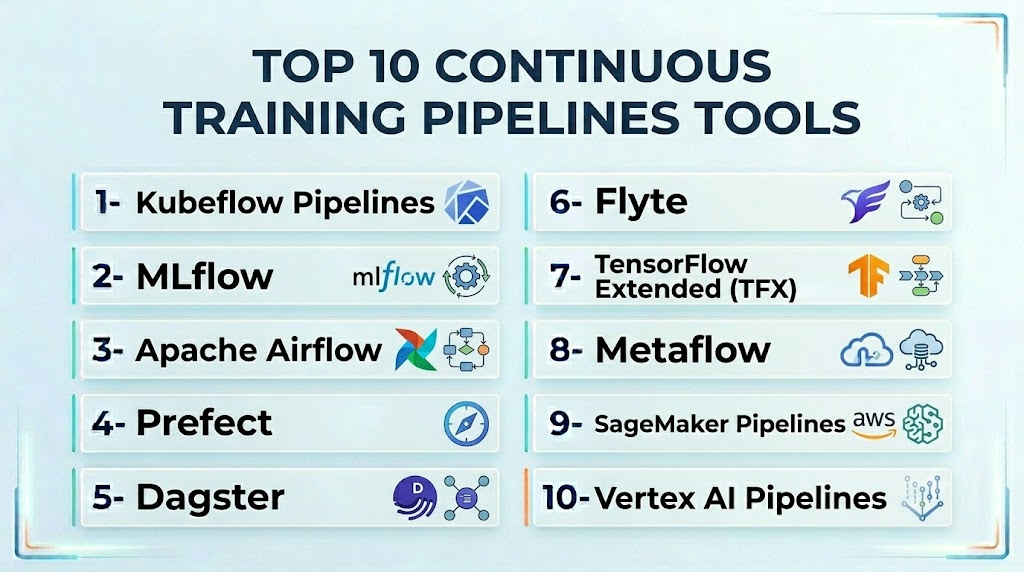
Top 10 Continuous Training Pipelines Tools
1- Kubeflow Pipelines
One-line verdict: Best for Kubernetes-native teams building scalable, production-grade ML training workflows.
Short description:
Kubeflow Pipelines is an open-source platform designed to build, deploy, and manage end-to-end ML workflows on Kubernetes. It is widely used in enterprise-grade ML systems requiring scalability and flexibility.
Standout Capabilities
- Kubernetes-native workflow orchestration
- Modular pipeline components
- Strong support for distributed training
- Integration with ML tooling ecosystem
- Reusable pipeline templates
- Strong scalability for large workloads
- CI/CD-friendly ML workflows
AI-Specific Depth
- Model support: BYO model, open-source frameworks
- RAG integration: N/A (requires external setup)
- Evaluation: External integration required
- Guardrails: Not built-in
- Observability: Basic logs + Kubernetes tooling
Pros
- Highly scalable infrastructure
- Open-source and flexible
- Strong Kubernetes integration
Cons
- Complex setup and maintenance
- Requires strong DevOps expertise
- Limited built-in AI evaluation tools
Security & Compliance
- RBAC supported via Kubernetes
- Encryption depends on cluster configuration
- Not publicly stated certifications
Deployment & Platforms
- Self-hosted (Kubernetes required)
- Linux-first environment
Integrations & Ecosystem
Kubeflow integrates deeply with Kubernetes-native tools:
- TensorFlow, PyTorch, XGBoost
- MLflow (via plugins)
- Argo workflows
- Docker containers
- Cloud Kubernetes services
Pricing Model
Open-source (infrastructure costs apply)
Best-Fit Scenarios
- Large-scale enterprise ML teams
- Kubernetes-first organizations
- Custom ML platform builders
2- MLflow
One-line verdict: Best for tracking experiments and managing lifecycle of continuously evolving ML models.
Short description:
MLflow is a widely used open-source platform for managing the ML lifecycle, including experimentation, reproducibility, and deployment.
Standout Capabilities
- Experiment tracking and comparison
- Model registry with versioning
- Deployment pipeline support
- Multi-framework compatibility
- Lightweight integration into pipelines
- Strong community adoption
- Works across cloud and on-prem
AI-Specific Depth
- Model support: Multi-framework (PyTorch, sklearn, etc.)
- RAG integration: External only
- Evaluation: Basic metric tracking
- Guardrails: Not included
- Observability: Experiment-level tracking
Pros
- Easy to adopt
- Strong ecosystem support
- Lightweight and flexible
Cons
- Limited orchestration capabilities
- Requires external pipeline tools
- Minimal built-in governance
Security & Compliance
- Role-based access in managed versions
- Not publicly stated certifications
Deployment & Platforms
- Self-hosted or managed cloud
- Cross-platform support
Integrations & Ecosystem
- Databricks
- Apache Spark
- Kubernetes
- Airflow, Prefect
- Cloud storage systems
Pricing Model
Open-source + enterprise managed options
Best-Fit Scenarios
- ML experiment tracking
- Model versioning pipelines
- Mid-scale AI teams
3- Apache Airflow
One-line verdict: Best for orchestrating complex, scheduled continuous training workflows.
Short description:
Apache Airflow is a workflow orchestration platform widely used for scheduling and managing ML pipelines and data workflows.
Standout Capabilities
- DAG-based workflow orchestration
- Strong scheduling engine
- Extensive plugin ecosystem
- Retry and failure handling
- Scalable task execution
- Cloud-native integrations
- Strong community support
AI-Specific Depth
- Model support: External systems
- RAG integration: Via plugins
- Evaluation: External
- Guardrails: Not built-in
- Observability: Task-level monitoring
Pros
- Highly flexible orchestration
- Mature ecosystem
- Strong scheduling capabilities
Cons
- Not ML-native
- Requires engineering effort
- Complex DAG management at scale
Security & Compliance
- Role-based access support
- Enterprise features vary
- Not publicly stated certifications
Deployment & Platforms
- Cloud or self-hosted
- Kubernetes-compatible
Integrations & Ecosystem
- AWS, GCP, Azure
- Spark, Hadoop
- MLflow, TensorFlow pipelines
Pricing Model
Open-source + managed services
Best-Fit Scenarios
- Scheduled retraining pipelines
- Data engineering-heavy ML workflows
- Enterprise orchestration needs
4- Prefect
One-line verdict: Best for modern, developer-friendly workflow orchestration with strong observability.
Short description:
Prefect is a modern workflow orchestration tool designed to simplify data and ML pipeline creation with dynamic execution.
Standout Capabilities
- Dynamic workflow execution
- Python-native pipelines
- Real-time monitoring
- Cloud-based orchestration
- Fault-tolerant workflows
- Easy deployment patterns
- Strong developer UX
AI-Specific Depth
- Model support: External
- RAG integration: Via custom flows
- Evaluation: External tools required
- Guardrails: Not built-in
- Observability: Strong runtime tracking
Pros
- Easy to use for developers
- Flexible and dynamic workflows
- Strong observability
Cons
- Less mature than Airflow
- Limited deep ML features
- Cloud dependency for full features
Security & Compliance
- RBAC in cloud version
- Not publicly stated certifications
Deployment & Platforms
- Cloud + self-hosted agent
- Cross-platform
Integrations & Ecosystem
- AWS, GCP, Azure
- MLflow, dbt
- Kubernetes
Pricing Model
Freemium + enterprise cloud tiers
Best-Fit Scenarios
- Fast-moving ML teams
- Lightweight pipeline orchestration
- Startups scaling AI systems
5- Dagster
One-line verdict: Best for data-aware ML pipelines with strong lineage and testing.
Short description:
Dagster is a modern data orchestration platform focused on type safety, testing, and data lineage in ML pipelines.
Standout Capabilities
- Data asset-centric pipelines
- Strong testing framework
- Built-in lineage tracking
- Type-safe pipeline definitions
- Local-first development
- Modular orchestration design
- Observability-first architecture
AI-Specific Depth
- Model support: External
- RAG integration: Supported via assets
- Evaluation: Custom pipelines
- Guardrails: Not native
- Observability: Strong lineage + logs
Pros
- Excellent data governance
- Developer-friendly
- Strong testing support
Cons
- Learning curve for assets model
- Not fully ML-native
- Requires integration for AI features
Security & Compliance
- RBAC available
- Not publicly stated certifications
Deployment & Platforms
- Cloud or self-hosted
- Kubernetes support
Integrations & Ecosystem
- dbt
- MLflow
- Spark
- Cloud platforms
Pricing Model
Open-source + enterprise cloud
Best-Fit Scenarios
- Data-heavy ML pipelines
- Governance-focused teams
- Production AI systems
6- Flyte
One-line verdict: Best for scalable, cloud-native ML workflows with strong reproducibility.
Short description:
Flyte is a Kubernetes-native workflow automation platform designed for large-scale, reproducible ML pipelines.
Standout Capabilities
- Strong reproducibility guarantees
- Kubernetes-native execution
- Typed workflows
- Scalable distributed compute
- Versioned workflows
- Multi-cloud support
- Strong ML focus
AI-Specific Depth
- Model support: BYO models
- RAG integration: External
- Evaluation: External tools
- Guardrails: Not native
- Observability: Workflow-level tracking
Pros
- Highly scalable
- Strong reproducibility
- ML-native design
Cons
- Complex setup
- Kubernetes dependency
- Smaller ecosystem than Airflow
Security & Compliance
- RBAC supported
- Not publicly stated certifications
Deployment & Platforms
- Kubernetes-based self-hosting
- Cloud deployments supported
Integrations & Ecosystem
- AWS, GCP, Azure
- ML frameworks
- Docker/K8s ecosystem
Pricing Model
Open-source + enterprise support
Best-Fit Scenarios
- Large-scale ML platforms
- Research-heavy environments
- Cloud-native AI systems
7- TensorFlow Extended (TFX)
One-line verdict: Best for TensorFlow-based production ML pipelines.
Short description:
TFX is a production-ready ML pipeline framework designed by Google for TensorFlow ecosystems.
Standout Capabilities
- End-to-end ML pipeline components
- Strong validation and transformation
- TensorFlow integration
- Scalable production workflows
- Data validation tools
- Model analysis support
- Enterprise-grade stability
AI-Specific Depth
- Model support: TensorFlow-centric
- RAG integration: Not native
- Evaluation: Built-in model analysis tools
- Guardrails: Data validation checks
- Observability: Pipeline-level metrics
Pros
- Highly stable production system
- Strong TensorFlow integration
- Built-in validation tools
Cons
- TensorFlow lock-in
- Less flexible than modern tools
- Steep learning curve
Security & Compliance
- Enterprise-grade in Google ecosystem
- Not publicly stated certifications
Deployment & Platforms
- Cloud or self-hosted
- Kubernetes compatible
Integrations & Ecosystem
- TensorFlow ecosystem
- Apache Beam
- GCP services
Pricing Model
Open-source
Best-Fit Scenarios
- TensorFlow production pipelines
- Enterprise ML workflows
- High-scale validation systems
8- Metaflow
One-line verdict: Best for data scientists moving from notebooks to production pipelines.
Short description:
Metaflow is a human-centric ML framework developed to simplify real-world production machine learning workflows.
Standout Capabilities
- Notebook-to-production transition
- Simple Python-based APIs
- Built-in versioning
- Scalable execution backend
- AWS integration support
- Data version tracking
- Easy experimentation loops
AI-Specific Depth
- Model support: Multi-framework
- RAG integration: External
- Evaluation: Basic tracking
- Guardrails: Not included
- Observability: Flow-level tracking
Pros
- Very easy for data scientists
- Strong usability
- Smooth scaling path
Cons
- AWS-centric
- Limited orchestration depth
- Smaller ecosystem
Security & Compliance
- AWS security integration
- Not publicly stated certifications
Deployment & Platforms
- Cloud-first (AWS)
- Limited self-host options
Integrations & Ecosystem
- AWS services
- Python ML stack
- External orchestration tools
Pricing Model
Open-source + AWS cost model
Best-Fit Scenarios
- Data science teams
- AWS-heavy organizations
- Prototype-to-production workflows
9- SageMaker Pipelines
One-line verdict: Best for fully managed continuous ML pipelines in AWS ecosystems.
Short description:
SageMaker Pipelines is AWS’s managed service for building end-to-end ML workflows with automation and scaling.
Standout Capabilities
- Fully managed ML pipelines
- Native AWS integration
- Automated retraining triggers
- Model registry integration
- Scalable compute backend
- Built-in monitoring
- Production-ready deployment
AI-Specific Depth
- Model support: AWS-supported frameworks
- RAG integration: Via AWS services
- Evaluation: Built-in metrics tools
- Guardrails: AWS safety tooling
- Observability: CloudWatch integration
Pros
- Fully managed service
- Strong AWS ecosystem integration
- Scales easily
Cons
- AWS lock-in
- Cost complexity
- Less flexible than open-source stacks
Security & Compliance
- AWS IAM, encryption, audit logs
- Compliance depends on AWS region
- Enterprise-grade controls
Deployment & Platforms
- Fully cloud (AWS only)
Integrations & Ecosystem
- AWS ML services
- S3, Lambda, CloudWatch
- SageMaker Studio
Pricing Model
Usage-based cloud pricing
Best-Fit Scenarios
- AWS-native ML teams
- Enterprise AI systems
- Managed ML lifecycle needs
10- Vertex AI Pipelines
One-line verdict: Best for Google Cloud-native continuous ML and AI workflows.
Short description:
Vertex AI Pipelines is Google Cloud’s managed ML pipeline service designed for scalable AI lifecycle automation.
Standout Capabilities
- End-to-end ML pipeline orchestration
- Tight GCP integration
- AutoML + custom ML support
- Scalable distributed execution
- Strong monitoring tools
- Model registry integration
- Enterprise AI deployment support
AI-Specific Depth
- Model support: GCP-supported + BYO
- RAG integration: Via Vertex AI ecosystem
- Evaluation: Built-in model evaluation tools
- Guardrails: Google safety tooling
- Observability: Stackdriver integration
Pros
- Strong cloud-native integration
- Scalable infrastructure
- Managed service convenience
Cons
- Google Cloud lock-in
- Pricing complexity
- Limited portability
Security & Compliance
- IAM-based security
- Encryption at rest and transit
- Compliance depends on GCP services
Deployment & Platforms
- Fully managed cloud (GCP)
Integrations & Ecosystem
- BigQuery, GCS
- Vertex AI ecosystem
- Kubernetes Engine
Pricing Model
Usage-based cloud pricing
Best-Fit Scenarios
- GCP-native ML teams
- Large-scale AI deployment
- Managed continuous training systems
Comparison Table (Top 10)
| Tool | Best For | Deployment | Model Flexibility | Strength | Watch-Out | Public Rating |
|---|---|---|---|---|---|---|
| Kubeflow Pipelines | Large-scale ML engineering | Self-hosted | BYO | Scalability | Complex setup | N/A |
| MLflow | Experiment tracking | Cloud/Self | Multi-framework | Simplicity | Limited orchestration | N/A |
| Apache Airflow | Workflow orchestration | Cloud/Self | External | Scheduling power | Not ML-native | N/A |
| Prefect | Modern orchestration | Cloud/Self | External | Developer UX | Ecosystem maturity | N/A |
| Dagster | Data-aware pipelines | Cloud/Self | External | Data lineage | Learning curve | N/A |
| Flyte | Scalable ML workflows | Kubernetes | BYO | Reproducibility | Setup complexity | N/A |
| TFX | TensorFlow pipelines | Cloud/Self | TensorFlow | Production stability | Vendor lock-in | N/A |
| Metaflow | Data science workflows | AWS/cloud | Multi-framework | Simplicity | AWS bias | N/A |
| SageMaker Pipelines | Managed AWS ML | Cloud | AWS ecosystem | Full managed ML | AWS lock-in | N/A |
| Vertex AI Pipelines | GCP ML pipelines | Cloud | Multi | Cloud-native AI | GCP lock-in | N/A |
Scoring & Evaluation (Transparent Rubric)
This scoring compares platforms based on real-world suitability for continuous training pipelines, not theoretical capability. Scores are relative and context-dependent.
| Tool | Core | Reliability/Eval | Guardrails | Integrations | Ease | Perf/Cost | Security/Admin | Support | Weighted Total |
|---|---|---|---|---|---|---|---|---|---|
| Kubeflow Pipelines | 9 | 6 | 5 | 8 | 5 | 9 | 7 | 6 | 7.2 |
| MLflow | 7 | 7 | 5 | 8 | 9 | 7 | 6 | 7 | 7.0 |
| Airflow | 8 | 6 | 5 | 9 | 7 | 7 | 7 | 8 | 7.1 |
| Prefect | 8 | 7 | 5 | 8 | 9 | 8 | 7 | 7 | 7.6 |
| Dagster | 8 | 8 | 6 | 8 | 7 | 7 | 8 | 7 | 7.5 |
| Flyte | 8 | 7 | 6 | 8 | 6 | 9 | 8 | 6 | 7.3 |
| TFX | 8 | 8 | 7 | 7 | 6 | 8 | 8 | 6 | 7.2 |
| Metaflow | 7 | 6 | 5 | 7 | 9 | 7 | 7 | 7 | 6.9 |
| SageMaker Pipelines | 9 | 8 | 8 | 9 | 8 | 8 | 9 | 8 | 8.4 |
| Vertex AI Pipelines | 9 | 8 | 8 | 9 | 8 | 8 | 9 | 8 | 8.4 |
Which Continuous Training Pipelines Tool Is Right for You?
Solo / Freelancer
Prefer lightweight tools:
- MLflow for tracking
- Prefect for workflows
SMB
Focus on simplicity + scalability:
- Prefect
- Dagster
- MLflow
Mid-Market
Balance governance and scale:
- Airflow
- Flyte
- Kubeflow Pipelines
Enterprise
Need governance + scalability:
- SageMaker Pipelines
- Vertex AI Pipelines
- Kubeflow Pipelines
Regulated industries (finance/healthcare/public sector)
Prioritize:
- Audit logs
- RBAC
- Data lineage
Recommended: - Dagster
- SageMaker Pipelines
- Vertex AI Pipelines
Budget vs premium
- Budget: MLflow, Airflow, Prefect (open-source tiers)
- Premium: Managed cloud pipelines (AWS/GCP)
Build vs buy
- Build if: you need deep customization, multi-cloud flexibility
- Buy if: you want managed scaling and compliance out of the box
Common Mistakes & How to Avoid Them
- No evaluation framework before deployment
- Ignoring data drift detection mechanisms
- Over-reliance on manual retraining
- Lack of model version control
- No rollback strategy for bad models
- Underestimating infrastructure costs
- Vendor lock-in without abstraction layer
- No observability into training runs
- Skipping guardrails against data poisoning
- Over-automation without human review loops
- Poor dataset versioning practices
- Not testing prompt injection risks in LLM pipelines
- Ignoring latency vs cost trade-offs
- Deploying without audit-ready logging
FAQs
1. What is a continuous training pipeline in AI?
It is an automated system that retrains machine learning or AI models whenever new data, feedback, or triggers are available. It ensures models stay updated and accurate.
2. How is it different from traditional ML pipelines?
Traditional pipelines run once or periodically, while continuous pipelines are event-driven and adaptive. They integrate real-time feedback and monitoring loops.
3. Do I need Kubernetes for these systems?
Not always. Tools like MLflow or Prefect can run without Kubernetes, but large-scale systems like Kubeflow or Flyte often require it.
4. What is RLHF/RLAIF in this context?
These are feedback-based learning methods where human or AI feedback continuously improves model behavior inside training pipelines.
5. Can I use these tools for LLM fine-tuning?
Yes. Many platforms now support LLM workflows, including evaluation loops, dataset versioning, and continuous fine-tuning triggers.
6. How important is evaluation in continuous training?
Extremely important. Without evaluation frameworks, continuous training can degrade model performance instead of improving it.
7. Are these pipelines expensive to run?
Costs vary widely depending on compute usage, orchestration tools, and cloud providers. Optimization is critical.
8. Can I switch tools later?
Yes, but migration is complex if pipelines are tightly coupled. Using abstraction layers reduces lock-in risk.
9. Do these tools support real-time retraining?
Some do via event-driven triggers, but most operate in near-real-time or batch-triggered modes.
10. What is the biggest risk in continuous training?
Data poisoning and uncontrolled feedback loops that degrade model quality over time.
11. How do I secure training pipelines?
Use RBAC, encryption, audit logs, and strict dataset validation pipelines.
12. Do I need human review in the loop?
Yes, especially for RLHF-style systems where automated feedback can introduce bias or errors.
Conclusion
Continuous Training Pipelines have become a foundational layer in modern AI infrastructure. They enable models to evolve continuously, respond to real-world changes, and maintain high performance in production environments.
However, the “best” tool is highly dependent on your architecture, cloud strategy, and team maturity. Kubernetes-native platforms like Kubeflow excel in scale, while managed services like SageMaker and Vertex AI reduce operational burden. Developer-first tools like MLflow and Prefect remain essential for flexibility and speed
