Introduction
Model governance workflows refer to the structured systems, tools, and processes used to manage AI models across their entire lifecycle—from development and training to deployment, monitoring, and retirement. In simple terms, they ensure AI systems behave safely, consistently, transparently, and in compliance with organizational and regulatory standards.
model governance has become critical because organizations are no longer deploying single models—they are deploying agentic systems, multi-model pipelines, and autonomous AI workflows that make decisions in real time. Without governance, these systems can become unpredictable, expensive, or even risky in regulated environments.
Model governance workflows are now used for:
- Monitoring model performance drift in production systems
- Enforcing safety and compliance policies for generative AI
- Tracking prompts, outputs, and decisions across agent workflows
- Auditing AI behavior for regulatory requirements
- Managing multi-model routing and version control
- Evaluating hallucination rates and reliability benchmarks
To evaluate these platforms effectively, buyers should consider:
- Model lifecycle coverage
- Evaluation and testing capabilities
- Guardrails and safety enforcement
- Observability and monitoring depth
- Multi-model support and routing
- Data privacy and retention controls
- Integration with MLOps/LLMOps stacks
- Explainability and auditability
- Cost and latency optimization tools
- Enterprise security and RBAC controls
- Deployment flexibility (cloud, hybrid, self-hosted)
Best for: Enterprises, regulated industries (finance, healthcare, government), AI-first SaaS companies, and engineering teams deploying production-scale AI systems with compliance needs.
Not ideal for: Hobby projects, early-stage prototypes, or teams using AI without production or compliance requirements.
What’s Changed in Model Governance Workflows
- Shift from model monitoring → full agent lifecycle governance
- Rise of multi-model orchestration and routing policies
- Increased focus on prompt injection and jailbreak defense
- Mandatory AI audit trails in regulated industries
- Expansion of evaluation-first development workflows
- Integration of real-time cost and token governance
- Strong adoption of human-in-the-loop approval systems
- Growth of policy-as-code for AI behavior control
- Emergence of continuous red teaming pipelines
- Built-in RAG governance and retrieval validation
- Increased demand for data residency and privacy controls
- Unified dashboards for models + agents + tools observability
Quick Buyer Checklist (Scan-Friendly)
- Data privacy and retention controls
- Support for BYO models (open-source or proprietary)
- Multi-model routing and fallback systems
- Built-in evaluation and benchmarking tools
- Guardrails for safety, bias, and injection attacks
- Observability: traces, logs, tokens, latency, cost
- Audit logs and compliance reporting
- RAG pipeline governance (if applicable)
- Integration with CI/CD and MLOps stacks
- Role-based access control and enterprise security
- Vendor lock-in risk and portability
- Support for agent-based workflows
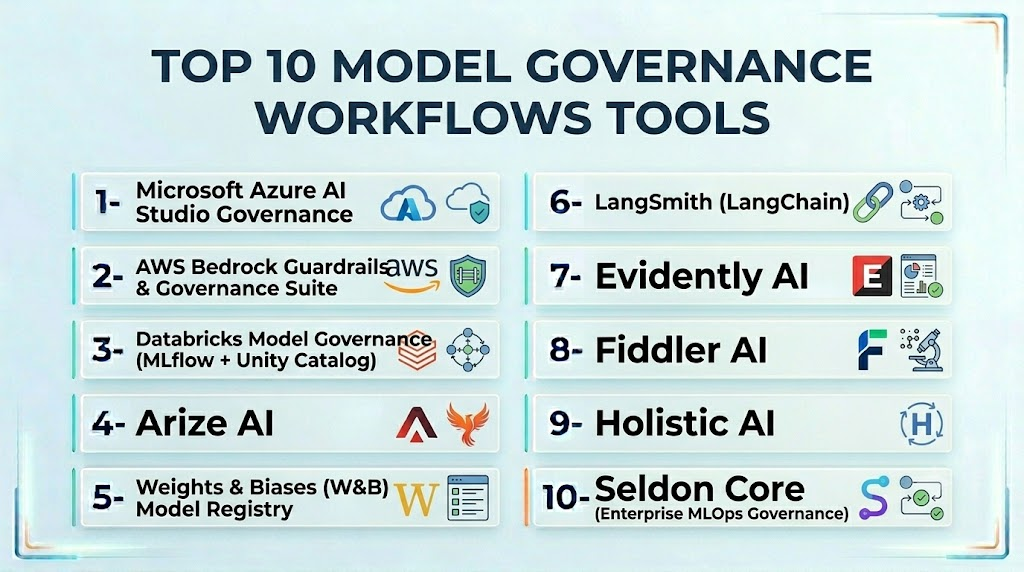
Top 10 Model Governance Workflows Tools
1- Microsoft Azure AI Studio Governance
One-line verdict: Best for enterprises deeply embedded in Microsoft AI and Azure ecosystems.
Short description:
Azure AI Studio Governance provides enterprise-grade controls for managing AI models, including safety, monitoring, and lifecycle governance. It is widely used in large organizations already standardized on Azure infrastructure.
Standout Capabilities
- Centralized AI governance dashboard
- Built-in safety filters and policy controls
- Model lifecycle tracking across environments
- Integration with Azure ML pipelines
- Enterprise-grade access control and logging
- Multi-model deployment support
- Real-time monitoring and drift detection
AI-Specific Depth
- Model support: Multi-model, Azure-hosted + BYO models
- RAG integration: Azure AI Search and vector stores
- Evaluation: Built-in evaluation pipelines and prompt testing
- Guardrails: Content filtering, safety policies, policy enforcement
- Observability: Latency, token usage, cost tracking dashboards
Pros
- Strong enterprise integration
- Deep compliance and governance tooling
- Scales across large AI ecosystems
Cons
- Complex setup for smaller teams
- Strong Azure dependency
Security & Compliance
RBAC, SSO, audit logs, encryption supported; certifications vary by Azure services.
Deployment & Platforms
Cloud-native (Azure only)
Integrations & Ecosystem
- Azure ML
- Azure OpenAI
- Power BI
- CI/CD pipelines
- APIs and SDKs
Pricing Model
Tiered enterprise usage-based model
Best-Fit Scenarios
- Large enterprises using Azure
- Regulated industries
- Multi-model production systems
2- AWS Bedrock Guardrails & Governance Suite
One-line verdict: Ideal for AWS-native AI workloads requiring scalable governance.
Short description:
AWS Bedrock provides governance layers for foundation models, enabling safe deployment, monitoring, and policy enforcement across AI applications built on AWS.
Standout Capabilities
- Guardrails for foundation models
- Multi-model orchestration
- Integration with AWS ML ecosystem
- Logging and monitoring via CloudWatch
- Policy-based output filtering
- Secure model hosting environment
AI-Specific Depth
- Model support: Multi-model (AWS Bedrock models + external APIs)
- RAG integration: AWS Knowledge Bases
- Evaluation: Basic evaluation via monitoring tools
- Guardrails: Prompt filtering, safety constraints
- Observability: CloudWatch metrics, logs, traces
Pros
- Strong cloud-native integration
- Scalable governance framework
- Secure production deployment
Cons
- Evaluation tooling still evolving
- AWS ecosystem lock-in
Security & Compliance
IAM, encryption, audit logs available
Deployment & Platforms
Cloud (AWS)
Integrations & Ecosystem
- SageMaker
- Lambda
- CloudWatch
- API Gateway
- Third-party ML tools
Pricing Model
Usage-based (AWS consumption model)
Best-Fit Scenarios
- AWS-first organizations
- Scalable AI APIs
- Production LLM applications
3- Databricks Model Governance (MLflow + Unity Catalog)
One-line verdict: Best for data-heavy enterprises running ML + LLM pipelines together.
Short description:
Databricks combines MLflow and Unity Catalog to offer structured governance for models, datasets, and AI pipelines in unified data environments.
Standout Capabilities
- Unified model registry
- Dataset and model lineage tracking
- Centralized governance across data + AI
- Experiment tracking with MLflow
- Fine-grained access controls
- Workflow automation pipelines
AI-Specific Depth
- Model support: Open-source + custom models
- RAG integration: Native support via Lakehouse architecture
- Evaluation: MLflow-based evaluation tracking
- Guardrails: Policy-based governance rules
- Observability: Full lineage and metrics tracking
Pros
- Strong data + AI unification
- Excellent lineage tracking
- Mature ML ecosystem
Cons
- Requires Databricks ecosystem adoption
- Steep learning curve
Security & Compliance
Enterprise-grade RBAC, audit logs, and data governance
Deployment & Platforms
Cloud + hybrid supported
Integrations & Ecosystem
- Apache Spark
- MLflow
- Delta Lake
- BI tools
- APIs and notebooks
Pricing Model
Usage-based + enterprise licensing
Best-Fit Scenarios
- Data engineering-heavy teams
- ML + LLM hybrid workflows
- Large-scale analytics organizations
4- Arize AI
One-line verdict: Best for model observability and LLM evaluation at scale.
Short description:
Arize AI focuses on monitoring, evaluation, and debugging of ML and LLM systems in production environments with deep observability features.
Standout Capabilities
- LLM observability dashboards
- Drift detection and alerting
- Prompt and response tracing
- Model evaluation workflows
- Root cause analysis tools
- Feedback loop integration
AI-Specific Depth
- Model support: Multi-model (LLMs + ML models)
- RAG integration: Supports RAG tracing
- Evaluation: Strong evaluation + benchmarking
- Guardrails: Limited policy enforcement
- Observability: Deep tracing and metrics
Pros
- Excellent debugging capabilities
- Strong LLM observability
- Fast issue detection
Cons
- Limited governance enforcement
- Not a full lifecycle platform
Security & Compliance
Not publicly stated
Deployment & Platforms
Cloud-based
Integrations & Ecosystem
- OpenAI APIs
- LangChain
- Vector databases
- Data warehouses
Pricing Model
Usage-based / enterprise tiers
Best-Fit Scenarios
- AI observability teams
- LLM debugging workflows
- RAG-based systems
5- Weights & Biases (W&B) Model Registry
One-line verdict: Best for ML experimentation tracking and model version governance.
Short description:
W&B provides experiment tracking, model registry, and evaluation tools widely used by ML teams managing iterative model development.
Standout Capabilities
- Experiment tracking dashboards
- Model version registry
- Performance comparison tools
- Collaboration workflows
- Dataset versioning support
- Integration with training pipelines
AI-Specific Depth
- Model support: ML + LLM fine-tuning workflows
- RAG integration: Limited
- Evaluation: Strong experiment-based evaluation
- Guardrails: Not available
- Observability: Training metrics + logs
Pros
- Excellent ML experimentation tracking
- Strong collaboration features
- Widely adopted in ML teams
Cons
- Limited production governance
- Not focused on safety controls
Security & Compliance
Not publicly stated
Deployment & Platforms
Cloud + enterprise self-host options
Integrations & Ecosystem
- PyTorch
- TensorFlow
- Hugging Face
- CI/CD tools
Pricing Model
Freemium + enterprise tiers
Best-Fit Scenarios
- ML research teams
- Model experimentation workflows
- Training pipeline governance
6- LangSmith (LangChain)
One-line verdict: Best for LLM application tracing and evaluation workflows.
Short description:
LangSmith is designed for debugging, evaluating, and monitoring LLM applications built using LangChain or similar frameworks.
Standout Capabilities
- Prompt trace visualization
- Dataset-based evaluation workflows
- Chain-of-thought debugging
- Human feedback integration
- Experiment tracking
- API-level observability
AI-Specific Depth
- Model support: Multi-provider LLMs
- RAG integration: Native LangChain support
- Evaluation: Strong LLM eval framework
- Guardrails: Limited policy enforcement
- Observability: Deep trace-level logs
Pros
- Excellent for LLM app debugging
- Easy integration with LangChain
- Strong evaluation tools
Cons
- Narrow ecosystem focus
- Limited enterprise governance
Security & Compliance
Not publicly stated
Deployment & Platforms
Cloud-based
Integrations & Ecosystem
- LangChain
- OpenAI
- Vector DBs
- APIs and SDKs
Pricing Model
Usage-based tiers
Best-Fit Scenarios
- LLM developers
- RAG application builders
- Prompt engineering workflows
7- Evidently AI
One-line verdict: Best open-source-style tool for model monitoring and drift detection.
Short description:
Evidently AI focuses on monitoring ML model performance, data drift, and prediction quality over time.
Standout Capabilities
- Data drift detection
- Model performance dashboards
- Custom monitoring metrics
- Batch evaluation pipelines
- Report generation tools
AI-Specific Depth
- Model support: ML models + basic LLM support
- RAG integration: Limited
- Evaluation: Strong statistical evaluation
- Guardrails: Not available
- Observability: Metrics + drift tracking
Pros
- Lightweight and flexible
- Strong monitoring capabilities
- Open-source friendly
Cons
- Limited enterprise governance
- Not full lifecycle platform
Security & Compliance
Varies / N/A
Deployment & Platforms
Self-host or cloud
Integrations & Ecosystem
- Python ML stacks
- Data pipelines
- BI tools
Pricing Model
Open-source + enterprise offerings
Best-Fit Scenarios
- ML monitoring systems
- Data science teams
- Lightweight governance setups
8- Fiddler AI
One-line verdict: Strong enterprise-grade explainability and monitoring platform.
Short description:
Fiddler AI focuses on model explainability, fairness, monitoring, and governance for enterprise ML systems.
Standout Capabilities
- Explainability dashboards
- Bias detection tools
- Model performance monitoring
- Drift alerts
- Governance workflows
AI-Specific Depth
- Model support: ML + LLM support
- RAG integration: Limited
- Evaluation: Strong explainability evaluation
- Guardrails: Policy-based controls
- Observability: Full model metrics
Pros
- Strong explainability features
- Enterprise-ready monitoring
- Good governance tools
Cons
- Less LLM-native than newer tools
- Complex enterprise setup
Security & Compliance
Enterprise-grade controls (details vary)
Deployment & Platforms
Cloud + hybrid
Integrations & Ecosystem
- ML pipelines
- Data warehouses
- APIs
Pricing Model
Enterprise subscription
Best-Fit Scenarios
- Regulated industries
- Explainability-focused AI
- Enterprise ML governance
9- Holistic AI
One-line verdict: Best for enterprise AI lifecycle governance with compliance focus.
Short description:
Holistic AI provides governance, risk, and compliance workflows specifically designed for enterprise AI systems.
Standout Capabilities
- AI risk assessment tools
- Compliance dashboards
- Model registry and tracking
- Bias and fairness testing
- Audit-ready reporting
AI-Specific Depth
- Model support: Multi-model enterprise AI
- RAG integration: Limited
- Evaluation: Compliance-focused evaluation
- Guardrails: Policy enforcement tools
- Observability: Governance-level monitoring
Pros
- Strong compliance focus
- Enterprise-ready governance
- Risk-first AI design
Cons
- Less developer-friendly
- Limited technical depth for LLM debugging
Security & Compliance
Strong compliance tooling (exact certifications not publicly stated)
Deployment & Platforms
Cloud + enterprise deployments
Integrations & Ecosystem
- Enterprise systems
- APIs
- Data platforms
Pricing Model
Enterprise licensing
Best-Fit Scenarios
- Regulated industries
- Risk-heavy AI deployments
- Compliance-driven organizations
10- Seldon Core (Enterprise MLOps Governance)
One-line verdict: Best for Kubernetes-native model deployment and governance.
Short description:
Seldon Core enables deployment, monitoring, and governance of ML models in Kubernetes environments.
Standout Capabilities
- Kubernetes-native model deployment
- Canary and A/B testing support
- Model monitoring pipelines
- Explainability tools integration
- Scalable inference architecture
AI-Specific Depth
- Model support: Open-source + custom models
- RAG integration: Limited
- Evaluation: External integration required
- Guardrails: Deployment-level controls
- Observability: Kubernetes metrics
Pros
- Highly scalable architecture
- Strong DevOps integration
- Flexible deployment model
Cons
- Requires Kubernetes expertise
- Not LLM-native
Security & Compliance
Varies / N/A
Deployment & Platforms
Self-hosted (Kubernetes-based)
Integrations & Ecosystem
- Kubernetes
- CI/CD pipelines
- ML frameworks
Pricing Model
Open-source + enterprise support
Best-Fit Scenarios
- Platform engineering teams
- Kubernetes-native AI deployments
- Large-scale inference systems
Comparison Table (Top 10)
| Tool Name | Best For | Deployment | Model Flexibility | Strength | Watch-Out | Public Rating |
|---|---|---|---|---|---|---|
| Azure AI Studio Governance | Enterprise AI governance | Cloud | Multi-model | Enterprise control | Azure lock-in | N/A |
| AWS Bedrock | Scalable AI apps | Cloud | Multi-model | AWS integration | Eval limitations | N/A |
| Databricks | Data + AI governance | Hybrid | BYO | Data lineage | Complexity | N/A |
| Arize AI | LLM observability | Cloud | Multi-model | Debugging | Limited governance | N/A |
| W&B | Experiment tracking | Cloud/self-host | ML + LLM | Training tracking | Weak governance | N/A |
| LangSmith | LLM debugging | Cloud | Multi-provider | Trace visibility | Narrow scope | N/A |
| Evidently AI | ML monitoring | Hybrid | ML-focused | Drift detection | Limited governance | N/A |
| Fiddler AI | Explainability | Enterprise cloud | ML + LLM | Bias detection | LLM lag | N/A |
| Holistic AI | AI compliance | Enterprise cloud | Multi-model | Risk governance | Less technical | N/A |
| Seldon Core | Kubernetes ML ops | Self-host | Open models | Scalability | Complex setup | N/A |
Scoring & Evaluation (Transparent Rubric)
Scoring reflects relative strengths across governance depth, evaluation, observability, and enterprise readiness—not absolute performance.
| Tool | Core | Reliability/Eval | Guardrails | Integrations | Ease | Perf/Cost | Security/Admin | Support | Weighted Total |
|---|---|---|---|---|---|---|---|---|---|
| Azure AI Studio Governance | 9.5 | 9 | 9 | 9 | 7 | 9 | 9.5 | 8 | 9.1 |
| AWS Bedrock | 9 | 8 | 9 | 9 | 8 | 9 | 9 | 8 | 8.8 |
| Databricks | 9 | 9 | 7 | 9 | 6 | 8 | 9 | 8 | 8.5 |
| Arize AI | 8.5 | 9.5 | 6 | 8 | 8 | 8 | 7 | 8 | 8.1 |
| W&B | 8.5 | 9 | 5 | 8 | 9 | 8 | 7 | 8 | 7.9 |
| LangSmith | 8 | 9 | 6 | 8 | 9 | 8 | 7 | 7 | 7.8 |
| Evidently AI | 7.5 | 8.5 | 5 | 7 | 9 | 8 | 7 | 7 | 7.4 |
| Fiddler AI | 8.5 | 9 | 8 | 8 | 7 | 8 | 9 | 8 | 8.3 |
| Holistic AI | 8.5 | 8.5 | 9 | 8 | 6 | 8 | 9 | 8 | 8.2 |
| Seldon Core | 8 | 7.5 | 6 | 8 | 6 | 9 | 8 | 7 | 7.5 |
Which Model Governance Workflows Tool Is Right for You?
Solo / Freelancer
Lightweight tools like LangSmith or Evidently AI work best for experimentation and debugging without heavy governance overhead.
SMB
Teams should focus on W&B or Arize AI for balancing monitoring, evaluation, and early-stage governance needs.
Mid-Market
Databricks or Fiddler AI provide stronger governance and scalability as AI systems mature.
Enterprise
Azure AI Studio Governance and AWS Bedrock dominate due to compliance, scale, and ecosystem integration.
Regulated industries (finance/healthcare/public sector)
Holistic AI and Fiddler AI are strongest due to risk, explainability, and compliance-focused workflows.
Budget vs premium
- Budget: Evidently AI, LangSmith
- Premium: Azure, AWS, Databricks, Fiddler AI
Build vs buy
- Build: Seldon Core + open-source stack
- Buy: Enterprise governance platforms for compliance-heavy systems
Common Mistakes & How to Avoid Them
- Ignoring evaluation pipelines before production
- Not tracking prompt versions or model versions
- Underestimating prompt injection risks
- Lack of cost monitoring for LLM usage
- No rollback strategy for bad model behavior
- Over-reliance on single model providers
- Missing audit logs in regulated environments
- Poor RAG validation leading to hallucinations
- No human-in-the-loop approval for sensitive outputs
- Vendor lock-in without abstraction layer
- Treating governance as optional instead of foundational
- Deploying agents without safety constraints
- Ignoring latency bottlenecks in production systems
FAQs
1. What is model governance in AI systems?
Model governance is the structured management of AI models across their lifecycle, including development, deployment, monitoring, and compliance.
It ensures models behave safely, transparently, and consistently in production environments.
2. Why is model governance important in 2026?
AI systems are now agentic and multi-model, increasing unpredictability. Governance ensures safety, reliability, and regulatory compliance.
It also helps control costs and prevent unintended behaviors in production systems.
3. Do model governance tools support LLMs and traditional ML?
Yes, most modern platforms support both LLMs and ML models.
However, LLM-specific features like prompt tracing and hallucination detection vary by tool.
4. What is the difference between observability and governance?
Observability focuses on monitoring system behavior, while governance enforces rules, policies, and compliance.
Governance includes observability but adds control layers and decision enforcement.
5. Can I use open-source tools for governance?
Yes, tools like Evidently AI and Seldon Core allow open-source governance setups.
However, enterprise compliance features may require commercial platforms.
6. What are AI guardrails?
Guardrails are safety mechanisms that restrict harmful or unwanted model outputs.
They include filtering, policy enforcement, and prompt injection protection.
7. How do governance tools handle RAG systems?
They monitor retrieval accuracy, validate knowledge sources, and track context usage.
Some tools offer deep tracing of RAG pipelines, while others provide basic support.
8. What is model evaluation in governance workflows?
Evaluation refers to systematically testing model outputs for accuracy, bias, hallucination, and performance.
It often includes automated tests and human feedback loops.
9. Do these tools support multi-model systems?
Yes, modern governance platforms support routing across multiple models.
This helps optimize cost, latency, and performance dynamically.
10. What are common governance risks?
Key risks include hallucinations, prompt injection attacks, data leakage, and model drift.
Without governance, these risks can silently degrade system reliability.
11. How expensive are governance platforms?
Costs vary widely depending on scale and features.
Many enterprise tools use usage-based or tiered pricing models.
12. Can governance tools reduce AI costs?
Yes, by optimizing model routing, tracking token usage, and reducing redundant calls.
They also help identify inefficient workflows in production systems.
Conclusion
Model governance workflows have become a foundational layer in modern AI systems, especially as organizations shift toward agent-based architectures and multi-model ecosystems. The right platform is no longer optional—it is essential for safety, reliability, and cost control.
The key takeaway is that there is no universal best tool. Enterprises may prioritize Azure or AWS, while developers often benefit from tools like LangSmith or Arize AI. Data-heavy teams lean toward Databricks, and regulated industries require compliance-first solutions like Holistic AI or Fiddler AI.
