Introduction
Retrieval-Augmented Generation RAG frameworks are systems that combine large language models with external knowledge retrieval to generate more accurate, grounded, and up-to-date responses. Instead of relying only on model memory, RAG systems first retrieve relevant information from databases, documents, vector stores, or APIs, and then use that context to generate answers.
RAG has become a foundational architecture for enterprise AI because it solves three critical problems: hallucination reduction, knowledge freshness, and domain adaptation without costly model retraining. Modern RAG systems are no longer simple pipelines—they are agentic, multi-step reasoning systems with memory, ranking, and evaluation layers.
RAG frameworks are widely used for:
- Enterprise knowledge assistants and chatbots
- Customer support automation with internal documents
- Legal, healthcare, and finance document reasoning
- AI copilots for engineering and analytics teams
- Multi-source retrieval across APIs, databases, and files
- Agentic workflows with tool calling and memory
- Research assistants with citation-grounded outputs
- Internal search and semantic query systems
To evaluate RAG frameworks effectively, buyers should consider:
- Retrieval quality and ranking strategies
- Vector database integration flexibility
- Support for hybrid search (keyword + semantic)
- Chunking and embedding pipelines
- Multi-modal retrieval support (text, images, PDFs)
- LLM orchestration and prompt control
- Evaluation and grounding metrics
- Latency and cost optimization
- Agent-based or multi-step reasoning support
- Observability and debugging tools
- Security, privacy, and data control
Best for: AI engineers, enterprise knowledge teams, LLM application developers, and organizations building production-grade AI assistants.
Not ideal for: simple chatbots, static rule-based systems, or non-knowledge-based AI use cases.
What’s Changed in RAG Frameworks
- Shift from basic retrieval → agentic multi-step reasoning RAG
- Native support for hybrid search (vector + keyword + graph)
- Integration with tool calling and autonomous agents
- Built-in RAG evaluation and grounding scoring
- Strong focus on context window optimization
- Support for multi-modal RAG (text, image, audio, video)
- Advanced reranking models for improved precision
- Memory-based RAG with persistent conversation context
- Real-time indexing and streaming ingestion pipelines
- Tight integration with LLMOps observability tools
- Security-focused retrieval (access control-aware RAG)
- Cost-aware retrieval routing (fewer tokens, smarter context selection)
Quick Buyer Checklist
- Does it support vector databases (Pinecone, Weaviate, etc.)?
- Can it handle hybrid search (keyword + semantic)?
- Does it support multi-step reasoning or agent workflows?
- Is retrieval quality measurable (precision/recall metrics)?
- Does it support document chunking strategies?
- Can it handle structured + unstructured data?
- Does it support RAG evaluation frameworks?
- Is there support for caching and latency optimization?
- Can it integrate with enterprise authentication systems?
- Does it support real-time indexing?
- Is multi-modal retrieval supported?
- Can it scale across large document corpora?
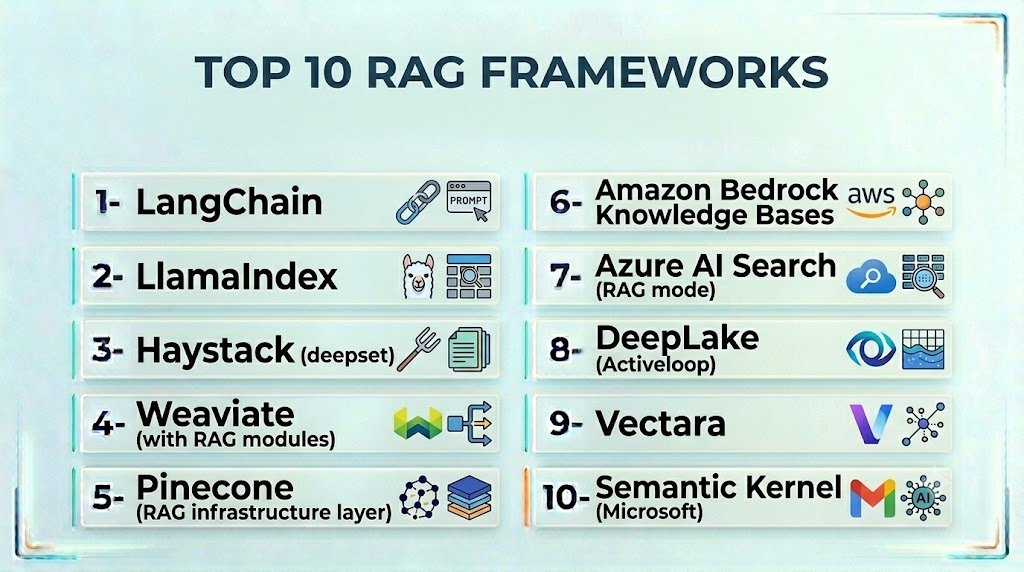
Top 10 RAG Frameworks
1- LangChain
One-line verdict: Most widely used RAG framework for building flexible LLM applications.
Short description:
LangChain is a modular framework for building LLM applications with strong support for retrieval-augmented generation pipelines, tool use, and agent workflows. It is widely adopted across startups and enterprises.
Standout Capabilities
- Modular RAG pipeline architecture
- Tool calling and agent orchestration
- Wide vector DB integrations
- Document loaders for multiple formats
- Prompt chaining and memory systems
- Multi-step reasoning pipelines
- Streaming and async execution support
AI-Specific Depth
- Model support: Multi-provider LLM support (OpenAI, open-source, etc.)
- RAG integration: Extensive vector DB and retriever support
- Evaluation: Basic evaluation via extensions
- Guardrails: External integrations required
- Observability: LangSmith integration for tracing
Pros
- Highly flexible and modular
- Huge ecosystem and community
- Strong RAG abstraction layer
Cons
- Can become complex at scale
- Rapid API changes
Security & Compliance
Not publicly stated
Deployment & Platforms
Cloud, self-hosted, hybrid
Integrations & Ecosystem
- Pinecone
- Weaviate
- OpenAI APIs
- Hugging Face
- LlamaIndex ecosystem
Pricing Model
Open-source + enterprise tools
Best-Fit Scenarios
- Custom RAG applications
- AI copilots
- Agent-based systems
2- LlamaIndex
One-line verdict: Best data-centric RAG framework for structured and unstructured retrieval.
Short description:
LlamaIndex is designed specifically for connecting LLMs with external data sources and building high-quality retrieval systems.
Standout Capabilities
- Advanced document indexing pipelines
- Structured + unstructured data support
- Query engines for RAG workflows
- Multi-document reasoning
- Hierarchical indexing strategies
- Vector + keyword hybrid retrieval
AI-Specific Depth
- Model support: Multi-LLM support
- RAG integration: Native and deep integration
- Evaluation: Built-in evaluation tools
- Guardrails: Limited built-in support
- Observability: Basic tracing tools
Pros
- Strong data ingestion pipelines
- Excellent retrieval accuracy tools
- Easy RAG setup
Cons
- Less flexible than LangChain
- Smaller ecosystem
Security & Compliance
Varies / N/A
Deployment & Platforms
Cloud + self-hosted
Integrations & Ecosystem
- Vector databases
- OpenAI APIs
- Document loaders
- Data warehouses
Pricing Model
Open-source + enterprise offerings
Best-Fit Scenarios
- Enterprise knowledge assistants
- Document-heavy AI systems
- Structured RAG pipelines
3- Haystack (deepset)
One-line verdict: Enterprise-grade RAG framework built for production search and QA systems.
Short description:
Haystack is a mature RAG framework designed for building scalable search and question-answering systems with strong enterprise features.
Standout Capabilities
- Pipeline-based RAG architecture
- Strong document retrieval systems
- Hybrid search support
- Production-ready deployment tools
- Multi-document QA pipelines
- Elasticsearch integration
AI-Specific Depth
- Model support: Multi-model support
- RAG integration: Strong native support
- Evaluation: Built-in evaluation pipelines
- Guardrails: Limited policy controls
- Observability: Pipeline tracing support
Pros
- Production-ready architecture
- Strong enterprise adoption
- Highly scalable
Cons
- Steeper learning curve
- Less flexible for rapid prototyping
Security & Compliance
Enterprise RBAC and security features (details vary)
Deployment & Platforms
Cloud + on-prem
Integrations & Ecosystem
- Elasticsearch
- OpenAI
- Hugging Face
- Vector DBs
Pricing Model
Open-source + enterprise
Best-Fit Scenarios
- Enterprise search systems
- Production QA systems
- Large-scale document retrieval
4- Weaviate (with RAG modules)
One-line verdict: Best vector database with built-in RAG capabilities.
Short description:
Weaviate is a vector database that includes native RAG modules for combining retrieval and generation in a single system.
Standout Capabilities
- Native vector + hybrid search
- Built-in RAG pipelines
- Schema-based knowledge graphs
- Real-time indexing
- Multi-modal support (text + images)
- Filtering + semantic search
AI-Specific Depth
- Model support: External LLM integration
- RAG integration: Native
- Evaluation: External tools required
- Guardrails: Limited
- Observability: Basic query logs
Pros
- Tight integration of storage + retrieval
- High performance
- Multi-modal support
Cons
- Less flexible as full framework
- Requires database-centric design
Security & Compliance
Not publicly stated
Deployment & Platforms
Cloud + self-host
Integrations & Ecosystem
- LangChain
- LlamaIndex
- OpenAI APIs
- Kubernetes
Pricing Model
Open-source + managed cloud
Best-Fit Scenarios
- Vector search applications
- RAG-powered search engines
- Multi-modal retrieval systems
5- Pinecone (RAG infrastructure layer)
One-line verdict: Best managed vector database for scalable RAG applications.
Short description:
Pinecone provides a fully managed vector database optimized for high-performance retrieval in RAG systems.
Standout Capabilities
- Fully managed vector search
- High-speed similarity search
- Real-time indexing
- Metadata filtering
- Scalable architecture
- Low-latency retrieval
AI-Specific Depth
- Model support: External embedding models
- RAG integration: High compatibility
- Evaluation: External required
- Guardrails: Not available
- Observability: Query-level metrics
Pros
- Extremely fast retrieval
- Easy scaling
- Minimal infrastructure overhead
Cons
- Vendor lock-in risk
- Not a full RAG framework
Security & Compliance
Enterprise security features available; specifics vary
Deployment & Platforms
Cloud-only
Integrations & Ecosystem
- LangChain
- LlamaIndex
- OpenAI
- Data pipelines
Pricing Model
Usage-based
Best-Fit Scenarios
- Production RAG systems
- High-scale search
- SaaS AI applications
6- Amazon Bedrock Knowledge Bases
One-line verdict: Best AWS-native RAG solution with managed knowledge integration.
Short description:
AWS Bedrock Knowledge Bases enables managed RAG pipelines integrated with AWS services.
Standout Capabilities
- Managed RAG pipeline setup
- Native AWS integration
- Vector store abstraction
- Secure document ingestion
- IAM-based access control
- Scalable retrieval systems
AI-Specific Depth
- Model support: Bedrock LLMs + external
- RAG integration: Native AWS RAG
- Evaluation: Basic monitoring
- Guardrails: AWS policy controls
- Observability: CloudWatch integration
Pros
- Fully managed AWS solution
- Strong security controls
- Scalable infrastructure
Cons
- AWS lock-in
- Limited customization
Security & Compliance
AWS IAM, encryption, audit logging
Deployment & Platforms
Cloud (AWS only)
Integrations & Ecosystem
- S3
- Lambda
- OpenSearch
- Bedrock models
Pricing Model
Usage-based
Best-Fit Scenarios
- AWS enterprise systems
- Secure RAG applications
- Scalable AI assistants
7- Azure AI Search (RAG mode)
One-line verdict: Best enterprise search + RAG integration in Microsoft ecosystem.
Short description:
Azure AI Search provides semantic search and vector capabilities for building RAG pipelines.
Standout Capabilities
- Hybrid search (semantic + keyword)
- Vector indexing support
- Cognitive search pipelines
- Enterprise security integration
- Scalable indexing system
AI-Specific Depth
- Model support: Azure OpenAI integration
- RAG integration: Native hybrid support
- Evaluation: External tools required
- Guardrails: Azure policy enforcement
- Observability: Azure monitoring tools
Pros
- Strong enterprise integration
- Hybrid search capabilities
- Secure architecture
Cons
- Azure ecosystem dependency
- Limited framework flexibility
Security & Compliance
Enterprise-grade Azure security
Deployment & Platforms
Cloud (Azure only)
Integrations & Ecosystem
- Azure OpenAI
- Cognitive Services
- Power BI
- Data Lake
Pricing Model
Usage-based
Best-Fit Scenarios
- Enterprise Microsoft environments
- Secure RAG applications
- Knowledge search systems
8- DeepLake (Activeloop)
One-line verdict: Best for multimodal RAG datasets and AI data lakes.
Short description:
DeepLake is a data lake optimized for AI workloads, including multimodal RAG systems with embeddings and structured datasets.
Standout Capabilities
- AI-optimized data storage
- Multimodal dataset support
- Streaming data ingestion
- Embedding storage
- Versioned datasets
- High-performance retrieval
AI-Specific Depth
- Model support: ML + LLM systems
- RAG integration: Strong dataset-level support
- Evaluation: External required
- Guardrails: Not available
- Observability: Dataset-level tracking
Pros
- Strong multimodal support
- Efficient dataset handling
- Good for large-scale AI data
Cons
- Not full RAG framework
- Requires integration with other tools
Security & Compliance
Varies / N/A
Deployment & Platforms
Cloud + self-host
Integrations & Ecosystem
- LangChain
- PyTorch
- Hugging Face
- Vector DBs
Pricing Model
Freemium + enterprise
Best-Fit Scenarios
- Multimodal AI systems
- Large-scale datasets
- AI data infrastructure
9- Vectara
One-line verdict: Best end-to-end managed RAG-as-a-service platform.
Short description:
Vectara provides a fully managed RAG pipeline including ingestion, retrieval, and generation.
Standout Capabilities
- End-to-end RAG pipeline
- Built-in ranking and retrieval
- Hallucination reduction techniques
- Secure document ingestion
- API-first architecture
- Enterprise-ready search
AI-Specific Depth
- Model support: Managed LLMs
- RAG integration: Fully native
- Evaluation: Built-in scoring
- Guardrails: Safety filters included
- Observability: API metrics
Pros
- Fully managed solution
- Strong out-of-the-box quality
- Minimal setup
Cons
- Limited customization
- Vendor dependency
Security & Compliance
Enterprise security features (varies)
Deployment & Platforms
Cloud-based
Integrations & Ecosystem
- APIs
- Document ingestion tools
- Enterprise systems
Pricing Model
Usage-based SaaS
Best-Fit Scenarios
- Fast RAG deployment
- Enterprise search systems
- SaaS AI assistants
10- Semantic Kernel (Microsoft)
One-line verdict: Best developer framework for building RAG + agentic AI systems.
Short description:
Semantic Kernel is a development framework for building AI applications with memory, planning, and RAG capabilities.
Standout Capabilities
- Planner-based AI workflows
- Memory + RAG integration
- Plugin architecture
- Multi-model orchestration
- Tool calling support
- Enterprise integration
AI-Specific Depth
- Model support: Multi-LLM support
- RAG integration: Strong via memory systems
- Evaluation: External tools required
- Guardrails: Limited
- Observability: Basic logs
Pros
- Strong for agentic systems
- Flexible architecture
- Microsoft ecosystem integration
Cons
- Still evolving
- Requires engineering effort
Security & Compliance
Varies / N/A
Deployment & Platforms
Cloud + self-host
Integrations & Ecosystem
- Azure OpenAI
- .NET / Python SDKs
- Enterprise APIs
- Vector DBs
Pricing Model
Open-source
Best-Fit Scenarios
- AI agents + RAG systems
- Enterprise copilots
- Multi-step reasoning apps
Comparison Table
| Tool Name | Best For | Deployment | RAG Strength | Model Flexibility | Strength | Watch-Out | Public Rating |
|---|---|---|---|---|---|---|---|
| LangChain | Custom RAG apps | Cloud/self-host | High | Multi-model | Flexibility | Complexity | N/A |
| LlamaIndex | Data-centric RAG | Cloud/self-host | High | Multi-model | Retrieval quality | Smaller ecosystem | N/A |
| Haystack | Enterprise search | Cloud/on-prem | High | Multi-model | Production readiness | Learning curve | N/A |
| Weaviate | Vector + RAG DB | Cloud/self-host | High | External LLMs | Speed | DB-centric | N/A |
| Pinecone | Scalable vector DB | Cloud | Medium | External | Performance | Lock-in | N/A |
| Bedrock KB | AWS RAG | Cloud | High | Bedrock models | Managed RAG | AWS lock-in | N/A |
| Azure AI Search | Enterprise search | Cloud | High | Azure LLMs | Hybrid search | Ecosystem lock-in | N/A |
| DeepLake | Multimodal RAG data | Cloud/self-host | Medium | Multi-model | Data handling | Not full framework | N/A |
| Vectara | Managed RAG SaaS | Cloud | Very High | Managed LLMs | Simplicity | Limited control | N/A |
| Semantic Kernel | Agentic RAG apps | Cloud/self-host | High | Multi-model | Agent workflows | Evolving tool | N/A |
Scoring & Evaluation (Transparent Rubric)
| Tool | Core | Reliability/Eval | Guardrails | Integrations | Ease | Perf/Cost | Security/Admin | Support | Weighted Total |
|---|---|---|---|---|---|---|---|---|---|
| LangChain | 9.5 | 8.5 | 7 | 9.5 | 8 | 8 | 8 | 9 | 8.7 |
| LlamaIndex | 9 | 9 | 7 | 9 | 8 | 8 | 8 | 8 | 8.5 |
| Haystack | 9 | 8.5 | 7 | 9 | 7 | 8 | 9 | 8 | 8.4 |
| Weaviate | 8.5 | 8 | 6 | 8.5 | 8 | 9 | 8 | 8 | 8.1 |
| Pinecone | 8 | 7.5 | 6 | 8.5 | 9 | 9.5 | 9 | 8 | 8.3 |
| Bedrock KB | 9 | 8 | 8 | 9 | 8 | 9 | 9 | 8 | 8.7 |
| Azure AI Search | 9 | 8 | 8 | 9 | 8 | 9 | 9 | 8 | 8.7 |
| DeepLake | 8 | 7.5 | 6 | 8 | 8 | 8 | 7 | 8 | 7.7 |
| Vectara | 9 | 9 | 8 | 8.5 | 9 | 9 | 9 | 8 | 8.8 |
| Semantic Kernel | 8.5 | 8 | 7 | 8.5 | 8 | 8 | 8 | 8 | 8.2 |
Which RAG Framework Is Right for You?
Solo / Freelancer
LangChain or LlamaIndex for rapid prototyping and flexible RAG apps.
SMB
Pinecone + LangChain or LlamaIndex for scalable production-ready RAG systems.
Mid-Market
Haystack or Weaviate for structured, reliable retrieval pipelines.
Enterprise
Azure AI Search, AWS Bedrock, or Vectara for secure and scalable deployments.
Regulated industries (finance/healthcare/public sector)
Azure AI Search and AWS Bedrock offer strongest governance and compliance.
Budget vs premium
- Budget: LangChain, LlamaIndex, Weaviate
- Premium: Vectara, Azure AI Search, Bedrock
Build vs buy
- Build: LangChain + LlamaIndex + vector DB stack
- Buy: Vectara, Azure AI Search, Bedrock
Common Mistakes & How to Avoid Them
- Poor chunking strategies leading to weak retrieval
- Ignoring embedding model quality
- Not using hybrid search approaches
- Overloading context windows with irrelevant data
- No evaluation framework for RAG quality
- Missing caching for repeated queries
- Ignoring latency optimization
- Weak access control for sensitive documents
- No monitoring of retrieval accuracy
- Treating RAG as static instead of dynamic
- Not tracking retrieval sources
- No fallback strategies for failed retrieval
- Overcomplicating early architecture
FAQs
1. What is a RAG framework?
A RAG framework combines retrieval systems with LLMs to generate grounded, accurate responses using external knowledge.
It improves factual accuracy and reduces hallucinations.
2. Why is RAG important in 2026?
Because LLMs alone cannot stay updated with real-time or domain-specific data.
RAG enables dynamic knowledge integration.
3. What is the difference between LangChain and LlamaIndex?
LangChain focuses on flexibility and agent workflows, while LlamaIndex focuses on data-centric retrieval quality.
Both are widely used for RAG systems.
4. Do RAG systems need vector databases?
Yes, most RAG systems rely on vector databases for semantic search.
However, hybrid systems also use keyword search engines.
5. Can RAG work with structured data?
Yes, modern frameworks support structured + unstructured data retrieval.
This improves enterprise use cases.
6. What is hybrid search in RAG?
Hybrid search combines keyword-based and semantic vector search.
It improves accuracy and recall.
7. How do you evaluate RAG performance?
Using metrics like retrieval accuracy, grounding score, hallucination rate, and response relevance.
Some tools also include built-in evaluation frameworks.
8. Is RAG better than fine-tuning?
They solve different problems.
RAG improves knowledge access, while fine-tuning improves behavior.
9. Can RAG systems support real-time data?
Yes, with streaming ingestion pipelines and real-time indexing systems.
This is common in modern enterprise setups.
10. What is RAG hallucination?
It occurs when the model generates incorrect answers despite retrieval.
It usually happens due to poor context selection or ranking.
11. Do RAG frameworks support agents?
Yes, modern frameworks integrate agent-based workflows and tool calling.
This allows multi-step reasoning.
12. What is the biggest challenge in RAG systems?
Ensuring high-quality retrieval and preventing irrelevant context injection.
This directly affects response accuracy.
Conclusion
RAG frameworks have become a foundational layer in modern AI systems, enabling LLMs to access accurate, real-time, and domain-specific knowledge. As systems evolve toward agentic workflows, RAG is no longer just retrieval—it is a full reasoning and knowledge orchestration layer.
The right framework depends on your needs: LangChain and LlamaIndex for flexibility, Pinecone and Weaviate for retrieval infrastructure, and enterprise solutions like Azure AI Search or Vectara for scalable deployments.
