Introduction
Vector search indexing pipelines are the backbone of modern AI systems that rely on semantic understanding instead of keyword matching. In simple terms, these tools take unstructured data—text, images, audio, or code—and convert it into high-dimensional vector embeddings that can be efficiently searched for similarity. This enables applications like retrieval-augmented generation, semantic search, recommendation systems, and agent memory.
and beyond, vector pipelines are no longer just a backend optimization layer—they are a core infrastructure for AI agents, multimodal systems, and enterprise knowledge intelligence. As organizations scale AI across workflows, the ability to index, update, and retrieve embeddings in real time has become mission-critical.
Real-world use cases include enterprise search across documents, AI copilots with long-term memory, e-commerce recommendation engines, fraud detection using behavioral similarity, multimodal image-text retrieval, and customer support automation with contextual recall.
What buyers should evaluate includes ingestion speed, embedding model compatibility, real-time update capability, hybrid search support, observability, cost efficiency, scalability, and governance controls like access policies and data retention.
Best for: AI engineers, ML platform teams, SaaS companies, and enterprises building retrieval-heavy AI systems, especially those deploying RAG, semantic search, or agentic workflows.
Not ideal for: Small static websites, simple keyword search applications, or teams without AI/ML infrastructure needs.
What’s Changed in Vector Search Indexing Pipelines
- Shift from batch indexing to real-time streaming vector ingestion for live AI systems
- Integration of multimodal embeddings (text, image, audio, video in unified vector spaces)
- Emergence of agent-native memory layers that continuously update vector stores
- Strong adoption of hybrid search (keyword + vector + graph fusion)
- Built-in evaluation frameworks for retrieval quality and hallucination reduction
- Automatic embedding model routing based on cost, latency, and accuracy trade-offs
- Native observability for vector drift, recall quality, and retrieval latency
- Increased focus on privacy-preserving embeddings and encrypted vector storage
- Data residency controls for enterprise compliance requirements
- Edge-based vector indexing for low-latency AI applications
- Plug-and-play RAG pipelines replacing manual ingestion workflows
- Standardization of vector DB interoperability APIs
Quick Buyer Checklist
- Does it support real-time vector ingestion and updates?
- Can it work with multiple embedding models or BYO models?
- Does it support hybrid search (keyword + semantic + metadata filters)?
- Are evaluation tools available for retrieval accuracy and drift?
- What guardrails exist for sensitive or poisoned data ingestion?
- How strong are observability features (latency, cost, recall metrics)?
- Does it support scaling to billions of vectors efficiently?
- Is multi-tenancy and access control available?
- What are the data retention and privacy controls?
- Does it lock you into a single vector database or embedding provider?
- How easily can it integrate with RAG frameworks and agent systems?
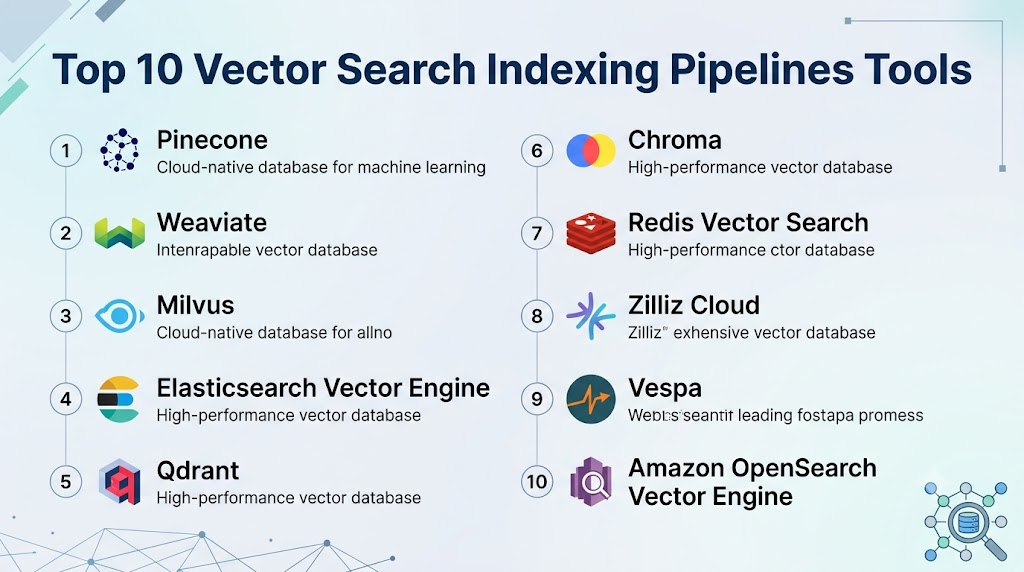
Top 10 Vector Search Indexing Pipelines Tools
1 — Pinecone
One-line verdict: Best for production-grade managed vector indexing with high scalability and low operational overhead.
Short description:
Pinecone is a fully managed vector database and indexing pipeline designed for real-time semantic search at scale. It is widely used in production RAG systems and AI copilots requiring fast retrieval and minimal infrastructure management.
Standout Capabilities
- Fully managed vector indexing and retrieval service
- Real-time updates with low-latency queries
- Horizontal scaling for large datasets
- Metadata filtering combined with vector similarity search
- Multi-region deployment support
- High availability architecture
- Built-in performance optimization for dense retrieval workloads
AI-Specific Depth
- Model support: BYO embedding models, multi-model compatible
- RAG / knowledge integration: Strong support for RAG pipelines
- Evaluation: Not publicly stated
- Guardrails: Basic filtering via metadata rules
- Observability: Query latency and throughput metrics available
Pros
- Extremely easy to deploy and scale
- High performance for real-time applications
- Minimal infrastructure management
Cons
- Vendor lock-in concerns
- Limited transparency into internal indexing mechanisms
- Can become expensive at scale
Security & Compliance
Not publicly stated in full detail; typically includes enterprise-grade encryption and access controls.
Deployment & Platforms
- Cloud-based only
- No self-hosted option
Integrations & Ecosystem
Supports APIs and SDKs for Python, JavaScript, and REST-based integration. Commonly used with LangChain, LlamaIndex, and RAG pipelines.
Pricing Model
Usage-based pricing with tiers; exact pricing varies.
Best-Fit Scenarios
- Enterprise RAG applications
- AI copilots with real-time retrieval
- Large-scale semantic search systems
2 — Weaviate
One-line verdict: Best open-source vector database for flexible hybrid search and knowledge graph integration.
Short description:
Weaviate is an open-source vector search engine that combines semantic search with graph-like relationships, making it powerful for knowledge-heavy AI systems and hybrid retrieval pipelines.
Standout Capabilities
- Hybrid vector + keyword search
- Built-in module system for embeddings
- Graph-like data modeling
- Multi-tenant architecture
- Real-time indexing support
- Modular ML integration layer
- Cloud and self-host options
AI-Specific Depth
- Model support: BYO + built-in embedding modules
- RAG / knowledge integration: Strong native support
- Evaluation: Not publicly stated
- Guardrails: Schema-based filtering
- Observability: Basic metrics and logs
Pros
- Open-source flexibility
- Strong hybrid search capabilities
- Highly extensible architecture
Cons
- Requires engineering expertise
- Operational complexity in self-hosted mode
- Performance tuning needed at scale
Security & Compliance
RBAC and API key-based access controls; enterprise features vary.
Deployment & Platforms
- Cloud
- Self-hosted
- Hybrid
Integrations & Ecosystem
Integrates with embedding providers, LangChain, LlamaIndex, and vector pipelines.
Pricing Model
Open-source core; managed cloud tier available.
Best-Fit Scenarios
- Knowledge graph + vector search systems
- Hybrid enterprise search
- AI research platforms
3 — Milvus
One-line verdict: Best for large-scale distributed vector indexing and high-throughput AI workloads.
Short description:
Milvus is a distributed vector database designed for massive-scale similarity search workloads, often used in enterprise AI systems requiring billions of vectors.
Standout Capabilities
- Distributed architecture
- GPU acceleration support
- High-dimensional vector indexing
- Multiple index types (HNSW, IVF, etc.)
- Horizontal scalability
- Fault-tolerant design
- Batch and streaming ingestion
AI-Specific Depth
- Model support: BYO embeddings
- RAG / knowledge integration: Supported via external frameworks
- Evaluation: Not publicly stated
- Guardrails: External layer required
- Observability: Metrics and logging supported
Pros
- Extremely scalable
- High performance for large datasets
- Open-source ecosystem
Cons
- Complex setup and tuning
- Requires infrastructure expertise
- Not beginner-friendly
Security & Compliance
Varies / N/A for enterprise compliance features.
Deployment & Platforms
- Self-hosted
- Cloud distributions available
Integrations & Ecosystem
Works with LangChain, LlamaIndex, and distributed AI pipelines.
Pricing Model
Open-source with optional managed services.
Best-Fit Scenarios
- Billion-scale vector datasets
- AI search engines
- Large recommendation systems
4 — Elasticsearch Vector Engine
One-line verdict: Best for teams already using Elasticsearch and adding semantic search capabilities.
Short description:
Elasticsearch now includes vector search capabilities, allowing organizations to extend traditional keyword search into semantic retrieval without changing their existing stack.
Standout Capabilities
- Hybrid keyword + vector search
- Mature distributed search infrastructure
- Advanced filtering and aggregation
- Real-time indexing
- Enterprise search capabilities
- Rich query DSL
- Observability via Elastic Stack
AI-Specific Depth
- Model support: External embedding models required
- RAG / knowledge integration: Supported via plugins
- Evaluation: Not publicly stated
- Guardrails: Access control and filters
- Observability: Strong logging and analytics
Pros
- Mature ecosystem
- Strong enterprise adoption
- Excellent hybrid search support
Cons
- Complex configuration
- Not purely AI-native
- Resource intensive
Security & Compliance
Enterprise-grade security features available in paid tiers.
Deployment & Platforms
- Cloud
- Self-hosted
Integrations & Ecosystem
Extensive integrations with Kibana, Beats, and external AI frameworks.
Pricing Model
Tiered subscription model.
Best-Fit Scenarios
- Enterprise search modernization
- Hybrid search systems
- Log + semantic search fusion
5 — Qdrant
One-line verdict: Best developer-friendly vector database with strong filtering and simple API design.
Short description:
Qdrant is an open-source vector search engine optimized for simplicity, performance, and flexible filtering, making it popular among developers building RAG systems.
Standout Capabilities
- Payload-based filtering
- Fast approximate nearest neighbor search
- Rust-based performance engine
- Simple REST and gRPC APIs
- Cloud and self-host options
- Horizontal scaling support
- Lightweight deployment
AI-Specific Depth
- Model support: BYO embeddings
- RAG / knowledge integration: Strong compatibility
- Evaluation: Not publicly stated
- Guardrails: Metadata filtering
- Observability: Basic metrics
Pros
- Easy to use
- High performance
- Lightweight deployment
Cons
- Smaller ecosystem than competitors
- Limited enterprise tooling
- Fewer advanced AI features
Security & Compliance
Not publicly stated.
Deployment & Platforms
- Cloud
- Self-hosted
Integrations & Ecosystem
Works well with LangChain, LlamaIndex, and Python-based AI stacks.
Pricing Model
Open-source + managed cloud offering.
Best-Fit Scenarios
- RAG prototypes
- Developer-first AI apps
- Lightweight semantic search
6 — Chroma
One-line verdict: Best lightweight vector database for prototyping and early-stage AI development.
Short description:
Chroma is a simple, developer-focused vector database designed for rapid experimentation in LLM and embedding-based applications.
Standout Capabilities
- Extremely simple API
- In-memory and persistent modes
- Fast prototyping workflow
- Python-first design
- Easy integration with LLM frameworks
- Minimal setup required
- Local development friendly
AI-Specific Depth
- Model support: BYO embeddings
- RAG / knowledge integration: Native support in frameworks
- Evaluation: Not publicly stated
- Guardrails: Not available
- Observability: Minimal
Pros
- Very easy to start
- Great for prototyping
- Lightweight
Cons
- Not production-grade at scale
- Limited enterprise features
- Performance constraints
Security & Compliance
Not publicly stated.
Deployment & Platforms
- Local
- Cloud options via third-party services
Integrations & Ecosystem
Strong integration with LangChain and Python AI tools.
Pricing Model
Open-source.
Best-Fit Scenarios
- Prototyping RAG apps
- Academic research
- Early-stage AI experiments
7 — Redis Vector Search
One-line verdict: Best for ultra-low-latency vector retrieval combined with caching workloads.
Short description:
Redis Stack extends Redis with vector search capabilities, enabling fast in-memory similarity search combined with caching and real-time workloads.
Standout Capabilities
- In-memory vector search
- Sub-millisecond latency
- Hybrid caching + vector retrieval
- Real-time updates
- Secondary indexing support
- High throughput architecture
- Simple integration with existing Redis systems
AI-Specific Depth
- Model support: BYO embeddings
- RAG / knowledge integration: Supported via external frameworks
- Evaluation: Not publicly stated
- Guardrails: External implementation required
- Observability: Redis monitoring tools
Pros
- Extremely fast
- Works with existing Redis infrastructure
- Great for real-time systems
Cons
- Memory-intensive
- Not optimized for very large datasets
- Limited AI-native features
Security & Compliance
Enterprise Redis offerings include RBAC and encryption features.
Deployment & Platforms
- Cloud
- Self-hosted
Integrations & Ecosystem
Integrates with caching systems, AI pipelines, and backend services.
Pricing Model
Open-source core + enterprise tiers.
Best-Fit Scenarios
- Real-time AI applications
- Recommendation engines
- Low-latency retrieval systems
8 — Zilliz Cloud
One-line verdict: Best managed Milvus-based vector platform for enterprise scalability.
Short description:
Zilliz Cloud is the managed version of Milvus, offering enterprise-ready vector search infrastructure without operational complexity.
Standout Capabilities
- Fully managed Milvus engine
- Auto-scaling infrastructure
- High availability architecture
- Enterprise-grade performance tuning
- Multi-region support
- Monitoring dashboards
- Simplified deployment lifecycle
AI-Specific Depth
- Model support: BYO embeddings
- RAG / knowledge integration: Supported
- Evaluation: Not publicly stated
- Guardrails: Not publicly stated
- Observability: Built-in monitoring dashboards
Pros
- No infrastructure management
- Enterprise scalability
- Based on proven Milvus engine
Cons
- Less control than self-hosted Milvus
- Vendor dependency
- Pricing transparency limited
Security & Compliance
Not publicly stated.
Deployment & Platforms
- Cloud only
Integrations & Ecosystem
Works with AI frameworks and vector pipelines.
Pricing Model
Usage-based managed service.
Best-Fit Scenarios
- Enterprise AI systems
- Large-scale semantic search
- Production RAG pipelines
9 — Vespa
One-line verdict: Best for complex ranking, recommendation, and large-scale search systems.
Short description:
Vespa is a powerful open-source search engine combining vector search, structured data, and machine learning ranking models.
Standout Capabilities
- Real-time indexing
- Advanced ranking pipelines
- Hybrid search engine
- Large-scale distributed architecture
- Machine-learned ranking support
- Streaming updates
- Multi-modal search capabilities
AI-Specific Depth
- Model support: Integrated ML ranking models + BYO embeddings
- RAG / knowledge integration: Supported
- Evaluation: Not publicly stated
- Guardrails: Limited native support
- Observability: Advanced query tracing
Pros
- Extremely powerful ranking system
- Scales to massive workloads
- Flexible architecture
Cons
- Steep learning curve
- Complex deployment
- Heavy engineering requirements
Security & Compliance
Not publicly stated.
Deployment & Platforms
- Self-hosted
- Cloud deployments available
Integrations & Ecosystem
APIs for AI pipelines and custom ranking systems.
Pricing Model
Open-source.
Best-Fit Scenarios
- Large recommendation engines
- AI search platforms
- Enterprise ranking systems
10 — Amazon OpenSearch Vector Engine
One-line verdict: Best for AWS-native vector search integrated into cloud ecosystems.
Short description:
OpenSearch includes vector search capabilities designed for AWS users building scalable search and analytics systems.
Standout Capabilities
- Native AWS integration
- Hybrid search support
- Managed scaling via AWS
- Real-time indexing
- Security via AWS IAM
- Observability via CloudWatch
- Enterprise search capabilities
AI-Specific Depth
- Model support: BYO embeddings
- RAG / knowledge integration: Supported
- Evaluation: Not publicly stated
- Guardrails: AWS security layer
- Observability: Cloud-native monitoring
Pros
- Deep AWS integration
- Scalable managed infrastructure
- Strong enterprise adoption
Cons
- AWS lock-in
- Complex configuration
- Costs can escalate
Security & Compliance
AWS-native compliance frameworks (varies by region and service configuration).
Deployment & Platforms
- Cloud (AWS only)
Integrations & Ecosystem
Integrates with AWS ecosystem including Lambda, S3, and Bedrock.
Pricing Model
Pay-as-you-go AWS pricing.
Best-Fit Scenarios
- AWS-native AI applications
- Enterprise search systems
- Cloud-scale semantic retrieval
Comparison Table (Top 10)
| Tool Name | Best For | Deployment | Model Flexibility | Strength | Watch-Out | Public Rating |
|---|---|---|---|---|---|---|
| Pinecone | Production RAG | Cloud | BYO / Multi-model | Scalability | Vendor lock-in | N/A |
| Weaviate | Hybrid search | Cloud/Self-host | BYO + modules | Flexibility | Complexity | N/A |
| Milvus | Massive scale | Self-host/Cloud | BYO | Scale | Ops complexity | N/A |
| Elasticsearch | Enterprise search | Cloud/Self-host | External models | Ecosystem | Heavy setup | N/A |
| Qdrant | Developers | Cloud/Self-host | BYO | Simplicity | Limited enterprise | N/A |
| Chroma | Prototyping | Local/Cloud | BYO | Ease of use | Not production-ready | N/A |
| Redis Vector | Real-time AI | Cloud/Self-host | BYO | Low latency | Memory-heavy | N/A |
| Zilliz Cloud | Managed Milvus | Cloud | BYO | Managed scale | Vendor dependency | N/A |
| Vespa | Ranking systems | Self-host | BYO + ML | Advanced ranking | Complexity | N/A |
| OpenSearch | AWS search | AWS Cloud | BYO | AWS integration | Lock-in | N/A |
Scoring & Evaluation (Transparent Rubric)
Scoring is based on relative capability across vector indexing, AI readiness, scalability, observability, and production maturity. Scores are comparative estimates.
| Tool | Core | Reliability/Eval | Guardrails | Integrations | Ease | Perf/Cost | Security/Admin | Support | Weighted Total |
|---|---|---|---|---|---|---|---|---|---|
| Pinecone | 9.5 | 8 | 7 | 9 | 9 | 9 | 8 | 8 | 8.8 |
| Weaviate | 9 | 8 | 7 | 8 | 7 | 8 | 7 | 7 | 7.9 |
| Milvus | 9.5 | 8 | 6 | 8 | 6 | 9 | 7 | 7 | 7.8 |
| Elasticsearch | 9 | 8 | 7 | 9 | 6 | 7 | 9 | 9 | 8.0 |
| Qdrant | 8.5 | 7 | 7 | 8 | 9 | 8 | 7 | 7 | 7.9 |
| Chroma | 7 | 6 | 5 | 6 | 10 | 8 | 5 | 6 | 6.6 |
| Redis Vector | 8.5 | 7 | 6 | 8 | 8 | 8 | 8 | 7 | 7.8 |
| Zilliz Cloud | 9 | 8 | 7 | 8 | 8 | 9 | 8 | 8 | 8.3 |
| Vespa | 9 | 8 | 7 | 8 | 5 | 8 | 7 | 7 | 7.7 |
| OpenSearch | 9 | 8 | 7 | 9 | 6 | 7 | 9 | 8 | 8.0 |
Which Vector Search Indexing Pipelines Tool Is Right for You?
Solo / Freelancer
Lightweight tools like Chroma or Qdrant are ideal for experimentation and prototypes without infrastructure overhead.
SMB
Weaviate, Qdrant, and Redis Vector Search offer a balance of usability, performance, and moderate scalability.
Mid-Market
Pinecone or Elasticsearch provide production-ready capabilities with stronger governance and scaling.
Enterprise
Zilliz Cloud, Pinecone, and Elasticsearch dominate due to scalability, reliability, and ecosystem maturity.
Regulated industries (finance/healthcare/public sector)
Elasticsearch and AWS OpenSearch are preferred due to compliance alignment and controlled deployment environments.
Budget vs premium
Open-source tools (Milvus, Qdrant, Weaviate) are cost-efficient but require engineering effort. Managed platforms trade cost for simplicity and reliability.
Build vs buy (when to DIY)
Build when you need full control over embeddings and indexing logic. Buy managed platforms when latency, scaling, and uptime are mission-critical.
60 Days: Harden
- Add evaluation harness for retrieval accuracy
- Implement prompt-injecton and data poisoning defenses
- Introduce access control and data governance
- Optimize embedding refresh strategies
- Introduce observability dashboards
Common Mistakes & How to Avoid Them
- Ignoring evaluation of retrieval quality before production rollout
- Treating vector search as “set and forget” infrastructure
- Not monitoring embedding drift over time
- Over-indexing without cost controls
- Using a single embedding model for all use cases
- Lack of hybrid search fallback strategy
- Poor metadata schema design
- No observability for query latency or failures
- Vendor lock-in without abstraction layer
- Skipping security and access control design
- Not testing prompt injection via retrieved documents
- Over-reliance on raw similarity without reranking
- No versioning for embeddings or indexes
- Ignoring cold-start performance issues
FAQs
1. What is a vector search indexing pipeline?
It is a system that converts raw data into embeddings and organizes them for similarity-based retrieval in AI systems.
2. How is vector search different from keyword search?
Keyword search matches exact terms, while vector search finds semantic meaning based on embeddings.
3. Do I need a vector database for RAG systems?
Yes, most production RAG systems require a vector index for efficient retrieval.
4. Can I use multiple embedding models together?
Yes, many modern pipelines support multi-model or routing-based embeddings.
5. Is self-hosting better than managed vector platforms?
Self-hosting gives control but increases complexity; managed platforms reduce operational overhead.
6. How do I evaluate vector search quality?
Use recall@k, precision, latency, and human relevance scoring.
7. What is hybrid search?
It combines keyword search and vector similarity for more accurate retrieval.
8. How do I prevent hallucinations in RAG systems?
Improve retrieval quality, use reranking, and add guardrails on context injection.
9. Are vector databases expensive?
Costs vary based on scale, indexing frequency, and query volume.
10. Can vector pipelines handle images and audio?
Yes, multimodal embeddings support text, image, audio, and video.
11. What is embedding drift?
It is the degradation of embedding consistency over time due to model updates or data changes.
12. Can I switch vector databases easily?
Migration is possible but requires careful reindexing and embedding alignment.
Conclusion
Vector search indexing pipelines are now foundational infrastructure for modern AI systems, especially those built around retrieval-augmented generation, semantic search, and autonomous agents. The landscape is shifting toward real-time ingestion, multimodal embeddings, hybrid retrieval, and strong governance capabilities.
