Introduction
Embedding models have become one of the most important building blocks in modern AI applications. Whether powering semantic search, retrieval-augmented generation, recommendation systems, customer support copilots, fraud detection, or AI agents, embeddings enable machines to understand the meaning and relationships behind data. As organizations deploy AI at scale, managing embedding models across multiple teams, datasets, and production environments has become increasingly complex.
Embedding Model Management Tools help organizations deploy, monitor, version, optimize, evaluate, and govern embedding models throughout their lifecycle. These platforms provide centralized controls for model selection, performance monitoring, cost optimization, security, observability, and integration with vector databases and AI pipelines.
Real-world use cases include enterprise search systems, RAG applications, recommendation engines, AI-powered knowledge management, customer service automation, document intelligence, and multimodal AI applications.
Evaluation Criteria for Buyers
When evaluating embedding model management tools, consider:
- Model deployment flexibility
- Multi-model support
- Embedding quality monitoring
- Version management
- Performance optimization
- Vector database integrations
- Security and governance
- Observability and analytics
- Cost management capabilities
- Scalability for enterprise workloads
Best for: AI engineering teams, MLOps teams, enterprises deploying RAG applications, SaaS providers, and organizations managing multiple embedding models across production environments.
Not ideal for: Small projects with a single embedding model, experimental prototypes, or organizations that do not require centralized AI infrastructure management.
What’s Changed in Embedding Model Management Tools
- Increased support for agentic AI workflows
- Real-time embedding monitoring and evaluation
- Multi-model routing capabilities
- Multimodal embedding support
- Improved vector database integrations
- Cost optimization through intelligent model selection
- Enhanced governance and compliance controls
- Better observability and tracing features
- Automated embedding quality evaluation
- Hybrid cloud deployment options
- Improved support for open-source models
- Enterprise-focused security enhancements
Quick Buyer Checklist
Before selecting a platform, verify:
- Supports proprietary and open-source models
- Provides model versioning
- Integrates with major vector databases
- Includes evaluation and testing capabilities
- Offers observability and monitoring
- Supports governance requirements
- Provides access controls and audit logs
- Enables cost optimization
- Supports hybrid deployment models
- Reduces vendor lock-in risk
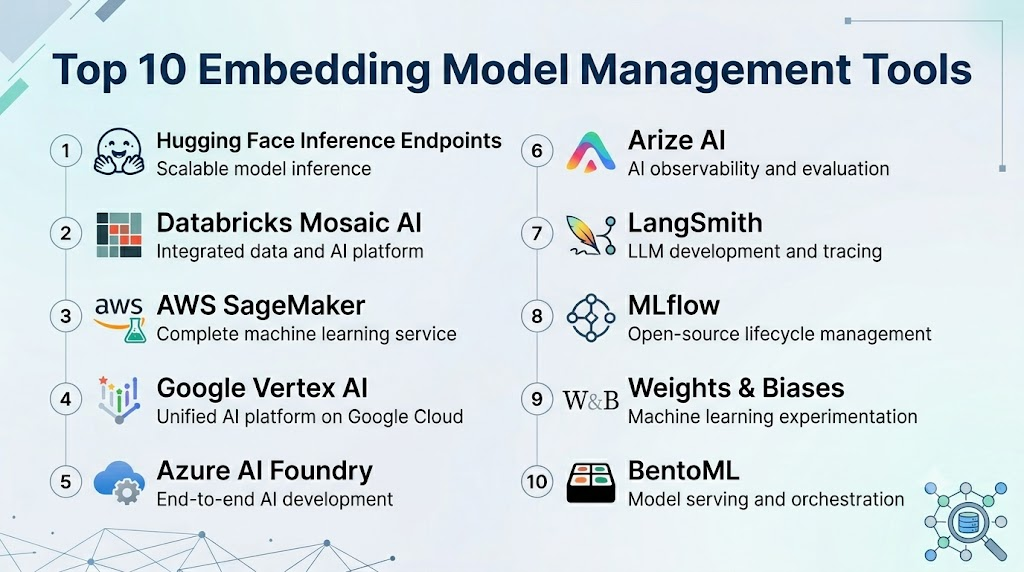
Top 10 Embedding Model Management Tools
1- Hugging Face Inference Endpoints
One-line verdict: Best for organizations deploying and managing open-source embedding models at scale.
Short description:
Hugging Face Inference Endpoints provide managed deployment infrastructure for embedding models. Organizations can deploy custom models while maintaining flexibility across various AI workloads and infrastructure environments.
Standout Capabilities
- Large open-source model ecosystem
- Custom model deployment
- Managed infrastructure
- API-based access
- Model versioning
- GPU optimization
- Enterprise deployment options
AI-Specific Depth
- Model support: Open-source, BYO models
- RAG integration: Strong ecosystem compatibility
- Evaluation: Available through ecosystem tools
- Guardrails: Varies based on implementation
- Observability: Performance monitoring available
Pros
- Massive model ecosystem
- Open-source flexibility
- Strong developer community
Cons
- Advanced governance may require additional tooling
- Configuration complexity for large deployments
- Some enterprise features require premium offerings
Deployment & Platforms
- Cloud
- Hybrid
- Enterprise deployments
Integrations & Ecosystem
Strong integrations with LangChain, LlamaIndex, vector databases, MLOps platforms, and AI development frameworks.
Pricing Model
Usage-based and enterprise plans.
Best-Fit Scenarios
- Open-source AI deployments
- Enterprise RAG systems
- Custom embedding model management
2- Databricks Mosaic AI
One-line verdict: Best for enterprises managing AI, data, and embedding workflows in a unified platform.
Short description:
Databricks Mosaic AI combines AI model management with enterprise data infrastructure, providing centralized governance and scalable deployment capabilities.
Standout Capabilities
- Unified AI platform
- Model governance
- Feature store integration
- Enterprise-scale infrastructure
- Monitoring capabilities
- Data lake integration
- Production deployment tools
AI-Specific Depth
- Model support: Open-source and proprietary
- RAG integration: Native support
- Evaluation: Built-in evaluation workflows
- Guardrails: Governance-focused controls
- Observability: Advanced monitoring
Pros
- Enterprise-ready platform
- Strong governance
- Unified data and AI management
Cons
- Higher complexity
- Enterprise-focused pricing
- Learning curve for new users
Deployment & Platforms
- Cloud
- Enterprise environments
Best-Fit Scenarios
- Large enterprises
- Data-intensive AI applications
- Regulated industries
3- AWS SageMaker
One-line verdict: Best for organizations already invested in the AWS ecosystem.
Short description:
AWS SageMaker offers comprehensive model lifecycle management capabilities, including deployment, monitoring, optimization, and governance of embedding models.
Standout Capabilities
- Full ML lifecycle support
- Managed infrastructure
- Auto-scaling
- Monitoring tools
- Security integration
- Model registry
- Experiment tracking
Pros
- Mature ecosystem
- Enterprise scalability
- Strong AWS integration
Cons
- AWS dependency
- Complex configuration
- Cost management challenges
Best-Fit Scenarios
- AWS-centric organizations
- Large-scale deployments
- Enterprise AI platforms
4- Google Vertex AI
One-line verdict: Best for organizations leveraging Google Cloud AI infrastructure.
Short description:
Vertex AI provides model deployment, monitoring, governance, and optimization tools for managing embedding models and generative AI applications.
Standout Capabilities
- Unified AI platform
- Managed model deployment
- Monitoring and evaluation
- Auto-scaling
- Security controls
- Pipeline orchestration
- Multimodal AI support
Pros
- Strong AI ecosystem
- Scalable infrastructure
- Advanced AI services
Cons
- Cloud dependency
- Enterprise complexity
- Learning curve
Best-Fit Scenarios
- Google Cloud users
- AI-first organizations
- Large-scale RAG systems
5- Azure AI Foundry
One-line verdict: Best for Microsoft-centric enterprises managing multiple AI models.
Short description:
Azure AI Foundry provides centralized AI lifecycle management capabilities, enabling organizations to deploy, monitor, and govern embedding models across enterprise environments.
Standout Capabilities
- Enterprise governance
- Security integration
- AI monitoring
- Model deployment
- Workflow orchestration
- Azure ecosystem integration
- Responsible AI controls
Pros
- Strong enterprise features
- Microsoft ecosystem integration
- Governance capabilities
Cons
- Azure dependency
- Complex licensing
- Advanced features may require expertise
Best-Fit Scenarios
- Microsoft enterprises
- Regulated industries
- Large AI programs
6- Arize AI
One-line verdict: Best for embedding quality monitoring and AI observability.
Short description:
Arize AI focuses on monitoring, observability, and evaluation for production AI systems, helping teams understand embedding performance and drift.
Standout Capabilities
- Embedding visualization
- Drift detection
- Monitoring dashboards
- AI observability
- Root cause analysis
- Performance analytics
- Evaluation workflows
Pros
- Strong observability
- Embedding-focused insights
- Production monitoring
Cons
- Not a full deployment platform
- Additional infrastructure required
- Specialized use case
Best-Fit Scenarios
- AI observability
- Embedding monitoring
- Production AI governance
7- LangSmith
One-line verdict: Best for RAG and LLM workflow evaluation involving embeddings.
Short description:
LangSmith provides tracing, monitoring, evaluation, and debugging tools for AI applications, helping teams optimize embedding-driven workflows.
Standout Capabilities
- Workflow tracing
- Evaluation pipelines
- Prompt testing
- Debugging tools
- Dataset management
- Experiment tracking
- Performance analysis
Pros
- Excellent developer experience
- Strong evaluation capabilities
- RAG-focused tooling
Cons
- Limited infrastructure management
- Best with LangChain ecosystem
- Not a standalone model platform
Best-Fit Scenarios
- RAG evaluation
- AI workflow optimization
- Development teams
8- MLflow
One-line verdict: Best open-source model lifecycle platform for embedding model management.
Short description:
MLflow provides open-source tools for experiment tracking, model versioning, deployment, and lifecycle management across AI systems.
Standout Capabilities
- Experiment tracking
- Model registry
- Version control
- Open-source ecosystem
- Flexible deployment
- Integration support
- Reproducibility tools
Pros
- Vendor-neutral
- Strong community
- Flexible architecture
Cons
- Requires operational expertise
- Limited built-in governance
- Additional integrations often needed
Best-Fit Scenarios
- Open-source environments
- MLOps teams
- Multi-cloud strategies
9- Weights & Biases
One-line verdict: Best for experiment tracking and embedding model evaluation.
Short description:
Weights & Biases helps AI teams monitor, evaluate, and optimize embedding models through extensive experiment management and visualization capabilities.
Standout Capabilities
- Experiment tracking
- Model evaluation
- Collaboration tools
- Visualization dashboards
- Performance comparisons
- Artifact management
- Reproducibility support
Pros
- Excellent visualization
- Strong collaboration features
- Developer-friendly
Cons
- Not a deployment platform
- Limited governance capabilities
- Infrastructure managed separately
Best-Fit Scenarios
- AI experimentation
- Model evaluation
- Research teams
10- BentoML
One-line verdict: Best for production deployment of embedding models with open-source flexibility.
Short description:
BentoML simplifies model serving and deployment, enabling organizations to operationalize embedding models efficiently across production environments.
Standout Capabilities
- Model serving
- API generation
- Deployment automation
- Multi-framework support
- Kubernetes integration
- Scalable architecture
- Open-source flexibility
Pros
- Flexible deployment options
- Strong production capabilities
- Open-source ecosystem
Cons
- Requires operational expertise
- Smaller ecosystem than hyperscalers
- Advanced governance requires integrations
Best-Fit Scenarios
- Self-managed AI infrastructure
- Production model serving
- Hybrid cloud deployments
Comparison Table
| Tool | Best For | Deployment | Model Flexibility | Strength | Watch-Out | Public Rating |
|---|---|---|---|---|---|---|
| Hugging Face | Open-source models | Cloud/Hybrid | High | Model ecosystem | Governance complexity | N/A |
| Databricks Mosaic AI | Enterprise AI | Cloud | High | Unified platform | Complexity | N/A |
| AWS SageMaker | AWS users | Cloud | High | Enterprise scale | AWS lock-in | N/A |
| Vertex AI | Google Cloud | Cloud | High | AI services | Cloud dependency | N/A |
| Azure AI Foundry | Microsoft enterprises | Cloud | High | Governance | Licensing complexity | N/A |
| Arize AI | Observability | Cloud | Medium | Monitoring | Not full lifecycle | N/A |
| LangSmith | Evaluation | Cloud | Medium | Workflow insights | Ecosystem dependency | N/A |
| MLflow | Open-source MLOps | Hybrid | High | Flexibility | Operational effort | N/A |
| Weights & Biases | Experimentation | Cloud | Medium | Visualization | Deployment separate | N/A |
| BentoML | Production serving | Hybrid | High | Deployment flexibility | Operational expertise | N/A |
Scoring & Evaluation
The following scores compare tools across embedding model management capabilities, governance, observability, scalability, integrations, and enterprise readiness.
| Tool | Core | Reliability | Guardrails | Integrations | Ease | Performance | Security | Support | Weighted Total |
|---|---|---|---|---|---|---|---|---|---|
| Hugging Face | 9 | 8 | 7 | 10 | 8 | 8 | 7 | 10 | 8.5 |
| Databricks | 10 | 9 | 9 | 9 | 7 | 9 | 10 | 9 | 9.1 |
| SageMaker | 9 | 9 | 9 | 8 | 7 | 9 | 10 | 9 | 8.9 |
| Vertex AI | 9 | 9 | 8 | 8 | 8 | 9 | 9 | 8 | 8.8 |
| Azure AI Foundry | 9 | 9 | 10 | 8 | 7 | 9 | 10 | 9 | 9.0 |
| Arize AI | 8 | 9 | 7 | 8 | 8 | 8 | 8 | 8 | 8.1 |
| LangSmith | 8 | 8 | 7 | 9 | 9 | 8 | 7 | 8 | 8.2 |
| MLflow | 9 | 8 | 7 | 9 | 7 | 8 | 7 | 9 | 8.2 |
| Weights & Biases | 8 | 8 | 6 | 8 | 9 | 8 | 7 | 8 | 7.9 |
| BentoML | 8 | 8 | 7 | 8 | 7 | 9 | 7 | 7 | 7.9 |
Which Embedding Model Management Tool Is Right for You?
Solo / Freelancer
Hugging Face, MLflow, and BentoML provide flexible and affordable options without requiring large enterprise infrastructure investments.
SMB
MLflow, Hugging Face, and LangSmith offer a strong balance between flexibility, scalability, and cost efficiency.
Mid-Market
Vertex AI, SageMaker, and Databricks provide centralized management and scalability for growing AI programs.
Enterprise
Databricks, Azure AI Foundry, and AWS SageMaker offer the strongest governance, scalability, and compliance capabilities.
Regulated Industries
Azure AI Foundry, Databricks, and SageMaker are often preferred due to governance, monitoring, and enterprise security features.
Budget vs Premium
Open-source solutions such as MLflow and BentoML minimize licensing costs. Premium enterprise platforms provide stronger governance and operational support.
Build vs Buy
Build when customization and control are priorities. Buy when speed, governance, support, and operational simplicity are more important.
Common Mistakes and How to Avoid Them
- Choosing models without evaluation benchmarks
- Ignoring embedding drift
- Missing observability requirements
- Underestimating infrastructure costs
- Skipping governance planning
- Not monitoring retrieval quality
- Poor model version management
- Vendor lock-in without migration planning
- Weak access controls
- Lack of auditability
- Overlooking latency requirements
- Inadequate testing before deployment
FAQs
1. What are embedding model management tools?
These platforms help deploy, monitor, govern, evaluate, and optimize embedding models throughout their lifecycle.
2. Why are embeddings important for AI applications?
Embeddings help AI systems understand semantic meaning, enabling search, recommendations, retrieval, and contextual understanding.
3. Do I need a dedicated embedding management platform?
Organizations managing multiple models, datasets, and AI applications often benefit significantly from centralized management.
4. Can these tools work with open-source models?
Many platforms support open-source, proprietary, and custom embedding models.
5. Which tool is best for RAG applications?
Hugging Face, Databricks, Vertex AI, and LangSmith are commonly used for RAG-related workflows.
6. What role does observability play?
Observability helps identify performance issues, embedding drift, latency problems, and retrieval quality degradation.
7. Are these tools suitable for small businesses?
Several solutions, including Hugging Face, MLflow, and BentoML, are accessible for SMB environments.
8. How important is model versioning?
Versioning ensures reproducibility, rollback capabilities, and governance across AI deployments.
9. What integrations should buyers prioritize?
Vector databases, MLOps platforms, data warehouses, orchestration tools, and AI frameworks are critical integrations.
10. How do these platforms improve governance?
They provide monitoring, auditing, access controls, lifecycle management, and policy enforcement capabilities.
11. Can embedding models be self-hosted?
Yes, many platforms support self-hosted, cloud, and hybrid deployment options.
12. What is the biggest challenge in embedding management?
Maintaining embedding quality, performance, governance, and cost efficiency at scale is often the primary challenge.
Conclusion
Embedding Model Management Tools are rapidly becoming essential infrastructure for modern AI systems. As organizations expand RAG deployments, AI agents, recommendation engines, semantic search platforms, and multimodal applications, managing embedding models effectively is no longer optional. The right platform can improve model quality, reduce operational complexity, enhance governance, and optimize costs.
