Introduction
Traditional keyword search often struggles to understand the intent and context behind user queries. Semantic Search Platforms solve this problem by leveraging artificial intelligence, machine learning, natural language processing, and vector embeddings to understand the meaning of words, phrases, and relationships rather than simply matching keywords. These platforms deliver more relevant, context-aware search results across documents, websites, applications, knowledge bases, and enterprise data repositories.
As organizations increasingly adopt AI-powered applications, semantic search has become a critical component of enterprise knowledge management, Retrieval-Augmented Generation (RAG), AI agents, customer support systems, e-commerce discovery, recommendation engines, and intelligent document retrieval. Modern semantic search platforms now support multimodal content, hybrid search, vector databases, AI governance, observability, and real-time indexing.
Real-world use cases include enterprise knowledge search, customer support automation, legal document discovery, healthcare information retrieval, e-commerce product discovery, media asset management, and AI-powered assistants.
Evaluation Criteria for Buyers
When evaluating semantic search platforms, consider:
- Search relevance and ranking quality
- Vector search capabilities
- Hybrid search support
- Real-time indexing
- Scalability
- AI model flexibility
- RAG compatibility
- Security and governance
- Observability and analytics
- Cost efficiency
- Integration ecosystem
- Deployment flexibility
Best for: Enterprises, AI teams, customer support organizations, SaaS providers, e-commerce businesses, knowledge management teams, and organizations implementing AI assistants or RAG applications.
Not ideal for: Small websites with basic search needs, static content repositories, or organizations requiring only traditional keyword-based search.
What’s Changed in Semantic Search Platforms
- Widespread adoption of vector-native search architectures
- Growth of agent-powered search experiences
- Increased multimodal search capabilities
- Better integration with AI copilots
- Real-time indexing and retrieval improvements
- Hybrid search becoming standard practice
- Enhanced retrieval evaluation frameworks
- Advanced observability for retrieval quality
- Stronger governance and access controls
- Automated reranking using LLMs
- Better support for private enterprise data
- Reduced latency through optimized retrieval pipelines
Quick Buyer Checklist
Before selecting a semantic search platform, verify:
- Supports vector search and embeddings
- Provides hybrid search capabilities
- Integrates with major LLM frameworks
- Supports RAG architectures
- Offers evaluation and testing features
- Includes observability dashboards
- Supports enterprise security controls
- Provides role-based access controls
- Supports multimodal content
- Allows flexible deployment options
- Minimizes vendor lock-in
- Supports large-scale indexing
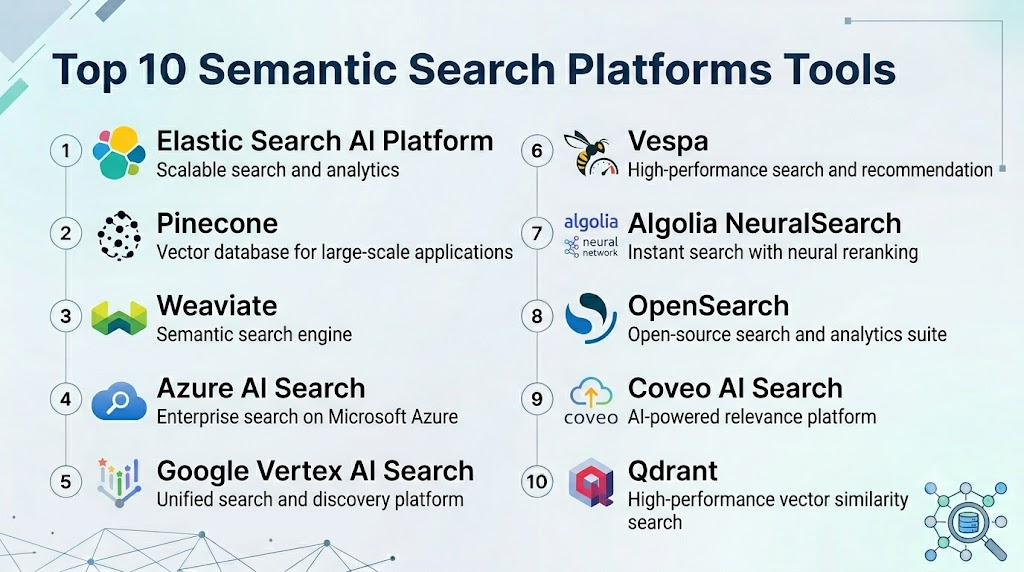
Top 10 Semantic Search Platforms Tools
1- Elastic Search AI Platform
One-line verdict: Best for enterprises seeking mature hybrid search and large-scale data indexing.
Short description:
Elastic combines traditional search with vector search and AI-powered retrieval, enabling organizations to modernize enterprise search without replacing existing infrastructure.
Standout Capabilities
- Hybrid search support
- Vector search engine
- Enterprise-scale indexing
- Real-time data ingestion
- AI-powered relevance ranking
- Security controls
- Advanced analytics
AI-Specific Depth
- Model support: BYO models and integrations
- RAG integration: Strong support
- Evaluation: Available through ecosystem tools
- Guardrails: Access and policy controls
- Observability: Extensive monitoring capabilities
Pros
- Enterprise-grade scalability
- Mature ecosystem
- Strong hybrid search support
Cons
- Configuration complexity
- Resource-intensive deployments
- Learning curve for advanced features
Deployment & Platforms
- Cloud
- Self-hosted
- Hybrid
Pricing Model
Subscription and enterprise licensing options.
Best-Fit Scenarios
- Enterprise knowledge search
- Security and analytics workloads
- AI-powered document retrieval
2- Pinecone
One-line verdict: Best for vector-native semantic search applications and RAG deployments.
Short description:
Pinecone provides a managed vector database platform optimized for semantic search, recommendation systems, and AI-powered retrieval applications.
Standout Capabilities
- Managed vector search
- Real-time indexing
- Low-latency retrieval
- Horizontal scaling
- Metadata filtering
- High availability
- RAG optimization
Pros
- Easy deployment
- Excellent scalability
- Minimal operational overhead
Cons
- Managed service dependency
- Vendor lock-in considerations
- Limited self-hosting options
Best-Fit Scenarios
- AI assistants
- Semantic product search
- Enterprise RAG systems
3- Weaviate
One-line verdict: Best open-source semantic search platform for flexible AI applications.
Short description:
Weaviate combines vector search, knowledge graph concepts, and AI modules to create highly flexible semantic retrieval systems.
Standout Capabilities
- Open-source architecture
- Hybrid search
- Knowledge graph integration
- Real-time indexing
- Multi-tenant support
- AI modules
- Flexible deployment
Pros
- Strong customization
- Open ecosystem
- Excellent RAG support
Cons
- Requires technical expertise
- Infrastructure management needed
- Complexity at scale
Best-Fit Scenarios
- AI-powered enterprise search
- Knowledge management systems
- Research applications
4- Azure AI Search
One-line verdict: Best for Microsoft-centric organizations deploying enterprise AI search.
Short description:
Azure AI Search combines traditional search, vector search, and AI enrichment capabilities into a managed cloud service.
Standout Capabilities
- Integrated vector search
- AI enrichment pipeline
- Security controls
- Hybrid retrieval
- Enterprise scalability
- Azure integration
- Cognitive search features
Pros
- Enterprise-ready
- Strong Microsoft integration
- Managed infrastructure
Cons
- Azure dependency
- Licensing complexity
- Cloud-focused architecture
Best-Fit Scenarios
- Microsoft enterprises
- Corporate knowledge bases
- AI copilots
5- Google Vertex AI Search
One-line verdict: Best for organizations leveraging Google’s AI and search ecosystem.
Short description:
Vertex AI Search enables semantic retrieval across structured and unstructured enterprise data while integrating with broader AI workflows.
Standout Capabilities
- Enterprise search
- AI-powered ranking
- Multimodal retrieval
- Managed infrastructure
- Real-time indexing
- LLM integration
- Data connectors
Pros
- Strong AI ecosystem
- Enterprise scalability
- Managed operations
Cons
- Google Cloud dependency
- Enterprise-oriented pricing
- Limited customization in some areas
Best-Fit Scenarios
- Enterprise search
- AI assistants
- Knowledge discovery
6- Vespa
One-line verdict: Best for large-scale recommendation and semantic retrieval systems.
Short description:
Vespa combines vector search, machine learning ranking, and structured search to support highly demanding applications.
Standout Capabilities
- Real-time serving
- Advanced ranking
- Large-scale indexing
- Streaming updates
- Hybrid search
- Machine learning integration
- Distributed architecture
Pros
- Massive scalability
- Powerful ranking models
- Open-source flexibility
Cons
- Complex operations
- Steep learning curve
- Requires specialized expertise
Best-Fit Scenarios
- Recommendation systems
- Search engines
- Large AI platforms
7- Algolia NeuralSearch
One-line verdict: Best for e-commerce and customer-facing semantic search experiences.
Short description:
Algolia combines keyword and semantic retrieval to improve product discovery and customer search experiences.
Standout Capabilities
- Neural search
- Hybrid retrieval
- Fast response times
- E-commerce optimization
- Personalization
- Merchandising tools
- Search analytics
Pros
- Easy implementation
- Excellent user experience
- Strong e-commerce focus
Cons
- Premium pricing at scale
- Less flexible for custom AI workloads
- Managed service limitations
Best-Fit Scenarios
- E-commerce search
- Product discovery
- Customer-facing applications
8- OpenSearch
One-line verdict: Best open-source alternative for semantic search and analytics.
Short description:
OpenSearch extends traditional search with vector search capabilities and integrates well with AI-driven retrieval workflows.
Standout Capabilities
- Open-source ecosystem
- Vector search support
- Analytics integration
- Security features
- Scalability
- Plugin ecosystem
- Hybrid search
Pros
- No vendor lock-in
- Flexible deployment
- Strong community support
Cons
- Requires management expertise
- Complex optimization
- Operational overhead
Best-Fit Scenarios
- Enterprise search
- AI retrieval systems
- Analytics platforms
9- Coveo AI Search
One-line verdict: Best for customer experience and workplace search applications.
Short description:
Coveo delivers AI-powered search, recommendations, and personalization for customer support and employee productivity.
Standout Capabilities
- AI relevance tuning
- Recommendation engine
- Workplace search
- Customer support optimization
- Analytics
- Personalization
- Enterprise connectors
Pros
- Strong business focus
- Excellent personalization
- Mature enterprise features
Cons
- Less developer-centric
- Enterprise pricing
- Limited open-source flexibility
Best-Fit Scenarios
- Customer support
- Workplace search
- Knowledge management
10- Qdrant
One-line verdict: Best lightweight semantic search platform for developers and startups.
Short description:
Qdrant provides a developer-friendly vector database optimized for semantic search, recommendation systems, and RAG applications.
Standout Capabilities
- Fast vector search
- Payload filtering
- Open-source architecture
- Cloud and self-hosting
- Lightweight deployment
- API-first design
- Horizontal scaling
Pros
- Easy to deploy
- Developer-friendly
- Cost-effective
Cons
- Smaller ecosystem
- Fewer enterprise features
- Limited advanced governance
Best-Fit Scenarios
- Startups
- AI applications
- RAG deployments
Comparison Table
| Tool | Best For | Deployment | Model Flexibility | Strength | Watch-Out | Public Rating |
|---|---|---|---|---|---|---|
| Elastic | Enterprise Search | Hybrid | High | Mature ecosystem | Complexity | N/A |
| Pinecone | RAG Systems | Cloud | High | Vector performance | Vendor lock-in | N/A |
| Weaviate | Open-source AI | Hybrid | High | Flexibility | Technical complexity | N/A |
| Azure AI Search | Microsoft Enterprises | Cloud | High | Enterprise integration | Azure dependency | N/A |
| Vertex AI Search | Google Cloud Users | Cloud | High | AI ecosystem | Cloud dependency | N/A |
| Vespa | Large Search Platforms | Self-hosted | High | Scalability | Complexity | N/A |
| Algolia | E-commerce Search | Cloud | Medium | User experience | Pricing | N/A |
| OpenSearch | Open-source Search | Hybrid | High | Flexibility | Management overhead | N/A |
| Coveo | Customer Experience | Cloud | Medium | Personalization | Enterprise pricing | N/A |
| Qdrant | Developers | Hybrid | High | Simplicity | Smaller ecosystem | N/A |
Scoring & Evaluation
| Tool | Core | Reliability | Guardrails | Integrations | Ease | Performance | Security | Support | Weighted Total |
|---|---|---|---|---|---|---|---|---|---|
| Elastic | 10 | 9 | 9 | 10 | 7 | 9 | 10 | 9 | 9.2 |
| Pinecone | 9 | 8 | 7 | 9 | 9 | 10 | 8 | 8 | 8.7 |
| Weaviate | 9 | 8 | 7 | 9 | 7 | 8 | 8 | 8 | 8.2 |
| Azure AI Search | 9 | 9 | 9 | 9 | 8 | 9 | 10 | 9 | 9.0 |
| Vertex AI Search | 9 | 9 | 8 | 9 | 8 | 9 | 9 | 8 | 8.8 |
| Vespa | 9 | 8 | 7 | 8 | 6 | 10 | 8 | 7 | 8.1 |
| Algolia | 8 | 8 | 7 | 8 | 10 | 9 | 8 | 8 | 8.4 |
| OpenSearch | 8 | 8 | 8 | 8 | 7 | 8 | 9 | 8 | 8.1 |
| Coveo | 8 | 8 | 8 | 8 | 8 | 8 | 8 | 8 | 8.0 |
| Qdrant | 8 | 7 | 6 | 8 | 9 | 8 | 7 | 7 | 7.7 |
Which Semantic Search Platform Is Right for You?
Solo / Freelancer
Qdrant and Weaviate provide affordable and flexible options for semantic search experimentation and development.
SMB
Pinecone, Algolia, and Qdrant offer strong performance with manageable operational requirements.
Mid-Market
Azure AI Search, Vertex AI Search, and Elastic provide scalability and enterprise-grade capabilities.
Enterprise
Elastic, Azure AI Search, and Vertex AI Search deliver governance, scalability, security, and operational maturity.
Regulated Industries
Elastic and Azure AI Search are commonly preferred for governance, access controls, and enterprise security requirements.
Budget vs Premium
Open-source options such as Weaviate, OpenSearch, Vespa, and Qdrant reduce licensing costs, while managed services simplify operations.
Build vs Buy
Build when customization and control are critical. Buy when speed, support, governance, and operational simplicity matter more.
Common Mistakes & How to Avoid Them
- Ignoring search relevance testing
- Using vector search without metadata filtering
- Failing to monitor retrieval quality
- Neglecting access controls
- Poor indexing strategies
- Overlooking latency requirements
- Ignoring evaluation frameworks
- Lack of observability
- Vendor lock-in risks
- Inadequate governance planning
- Poor hybrid search configuration
- Scaling without performance testing
FAQs
1. What is semantic search?
Semantic search uses AI and embeddings to understand query meaning rather than relying solely on keyword matching.
2. How does semantic search improve user experience?
It delivers more relevant results by understanding context, intent, and relationships between concepts.
3. What is the role of vector databases?
Vector databases store embeddings and enable fast similarity searches that power semantic retrieval.
4. Is semantic search required for RAG applications?
Most production RAG systems depend on semantic retrieval to provide relevant context to language models.
5. Can semantic search work with structured data?
Yes. Modern platforms support structured, semi-structured, and unstructured content.
6. What is hybrid search?
Hybrid search combines keyword search and semantic retrieval to improve result quality.
7. How important is observability?
Observability helps teams monitor search quality, latency, costs, and retrieval performance.
8. Can semantic search support multimodal content?
Many modern platforms support text, images, documents, and other content types.
9. Are open-source platforms suitable for enterprises?
Yes, provided organizations have the expertise to manage and secure deployments.
10. What is the biggest implementation challenge?
Maintaining relevance quality while balancing performance, scalability, and operational costs.
11. How does semantic search help AI agents?
It provides relevant contextual knowledge that agents can use to make better decisions and responses.
12. Can organizations migrate between semantic search platforms?
Yes, although migration often requires reindexing, testing, and integration updates.
Conclusion
Semantic Search Platforms have become essential infrastructure for AI-powered applications, enterprise knowledge systems, customer support automation, recommendation engines, and RAG architectures. The market has evolved significantly with vector-native search, multimodal retrieval, AI observability, governance capabilities, and real-time indexing becoming standard expectations. Organizations that invest in modern semantic search capabilities can significantly improve information discovery, user experience, and AI application performance.
