Introduction
Retrieval-Augmented Generation (RAG) systems have become a core architecture for enterprise AI applications, powering everything from internal knowledge assistants to customer support bots and research copilots. However, as RAG pipelines grow in complexity, evaluating their performance reliably has become one of the hardest engineering challenges in AI.
RAG evaluation and benchmarking tools solve this by measuring how well a system retrieves relevant context, generates accurate responses, avoids hallucinations, and performs under real-world conditions. These platforms help teams test prompts, compare models, track regressions, and continuously improve retrieval quality across vector databases and LLMs.
RAG evaluation is no longer optional. It is essential due to rising expectations around reliability, compliance, cost control, and AI observability. Modern AI systems must be measurable, explainable, and auditable.
Real-world use cases
- Enterprise search assistants validating answer accuracy
- Customer support chatbots measuring hallucination rates
- Legal and financial AI systems requiring traceable outputs
- LLM apps comparing model versions before deployment
- RAG pipelines optimizing chunking and retrieval strategies
What to evaluate when choosing a tool
- Retrieval quality and relevance scoring
- Hallucination detection accuracy
- Support for offline and online evaluation
- Dataset versioning and experiment tracking
- Integration with vector databases and LLM providers
- Cost and latency monitoring
- Guardrails and safety testing capabilities
- Human feedback loops and labeling support
- Observability and trace debugging
- Deployment flexibility and compliance readiness
Best for: AI engineers, ML teams, platform architects, and enterprises building production-grade RAG systems.
Not ideal for: Small apps with no retrieval layer or teams using single-shot LLM prompts without external knowledge sources.
What’s Changed in RAG Evaluation & Benchmarking Tools
- Shift from static evaluation to continuous evaluation pipelines
- Strong focus on hallucination detection and factual grounding
- Rise of agentic workflows requiring multi-step evaluation
- Integration with LLM observability and tracing platforms
- Native support for multi-model benchmarking and routing
- Built-in prompt injection and adversarial testing frameworks
- Increased adoption of synthetic evaluation dataset generation
- Emphasis on cost-performance tradeoffs (token-aware evaluation)
- Enterprise governance features like audit logs and approval workflows
- Tight integration with vector databases and embedding pipelines
- Real-time evaluation in production environments, not just offline tests
- Expansion toward multimodal RAG evaluation (text + image + audio inputs)
Quick Buyer Checklist (Scan-Friendly)
- Does it support offline and online evaluation?
- Can it benchmark multiple LLMs and embedding models?
- Does it integrate with your vector database?
- Does it support custom evaluation metrics?
- Can it detect hallucinations and grounding errors?
- Does it support prompt injection testing?
- Are traces and logs available for debugging?
- Can you export evaluation datasets easily?
- Is there RBAC and audit logging for enterprise use?
- Does it support CI/CD-based evaluation pipelines?
- Can it monitor cost and latency per query?
- Is there flexibility to bring your own models?
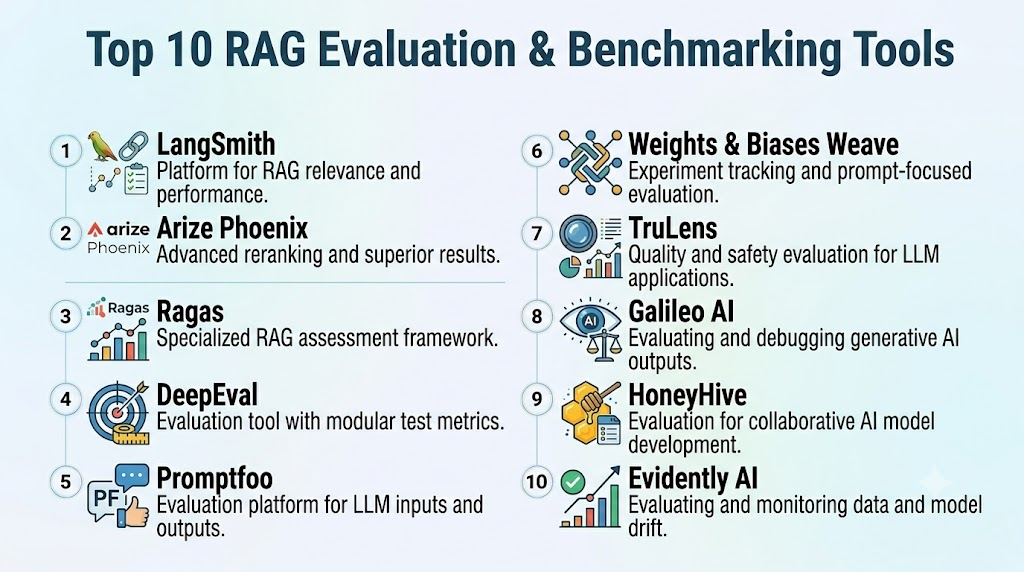
Top 10 RAG Evaluation & Benchmarking Tools
1 — LangSmith
One-line verdict: Best for teams using LangChain needing full RAG observability and evaluation pipelines.
Short description:
LangSmith is a developer-focused platform for debugging, evaluating, and monitoring LLM applications, especially those built with LangChain. It provides deep tracing and experiment tracking for RAG systems.
Standout Capabilities
- End-to-end LLM trace visualization
- Dataset-based evaluation workflows
- Prompt versioning and comparison
- Regression testing for RAG pipelines
- Built-in feedback collection tools
- Multi-model experimentation support
- Strong LangChain ecosystem integration
AI-Specific Depth
- Model support: Multi-model (OpenAI, Anthropic, open-source via API)
- RAG integration: Strong LangChain-native connectors
- Evaluation: Offline + regression + human feedback evaluation
- Guardrails: Basic prompt-level safety checks
- Observability: Full trace, latency, token usage, cost tracking
Pros
- Excellent developer experience
- Strong debugging and trace visibility
- Tight LangChain ecosystem integration
Cons
- Less useful outside LangChain ecosystem
- Enterprise governance features still evolving
Security & Compliance
- RBAC and SSO support available in enterprise tiers
- Audit logs: Not publicly stated
Deployment & Platforms
- Cloud-based platform
- Web UI with API access
Integrations & Ecosystem
Supports:
- LangChain
- OpenAI-compatible APIs
- Vector databases via pipelines
- CI/CD workflows via API
Pricing Model
Usage-based and tiered subscription model
Best-Fit Scenarios
- LangChain-based RAG apps
- AI startups building MVP to production pipelines
- Teams needing rapid debugging tools
2 — Arize Phoenix
One-line verdict: Best open-source observability and RAG evaluation platform for ML engineers.
Short description:
Phoenix by Arize is an open-source tool focused on tracing, evaluating, and diagnosing LLM and RAG systems. It is widely used for debugging production AI systems.
Standout Capabilities
- Open-source LLM observability
- RAG tracing and retrieval inspection
- Embedding drift analysis
- Dataset-based evaluation pipelines
- Human feedback integration
- Query-response debugging workflows
- Performance regression detection
AI-Specific Depth
- Model support: Multi-model + BYO model
- RAG integration: Strong vector DB inspection support
- Evaluation: Offline evaluation + monitoring-based scoring
- Guardrails: Limited built-in guardrails
- Observability: Deep tracing and embedding visualization
Pros
- Open-source and flexible
- Strong debugging capabilities
- Excellent for research and production hybrid setups
Cons
- Requires engineering effort to deploy at scale
- UI less polished than enterprise tools
Security & Compliance
- Self-hosted deployment possible
- Enterprise controls: Not publicly stated
Deployment & Platforms
- Self-hosted and cloud options
- Web-based UI
Integrations & Ecosystem
- Vector DBs (Pinecone, Weaviate, etc.)
- LLM APIs
- Python SDK ecosystem
Pricing Model
Open-source core with optional enterprise offerings
Best-Fit Scenarios
- Engineering-heavy AI teams
- Research + production hybrid environments
- Teams needing deep debugging control
3 — Ragas
One-line verdict: Best lightweight RAG evaluation framework for metric-driven AI testing.
Short description:
Ragas is a popular open-source evaluation library designed specifically for RAG pipelines, focusing on retrieval quality, faithfulness, and answer relevance.
Standout Capabilities
- RAG-specific evaluation metrics
- Faithfulness scoring
- Context relevance scoring
- Synthetic dataset generation
- Easy integration with Python pipelines
- Fast benchmarking workflows
- Minimal setup overhead
AI-Specific Depth
- Model support: Any LLM via API wrapper
- RAG integration: Vector DB agnostic
- Evaluation: Strong offline evaluation metrics
- Guardrails: Not included
- Observability: Not included
Pros
- Extremely lightweight
- Easy to integrate
- Strong academic and industry adoption
Cons
- No production observability
- Limited enterprise features
Security & Compliance
Not publicly stated
Deployment & Platforms
- Python library
- Local or cloud execution
Integrations & Ecosystem
- Works with LangChain, LlamaIndex
- Compatible with most vector DBs
Pricing Model
Open-source
Best-Fit Scenarios
- RAG prototyping
- Academic benchmarking
- Model comparison experiments
4 — DeepEval
One-line verdict: Best unit-testing framework for LLM and RAG pipelines in CI/CD workflows.
Short description:
DeepEval is a testing framework that brings software testing principles into LLM evaluation, enabling automated RAG quality checks.
Standout Capabilities
- Unit tests for LLM outputs
- CI/CD integration support
- Hallucination detection metrics
- RAG evaluation suite
- Custom test case definitions
- Regression testing pipelines
- Multi-model comparison
AI-Specific Depth
- Model support: Multi-model via API
- RAG integration: Yes, via test harness
- Evaluation: Strong automated testing
- Guardrails: Basic evaluation-based guardrails
- Observability: Limited
Pros
- Ideal for CI/CD pipelines
- Developer-friendly testing approach
- Strong regression testing support
Cons
- Limited UI/visualization tools
- Requires setup for enterprise usage
Security & Compliance
Not publicly stated
Deployment & Platforms
- Python-based framework
- Local or CI environments
Integrations & Ecosystem
- GitHub Actions
- LangChain-compatible workflows
- API-based LLM providers
Pricing Model
Open-source
Best-Fit Scenarios
- DevOps for AI systems
- Automated RAG testing pipelines
- Continuous deployment environments
5 — Promptfoo
One-line verdict: Best for prompt-level testing and multi-model RAG comparison workflows.
Short description:
Promptfoo is a flexible open-source tool for testing prompts, evaluating outputs, and comparing LLM responses across models.
Standout Capabilities
- Prompt regression testing
- Multi-model comparison
- Dataset-driven evaluation
- CI/CD integration
- YAML-based test configuration
- Custom scoring functions
- API automation support
AI-Specific Depth
- Model support: Multi-model
- RAG integration: Indirect via prompt pipelines
- Evaluation: Strong prompt-level evaluation
- Guardrails: Not built-in
- Observability: Minimal
Pros
- Simple and fast to adopt
- Excellent for prompt testing
- CI/CD friendly
Cons
- Not a full observability platform
- Limited RAG-specific tooling
Security & Compliance
Not publicly stated
Deployment & Platforms
- CLI-based tool
- Local or CI/CD execution
Integrations & Ecosystem
- GitHub Actions
- OpenAI-compatible APIs
- Custom LLM endpoints
Pricing Model
Open-source
Best-Fit Scenarios
- Prompt engineers
- LLM experiment tracking
- Lightweight RAG testing
6 — Weights & Biases Weave
One-line verdict: Best enterprise-grade LLM observability and evaluation platform.
Short description:
Weave extends W&B into LLM evaluation and RAG observability, enabling deep tracking of experiments, datasets, and model outputs.
Standout Capabilities
- Experiment tracking for LLMs
- Dataset versioning
- Evaluation dashboards
- RAG performance monitoring
- Collaboration tools for ML teams
- Model comparison workflows
- Production observability
AI-Specific Depth
- Model support: Multi-model ecosystem
- RAG integration: Strong via pipelines
- Evaluation: Advanced offline + online eval
- Guardrails: Not core focus
- Observability: Full ML lifecycle tracking
Pros
- Enterprise-ready platform
- Strong ML ecosystem integration
- Excellent visualization tools
Cons
- Complex setup for small teams
- Can be expensive at scale
Security & Compliance
- Enterprise RBAC and audit logs available
- Compliance certifications: Not publicly stated
Deployment & Platforms
- Cloud-based platform
- Web + SDK support
Integrations & Ecosystem
- ML frameworks
- LLM APIs
- Data pipelines and notebooks
Pricing Model
Tiered enterprise SaaS
Best-Fit Scenarios
- Large AI teams
- Enterprise ML lifecycle management
- Production RAG systems
7 — TruLens
One-line verdict: Best framework for feedback-driven evaluation of LLM and RAG systems.
Short description:
TruLens provides evaluation and monitoring tools focused on grounding, relevance, and hallucination detection in LLM applications.
Standout Capabilities
- Feedback function-based evaluation
- RAG grounding metrics
- Continuous monitoring
- Human feedback loops
- Custom evaluation logic
- Experiment tracking
- Lightweight deployment
AI-Specific Depth
- Model support: Multi-model
- RAG integration: Strong
- Evaluation: Feedback-based evaluation system
- Guardrails: Evaluation-driven safety checks
- Observability: Strong monitoring layer
Pros
- Flexible evaluation logic
- Strong RAG grounding metrics
- Easy to integrate
Cons
- Smaller ecosystem
- Limited enterprise features
Security & Compliance
Not publicly stated
Deployment & Platforms
- Python library + cloud options
- Local deployment supported
Integrations & Ecosystem
- LangChain
- Vector databases
- LLM APIs
Pricing Model
Open-source + enterprise offering
Best-Fit Scenarios
- Research teams
- Feedback-driven AI apps
- RAG quality monitoring
8 — Galileo AI
One-line verdict: Best enterprise-focused LLM evaluation and quality intelligence platform.
Short description:
Galileo AI provides evaluation, observability, and data intelligence tools for LLM and RAG applications at enterprise scale.
Standout Capabilities
- LLM quality scoring
- Dataset evaluation pipelines
- Error analysis dashboards
- Model comparison tools
- Production monitoring
- Hallucination detection
- Enterprise workflow integration
AI-Specific Depth
- Model support: Multi-model
- RAG integration: Strong enterprise support
- Evaluation: Advanced scoring systems
- Guardrails: Some policy evaluation features
- Observability: Full monitoring suite
Pros
- Enterprise-grade reliability
- Strong evaluation analytics
- Scalable architecture
Cons
- Less open-source flexibility
- Pricing transparency limited
Security & Compliance
- Enterprise security controls available
- Certifications: Not publicly stated
Deployment & Platforms
- Cloud platform
- Web-based dashboards
Integrations & Ecosystem
- LLM APIs
- Data pipelines
- Enterprise ML stacks
Pricing Model
Enterprise SaaS
Best-Fit Scenarios
- Large organizations
- Production RAG systems
- Compliance-heavy industries
9 — HoneyHive
One-line verdict: Best collaborative observability platform for AI product teams.
Short description:
HoneyHive focuses on observability, evaluation, and collaboration for LLM and RAG applications in production environments.
Standout Capabilities
- End-to-end tracing
- Dataset labeling workflows
- Evaluation dashboards
- Team collaboration features
- Prompt and model versioning
- Error analysis tools
- Feedback loops
AI-Specific Depth
- Model support: Multi-model
- RAG integration: Strong support
- Evaluation: Human + automated evaluation
- Guardrails: Limited
- Observability: Strong tracing system
Pros
- Strong team collaboration features
- Clean UI for evaluation workflows
- Good for production monitoring
Cons
- Smaller ecosystem
- Some features still evolving
Security & Compliance
Not publicly stated
Deployment & Platforms
- Cloud-based platform
- Web interface
Integrations & Ecosystem
- LLM APIs
- Vector databases
- CI/CD tools via API
Pricing Model
Tiered SaaS model
Best-Fit Scenarios
- Product teams building AI apps
- Cross-functional AI workflows
- RAG production monitoring
10 — Evidently AI
One-line verdict: Best for data and ML monitoring with expanding LLM evaluation capabilities.
Short description:
Evidently AI is widely used for ML monitoring and has expanded into LLM and RAG evaluation use cases.
Standout Capabilities
- Data drift detection
- Model performance monitoring
- Custom evaluation reports
- LLM evaluation modules
- Dashboarding and reporting
- Dataset validation tools
- Experiment tracking
AI-Specific Depth
- Model support: Multi-model
- RAG integration: Partial / evolving
- Evaluation: Data-centric evaluation tools
- Guardrails: Not core focus
- Observability: Strong ML observability
Pros
- Strong data monitoring foundation
- Flexible dashboards
- Open-source core available
Cons
- RAG-specific features still evolving
- Requires customization for advanced LLM use cases
Security & Compliance
Not publicly stated
Deployment & Platforms
- Self-hosted or cloud
- Python-based system
Integrations & Ecosystem
- ML pipelines
- Data warehouses
- LLM APIs
Pricing Model
Open-source + enterprise tier
Best-Fit Scenarios
- ML + LLM hybrid teams
- Data-centric organizations
- Early-stage RAG evaluation setups
Comparison Table (Top 10)
| Tool Name | Best For | Deployment | Model Flexibility | Strength | Watch-Out | Public Rating |
|---|---|---|---|---|---|---|
| LangSmith | LangChain RAG apps | Cloud | Multi-model | Deep tracing | Ecosystem lock-in | N/A |
| Arize Phoenix | Open-source observability | Self-hosted | Multi/BYO | Debugging depth | Setup complexity | N/A |
| Ragas | RAG metrics | Library | Any | Lightweight eval | No observability | N/A |
| DeepEval | CI/CD testing | Local/CI | Multi-model | Automated tests | Limited UI | N/A |
| Promptfoo | Prompt testing | CLI/CI | Multi-model | Fast comparisons | Not RAG-native | N/A |
| Weave | Enterprise ML ops | Cloud | Multi-model | Full lifecycle tracking | Complexity | N/A |
| TruLens | Feedback evaluation | Hybrid | Multi-model | Grounding metrics | Smaller ecosystem | N/A |
| Galileo AI | Enterprise evaluation | Cloud | Multi-model | Quality intelligence | Limited openness | N/A |
| HoneyHive | Team observability | Cloud | Multi-model | Collaboration | Emerging platform | N/A |
| Evidently AI | ML monitoring | Hybrid | Multi-model | Data drift analysis | RAG depth limited | N/A |
Scoring & Evaluation (Transparent Rubric)
Scoring is comparative and based on platform maturity, usability, and RAG-specific depth. Scores reflect general capability, not strict benchmarks.
| Tool | Core | Reliability/Eval | Guardrails | Integrations | Ease | Perf/Cost | Security/Admin | Support | Weighted Total |
|---|---|---|---|---|---|---|---|---|---|
| LangSmith | 9 | 9 | 7 | 9 | 8 | 8 | 7 | 8 | 8.3 |
| Arize Phoenix | 8 | 8 | 6 | 7 | 7 | 7 | 7 | 7 | 7.3 |
| Ragas | 7 | 9 | 5 | 8 | 9 | 9 | 6 | 6 | 7.5 |
| DeepEval | 8 | 8 | 6 | 8 | 8 | 8 | 6 | 7 | 7.6 |
| Promptfoo | 8 | 7 | 5 | 8 | 9 | 9 | 6 | 6 | 7.4 |
| Weave | 9 | 9 | 7 | 9 | 7 | 7 | 8 | 8 | 8.2 |
| TruLens | 8 | 8 | 7 | 7 | 8 | 8 | 6 | 6 | 7.5 |
| Galileo AI | 9 | 9 | 8 | 9 | 7 | 7 | 8 | 8 | 8.4 |
| HoneyHive | 8 | 8 | 7 | 8 | 8 | 8 | 7 | 7 | 7.9 |
| Evidently AI | 8 | 7 | 6 | 8 | 8 | 7 | 7 | 7 | 7.3 |
Which RAG Evaluation & Benchmarking Tool Is Right for You?
Solo / Freelancer
Lightweight tools matter most here. Ragas and Promptfoo provide fast experimentation without overhead. DeepEval also works well for structured testing.
SMB
Teams benefit from balancing observability and simplicity. LangSmith, TruLens, and HoneyHive provide strong mid-market capability without enterprise complexity.
Mid-Market
At this stage, structured evaluation pipelines and observability become critical. Weave, LangSmith, and Arize Phoenix offer scalable workflows.
Enterprise
Enterprises need governance, auditability, and scalability. Galileo AI and Weave stand out for production-scale evaluation and compliance alignment.
Regulated industries (finance/healthcare/public sector)
Focus on tools with strong auditability and deployment flexibility. Weave, Arize Phoenix, and Galileo AI are typically better suited.
Budget vs premium
- Budget-friendly: Ragas, Promptfoo, DeepEval
- Premium: Galileo AI, Weave, LangSmith
Build vs buy (DIY vs platform)
- Build (DIY): Ragas + DeepEval + Promptfoo stack
- Buy (platform): LangSmith, Weave, Galileo AI, HoneyHive
Common Mistakes & How to Avoid Them
- Skipping evaluation entirely before production
- Relying only on human feedback without metrics
- Ignoring retrieval quality and focusing only on generation
- Not testing prompt injection vulnerabilities
- Failing to version datasets and prompts
- Overfitting evaluation datasets
- Not tracking token and cost metrics
- Using single-model benchmarking only
- Lack of traceability in production queries
- No rollback strategy for bad model updates
- Ignoring latency performance under load
- Treating RAG as static instead of continuously evolving
- Over-reliance on vendor dashboards without raw data access
FAQs
1. What are RAG evaluation tools used for?
They measure how accurately a retrieval-augmented generation system finds and uses external knowledge. They help detect hallucinations, improve relevance, and benchmark models.
2. Do I need evaluation tools for small AI apps?
If your app uses external knowledge or vector databases, yes. Even small apps benefit from basic RAG evaluation to avoid incorrect answers.
3. Can these tools work with any vector database?
Most modern tools support multiple vector databases like Pinecone, Weaviate, or FAISS through connectors or APIs.
4. Do RAG evaluation tools support multiple LLMs?
Yes. Many platforms support multi-model benchmarking, allowing comparison between OpenAI, Anthropic, and open-source models.
5. What is the difference between observability and evaluation?
Evaluation measures quality (accuracy, relevance), while observability tracks runtime behavior (latency, cost, traces).
6. Are open-source tools enough for production?
They can be, but enterprise setups often require additional governance, security, and scaling features.
7. How do these tools detect hallucinations?
They compare generated responses against retrieved context using scoring functions or LLM-based evaluators.
8. Can I build my own evaluation system?
Yes. Many teams combine open-source frameworks like Ragas and DeepEval to build custom evaluation pipelines.
9. Do these tools increase AI cost?
Indirectly yes, due to evaluation runs, but they often reduce overall cost by optimizing model usage.
10. What is the biggest challenge in RAG evaluation?
Defining reliable ground truth and consistent evaluation metrics across diverse queries.
11. How often should RAG systems be evaluated?
Continuously in production plus offline during development cycles.
12. What is the future of RAG evaluation?
It is moving toward real-time, agent-based evaluation with automated feedback loops and self-improving systems.
Conclusion
RAG evaluation and benchmarking tools have become essential infrastructure for modern AI systems. As applications move toward production-grade reliability, teams must go beyond basic prompting and adopt structured evaluation, observability, and governance practices.
There is no single best tool. The right choice depends on your stage, scale, and technical maturity. Lightweight frameworks like Ragas and Promptfoo are ideal for experimentation, while platforms like LangSmith, Weave, and Galileo AI are better suited for production and enterprise environments.
