Introduction
AI Policy Management Tools are platforms that help organizations define, enforce, and monitor rules for how artificial intelligence systems behave across applications, users, and workflows. In simple terms, they act as the “governance layer” between powerful AI models and real-world business usage, ensuring that outputs remain safe, compliant, explainable, and aligned with internal or regulatory policies.
and beyond, these tools have become essential because AI systems are no longer isolated experiments—they are embedded in customer service, finance, healthcare, software development, and decision-making workflows. As agentic AI systems become more autonomous, the need for structured policy enforcement, auditability, and risk control has grown significantly.
Common real-world use cases include:
- Enforcing content safety rules in generative AI chatbots
- Blocking sensitive data leakage in enterprise copilots
- Applying region-specific compliance rules (GDPR, HIPAA, etc.)
- Managing model behavior across multiple AI vendors
- Monitoring agent actions in autonomous workflows
- Auditing AI decisions for regulatory reporting
Key evaluation criteria buyers should consider include:
- Policy flexibility and rule definition capabilities
- Multi-model and multi-agent support
- Guardrails and safety enforcement strength
- Observability and audit logging depth
- Data privacy, retention, and residency controls
- Integration with LLMs, APIs, and enterprise systems
- Evaluation and testing frameworks
- Cost and latency impact
- Deployment flexibility (cloud, hybrid, self-hosted)
- Vendor lock-in risk and portability
Best for:
Enterprises, regulated industries (finance, healthcare, government), and mid-to-large organizations deploying LLMs or agentic AI systems at scale with compliance requirements.
Not ideal for:
Small teams using simple AI tools (like standalone chatbots or basic API usage) where governance complexity is minimal.
What’s Changed in AI Policy Management Tools
- Shift from static rules to dynamic policy engines powered by AI agents
- Expansion from text moderation to multimodal governance (text, image, audio, video)
- Strong adoption of agentic workflow controls and tool-use permissions
- Increased focus on prompt injection and jailbreak defense layers
- Built-in evaluation frameworks for hallucination and factuality scoring
- Policy-as-code becoming standard for enterprise AI governance
- Native support for multi-model routing and fallback policies
- Rising demand for real-time observability dashboards (tokens, cost, latency)
- Integration with vector databases and RAG pipelines for controlled retrieval
- Stricter compliance expectations around audit trails and explainability
- Privacy-first architecture with data minimization and retention control
- Emergence of “AI risk scoring” for automated policy enforcement
Quick Buyer Checklist
- Does the tool support multi-model environments (OpenAI, open-source, etc.)?
- Can you define granular policies for users, prompts, and outputs?
- Is there built-in evaluation for hallucinations and unsafe outputs?
- Does it support RAG pipelines and knowledge connectors?
- Are guardrails configurable for prompt injection defense?
- Can you track latency, token usage, and cost per request?
- Does it provide audit logs for compliance reporting?
- Is self-hosting or hybrid deployment available if needed?
- How easy is it to integrate with your existing AI stack?
- What is the vendor lock-in risk for policies and workflows?
- Does it support human-in-the-loop review workflows?
- How mature is the alerting and incident response system?
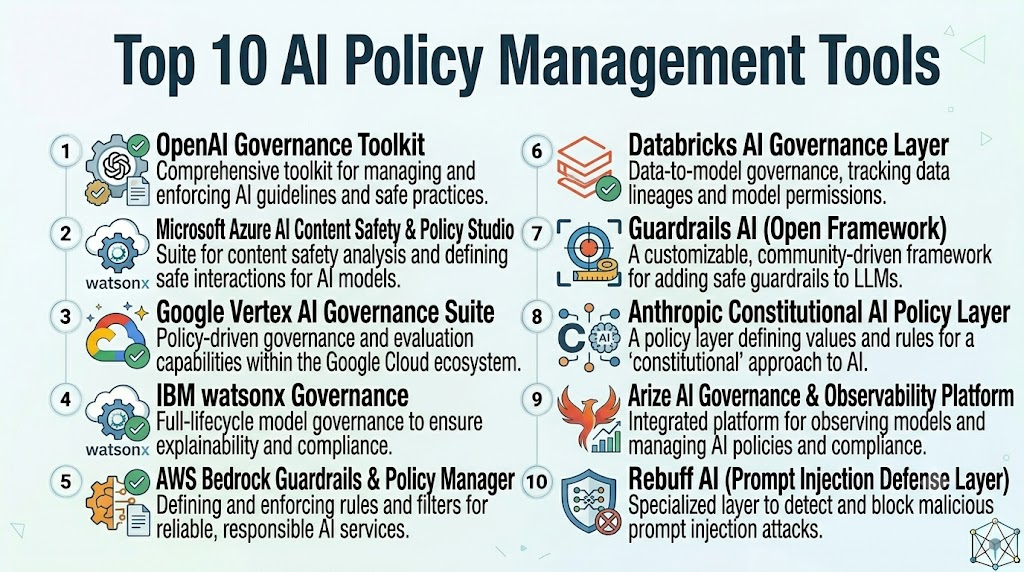
Top 10 AI Policy Management Tools
1 — OpenAI Governance Toolkit
One-line verdict: Best for teams standardizing policy enforcement around OpenAI-based applications.
Short description (2–3 lines):
OpenAI Governance Toolkit focuses on policy enforcement, usage controls, and safety alignment for applications built on OpenAI models. It is commonly used by enterprise teams integrating GPT-based systems into production workflows.
Standout Capabilities
- Centralized policy definition for AI interactions
- Content moderation and safety filtering layers
- Role-based access for AI capabilities
- Usage monitoring across applications
- Prompt-level control and constraints
- Enterprise admin controls for model usage governance
- Integration with OpenAI ecosystem APIs
AI-Specific Depth
- Model support: Proprietary (OpenAI ecosystem)
- RAG / knowledge integration: Varies / N/A
- Evaluation: Basic safety and moderation scoring
- Guardrails: Strong content filtering and policy enforcement
- Observability: Usage logs, token tracking (varies by setup)
Pros
- Tight integration with GPT ecosystem
- Strong baseline safety and moderation
- Easy to deploy for OpenAI-first stacks
Cons
- Limited flexibility outside OpenAI ecosystem
- Advanced enterprise governance may require additional tooling
- RAG and multi-model control are not deeply native
Security & Compliance
Not publicly stated in full detail for governance toolkit layer.
Deployment & Platforms
- Cloud-based
- API-first integration
- No self-hosted option
Integrations & Ecosystem
- OpenAI APIs
- Third-party monitoring tools via API
- Enterprise identity systems (varies)
Pricing model is usage-based through underlying OpenAI services.
Best-Fit Scenarios
- GPT-powered SaaS applications
- Internal copilots using OpenAI models
- Startups needing fast safety controls
2 — Microsoft Azure AI Content Safety & Policy Studio
One-line verdict: Best for enterprise compliance-heavy environments using Azure AI stack.
Short description (2–3 lines):
Azure AI Policy Studio provides governance, safety filters, and policy enforcement across Azure-hosted AI workloads. It is designed for enterprise-grade compliance and integration with Microsoft ecosystems.
Standout Capabilities
- Enterprise-grade content filtering
- Policy configuration for AI services
- Integration with Azure OpenAI and AI services
- Multi-layer safety classification
- Regional compliance controls
- Enterprise identity integration
- Monitoring and audit dashboards
AI-Specific Depth
- Model support: Azure-hosted + BYO via Azure ecosystem
- RAG / knowledge integration: Supported via Azure AI Search
- Evaluation: Safety scoring and moderation tools
- Guardrails: Strong enterprise-level enforcement
- Observability: Logs, telemetry, and monitoring dashboards
Pros
- Strong enterprise compliance alignment
- Deep integration with Microsoft ecosystem
- Scales well for large deployments
Cons
- Complex setup for smaller teams
- Vendor lock-in within Azure ecosystem
- Policy flexibility can feel rigid
Security & Compliance
Enterprise-grade identity, RBAC, audit logging (exact certifications vary by deployment).
Deployment & Platforms
- Cloud (Azure-only)
- Enterprise hybrid possible via Azure Arc
Integrations & Ecosystem
- Microsoft 365
- Azure AI Studio
- Azure OpenAI Service
- Power Platform
- Enterprise SIEM tools
Pricing model: enterprise consumption-based.
Best-Fit Scenarios
- Large enterprises on Azure
- Regulated industries
- Internal AI copilots at scale
3 — Google Vertex AI Governance Suite
One-line verdict: Best for organizations building multi-model AI systems on Google Cloud.
Short description (2–3 lines):
Vertex AI Governance Suite offers policy management, model monitoring, and AI safety controls integrated into Google Cloud’s AI ecosystem.
Standout Capabilities
- Centralized model governance
- Safety filtering for generative outputs
- Model registry with policy constraints
- Evaluation pipelines for LLM outputs
- Data lineage tracking
- Integrated MLOps workflows
- Multi-model support
AI-Specific Depth
- Model support: Google models + BYO models
- RAG / knowledge integration: Vertex AI Search + embeddings
- Evaluation: Built-in evaluation pipelines
- Guardrails: Policy-based filtering and safety rules
- Observability: Model performance and drift monitoring
Pros
- Strong MLOps + governance combination
- Scalable for enterprise AI systems
- Good integration with data pipelines
Cons
- Learning curve is steep
- Complex configuration
- Best value only inside Google Cloud
Security & Compliance
Enterprise GCP compliance framework (details vary by configuration).
Deployment & Platforms
- Cloud-native (GCP)
Integrations & Ecosystem
- BigQuery
- Vertex AI
- Looker
- Dataflow
- External ML frameworks
Pricing: usage-based cloud pricing.
Best-Fit Scenarios
- AI-native enterprises on GCP
- Data-heavy organizations
- Multi-model ML pipelines
4 — IBM watsonx Governance
One-line verdict: Best for regulated industries needing explainable AI governance.
Short description (2–3 lines):
IBM watsonx Governance provides structured AI lifecycle governance, policy enforcement, and compliance monitoring for enterprise AI systems.
Standout Capabilities
- AI lifecycle governance workflows
- Risk classification frameworks
- Model documentation automation
- Compliance reporting tools
- Policy enforcement across AI assets
- Audit-ready logs
- Enterprise workflow integration
AI-Specific Depth
- Model support: Multi-model (IBM + external)
- RAG / knowledge integration: Supported via watsonx ecosystem
- Evaluation: Model risk and fairness evaluation
- Guardrails: Strong compliance-based controls
- Observability: Full lifecycle tracking
Pros
- Strong governance framework
- Built for regulated industries
- Mature enterprise tooling
Cons
- Complex implementation
- Heavy enterprise focus
- Less developer-friendly UX
Security & Compliance
Strong enterprise controls; certifications vary by deployment.
Deployment & Platforms
- Cloud
- Hybrid enterprise deployments
Integrations & Ecosystem
- IBM watsonx
- Data platforms
- Enterprise compliance systems
Pricing: enterprise licensing model.
Best-Fit Scenarios
- Banking and insurance
- Government systems
- High-regulation environments
5 — AWS Bedrock Guardrails & Policy Manager
One-line verdict: Best for AWS-native AI workloads requiring scalable policy enforcement.
Short description (2–3 lines):
AWS Bedrock Guardrails enables policy enforcement, safety controls, and model governance for generative AI applications built on AWS infrastructure.
Standout Capabilities
- Prompt and response filtering
- Topic blocking and safety rules
- Multi-model governance
- Integration with AWS AI stack
- Scalable enforcement at runtime
- Real-time policy checks
- Monitoring and logging integration
AI-Specific Depth
- Model support: Bedrock models + third-party models
- RAG / knowledge integration: Supported via AWS ecosystem
- Evaluation: Basic safety evaluation
- Guardrails: Strong runtime enforcement
- Observability: CloudWatch integration
Pros
- Highly scalable
- Deep AWS integration
- Strong runtime safety controls
Cons
- AWS ecosystem dependency
- Limited cross-cloud portability
- Advanced governance requires multiple services
Security & Compliance
AWS enterprise security standards apply (specifics vary).
Deployment & Platforms
- AWS Cloud only
Integrations & Ecosystem
- AWS Lambda
- Amazon Bedrock
- CloudWatch
- SageMaker
Pricing: usage-based AWS pricing.
Best-Fit Scenarios
- AWS-native AI applications
- Scalable production AI systems
- Enterprise cloud workloads
6 — Databricks AI Governance Layer
One-line verdict: Best for data-driven organizations building AI on lakehouse architecture.
Short description (2–3 lines):
Databricks AI Governance Layer manages policies, model tracking, and evaluation within the Databricks Lakehouse ecosystem.
Standout Capabilities
- Unified data + AI governance
- Model tracking and lineage
- Policy enforcement on datasets and models
- Integration with MLflow
- Evaluation pipelines
- Data access controls
- Enterprise audit logging
AI-Specific Depth
- Model support: Multi-model via MLflow
- RAG / knowledge integration: Strong via lakehouse architecture
- Evaluation: MLflow-based evaluation
- Guardrails: Data-level governance policies
- Observability: Strong model tracking
Pros
- Excellent for data-centric AI stacks
- Strong ML lifecycle integration
- Scales well for enterprises
Cons
- Requires Databricks ecosystem adoption
- Steep learning curve
- Governance tied to platform
Security & Compliance
Enterprise-grade controls via Databricks platform.
Deployment & Platforms
- Cloud (multi-cloud support)
Integrations & Ecosystem
- MLflow
- Spark ecosystem
- BI tools
Pricing: enterprise usage-based.
Best-Fit Scenarios
- Data science teams
- AI + analytics combined workflows
- Lakehouse architectures
7 — Guardrails AI (Open Framework)
One-line verdict: Best for developers needing flexible open-source AI policy enforcement.
Short description (2–3 lines):
Guardrails AI is an open framework for validating, structuring, and enforcing policies on LLM outputs.
Standout Capabilities
- Output validation pipelines
- Schema-based enforcement
- Custom rule creation
- LLM response structuring
- Lightweight integration
- Developer-first design
- Extensible architecture
AI-Specific Depth
- Model support: Any LLM
- RAG / knowledge integration: Works alongside external systems
- Evaluation: Basic validation checks
- Guardrails: Strong custom rule-based system
- Observability: Limited native observability
Pros
- Highly flexible
- Open-source
- Easy integration
Cons
- Requires engineering effort
- No enterprise governance UI
- Limited built-in compliance tools
Security & Compliance
Not publicly stated.
Deployment & Platforms
- Self-hosted
- Cloud deployments via integration
Integrations & Ecosystem
- LangChain
- LLM APIs
- Custom pipelines
Pricing: open-source.
Best-Fit Scenarios
- Developers building custom AI apps
- Research environments
- Prototype governance systems
8 — Anthropic Constitutional AI Policy Layer
One-line verdict: Best for safety-first AI applications using constitutional rule frameworks.
Short description (2–3 lines):
Anthropic’s policy layer applies constitutional AI principles to enforce safe and aligned outputs in Claude-based systems.
Standout Capabilities
- Constitutional rule-based alignment
- Safety-first model behavior
- Built-in refusal logic
- Ethical constraint frameworks
- Robust prompt handling
- Enterprise API controls
- Context-aware safety reasoning
AI-Specific Depth
- Model support: Claude models
- RAG / knowledge integration: Supported via API
- Evaluation: Safety-aligned scoring
- Guardrails: Strong built-in safety alignment
- Observability: API-level monitoring
Pros
- Strong safety orientation
- High-quality reasoning alignment
- Easy integration via API
Cons
- Limited customization of policies
- Locked into Claude ecosystem
- Less enterprise governance tooling
Security & Compliance
Not publicly stated in full governance detail.
Deployment & Platforms
- Cloud API
Integrations & Ecosystem
- Claude API
- Developer SDKs
Pricing: API-based usage.
Best-Fit Scenarios
- Safety-critical AI apps
- Customer-facing assistants
- Ethical AI deployments
9 — Arize AI Governance & Observability Platform
One-line verdict: Best for monitoring, evaluating, and governing LLM performance at scale.
Short description (2–3 lines):
Arize provides AI observability and governance tools for monitoring LLM behavior, performance, and policy compliance.
Standout Capabilities
- LLM observability dashboards
- Drift detection
- Evaluation workflows
- Prompt and response tracking
- Root cause analysis tools
- Model performance monitoring
- Incident alerting
AI-Specific Depth
- Model support: Multi-model
- RAG / knowledge integration: Supported indirectly
- Evaluation: Strong evaluation pipelines
- Guardrails: Limited enforcement focus
- Observability: Industry-leading
Pros
- Excellent observability tools
- Strong evaluation capabilities
- Works across stacks
Cons
- Not a full policy enforcement system
- Requires integration with other tools
- Complex for small teams
Security & Compliance
Not publicly stated.
Deployment & Platforms
- Cloud platform
Integrations & Ecosystem
- OpenTelemetry
- LLM frameworks
- Cloud AI services
Pricing: enterprise SaaS model.
Best-Fit Scenarios
- LLM production monitoring
- AI reliability teams
- Model QA pipelines
10 — Rebuff AI (Prompt Injection Defense Layer)
One-line verdict: Best for protecting AI systems from prompt injection and malicious inputs.
Short description (2–3 lines):
Rebuff focuses on detecting and preventing prompt injection attacks in LLM applications through security-first policy enforcement.
Standout Capabilities
- Prompt injection detection
- Input sanitization layers
- Risk scoring for prompts
- API-level protection
- Lightweight integration
- Security-first AI guardrails
- Real-time threat blocking
AI-Specific Depth
- Model support: Any LLM
- RAG / knowledge integration: Works alongside RAG systems
- Evaluation: Security-focused evaluation
- Guardrails: Strong injection defense
- Observability: Basic security logs
Pros
- Strong security focus
- Lightweight integration
- Easy to deploy
Cons
- Narrow scope (security only)
- Not a full governance suite
- Limited enterprise features
Security & Compliance
Not publicly stated.
Deployment & Platforms
- Cloud + self-hosted options
Integrations & Ecosystem
- LLM APIs
- Backend systems
- Security pipelines
Pricing: open-source + enterprise support.
Best-Fit Scenarios
- Security-focused AI applications
- RAG systems exposed to external input
- LLM APIs in production
Comparison Table (Top 10)
| Tool Name | Best For | Deployment | Model Flexibility | Strength | Watch-Out | Public Rating |
|---|---|---|---|---|---|---|
| OpenAI Governance Toolkit | GPT apps | Cloud | Hosted | Fast safety setup | Limited flexibility | N/A |
| Azure AI Policy Studio | Enterprise Azure | Cloud | Multi-model | Enterprise compliance | Azure lock-in | N/A |
| Vertex AI Governance | GCP AI systems | Cloud | Multi-model | MLOps integration | Complexity | N/A |
| IBM watsonx Governance | Regulated industries | Hybrid | Multi-model | Compliance strength | Heavy setup | N/A |
| AWS Bedrock Guardrails | AWS AI apps | Cloud | Multi-model | Scalability | AWS dependency | N/A |
| Databricks Governance | Data + AI teams | Cloud | Multi-model | Lakehouse governance | Platform lock-in | N/A |
| Guardrails AI | Developers | Self-hosted | Any LLM | Flexibility | No UI tools | N/A |
| Anthropic Policy Layer | Safety-first apps | Cloud API | Claude only | Alignment quality | Ecosystem lock-in | N/A |
| Arize AI | Observability teams | Cloud | Multi-model | Monitoring depth | Not enforcement | N/A |
| Rebuff AI | Security teams | Cloud/self-hosted | Any LLM | Injection defense | Narrow scope | N/A |
Scoring & Evaluation (Transparent Rubric)
Scoring is comparative and based on governance depth, AI safety capabilities, observability maturity, and enterprise readiness. Scores are relative, not absolute, and “N/A” is used where verification is not publicly available.
| Tool | Core | Reliability/Eval | Guardrails | Integrations | Ease | Perf/Cost | Security/Admin | Support | Weighted Total |
|---|---|---|---|---|---|---|---|---|---|
| OpenAI Governance Toolkit | 8.5 | 7.5 | 8.5 | 8 | 9 | 8 | 7.5 | 8 | 8.1 |
| Azure AI Policy Studio | 9 | 8.5 | 9 | 9 | 7.5 | 8 | 9 | 8.5 | 8.6 |
| Vertex AI Governance | 8.5 | 8 | 8.5 | 8.5 | 7 | 8 | 8.5 | 8 | 8.1 |
| IBM watsonx Governance | 9 | 8.5 | 9 | 8.5 | 6.5 | 7.5 | 9 | 8 | 8.3 |
| AWS Bedrock Guardrails | 8.5 | 8 | 8.5 | 9 | 8 | 8.5 | 8.5 | 8 | 8.4 |
| Databricks Governance | 9 | 8.5 | 8.5 | 9 | 7.5 | 8 | 8.5 | 8 | 8.4 |
| Guardrails AI | 7.5 | 7 | 7 | 7 | 8.5 | 8 | 6.5 | 7 | 7.4 |
| Anthropic Policy Layer | 8.5 | 8.5 | 9 | 8 | 9 | 8.5 | 7.5 | 8 | 8.4 |
| Arize AI | 8.5 | 9 | 7.5 | 9 | 8 | 8 | 8 | 8 | 8.3 |
| Rebuff AI | 7.5 | 7 | 9 | 7.5 | 9 | 8 | 7 | 7.5 | 7.9 |
Which AI Policy Management Tool Is Right for You?
Solo / Freelancer
Best suited tools are lightweight frameworks like Guardrails AI or API-native policy layers. Focus is on simplicity, not enterprise governance.
SMB
SMBs benefit from OpenAI Governance Toolkit and Anthropic Policy Layer for quick deployment with built-in safety controls and minimal overhead.
Mid-Market
Mid-sized companies should look at AWS Bedrock Guardrails or Databricks Governance for scalable policy enforcement and observability.
Enterprise
Enterprises require Azure AI Policy Studio, IBM watsonx Governance, or Vertex AI Governance for compliance, auditability, and multi-team coordination.
Regulated industries
Finance, healthcare, and government should prioritize IBM watsonx Governance or Azure AI Policy Studio due to strong audit and compliance support.
Budget vs premium
Budget-focused teams can use open-source frameworks; premium enterprise tools offer deeper governance, observability, and compliance.
Build vs buy
- Build if you need custom workflows and developer control
- Buy if you need compliance, auditability, and scale quickly
Common Mistakes & How to Avoid Them
- No formal evaluation framework for AI outputs
- Ignoring prompt injection risks in production systems
- Over-relying on model providers without governance layers
- Not tracking cost per request or per workflow
- Missing audit logs for compliance requirements
- Treating governance as optional instead of foundational
- Failing to test edge cases and adversarial prompts
- Locking into a single model provider too early
- Lack of visibility into latency and performance
- No human-in-the-loop fallback mechanism
- Poor policy version control and change tracking
- Underestimating data retention risks
- Not aligning policies across teams and departments
- Deploying AI without rollback or kill-switch mechanisms
FAQs
1. What are AI Policy Management Tools used for?
They enforce rules and governance over AI systems, ensuring safe, compliant, and controlled outputs across applications and workflows.
2. Do these tools work with all LLMs?
Many support multi-model environments, but some are ecosystem-specific. Flexibility varies by vendor.
3. Can I self-host AI policy management systems?
Some open-source tools allow self-hosting, while enterprise platforms are typically cloud-based or hybrid.
4. How do these tools handle data privacy?
They often include retention controls, access policies, and audit logs, but capabilities vary significantly.
5. What is prompt injection defense?
It is a security layer that prevents malicious inputs from manipulating AI behavior or leaking sensitive data.
6. Do I need evaluation frameworks?
Yes, evaluation ensures your AI outputs remain accurate, safe, and consistent over time.
7. Are these tools expensive?
Enterprise solutions can be costly; open-source or lightweight tools are more budget-friendly.
8. Can I switch between policy tools later?
Yes, but migration can be complex due to policy definitions and integration dependencies.
9. Do these tools support RAG systems?
Most modern platforms support or integrate with RAG pipelines for controlled knowledge retrieval.
10. Are these tools necessary for small projects?
Not always. Simple AI use cases may not require full governance layers.
11. What is AI observability?
It is the ability to monitor AI behavior, including latency, cost, and output quality in real time.
12. What is policy-as-code in AI?
It means defining governance rules in code format for automation and version control.
Conclusion
AI Policy Management Tools are becoming a foundational layer of modern AI infrastructure. As organizations move toward autonomous agents and multimodal systems, governance is no longer optional—it is essential for safety, compliance, and performance stability.
The right choice depends heavily on your ecosystem, scale, and regulatory needs. Enterprises should prioritize full governance suites, while developers may prefer lightweight frameworks. Regardless of size, every organization deploying AI at scale should invest in evaluation, observability, and guardrails.
