Introduction
Global supply chains are becoming more complex every day. Businesses now manage suppliers, warehouses, transportation partners, customer expectations, inventory levels, and delivery timelines across multiple locations. Traditional supply chain methods often struggle with sudden demand changes, delays, stock shortages, rising logistics costs, and limited visibility. This is where artificial intelligence is becoming essential. AI helps companies predict demand, optimize inventory, automate warehouse tasks, monitor supplier risks, improve delivery routes, and make faster decisions. Instead of reacting after problems happen, businesses can use AI to plan ahead. For professionals, students, and business leaders who want to understand modern artificial intelligence concepts, AIUniverse.xyz can be a useful educational learning resource for exploring AI-powered business transformation.
In this article, you will learn how AI is revolutionizing supply chain management, how it improves logistics and operations, where it is used in real business scenarios, and how organizations can prepare for AI-powered supply chains.
What Is AI in Supply Chain Management?
AI in supply chain management means using artificial intelligence technologies to plan, monitor, automate, and improve supply chain operations. It helps businesses make smarter decisions using data instead of depending only on manual planning or guesswork.
AI can analyze large amounts of data from sales, suppliers, warehouses, transportation systems, customer orders, machines, and market patterns. It then finds useful insights that help teams act faster and more accurately.
Core Technologies Used in AI Supply Chains
AI-powered supply chains commonly use:
- Machine learning to identify patterns and improve predictions
- Predictive analytics to forecast demand, delays, and risks
- Robotic process automation to reduce repetitive manual work
- Computer vision to inspect products and monitor warehouse activity
- Natural language processing to analyze documents, emails, and supplier communication
- Internet of Things sensors to track goods, vehicles, equipment, and storage conditions
- Digital twins to simulate supply chain scenarios before taking action
Role of Machine Learning, Automation, and Predictive Analytics
Machine learning helps supply chain systems learn from past and current data. For example, it can study customer orders, seasonal trends, and market behavior to predict future demand.
Automation helps reduce manual work in warehouses, procurement, reporting, and order processing. Predictive analytics helps managers see possible risks before they become serious problems.
Together, these technologies create an intelligent supply chain that is faster, more accurate, and more resilient.
Why AI Matters in Supply Chain Operations
AI matters because supply chains depend on speed, accuracy, and coordination. A small delay in one part of the supply chain can affect production, delivery, customer satisfaction, and revenue.
AI helps businesses:
- Reduce delays
- Avoid overstocking and stockouts
- Improve delivery planning
- Track risks early
- Use resources more efficiently
- Support better decision-making
4. Challenges in Traditional Supply Chain Management
Traditional supply chains often depend on manual planning, disconnected systems, spreadsheets, and delayed reporting. These methods may work for small operations, but they become difficult to manage as the business grows.
Demand Uncertainty
Customer demand can change quickly. A product may suddenly become popular, or demand may drop because of market changes.
Traditional forecasting often depends on old sales data and manual judgment. This can lead to incorrect planning, missed sales, or excess inventory.
Inventory Imbalances
Inventory imbalance happens when a company has too much stock of one product and not enough of another.
Too much inventory increases storage costs and blocks working capital. Too little inventory causes stockouts, delayed orders, and unhappy customers.
Transportation Delays
Transportation delays can happen due to traffic, weather, port congestion, vehicle breakdowns, or poor route planning.
In traditional systems, companies may discover these delays too late. This makes it harder to adjust delivery schedules or inform customers on time.
Limited Visibility
Many companies cannot see their full supply chain in real time. They may know what is happening in their own warehouse but not with suppliers, transporters, or regional distribution centers.
Limited visibility creates confusion and slows down decision-making.
Manual Decision-Making
Manual decision-making depends heavily on human experience. While experience is valuable, people cannot analyze millions of data points quickly.
This can result in slow responses, missed patterns, and reactive decisions.
How AI Is Revolutionizing Supply Chain Management
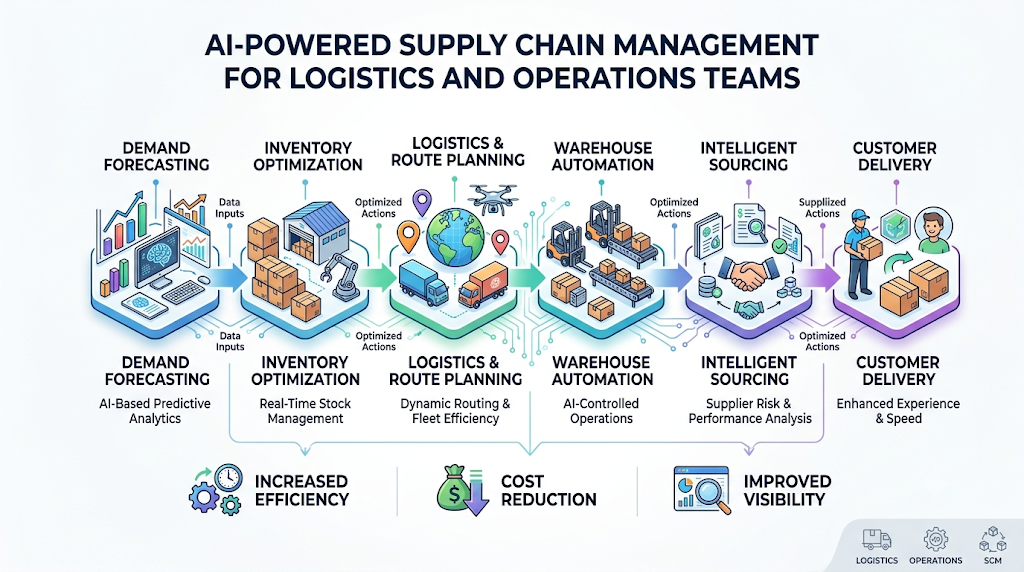
AI is changing supply chains by making them more predictive, automated, connected, and intelligent. It helps companies move from reactive operations to proactive planning.
Demand Forecasting
AI demand forecasting uses sales history, customer behavior, market trends, promotions, location data, and external signals to predict future demand.
For example, a retail company can use AI to predict which products will sell more in a specific region. This helps the company send the right stock to the right warehouse before demand increases.
This reduces stockouts, improves customer satisfaction, and prevents unnecessary inventory buildup.
Inventory Optimization
AI inventory management helps businesses maintain the right stock level at the right time.
For example, a manufacturer can use AI to calculate how much raw material is needed based on production schedules, supplier lead times, and customer orders.
AI can also recommend when to reorder, how much to reorder, and where inventory should be stored.
This helps companies reduce storage costs while still meeting customer demand.
Warehouse Automation
Warehouse automation uses AI, robotics, sensors, and software to improve warehouse operations.
AI can help with:
- Picking and packing
- Product sorting
- Shelf scanning
- Quality inspection
- Space optimization
- Worker task assignment
For example, an e-commerce warehouse can use AI-powered systems to identify the fastest picking route for workers or robots. This improves order fulfillment speed and reduces errors.
Route Optimization
AI logistics systems can analyze traffic, fuel costs, delivery windows, road conditions, vehicle capacity, and customer locations to suggest the best delivery routes.
For example, a delivery company can use AI to adjust routes in real time when traffic increases or a vehicle faces a delay.
This improves delivery performance, reduces fuel costs, and helps customers receive accurate delivery updates.
Supplier Risk Analysis
Suppliers are an important part of the supply chain. If a supplier fails to deliver raw materials on time, the entire production process may be affected.
AI can monitor supplier performance, delivery history, quality issues, financial risk, communication delays, and regional disruptions.
For example, if a supplier frequently misses delivery deadlines, AI can alert procurement teams early. This allows the business to find backup suppliers before operations are affected.
Predictive Maintenance
Predictive maintenance uses AI to monitor machines, vehicles, warehouse equipment, and production systems.
Instead of waiting for equipment to fail, AI can detect warning signs such as unusual vibration, temperature changes, or performance drops.
For example, a logistics company can use AI to predict when a delivery vehicle may need maintenance. This reduces breakdowns, improves safety, and avoids delivery delays.
Real-Time Supply Chain Visibility
AI-powered supply chain platforms can collect real-time data from warehouses, vehicles, suppliers, sensors, and enterprise systems.
This gives managers a clear view of inventory, shipments, delays, demand changes, and operational risks.
For example, a food distribution company can track temperature-sensitive goods during transportation. If the temperature goes beyond the safe range, the system can alert the team immediately.
Simple AI-Powered Supply Chain Workflow
A typical AI-powered supply chain workflow looks like this:
- Data is collected from sales, suppliers, warehouses, vehicles, and customer orders.
- AI systems clean and analyze the data.
- Machine learning models detect patterns and risks.
- The system generates recommendations or automated actions.
- Managers review insights and make decisions.
- Results are monitored and used to improve future predictions.
This workflow helps businesses continuously improve operations.
AIUniverse.xyz Guide to AI-Powered Supply Chain Management
AIUniverse.xyz focuses on helping learners understand artificial intelligence in a practical and business-friendly way. For supply chain professionals, learning AI is no longer only a technical advantage. It is becoming an important business skill.
Understanding AI Fundamentals
Before using AI in supply chain management, professionals should understand basic AI concepts such as machine learning, data models, automation, prediction, and analytics.
This foundation helps teams communicate better with data scientists, software vendors, and technology partners.
Building Data-Driven Supply Chains
AI works best when businesses have clean, connected, and reliable data.
A data-driven supply chain collects information from sales systems, warehouse software, transport platforms, supplier records, and customer service channels.
When this data is connected, AI can provide better insights.
Improving Operational Efficiency
AI helps supply chain teams reduce waste, improve planning, and use resources more effectively.
For example, AI can identify slow-moving inventory, high-cost delivery routes, repeated supplier delays, or warehouse bottlenecks.
These insights help managers take practical action.
Automating Repetitive Processes
Many supply chain tasks are repetitive. These include order updates, invoice matching, shipment tracking, stock alerts, and report generation.
AI and automation can handle many of these tasks, allowing employees to focus on planning, problem-solving, and customer service.
Preparing for Future Supply Chain Technologies
Supply chain technology will continue to become more intelligent. Professionals should prepare by learning about AI analytics, digital twins, robotics, intelligent logistics, and automation platforms.
Continuous learning helps supply chain teams stay relevant and competitive.
Benefits of AI in Supply Chain Management
AI creates value across the entire supply chain. It improves planning, execution, monitoring, and decision-making.
Faster Decision-Making
AI can analyze data faster than manual teams. It can quickly identify problems, suggest actions, and support urgent decisions.
For example, if demand suddenly increases in one region, AI can recommend inventory redistribution.
Reduced Operational Costs
AI helps reduce costs by improving inventory planning, route efficiency, warehouse productivity, and equipment maintenance.
Lower waste and better planning lead to stronger margins.
Better Customer Satisfaction
Customers expect fast delivery, accurate updates, and product availability.
AI helps businesses fulfill orders more accurately, reduce delays, and provide better delivery visibility.
Improved Forecast Accuracy
AI demand forecasting uses more data points than traditional forecasting methods. This improves the accuracy of sales, inventory, and production planning.
Better forecasting helps businesses avoid both shortages and excess stock.
Increased Supply Chain Resilience
A resilient supply chain can handle disruption and recover quickly.
AI helps identify supplier risks, demand changes, transportation problems, and operational bottlenecks early.
Enhanced Productivity
AI reduces repetitive tasks and supports smarter workflows.
Employees can spend more time on strategic activities such as supplier negotiation, process improvement, customer experience, and risk planning.
Real-World Applications
AI in supply chain management is useful across many industries. Each industry uses AI differently based on its operations, products, and customer needs.
Manufacturing
Manufacturers use AI for production planning, raw material forecasting, supplier monitoring, quality inspection, and predictive maintenance.
For example, a factory can use AI to predict machine failure and schedule maintenance before production stops.
Retail
Retail companies use AI to forecast demand, manage store inventory, plan promotions, and personalize product availability by location.
For example, a fashion retailer can use AI to decide which products should be stocked in each store based on local buying patterns.
Healthcare
Healthcare supply chains manage medicines, medical devices, hospital supplies, and temperature-sensitive products.
AI can help hospitals and distributors maintain critical stock levels and reduce supply shortages.
E-Commerce
E-commerce businesses use AI for warehouse automation, delivery route optimization, customer demand prediction, and return management.
For example, AI can help an online marketplace predict which products should be stored near high-demand locations.
Food and Beverage
Food and beverage supply chains require freshness, temperature control, and fast movement.
AI can help forecast demand, reduce food waste, monitor storage conditions, and optimize delivery schedules.
Transportation and Logistics
Logistics companies use AI for route planning, fleet management, shipment tracking, driver scheduling, and predictive maintenance.
This improves delivery speed, reduces fuel usage, and improves asset utilization.
Traditional Supply Chain vs AI-Driven Supply Chain
| Capability | Traditional Supply Chain | AI-Driven Supply Chain |
|---|---|---|
| Demand Forecasting | Historical estimates | Predictive analytics |
| Inventory Management | Manual planning | Intelligent optimization |
| Decision-Making | Mostly reactive | Data-driven and proactive |
| Warehouse Operations | Labor-intensive | Automated workflows |
| Risk Management | Limited visibility | Continuous monitoring |
| Route Planning | Fixed or manually adjusted routes | Real-time route optimization |
| Supplier Monitoring | Periodic reviews | Continuous supplier risk analysis |
| Maintenance | Scheduled or reactive maintenance | Predictive maintenance |
| Customer Updates | Delayed communication | Real-time visibility |
| Reporting | Manual reports | Automated insights and dashboards |
Common Challenges of AI Adoption
AI adoption in supply chain management can bring strong benefits, but it also requires careful planning. Businesses should understand the common challenges before starting.
Data Quality Issues
AI depends on data. If data is incomplete, outdated, duplicated, or inaccurate, AI results may also be unreliable.
Recommendation: Start by cleaning supplier records, inventory data, order history, and logistics data. Create clear data ownership across teams.
Integration Complexity
Many supply chain systems are old or disconnected. AI tools may need to connect with ERP, warehouse management, transport management, procurement, and customer service systems.
Recommendation: Begin with one focused use case, such as demand forecasting or shipment visibility. Expand after proving business value.
Workforce Training
Employees may not understand how AI works or how to use AI insights in daily operations.
Recommendation: Train supply chain teams on AI basics, data interpretation, dashboards, automation workflows, and decision-making with analytics.
High Initial Investment
AI projects may require software, data infrastructure, integration work, skilled people, and process changes.
Recommendation: Start with high-impact areas where savings or efficiency gains can be measured clearly, such as inventory optimization or route planning.
Data Privacy and Security
Supply chain data may include supplier contracts, pricing, customer orders, shipment details, and business-sensitive information.
Recommendation: Use proper access control, encryption, governance policies, and vendor security checks before implementing AI systems.
Best Practices for AI-Powered Supply Chain Management
To get the best results from AI, companies should treat it as a business transformation project, not just a software installation.
Best practices include:
- Build a strong data foundation
- Automate repetitive processes
- Monitor key operational metrics
- Integrate AI with existing business systems
- Continuously improve AI models
- Start with clear business problems
- Involve supply chain, IT, finance, and operations teams
- Keep humans involved in important decisions
- Measure results before scaling
- Train employees regularly
A practical approach is to begin small, prove value, and then expand AI across more supply chain functions.
Key Performance Indicators
AI-powered supply chain management should be measured using clear KPIs. These metrics help businesses understand whether AI is improving performance.
Inventory Turnover
Inventory turnover shows how quickly inventory is sold or used.
Higher turnover usually means better inventory planning and less blocked capital.
Order Fulfillment Rate
Order fulfillment rate measures how many customer orders are completed correctly and on time.
AI can improve this by predicting demand and optimizing warehouse workflows.
Forecast Accuracy
Forecast accuracy measures how close demand predictions are to actual sales or usage.
AI demand forecasting can improve planning across procurement, production, and logistics.
Delivery Performance
Delivery performance measures whether shipments reach customers on time.
AI logistics tools can improve this through route optimization and real-time tracking.
Warehouse Efficiency
Warehouse efficiency measures picking speed, packing accuracy, space utilization, and labor productivity.
AI and automation can reduce errors and improve order processing speed.
Supply Chain Costs
Supply chain costs include warehousing, transportation, labor, inventory carrying costs, and supplier-related expenses.
AI can help reduce these costs through better planning and automation.
Career Opportunities
As AI becomes more important in supply chain management, new career opportunities are emerging for professionals with both business and technology skills.
Popular roles include:
- AI Supply Chain Analyst: Uses AI insights to improve planning, inventory, and logistics decisions.
- Supply Chain Data Scientist: Builds models for forecasting, optimization, and risk analysis.
- Logistics Automation Engineer: Designs automation workflows for transportation and warehouse operations.
- Operations Analyst: Studies operational data and recommends process improvements.
- AI Solutions Consultant: Helps businesses implement AI tools for supply chain transformation.
- Digital Supply Chain Manager: Leads technology-driven supply chain modernization.
Professionals who understand both supply chain operations and AI concepts can become valuable assets for modern organizations.
Future of AI in Supply Chain Management
The future of supply chain management will be more connected, intelligent, and automated. AI will play a major role in this transformation.
Autonomous Supply Chains
Autonomous supply chains will use AI to make routine decisions with limited manual effort.
For example, systems may automatically reorder inventory, adjust delivery routes, or alert teams about supplier risks.
AI-Powered Digital Twins
Digital twins are virtual models of real supply chains.
Businesses can use digital twins to test different scenarios, such as supplier delays, demand spikes, warehouse changes, or transportation disruptions.
Intelligent Robotics
Robots will become more intelligent in warehouses, factories, and distribution centers.
AI-powered robots can assist with picking, sorting, packing, inspection, and movement of goods.
Sustainable Supply Chains
AI can help companies reduce waste, lower fuel usage, improve route planning, and choose better sourcing options.
This supports more sustainable and responsible supply chain operations.
Hyperautomation
Hyperautomation means combining AI, automation, analytics, and workflow tools to automate complete business processes.
In supply chains, this can improve procurement, inventory planning, shipment tracking, reporting, and customer updates.
Common Misconceptions About AI in Supply Chains
AI is powerful, but many people misunderstand how it works in supply chain management.
AI Replaces Human Workers
AI does not replace every human role. It supports workers by handling repetitive tasks, analyzing data, and giving better recommendations.
Humans are still needed for strategy, negotiation, judgment, leadership, and exception handling.
AI Is Only for Large Enterprises
AI is useful for large companies, but smaller businesses can also use AI tools for demand forecasting, inventory planning, customer orders, and logistics tracking.
The key is to start with practical use cases.
AI Delivers Instant Results
AI needs clean data, clear goals, testing, training, and improvement.
Businesses should not expect instant transformation. AI adoption is a step-by-step journey.
Automation Eliminates Human Oversight
Automation can reduce manual work, but human oversight remains important.
Critical decisions involving suppliers, customers, costs, and risks should include human review.
FAQ Section
- What is AI in supply chain management?
AI in supply chain management means using artificial intelligence to improve planning, forecasting, inventory control, logistics, warehouse operations, and decision-making. It helps businesses use data more effectively. - How AI is revolutionizing supply chain management?
AI is revolutionizing supply chain management by making operations more predictive, automated, and data-driven. It helps companies forecast demand, optimize inventory, reduce delays, and manage risks earlier. - How does AI improve demand forecasting?
AI studies sales history, customer behavior, market trends, and other data points to predict future demand. This helps businesses plan inventory and production more accurately. - Can AI reduce supply chain costs?
Yes, AI can reduce costs by improving route planning, reducing excess inventory, preventing equipment failures, automating manual tasks, and improving warehouse efficiency. - What is AI inventory management?
AI inventory management uses data and predictive analytics to decide how much stock is needed, when to reorder, and where inventory should be placed. - Is AI useful for small supply chain businesses?
Yes, small businesses can use AI for forecasting, order tracking, stock planning, customer demand analysis, and simple automation. They should start with affordable and focused use cases. - What data is needed for AI supply chain systems?
AI systems may use sales data, inventory records, supplier data, shipment details, warehouse data, customer orders, machine data, and delivery performance data. - Does AI remove the need for supply chain managers?
No, AI supports supply chain managers by giving better insights and automating repetitive work. Managers are still needed for strategy, judgment, leadership, and decision-making. - What are the risks of AI adoption in supply chains?
Common risks include poor data quality, integration issues, high initial investment, lack of employee training, and data privacy concerns. These risks can be managed with proper planning. - What skills are useful for AI-powered supply chain careers?
Useful skills include supply chain planning, data analytics, AI fundamentals, forecasting, logistics management, process automation, dashboard analysis, and business problem-solving.
Final Summary
AI is changing the way businesses manage supply chains. It helps companies move from manual, reactive, and disconnected operations to smarter, faster, and more resilient supply chain systems. By using AI in supply chain management, organizations can improve demand forecasting, optimize inventory, automate warehouses, plan better delivery routes, monitor supplier risks, and improve real-time visibility. The real power of AI is not only automation. It is better decision-making. AI gives supply chain teams the ability to understand patterns, predict problems, and act before disruptions become serious.
