Introduction
Secure enclave inference platforms provide a way to run AI models inside hardware‑backed trusted execution environments (TEEs) or isolated secure environments so that sensitive data and models are kept confidential during inference. These platforms are increasingly crucial in regulated industries (finance, healthcare, government) where model IP protection and data privacy are non‑negotiable. They help organizations process sensitive inputs without exposing them to the host cloud provider or external actors. Real‑world use cases include confidential machine learning predictions on personal data, encrypted model serving, secure third‑party inference, and compliance with privacy regulations like HIPAA and GDPR. When selecting a secure enclave platform, buyers should weigh enclave technology, performance overhead, deployment flexibility, supported models, scalability, and compliance certifications.
Best for
Organizations with sensitive data, strict compliance requirements, or IP protection needs (healthcare, finance, defense, regulated enterprises).
Not ideal for
Small teams without security needs or projects where performance overhead is a major constraint and data is non‑sensitive.
Key Trends
- Growing adoption of confidential computing and hardware‑enforced enclaves
- Integration with cloud and hybrid environments
- Support for GPU‑accelerated secure inference
- Focus on minimizing performance overhead
- Increased demand for multi‑tenant secure inference
- Expansion of TEE support beyond Intel SGX to AMD SEV, ARM TrustZone, and Nitro Enclaves
- Secure model orchestration and logging controls
- Compliance‑centric design (HIPAA, PCI‑DSS, SOC 2)
- Tooling for secure pipelines and auditability
- Pre‑built integrations with MLOps platforms
Methodology
- Shortlist based on platform adoption, security pedigree, and technical capabilities
- Evaluated support for hardware TEEs or isolated secure runtimes
- Assessed ease of integration, scalability, performance, and compliance
- Prioritized platforms offering API access and developer tooling
- Included cloud native and hybrid deployment options
- Benchmarked documentation, SDKs, and support channels
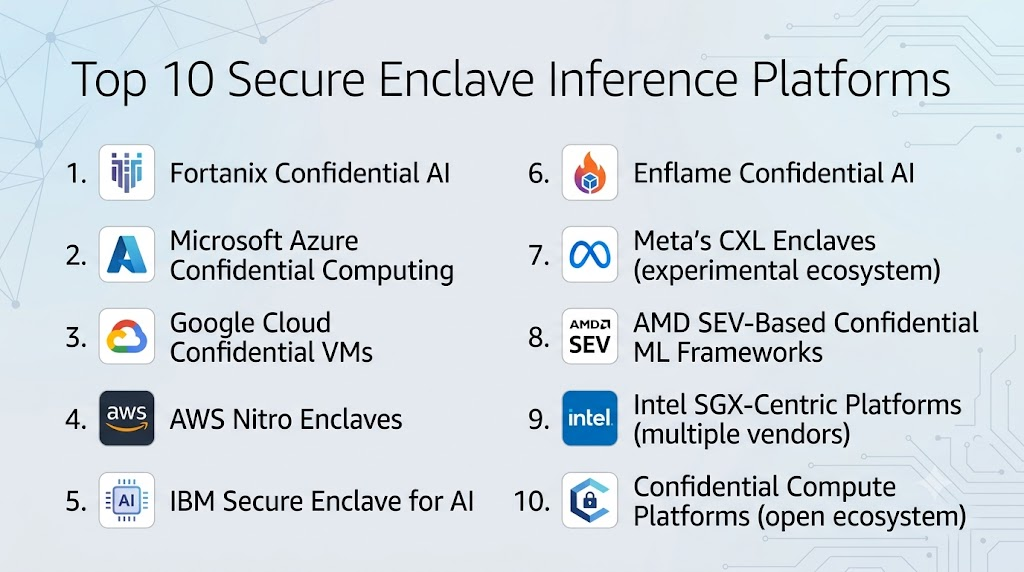
Top 10 Secure Enclave Inference Platforms
1‑ Fortanix Confidential AI
Verdict: Enterprise‑grade confidential inference platform.
Short Description: Fortanix enables secure machine learning inference in hardware‑backed enclaves like Intel SGX, with strong key management and policy controls.
Standout Capabilities / Key Features:
- Intel SGX‑based secure enclaves
- Transparent SDK and REST API
- Policy‑based access controls
- Secure key and secrets management
- Audit logging and attestation
Pros: Strong security focus, granular policy controls; Cons: SGX‑only hardware limits
Deployment: Cloud & on‑prem hybrid
Security & Compliance: SOC 2, GDPR, HIPAA readiness
Best‑Fit Scenarios: Regulated enterprises needing end‑to‑end confidential inference
2‑ Microsoft Azure Confidential Computing
Verdict: Integrated confidential inference with Azure ecosystem.
Short Description: Azure Confidential Computing offers secure inference environments leveraging hardware TEEs such as AMD SEV and Intel SGX.
Standout Capabilities / Key Features:
- Integrated with Azure ML and AKS
- Support for AMD SEV and Intel SGX
- Enclave attestation and identity
- Secure model execution
Pros: Deep Azure integration; Cons: Azure ecosystem dependence
Deployment: Cloud‑native
Security & Compliance: ISO 27001, SOC 2, HIPAA, FedRAMP
Best‑Fit Scenarios: Enterprises already on Azure
3‑ Google Cloud Confidential VMs
Verdict: Confidential inference with broad cloud services.
Short Description: Google Confidential VMs use AMD SEV to protect data in use, suitable for secure model serving and inference.
Standout Capabilities / Key Features:
- AMD SEV hardware isolation
- Works with Vertex AI and GKE
- Encrypted memory during inference
- Logging and audit support
Pros: Broad cloud integration; Cons: Requires cloud management
Deployment: Cloud‑native
Security & Compliance: ISO 27001, SOC 2, GDPR
Best‑Fit Scenarios: Google Cloud customers needing confidential compute
4‑ AWS Nitro Enclaves
Verdict: High‑isolation inference with AWS ecosystem.
Short Description: AWS Nitro Enclaves create isolated compute environments for secure inference without persistent storage or networking outside the enclave.
Standout Capabilities / Key Features:
- Strong isolation
- KMS integration for secure keys
- Attestation support
- Serverless‑friendly patterns
Pros: Tight AWS integration; Cons: Enclave memory limits
Deployment: Cloud‑native AWS
Security & Compliance: PCI‑DSS, HIPAA, SOC 2
Best‑Fit Scenarios: Secure inference in AWS‑centric architectures
5‑ IBM Secure Enclave for AI
Verdict: Enterprise‑oriented secure inference platform.
Short Description: IBM offers secure enclaves for AI models combining hardware attestation with enterprise security controls.
Standout Capabilities / Key Features:
- Hardware‑level attestation
- Integration with IBM Cloud Pak for Data
- Secure lifecycle management
Pros: Enterprise toolchain integration; Cons: Less flexible for hybrid clouds
Deployment: Cloud & on‑prem
Security & Compliance: SOC 2, ISO 27001
Best‑Fit Scenarios: Large enterprises, hybrid deployments
6‑ Enflame Confidential AI
Verdict: Confidential inference optimized for AI workloads.
Short Description: Focused on secure execution of deep learning inference in hardware TEEs with minimal performance loss.
Standout Capabilities / Key Features:
- Support for large model inference
- TEE acceleration
- Integration with model serving tools
Pros: Performance‑oriented design; Cons: Smaller ecosystem
Deployment: Cloud & hybrid
Security & Compliance: Varies / emerging
Best‑Fit Scenarios: Performance‑sensitive secure inference
7‑ Meta’s CXL Enclaves (experimental ecosystem)
Verdict: Next‑gen secure inference via CXL‑based isolation.
Short Description: An emerging secure inference approach using CXL‑enabled hardware isolation (early ecosystem).
Standout Capabilities / Key Features:
- Hardware‑accelerated isolation
- Lower overhead vs legacy TEEs
Pros: Future‑oriented; Cons: Nascent support
Deployment: Hybrid & research‑oriented
Security & Compliance: Varies
Best‑Fit Scenarios: Cutting‑edge research and experimentation
8‑ AMD SEV‑Based Confidential ML Frameworks
Verdict: Confidential inference using AMD SEV at the hypervisor level.
Short Description: Frameworks that leverage AMD SEV to isolate model inference workloads securely in virtualized environments.
Standout Capabilities / Key Features:
- Memory encryption during inference
- Integration with Kubernetes/VPS
Pros: Broad hardware support; Cons: Requires platform integration
Deployment: Cloud & on‑prem
Security & Compliance: GDPR, SOC 2
Best‑Fit Scenarios: Hybrid cloud and virtualization use cases
9‑ Intel SGX‑Centric Platforms (multiple vendors)
Verdict: Mature enclave support for secure serving.
Short Description: Multiple enterprise platforms using Intel SGX for isolated inference with attestation and secure I/O.
Standout Capabilities / Key Features:
- Fine‑grained hardware isolation
- Attestation & cryptographic proofs
Pros: Strong attack surface protection; Cons: SGX memory constraints
Deployment: Cloud & edge
Security & Compliance: Varies by vendor
Best‑Fit Scenarios: High‑security, low‑latency inference
10‑ Confidential Compute Platforms (open ecosystem)
Verdict: General secure inference via confidential runtimes (open ENARX, OpenEnclave).
Short Description: Open frameworks providing secure enclave runtimes for inference across heterogeneous hardware.
Standout Capabilities / Key Features:
- Multi‑TEE support
- Cloud‑agnostic design
Pros: Flexible and open; Cons: Requires integration work
Deployment: Hybrid & cloud
Security & Compliance: Varies‑by‑framework
Best‑Fit Scenarios: Developers needing cross‑platform secure inference
Comparison Table
| Platform | Enclave Type | Performance | Scalability | Security | Deployment |
|---|---|---|---|---|---|
| Fortanix Confidential AI | Intel SGX | Medium | High | Very High | Cloud + Hybrid |
| Azure Confidential Computing | SGX/SEV | High | Very High | Very High | Cloud |
| Google Confidential VMs | AMD SEV | High | Very High | High | Cloud |
| AWS Nitro Enclaves | Nitro | Medium‑High | Very High | Very High | Cloud |
| IBM Secure Enclave | SGX + Controls | Medium | High | Very High | Hybrid/Cloud |
| Enflame Confidential AI | Multiple TEEs | High | High | High | Hybrid |
| Meta CXL Enclaves | CXL | Very High (future) | Emerging | High | Hybrid/Research |
| AMD SEV Frameworks | SEV | High | High | High | Hybrid |
| Intel SGX Platforms | SGX | Medium | Medium | Very High | Cloud/Edge |
| Open Enclave / ENARX | Multi‑TEE | Medium | High | High | Cloud/Hybrid |
Evaluation & Scoring Table
| Platform | Security 25% | Performance 15% | Integrations 15% | Scalability 15% | Ease 10% | Compliance 10% | Value 10% | Total |
|---|---|---|---|---|---|---|---|---|
| Fortanix | 25 | 12 | 12 | 14 | 9 | 9 | 9 | 90 |
| Azure Confidential | 24 | 14 | 14 | 15 | 8 | 9 | 9 | 93 |
| Google Confidential VMs | 23 | 14 | 13 | 15 | 9 | 9 | 9 | 92 |
| AWS Nitro Enclaves | 24 | 13 | 14 | 15 | 8 | 9 | 9 | 92 |
| IBM Secure Enclave | 25 | 11 | 11 | 13 | 8 | 9 | 8 | 85 |
| Enflame | 22 | 13 | 10 | 14 | 8 | 7 | 8 | 82 |
| Meta CXL Enclaves | 20 | 15 | 9 | 10 | 7 | 7 | 7 | 75 |
| AMD SEV Frameworks | 23 | 13 | 11 | 14 | 8 | 8 | 8 | 85 |
| Intel SGX Platforms | 24 | 12 | 10 | 12 | 7 | 8 | 7 | 80 |
| Open Enclave/ENARX | 21 | 11 | 11 | 13 | 8 | 7 | 8 | 79 |
Which Secure Enclave Inference Platform Is Right for You?
- Enterprise & Compliance‑Critical: Azure Confidential, Fortanix, AWS Nitro Enclaves
- Cloud‑Native with Broad Services: Google Confidential VMs, Azure Confidential
- Hybrid / On‑Prem Security Needs: Fortanix, IBM Secure Enclave, AMD SEV Frameworks
- Performance‑Focused Secure Inference: Enflame, Meta CXL Enclaves (emerging)
- Flexible Open Systems: ENARX / Open Enclave
Implementation Playbook
- 30 Days: Identify sensitive workflows, pilot secure inference with one platform, validate enclave attestation
- 60 Days: Integrate secure endpoints into production pipelines, establish secure key and secret management, monitor performance
- 90 Days: Scale across teams, implement autoscaling policies, monitor costs and compliance audits
Common Mistakes
- Choosing secure inference without validating performance impact
- Ignoring integration complexity with existing data pipelines
- Underestimating logging and audit requirements
- Skipping enclave attestation verification steps
- Not planning for model versioning under secure constraints
Frequently Asked Questions
What is a secure enclave inference platform?
A platform that runs AI model inference within isolated, hardware‑backed secure environments to protect data in use and model IP.
Why are secure enclaves needed?
They prevent sensitive input data and proprietary models from being exposed during inference, helping meet compliance and privacy requirements.
Which hardware TEEs are commonly used?
Intel SGX, AMD SEV, AWS Nitro Enclaves, ARM TrustZone, and emerging CXL‑based isolation technologies.
Do secure enclaves impact inference performance?
Yes — hardware isolation can introduce overhead, though newer technologies and optimized runtimes aim to minimize it.
Can these platforms be used in hybrid deployments?
Many support cloud + on‑prem configurations, especially Fortanix and open enclave runtimes.
Are these platforms compliant with regulations?
Most enterprise offerings target SOC 2, ISO 27001, GDPR, HIPAA, and in some cases FedRAMP.
Is fine‑tuning supported inside enclaves?
Fine‑tuning is possible but often limited; many focus on secure inference rather than model training inside enclaves.
Can secure enclaves protect model IP?
Yes — enclaves help prevent model extraction or leakage during inference.
Do platforms offer attestation?
Yes — attestation proves the enclave is running trusted code before deployment.
Are secure enclave platforms expensive?
They can be costlier due to hardware requirements, but value is high for sensitive workloads.
Can I run multimodal models securely?
Some platforms support secure inference for multimodal models depending on enclave capabilities.
How do I monitor secure inference workloads?
Through enclave‑aware logging, audit trails, and performance dashboards provided by the platform.
Conclusion
Secure enclave inference platforms are critical where data confidentiality, model IP protection, and compliance are required. From enterprise solutions like Azure Confidential and Fortanix to open runtimes like ENARX, organizations can choose based on deployment models, integrations, and performance needs. Following a structured evaluation and phased implementation ensures secure, scalable AI inference without compromising compliance or performance.
