Introduction
AI Anomaly Detection for Accounting Tools use artificial intelligence, machine learning, pattern recognition, and financial analytics to identify unusual transactions, accounting errors, fraud indicators, and financial irregularities. These platforms analyze invoices, journal entries, payments, expenses, ledger activities, and historical financial data to detect suspicious patterns.
Traditional accounting reviews often depend on manual audits, rule-based checks, and periodic financial inspections. AI-powered anomaly detection solutions help finance teams move toward proactive monitoring by continuously analyzing accounting activities and highlighting potential risks.
These tools support accountants, auditors, finance teams, and compliance professionals by improving financial accuracy, reducing fraud risks, identifying errors earlier, and strengthening accounting controls.
Real-world use cases:
- Detecting unusual financial transactions
- Identifying duplicate payments
- Finding accounting entry errors
- Monitoring suspicious expenses
- Detecting invoice irregularities
- Supporting internal audits
- Identifying payment fraud patterns
- Improving financial compliance
- Monitoring ledger activities
- Reducing manual audit workload
Evaluation Criteria for Buyers:
- AI anomaly detection accuracy
- Financial data analysis capabilities
- Fraud detection features
- Accounting system integrations
- Real-time monitoring
- Audit reporting capabilities
- Security and compliance controls
- Ease of implementation
Best for
Enterprises, accounting departments, audit teams, financial institutions, and organizations managing complex financial operations.
Not ideal for
Small businesses with limited accounting transactions or organizations without digital financial records.
Key Trends
- AI-powered financial monitoring
- Continuous accounting audits
- Machine learning fraud detection
- Automated compliance checks
- Predictive financial risk analysis
- Real-time transaction monitoring
- Intelligent audit workflows
- Automated journal entry review
- Financial data intelligence
- AI-powered internal controls
Methodology
- Selected platforms based on AI accounting anomaly detection capabilities
- Evaluated fraud detection, analytics, automation, and integrations
- Considered solutions for enterprise and finance teams
- Prioritized platforms supporting proactive accounting monitoring
- Reviewed security, scalability, and usability features
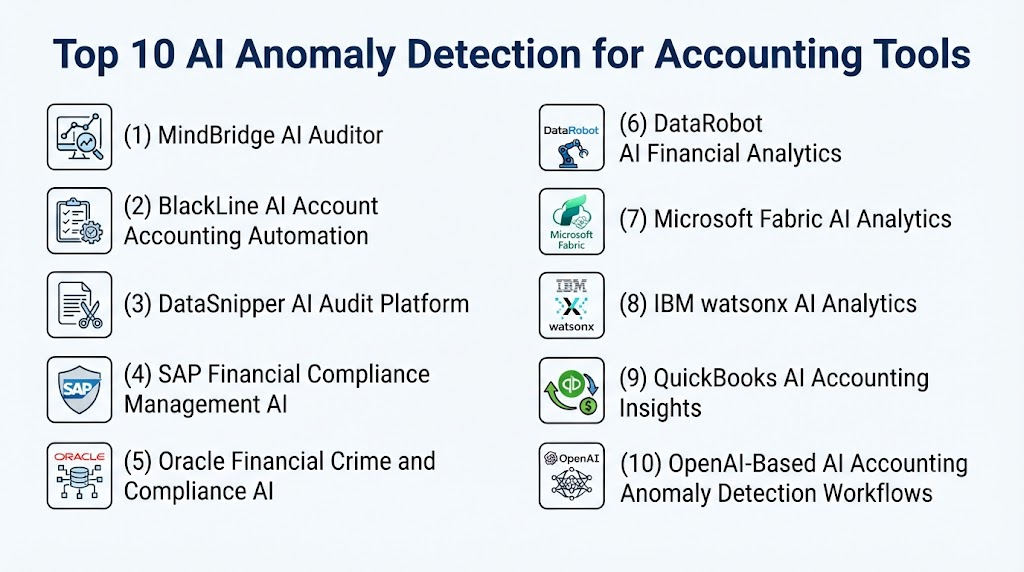
Top 10 AI Anomaly Detection for Accounting Tools
1. MindBridge AI Auditor
Verdict: AI-powered audit analytics platform for detecting financial anomalies and accounting risks.
Short Description: MindBridge AI Auditor helps organizations analyze financial transactions, identify unusual patterns, and improve audit effectiveness.
Key Features:
- Transaction risk scoring
- Accounting anomaly detection
- Audit analytics
- Financial pattern analysis
- Risk visualization
Pros:
- Strong audit intelligence
- Advanced risk detection
Cons:
- Designed mainly for audit environments
- Requires financial expertise
Deployment: Cloud-based
Security & Compliance: Enterprise security controls
Integrations & Ecosystem: Accounting and ERP systems
Support & Community: Enterprise support
Pricing Model: Subscription-based
Best-Fit Scenarios: Audit teams and enterprises
2. BlackLine AI Accounting Automation
Verdict: AI-enabled financial close and accounting control platform.
Short Description: BlackLine AI helps finance teams identify accounting issues, automate reconciliation, and improve financial accuracy.
Key Features:
- Account reconciliation
- Transaction monitoring
- Financial controls
- Close management
- Accounting analytics
Pros:
- Strong accounting workflow support
- Enterprise finance capabilities
Cons:
- Focused on larger organizations
- Implementation requires planning
Deployment: Cloud-based
Security & Compliance: Enterprise security standards
Integrations & Ecosystem: ERP and accounting platforms
Support & Community: Enterprise support
Pricing Model: Subscription-based
Best-Fit Scenarios: Enterprise accounting teams
3. DataSnipper AI Audit Platform
Verdict: AI-assisted audit automation platform for financial document analysis.
Short Description: DataSnipper AI helps auditors analyze financial documents, verify information, and improve audit efficiency.
Key Features:
- Document analysis
- Audit automation
- Data verification
- Financial review support
- Evidence management
Pros:
- Improves audit productivity
- Easy integration with audit workflows
Cons:
- Audit-focused
- Requires proper workflow adoption
Deployment: Cloud and desktop environments
Security & Compliance: Security controls available
Integrations & Ecosystem: Accounting and audit tools
Support & Community: Customer support
Pricing Model: Subscription-based
Best-Fit Scenarios: Audit professionals
4. SAP Financial Compliance Management AI
Verdict: Enterprise AI solution for financial monitoring and compliance analytics.
Short Description: SAP financial intelligence solutions help organizations analyze transactions, detect irregularities, and strengthen financial controls.
Key Features:
- Transaction monitoring
- Compliance analytics
- Financial risk analysis
- Control monitoring
- Reporting
Pros:
- Strong enterprise integration
- Global finance support
Cons:
- Requires SAP expertise
- Complex implementation
Deployment: Cloud and enterprise environments
Security & Compliance: Enterprise security controls
Integrations & Ecosystem: SAP ecosystem
Support & Community: Enterprise support
Pricing Model: Subscription-based
Best-Fit Scenarios: SAP enterprises
5. Oracle Financial Crime and Compliance AI
Verdict: AI-powered financial analytics platform for detecting suspicious activities.
Short Description: Oracle AI solutions help organizations analyze financial transactions, identify risks, and improve compliance monitoring.
Key Features:
- Transaction analytics
- Risk detection
- Financial monitoring
- Compliance reporting
- Pattern recognition
Pros:
- Strong enterprise analytics
- Financial risk capabilities
Cons:
- Requires Oracle expertise
- Enterprise-focused
Deployment: Cloud and enterprise environments
Security & Compliance: Enterprise security standards
Integrations & Ecosystem: Oracle financial systems
Support & Community: Enterprise support
Pricing Model: Subscription-based
Best-Fit Scenarios: Large financial organizations
6. DataRobot AI Financial Analytics
Verdict: AI platform for building custom financial anomaly detection models.
Short Description: DataRobot AI helps organizations create machine learning models to identify unusual accounting and financial patterns.
Key Features:
- Predictive analytics
- Machine learning models
- Risk detection
- Data analysis
- Model management
Pros:
- Flexible AI modeling
- Custom analytics capabilities
Cons:
- Requires data science expertise
- Implementation varies
Deployment: Cloud and enterprise environments
Security & Compliance: Enterprise security controls
Integrations & Ecosystem: Data platforms and business systems
Support & Community: Enterprise support
Pricing Model: Subscription-based
Best-Fit Scenarios: Advanced analytics teams
7. Microsoft Fabric AI Analytics
Verdict: AI-powered analytics platform for financial data analysis and anomaly detection.
Short Description: Microsoft Fabric AI helps organizations analyze financial datasets, detect unusual patterns, and create intelligence workflows.
Key Features:
- Data analytics
- AI anomaly detection
- Financial dashboards
- Machine learning workflows
- Data integration
Pros:
- Strong Microsoft ecosystem
- Flexible analytics platform
Cons:
- Requires technical expertise
- Custom modeling needed
Deployment: Cloud-based
Security & Compliance: Enterprise cloud security
Integrations & Ecosystem: Microsoft ecosystem
Support & Community: Microsoft support
Pricing Model: Usage-based
Best-Fit Scenarios: Enterprise analytics teams
8. IBM watsonx AI Analytics
Verdict: Enterprise AI platform for developing accounting anomaly detection solutions.
Short Description: IBM watsonx helps organizations build AI models that analyze financial data and identify accounting irregularities.
Key Features:
- Machine learning analytics
- Financial risk analysis
- AI model management
- Data intelligence
- Custom workflows
Pros:
- Enterprise AI capabilities
- Flexible deployment options
Cons:
- Requires technical expertise
- Implementation effort required
Deployment: Cloud and enterprise environments
Security & Compliance: Enterprise security controls
Integrations & Ecosystem: Enterprise data platforms
Support & Community: Enterprise support
Pricing Model: Subscription and usage-based
Best-Fit Scenarios: Enterprise AI teams
9. QuickBooks AI Accounting Insights
Verdict: AI-assisted accounting platform supporting financial transaction analysis.
Short Description: QuickBooks AI helps businesses identify unusual transactions, organize accounting data, and improve financial visibility.
Key Features:
- Transaction analysis
- Accounting insights
- Expense monitoring
- Financial reporting
- Data organization
Pros:
- Easy adoption
- Suitable for small businesses
Cons:
- Limited enterprise anomaly detection
- Advanced features vary
Deployment: Cloud-based
Security & Compliance: Platform security controls
Integrations & Ecosystem: Accounting ecosystem
Support & Community: Customer support
Pricing Model: Subscription-based
Best-Fit Scenarios: Small businesses
10. OpenAI-Based AI Accounting Anomaly Detection Workflows
Verdict: Custom AI approach for creating organization-specific accounting monitoring systems.
Short Description: AI workflows can analyze journal entries, invoices, payments, and accounting records to identify unusual financial activities.
Key Features:
- Transaction analysis
- Accounting pattern detection
- Financial risk insights
- Custom alerts
- Audit assistance
Pros:
- Highly customizable
- Supports unique accounting requirements
Cons:
- Requires implementation effort
- Needs financial governance
Deployment: API and custom environments
Security & Compliance: Depends on implementation
Integrations & Ecosystem: ERP systems, accounting platforms, databases
Support & Community: Developer ecosystem
Pricing Model: Usage-based
Best-Fit Scenarios: Custom enterprise solutions
Comparison Table
| Platform | AI Detection | Accounting Analytics | Audit Support | Integrations | Best Use |
|---|---|---|---|---|---|
| MindBridge AI | Excellent | Excellent | Excellent | High | Audit analytics |
| BlackLine AI | Excellent | Excellent | High | Excellent | Accounting operations |
| DataSnipper AI | High | High | Excellent | High | Audit workflows |
| SAP Compliance AI | Excellent | Excellent | High | Excellent | SAP enterprises |
| Oracle Compliance AI | Excellent | Excellent | High | Excellent | Enterprise finance |
| DataRobot AI | Excellent | Custom | Medium | High | Custom analytics |
| Microsoft Fabric AI | High | Excellent | Medium | Excellent | Data analytics |
| IBM watsonx AI | Excellent | Custom | High | High | Enterprise AI |
| QuickBooks AI | Medium | Medium | Low | High | Small businesses |
| OpenAI Workflows | Excellent | Custom | Custom | Custom | Custom solutions |
Evaluation & Scoring Table
| Platform | AI Accuracy 25% | Detection Quality 15% | Accounting Features 15% | Integrations 15% | Security 10% | Ease 10% | Value 10% | Total |
|---|---|---|---|---|---|---|---|---|
| MindBridge AI | 25 | 15 | 15 | 14 | 10 | 8 | 8 | 95 |
| BlackLine AI | 24 | 15 | 15 | 15 | 10 | 8 | 8 | 95 |
| DataSnipper AI | 23 | 14 | 14 | 14 | 9 | 10 | 9 | 93 |
| SAP Compliance AI | 24 | 15 | 15 | 15 | 10 | 8 | 8 | 95 |
| Oracle Compliance AI | 24 | 15 | 15 | 15 | 10 | 8 | 8 | 95 |
| DataRobot AI | 25 | 15 | 13 | 13 | 10 | 8 | 9 | 93 |
| Microsoft Fabric AI | 23 | 14 | 13 | 15 | 10 | 9 | 9 | 93 |
| IBM watsonx AI | 24 | 15 | 14 | 13 | 10 | 8 | 9 | 93 |
| QuickBooks AI | 20 | 11 | 11 | 14 | 9 | 10 | 10 | 85 |
| OpenAI Workflows | 25 | 15 | 15 | 12 | 8 | 8 | 9 | 92 |
Which AI Anomaly Detection for Accounting Tool Is Right for You?
- Enterprise Accounting Controls: BlackLine AI, SAP Compliance AI, Oracle Compliance AI
- Audit Analytics: MindBridge AI, DataSnipper AI
- Custom Financial Risk Models: DataRobot AI, IBM watsonx AI
- Microsoft Data Environments: Microsoft Fabric AI
- Small Business Accounting Insights: QuickBooks AI
- Custom Accounting Intelligence: OpenAI-based workflows
Implementation Playbook
30 Days
- Identify accounting risk areas
- Collect transaction history
- Define anomaly detection goals
60 Days
- Connect accounting systems
- Configure AI monitoring rules
- Test anomaly alerts
90 Days
- Automate accounting reviews
- Improve financial controls
- Optimize audit workflows
Common Mistakes
- Using incomplete accounting data
- Treating every anomaly as fraud
- Ignoring business context
- Not validating AI alerts
- Failing to maintain financial controls
Frequently Asked Questions
What are AI anomaly detection tools for accounting?
They are AI-powered systems that identify unusual financial transactions and accounting patterns.
How does AI detect accounting anomalies?
AI analyzes transaction history, patterns, and financial behavior to identify unusual activities.
Can AI detect accounting fraud?
AI can identify suspicious patterns that may require further investigation.
Can AI find duplicate transactions?
Yes. Many solutions detect duplicate or inconsistent financial entries.
Do these tools integrate with accounting software?
Most enterprise solutions support ERP and accounting integrations.
Can AI replace financial audits?
No. AI supports auditors and finance teams with better insights.
Are AI anomaly alerts always correct?
No. Human review is required before taking action.
Can small businesses use accounting AI tools?
Yes. Some solutions support smaller accounting environments.
How does AI improve financial compliance?
It helps organizations monitor transactions and identify potential risks.
Are accounting AI tools secure?
Organizations should review security and data governance practices.
Can AI analyze journal entries?
Yes. AI can review accounting records for unusual patterns.
How should companies implement AI accounting anomaly detection?
Start with clean financial data, test alerts, and combine AI insights with accounting expertise.
Conclusion
AI Anomaly Detection for Accounting Tools are helping organizations strengthen financial controls by identifying unusual transactions, reducing accounting errors, and improving audit efficiency. Platforms such as MindBridge AI Auditor, BlackLine AI, SAP financial intelligence solutions, and Oracle financial analytics provide advanced capabilities for modern finance teams.Organizations should select solutions based on accounting complexity, transaction volume, compliance requirements, and technology environment. Combining AI-driven financial monitoring with expert review helps businesses improve accuracy, reduce risks, and create stronger accounting processes.
