Introduction
AI Workplace Safety Analytics Tools use artificial intelligence, machine learning, computer vision, predictive analytics, and data intelligence to help organizations identify workplace risks, prevent incidents, and improve occupational safety management. These platforms analyze safety reports, operational data, environmental conditions, employee behavior patterns, and incident history to provide actionable safety insights.
Traditional workplace safety programs often depend on manual inspections, incident reporting, and reactive responses after accidents occur. AI-powered safety analytics solutions help organizations move toward proactive risk prevention by identifying unsafe patterns, predicting potential hazards, and improving safety decision-making.
These tools support safety managers, operations teams, HR departments, and business leaders by improving workplace visibility, reducing risks, and creating stronger safety programs.
Real-world use cases:
- Predicting workplace safety risks
- Incident trend analysis
- Hazard identification
- Near-miss detection
- Safety compliance monitoring
- Workplace behavior analysis
- Environmental risk monitoring
- Safety reporting automation
- Predictive maintenance support
- Improving employee safety awareness
Evaluation Criteria for Buyers:
- AI risk prediction accuracy
- Safety analytics capabilities
- Incident management support
- Computer vision capabilities
- Integration with operational systems
- Real-time alerts
- Reporting and dashboards
- Security and privacy controls
Best for
Manufacturing companies, construction organizations, industrial operations, logistics companies, healthcare facilities, and enterprises managing workplace safety programs.
Not ideal for
Organizations without digital safety records or businesses with minimal workplace risk monitoring requirements.
Key Trends
- AI-powered predictive safety analytics
- Computer vision workplace monitoring
- Real-time hazard detection
- Automated safety inspections
- IoT-enabled safety intelligence
- Predictive incident prevention
- Digital safety management systems
- AI compliance monitoring
- Worker health and safety analytics
- Connected workplace safety platforms
Methodology
- Selected platforms based on AI workplace safety analytics capabilities
- Evaluated predictive analytics, monitoring, integrations, and reporting features
- Considered solutions for industrial and enterprise environments
- Prioritized platforms supporting proactive safety management
- Reviewed security, compliance, and scalability capabilities
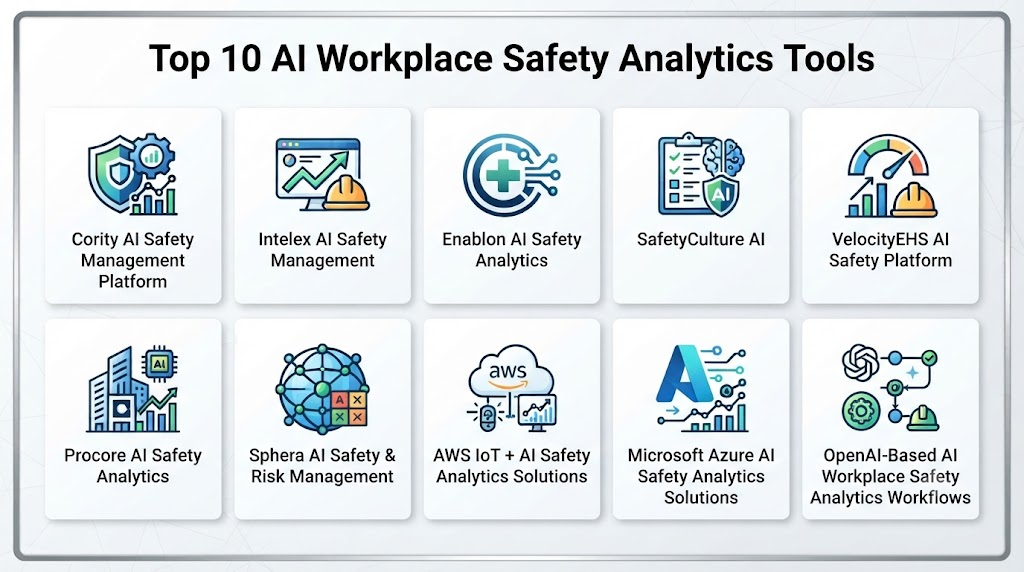
Top 10 AI Workplace Safety Analytics Tools
1. Cority AI Safety Management Platform
Verdict: Enterprise safety management platform with AI-driven workplace risk analytics.
Short Description: Cority AI helps organizations manage safety data, analyze workplace risks, track incidents, and improve environmental health and safety programs.
Key Features:
- Safety analytics
- Incident management
- Risk assessment
- Compliance tracking
- Safety reporting
Pros:
- Strong EHS capabilities
- Enterprise scalability
Cons:
- Complex implementation
- Enterprise-focused pricing
Deployment: Cloud-based
Security & Compliance: Enterprise security controls
Integrations & Ecosystem: EHS and business systems
Support & Community: Enterprise support
Pricing Model: Subscription-based
Best-Fit Scenarios: Large safety-focused organizations
2. Intelex AI Safety Management
Verdict: AI-enabled workplace safety platform for incident prevention and analytics.
Short Description: Intelex AI helps organizations analyze safety data, manage incidents, and improve workplace risk management processes.
Key Features:
- Incident tracking
- Safety analytics
- Risk management
- Audit management
- Compliance reporting
Pros:
- Strong safety workflows
- Good compliance support
Cons:
- Requires configuration
- Enterprise-focused
Deployment: Cloud-based
Security & Compliance: Enterprise security standards
Integrations & Ecosystem: EHS and enterprise applications
Support & Community: Enterprise support
Pricing Model: Subscription-based
Best-Fit Scenarios: Industrial organizations
3. Enablon AI Safety Analytics
Verdict: Enterprise AI-powered EHS platform for workplace risk management.
Short Description: Enablon AI helps organizations monitor safety performance, analyze incidents, and improve workplace risk prevention.
Key Features:
- Safety analytics
- Risk prediction
- Incident investigation
- Compliance management
- Reporting dashboards
Pros:
- Strong global EHS capabilities
- Advanced analytics
Cons:
- Complex deployment
- Requires safety expertise
Deployment: Cloud-based
Security & Compliance: Enterprise security controls
Integrations & Ecosystem: EHS and enterprise platforms
Support & Community: Enterprise support
Pricing Model: Subscription-based
Best-Fit Scenarios: Global enterprises
4. SafetyCulture AI
Verdict: AI-assisted safety inspection and workplace operations platform.
Short Description: SafetyCulture AI helps organizations perform inspections, collect safety data, identify issues, and improve workplace practices.
Key Features:
- Digital inspections
- Safety reporting
- Issue tracking
- Risk identification
- Mobile safety workflows
Pros:
- Easy adoption
- Strong mobile capabilities
Cons:
- Advanced analytics depend on data
- Less enterprise depth than EHS suites
Deployment: Cloud-based
Security & Compliance: Platform security controls
Integrations & Ecosystem: Workplace and operational tools
Support & Community: Customer support
Pricing Model: Subscription-based
Best-Fit Scenarios: Operational safety teams
5. VelocityEHS AI Safety Platform
Verdict: AI-enabled EHS platform for workplace safety management.
Short Description: VelocityEHS helps organizations manage safety programs, analyze risks, and improve compliance processes.
Key Features:
- Safety analytics
- Incident management
- Training tracking
- Risk assessments
- Compliance reporting
Pros:
- Broad EHS capabilities
- Strong compliance support
Cons:
- Requires setup
- Enterprise-oriented
Deployment: Cloud-based
Security & Compliance: Enterprise security controls
Integrations & Ecosystem: EHS systems and business tools
Support & Community: Customer support
Pricing Model: Subscription-based
Best-Fit Scenarios: Safety management teams
6. Procore AI Safety Analytics
Verdict: AI-powered construction safety analytics platform.
Short Description: Procore AI helps construction organizations analyze project safety data, manage risks, and improve field safety operations.
Key Features:
- Safety observations
- Incident tracking
- Construction analytics
- Risk reporting
- Project safety insights
Pros:
- Strong construction focus
- Good project integration
Cons:
- Industry-specific
- Less suitable outside construction
Deployment: Cloud-based
Security & Compliance: Enterprise security controls
Integrations & Ecosystem: Construction management platforms
Support & Community: Customer support
Pricing Model: Subscription-based
Best-Fit Scenarios: Construction companies
7. Sphera AI Safety & Risk Management
Verdict: AI-powered operational risk and safety management platform.
Short Description: Sphera AI helps organizations analyze operational risks, manage safety performance, and improve compliance.
Key Features:
- Risk analytics
- Incident management
- Safety performance tracking
- Operational intelligence
- Compliance monitoring
Pros:
- Strong industrial risk capabilities
- Enterprise support
Cons:
- Complex implementation
- Designed for larger organizations
Deployment: Cloud-based
Security & Compliance: Enterprise security standards
Integrations & Ecosystem: Industrial and enterprise systems
Support & Community: Enterprise support
Pricing Model: Subscription-based
Best-Fit Scenarios: Industrial enterprises
8. AWS IoT + AI Safety Analytics Solutions
Verdict: Cloud-based AI approach for connected workplace safety monitoring.
Short Description: AWS IoT and AI solutions can analyze sensor data, equipment conditions, and workplace environments to identify safety risks.
Key Features:
- Sensor analytics
- Predictive monitoring
- Real-time alerts
- Equipment insights
- Custom safety models
Pros:
- Highly scalable
- Flexible customization
Cons:
- Requires technical expertise
- Implementation varies
Deployment: Cloud-based
Security & Compliance: Cloud security controls
Integrations & Ecosystem: IoT and enterprise systems
Support & Community: Developer ecosystem
Pricing Model: Usage-based
Best-Fit Scenarios: Connected industrial environments
9. Microsoft Azure AI Safety Analytics Solutions
Verdict: AI-powered cloud platform for developing workplace safety intelligence systems.
Short Description: Azure AI solutions help organizations build safety analytics workflows using machine learning, computer vision, and operational data.
Key Features:
- AI analytics
- Computer vision
- Predictive models
- Data processing
- Custom dashboards
Pros:
- Strong AI ecosystem
- Enterprise cloud capabilities
Cons:
- Requires technical resources
- Custom development needed
Deployment: Cloud-based
Security & Compliance: Enterprise cloud security
Integrations & Ecosystem: Microsoft ecosystem
Support & Community: Developer and enterprise support
Pricing Model: Usage-based
Best-Fit Scenarios: Custom AI safety solutions
10. OpenAI-Based AI Workplace Safety Analytics Workflows
Verdict: Custom AI approach for creating workplace safety intelligence systems.
Short Description: AI workflows can analyze safety reports, incident records, employee feedback, and operational data to identify risks and generate safety insights.
Key Features:
- Safety report analysis
- Incident summarization
- Risk pattern detection
- Compliance insights
- Custom safety analytics
Pros:
- Highly customizable
- Supports unique safety requirements
Cons:
- Requires implementation effort
- Needs safety data governance
Deployment: API and custom environments
Security & Compliance: Depends on implementation
Integrations & Ecosystem: EHS systems, databases, IoT platforms
Support & Community: Developer ecosystem
Pricing Model: Usage-based
Best-Fit Scenarios: Custom enterprise solutions
Comparison Table
| Platform | AI Analytics | Risk Detection | Incident Management | Integrations | Best Use |
|---|---|---|---|---|---|
| Cority AI | Excellent | Excellent | Excellent | High | Enterprise EHS |
| Intelex AI | High | Excellent | Excellent | High | Safety management |
| Enablon AI | Excellent | Excellent | High | High | Global enterprises |
| SafetyCulture AI | High | High | High | Medium | Safety inspections |
| VelocityEHS AI | High | High | High | High | Compliance teams |
| Procore AI | High | High | Medium | High | Construction safety |
| Sphera AI | Excellent | Excellent | High | High | Industrial risk |
| AWS AI Safety Solutions | Excellent | Custom | Custom | Excellent | IoT safety |
| Azure AI Safety Solutions | Excellent | Custom | Custom | Excellent | Custom AI systems |
| OpenAI Workflows | Excellent | Custom | Custom | Custom | Custom solutions |
Evaluation & Scoring Table
| Platform | AI Accuracy 25% | Risk Analytics 15% | Safety Features 15% | Integrations 15% | Security 10% | Ease 10% | Value 10% | Total |
|---|---|---|---|---|---|---|---|---|
| Cority AI | 25 | 15 | 15 | 14 | 10 | 8 | 8 | 95 |
| Intelex AI | 24 | 15 | 15 | 14 | 10 | 8 | 8 | 94 |
| Enablon AI | 25 | 15 | 14 | 14 | 10 | 8 | 8 | 94 |
| SafetyCulture AI | 22 | 13 | 14 | 12 | 9 | 10 | 10 | 90 |
| VelocityEHS AI | 23 | 14 | 14 | 14 | 10 | 9 | 9 | 93 |
| Procore AI | 22 | 13 | 14 | 14 | 9 | 10 | 9 | 91 |
| Sphera AI | 24 | 15 | 15 | 14 | 10 | 8 | 8 | 94 |
| AWS AI Solutions | 25 | 15 | 14 | 15 | 10 | 8 | 8 | 95 |
| Azure AI Solutions | 25 | 15 | 14 | 15 | 10 | 8 | 8 | 95 |
| OpenAI Workflows | 25 | 15 | 15 | 12 | 8 | 8 | 9 | 92 |
Which AI Workplace Safety Analytics Tool Is Right for You?
- Enterprise EHS Management: Cority AI, Enablon AI, Sphera AI
- Safety Compliance Programs: Intelex AI, VelocityEHS AI
- Construction Safety: Procore AI
- Mobile Safety Inspections: SafetyCulture AI
- IoT-Based Safety Monitoring: AWS AI Safety Solutions
- Custom AI Safety Systems: OpenAI-based workflows
Implementation Playbook
30 Days
- Identify safety goals
- Collect incident and operational data
- Define risk measurement criteria
60 Days
- Connect safety systems
- Configure AI analytics workflows
- Validate risk predictions
90 Days
- Automate safety monitoring
- Improve incident prevention
- Optimize workplace safety programs
Common Mistakes
- Using incomplete safety data
- Ignoring employee privacy
- Treating AI alerts as final decisions
- Not involving safety professionals
- Failing to update risk models
Frequently Asked Questions
What are AI workplace safety analytics tools?
They are AI-powered platforms that analyze workplace data to identify safety risks and improve prevention strategies.
How do AI safety analytics tools work?
They analyze incidents, operational data, sensors, and workplace patterns to generate safety insights.
Can AI predict workplace accidents?
AI can identify risk patterns that may help organizations prevent incidents.
Do these tools replace safety managers?
No. They support safety teams with better information and analysis.
Can AI detect safety hazards?
Yes. Some platforms identify risks through data analysis and computer vision.
Do workplace safety tools integrate with EHS systems?
Most enterprise solutions support EHS and operational integrations.
Are AI safety predictions accurate?
Accuracy depends on data quality and model effectiveness.
Can small companies use AI safety tools?
Yes. Some solutions support smaller safety programs.
How does AI improve workplace safety?
It helps organizations move from reactive responses to proactive risk management.
Are employee safety analytics secure?
Organizations should implement appropriate privacy and security controls.
Can AI analyze safety reports?
Yes. AI can summarize reports and identify recurring risk patterns.
How should companies implement AI safety analytics?
Start with reliable safety data, test workflows, and combine AI insights with expert review.
Conclusion
AI Workplace Safety Analytics Tools are helping organizations improve safety management by identifying risks, analyzing incidents, and supporting proactive prevention strategies. Platforms such as Cority AI, Intelex AI, Enablon AI, and Sphera AI provide advanced capabilities for modern workplace safety programs.Organizations should choose solutions based on industry requirements, workforce size, safety complexity, and technology integration needs. Combining AI-powered safety analytics with human expertise helps businesses reduce workplace risks, improve compliance, and create safer working environments.
