Introduction
AI Phishing Detection Systems use artificial intelligence, machine learning, natural language processing, behavioral analysis, and threat intelligence to identify and prevent phishing attacks across email, messaging platforms, websites, and digital communication channels. These systems analyze message content, sender behavior, URLs, attachments, user activity, and threat indicators to detect malicious attempts before they reach users.
Traditional phishing protection methods often depend on signature-based detection and predefined rules, which can struggle against sophisticated phishing campaigns, business email compromise, and AI-generated attacks. AI-powered phishing detection solutions improve security by analyzing patterns, detecting anomalies, understanding context, and automatically blocking suspicious communications.
These platforms are widely used by enterprises, financial institutions, government organizations, security teams, and managed security providers to reduce phishing risks, protect users, and strengthen email security operations.
Real-world use cases:
- Email phishing detection
- Business email compromise prevention
- Malicious URL identification
- Attachment threat analysis
- AI-generated phishing detection
- User behavior analysis
- Credential theft prevention
- Security awareness support
- Automated threat investigation
- Real-time message classification
Evaluation Criteria for Buyers:
- AI detection accuracy
- Email and communication protection
- Threat intelligence integration
- Malware and URL analysis
- Behavioral analytics
- Automated response capabilities
- Security platform integrations
- Enterprise scalability
Best for
Enterprises, financial organizations, government agencies, security operations teams, and organizations managing large email environments.
Not ideal for
Small teams with minimal email usage or organizations without cybersecurity monitoring requirements.
Key Trends
- AI-powered phishing detection
- Generative AI phishing defense
- Behavioral email security
- Natural language understanding
- Automated threat investigation
- Zero-day phishing detection
- Cloud email protection
- Security awareness integration
- Identity-based threat detection
- Automated response workflows
Methodology
- Selected platforms based on AI phishing detection capabilities
- Evaluated detection accuracy, automation, integrations, and response features
- Considered enterprise email security requirements
- Prioritized platforms supporting modern phishing threats
- Reviewed scalability, usability, and security controls
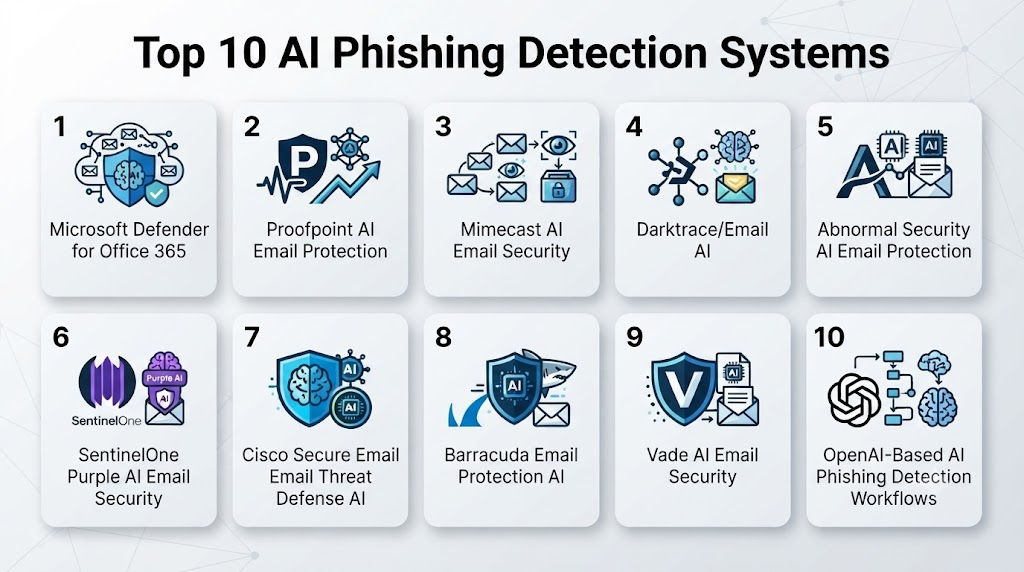
Top 10 AI Phishing Detection Systems
1. Microsoft Defender for Office 365
Verdict: AI-powered email security platform for detecting phishing, malware, and business email compromise.
Short Description: Microsoft Defender for Office 365 uses AI, threat intelligence, and behavioral analysis to protect organizations from advanced email threats.
Key Features:
- Phishing detection
- Safe links protection
- Attachment analysis
- Threat intelligence
- Automated investigation
Pros:
- Strong Microsoft ecosystem integration
- Advanced threat protection capabilities
Cons:
- Best with Microsoft environments
- Requires configuration expertise
Deployment: Cloud-based
Security & Compliance: Enterprise security controls
Integrations & Ecosystem: Microsoft security ecosystem
Support & Community: Enterprise support
Pricing Model: Subscription-based
Best-Fit Scenarios: Enterprise email security
2. Proofpoint AI Email Protection
Verdict: Enterprise AI email security platform for phishing and threat prevention.
Short Description: Proofpoint AI helps organizations detect phishing attacks, analyze email threats, and protect users from targeted campaigns.
Key Features:
- Email threat detection
- Business email compromise protection
- Threat intelligence
- User risk analysis
- Automated response
Pros:
- Strong phishing protection
- Advanced threat intelligence
Cons:
- Enterprise-focused
- Requires security expertise
Deployment: Cloud-based
Security & Compliance: Enterprise security controls
Integrations & Ecosystem: Email and security platforms
Support & Community: Enterprise support
Pricing Model: Subscription-based
Best-Fit Scenarios: Large organizations
3. Mimecast AI Email Security
Verdict: AI-enhanced email security platform for phishing prevention and cyber resilience.
Short Description: Mimecast AI helps organizations detect malicious emails, protect users, and manage email-based security risks.
Key Features:
- Phishing detection
- Email filtering
- URL protection
- Threat analysis
- Security awareness tools
Pros:
- Strong email security capabilities
- Good enterprise adoption
Cons:
- Requires deployment planning
- Advanced features vary
Deployment: Cloud-based
Security & Compliance: Enterprise security controls
Integrations & Ecosystem: Email platforms
Support & Community: Customer support
Pricing Model: Subscription-based
Best-Fit Scenarios: Enterprise email protection
4. Darktrace/Email AI
Verdict: AI-driven email security platform using behavioral analysis.
Short Description: Darktrace/Email uses machine learning to identify abnormal communication patterns and detect sophisticated phishing attacks.
Key Features:
- Behavioral detection
- Email anomaly analysis
- Threat investigation
- Automated response
- AI risk scoring
Pros:
- Strong anomaly detection
- Good against unknown threats
Cons:
- Requires tuning
- Enterprise-oriented
Deployment: Cloud-based
Security & Compliance: Enterprise security standards
Integrations & Ecosystem: Security operations platforms
Support & Community: Enterprise support
Pricing Model: Subscription-based
Best-Fit Scenarios: Advanced threat protection
5. Abnormal Security AI Email Protection
Verdict: AI-native email security platform focused on behavioral phishing detection.
Short Description: Abnormal Security uses machine learning to analyze email behavior and detect advanced phishing and social engineering attacks.
Key Features:
- Behavioral AI detection
- Account compromise detection
- Email risk analysis
- Automated remediation
- Threat investigation
Pros:
- Strong AI-based detection
- Good protection against social engineering
Cons:
- Email-focused platform
- Requires integration setup
Deployment: Cloud-based
Security & Compliance: Enterprise security controls
Integrations & Ecosystem: Email platforms
Support & Community: Customer support
Pricing Model: Subscription-based
Best-Fit Scenarios: Cloud email environments
6. SentinelOne Purple AI Email Security
Verdict: AI-assisted cybersecurity platform supporting phishing investigation and response.
Short Description: SentinelOne AI capabilities help security teams investigate threats, analyze suspicious activity, and improve response workflows.
Key Features:
- AI investigation
- Threat analysis
- Security automation
- Incident response
- Behavioral detection
Pros:
- Strong AI security capabilities
- Good endpoint ecosystem
Cons:
- Best within SentinelOne environment
- Requires security expertise
Deployment: Cloud-based
Security & Compliance: Enterprise security controls
Integrations & Ecosystem: Endpoint and security platforms
Support & Community: Enterprise support
Pricing Model: Subscription-based
Best-Fit Scenarios: Security operations teams
7. Cisco Secure Email Threat Defense AI
Verdict: AI-powered email protection platform for phishing and malware defense.
Short Description: Cisco Secure Email Threat Defense uses AI and threat intelligence to detect malicious emails and protect organizations.
Key Features:
- Email threat detection
- URL analysis
- Malware protection
- Threat intelligence
- Security analytics
Pros:
- Strong security ecosystem
- Enterprise reliability
Cons:
- Requires Cisco expertise
- Complex environments
Deployment: Cloud and enterprise environments
Security & Compliance: Enterprise security standards
Integrations & Ecosystem: Cisco security ecosystem
Support & Community: Enterprise support
Pricing Model: Subscription-based
Best-Fit Scenarios: Enterprise security teams
8. Barracuda Email Protection AI
Verdict: AI-enabled email security solution for phishing and ransomware prevention.
Short Description: Barracuda AI helps organizations identify malicious emails, protect users, and automate email security workflows.
Key Features:
- Phishing protection
- Spam filtering
- URL defense
- Threat analysis
- Email monitoring
Pros:
- Easy deployment
- Broad email security features
Cons:
- Advanced AI capabilities vary
- Best suited for email security use cases
Deployment: Cloud-based
Security & Compliance: Security controls available
Integrations & Ecosystem: Email systems
Support & Community: Customer support
Pricing Model: Subscription-based
Best-Fit Scenarios: Businesses of various sizes
9. Vade AI Email Security
Verdict: AI-powered email threat detection platform specializing in phishing protection.
Short Description: Vade AI analyzes email content, sender behavior, and threat intelligence to identify phishing attacks.
Key Features:
- Phishing detection
- Malware analysis
- Threat intelligence
- Email filtering
- Security automation
Pros:
- AI-focused detection
- Strong email protection
Cons:
- Email-specific platform
- Enterprise features vary
Deployment: Cloud-based
Security & Compliance: Enterprise security controls
Integrations & Ecosystem: Email platforms
Support & Community: Customer support
Pricing Model: Subscription-based
Best-Fit Scenarios: Email security teams
10. OpenAI-Based AI Phishing Detection Workflows
Verdict: Custom AI approach for building organization-specific phishing detection systems.
Short Description: AI workflows can analyze emails, messages, URLs, attachments, and user behavior to identify phishing risks and support security investigations.
Key Features:
- Email analysis
- Threat classification
- URL risk evaluation
- Security recommendations
- Custom detection workflows
Pros:
- Highly customizable
- Supports unique security requirements
Cons:
- Requires cybersecurity expertise
- Needs validation and governance
Deployment: API and custom environments
Security & Compliance: Depends on implementation
Integrations & Ecosystem: Email systems, SIEM, SOAR, threat intelligence platforms
Support & Community: Developer ecosystem
Pricing Model: Usage-based
Best-Fit Scenarios: Custom security solutions
Comparison Table
| Platform | AI Detection | Email Protection | Threat Intelligence | Automation | Best Use |
|---|---|---|---|---|---|
| Microsoft Defender | Excellent | Excellent | Excellent | Excellent | Enterprise email security |
| Proofpoint AI | Excellent | Excellent | Excellent | High | Targeted phishing defense |
| Mimecast AI | Excellent | Excellent | High | High | Email protection |
| Darktrace Email AI | Excellent | High | High | Excellent | Unknown threat detection |
| Abnormal Security | Excellent | Excellent | High | Excellent | Behavioral phishing defense |
| SentinelOne AI | High | High | High | Excellent | SOC teams |
| Cisco Secure Email | Excellent | Excellent | Excellent | High | Enterprise security |
| Barracuda AI | High | Excellent | High | High | Business email security |
| Vade AI | High | Excellent | High | High | Email filtering |
| OpenAI Workflows | Excellent | Custom | Custom | Custom | Custom solutions |
Evaluation & Scoring Table
| Platform | AI Accuracy 25% | Detection 15% | Threat Intelligence 15% | Integrations 15% | Security 10% | Ease 10% | Value 10% | Total |
|---|---|---|---|---|---|---|---|---|
| Microsoft Defender | 25 | 15 | 15 | 15 | 10 | 9 | 9 | 98 |
| Proofpoint AI | 25 | 15 | 15 | 14 | 10 | 8 | 8 | 95 |
| Mimecast AI | 24 | 15 | 14 | 14 | 10 | 9 | 9 | 95 |
| Darktrace Email AI | 25 | 14 | 14 | 14 | 10 | 8 | 8 | 93 |
| Abnormal Security | 25 | 15 | 14 | 14 | 10 | 9 | 9 | 96 |
| SentinelOne AI | 23 | 14 | 14 | 14 | 10 | 8 | 9 | 92 |
| Cisco Secure Email | 24 | 15 | 15 | 14 | 10 | 8 | 8 | 94 |
| Barracuda AI | 22 | 14 | 13 | 14 | 9 | 10 | 9 | 91 |
| Vade AI | 23 | 14 | 13 | 13 | 9 | 10 | 9 | 91 |
| OpenAI Workflows | 25 | 15 | 15 | 12 | 8 | 8 | 9 | 92 |
Which AI Phishing Detection System Is Right for You?
- Microsoft-Based Organizations: Microsoft Defender for Office 365
- Enterprise Email Security: Proofpoint AI, Mimecast AI
- Behavior-Based Detection: Darktrace Email AI, Abnormal Security
- Security Operations Teams: SentinelOne AI, Cisco Secure Email
- Custom AI Phishing Detection: OpenAI-based workflows
Implementation Playbook
30 Days
- Analyze phishing risks
- Review email security workflows
- Identify integration requirements
60 Days
- Connect email systems
- Configure AI detection models
- Test phishing scenarios
90 Days
- Automate threat response
- Monitor detection performance
- Improve security workflows
Common Mistakes
- Relying only on traditional filters
- Ignoring user behavior analysis
- Poor email security configuration
- Not monitoring AI detections
- Lack of security awareness integration
Frequently Asked Questions
What are AI phishing detection systems?
They are AI-powered platforms that detect and prevent phishing attacks across digital communication channels.
How does AI detect phishing emails?
AI analyzes content, sender behavior, links, attachments, and threat patterns.
Can AI detect new phishing attacks?
Yes. Machine learning helps identify unknown and evolving threats.
Can AI stop business email compromise attacks?
AI can identify suspicious communication patterns and reduce BEC risks.
Do phishing detection tools analyze attachments?
Many platforms scan attachments for malicious behavior.
Can AI reduce phishing false positives?
Yes. Behavioral analysis helps improve detection accuracy.
Do these systems integrate with email platforms?
Most support major enterprise email environments.
Can AI detect AI-generated phishing emails?
AI models can analyze patterns commonly associated with generated phishing content.
Do AI phishing tools replace security teams?
No. They support analysts and automate repetitive tasks.
Are AI phishing detection systems secure?
Organizations should evaluate security controls and data handling practices.
Can small businesses use AI phishing protection?
Yes. Many cloud-based solutions support smaller organizations.
How should organizations implement AI phishing detection?
Start with email analysis, integrate security tools, test workflows, and continuously improve protection.
Conclusion
AI Phishing Detection Systems are transforming email security by improving threat detection, reducing phishing risks, and automating security investigations. Platforms such as Microsoft Defender for Office 365, Proofpoint AI, Abnormal Security, and Mimecast AI provide advanced capabilities for protecting organizations against modern phishing attacks.Organizations should select solutions based on email infrastructure, threat exposure, integration requirements, and security maturity. Combining AI-powered detection with security awareness and human oversight helps businesses strengthen defenses against evolving phishing threats.
