Introduction
As organizations continue to migrate workloads, applications, and sensitive data to public, private, and hybrid cloud environments, cloud security has become one of the highest priorities for IT and cybersecurity teams. While cloud providers offer secure infrastructure, customers remain responsible for properly configuring cloud resources. Misconfigured storage buckets, overly permissive Identity and Access Management (IAM) policies, exposed databases, unsecured virtual machines, and incorrectly configured networking components remain among the leading causes of cloud security incidents.
AI Cloud Misconfiguration Detection tools help organizations continuously monitor cloud environments, automatically identify configuration errors, prioritize security risks, and recommend remediation actions before attackers can exploit them. These platforms use artificial intelligence, machine learning, security analytics, and threat intelligence to understand cloud infrastructure, detect risky configurations, reduce alert fatigue, and accelerate remediation across multi-cloud environments.
Unlike traditional cloud security tools that generate thousands of alerts with little context, AI-powered solutions analyze resource relationships, attack paths, workload sensitivity, compliance requirements, and real-world threat intelligence to prioritize the most critical risks. This enables security teams to focus on issues that pose the greatest business impact rather than manually reviewing every configuration finding.
Modern AI Cloud Misconfiguration Detection platforms integrate with Cloud Security Posture Management (CSPM), Cloud Native Application Protection Platforms (CNAPP), Infrastructure as Code (IaC) scanning, Kubernetes security, identity management, DevSecOps pipelines, and Security Operations Centers (SOC), making them essential components of cloud security strategies.
Real-world Use Cases
- Continuous cloud security posture monitoring
- Misconfigured storage bucket detection
- Identity and Access Management (IAM) policy analysis
- Kubernetes configuration monitoring
- Infrastructure as Code security scanning
- Multi-cloud compliance monitoring
- Cloud workload risk prioritization
- DevSecOps security automation
- Attack path analysis
- Automated cloud remediation recommendations
Evaluation Criteria for Buyers
When selecting an AI Cloud Misconfiguration Detection platform, evaluate solutions based on:
- AI-powered risk prioritization
- Multi-cloud support
- CSPM and CNAPP capabilities
- Infrastructure as Code scanning
- Identity risk analysis
- Compliance monitoring
- Automation and remediation workflows
- Enterprise scalability and integrations
Best For
- Enterprise cloud security teams
- DevSecOps teams
- Cloud architects
- Security Operations Centers
- Compliance teams
- Managed security providers
Not Ideal For
Organizations with minimal cloud infrastructure or businesses managing only a few isolated cloud resources without centralized governance.
Key Trends
- AI-driven CSPM
- AI-powered CNAPP platforms
- Identity-aware cloud security
- Attack path analysis
- Infrastructure as Code security
- Cloud AI copilots
- Automated remediation
- Continuous compliance monitoring
- Kubernetes security analytics
- Multi-cloud governance
Methodology
This comparison evaluates each platform based on:
- AI capabilities
- Cloud visibility
- Misconfiguration detection accuracy
- Compliance coverage
- Attack path analysis
- Automation features
- Integrations
- Enterprise readiness
- Ease of deployment
- Overall value
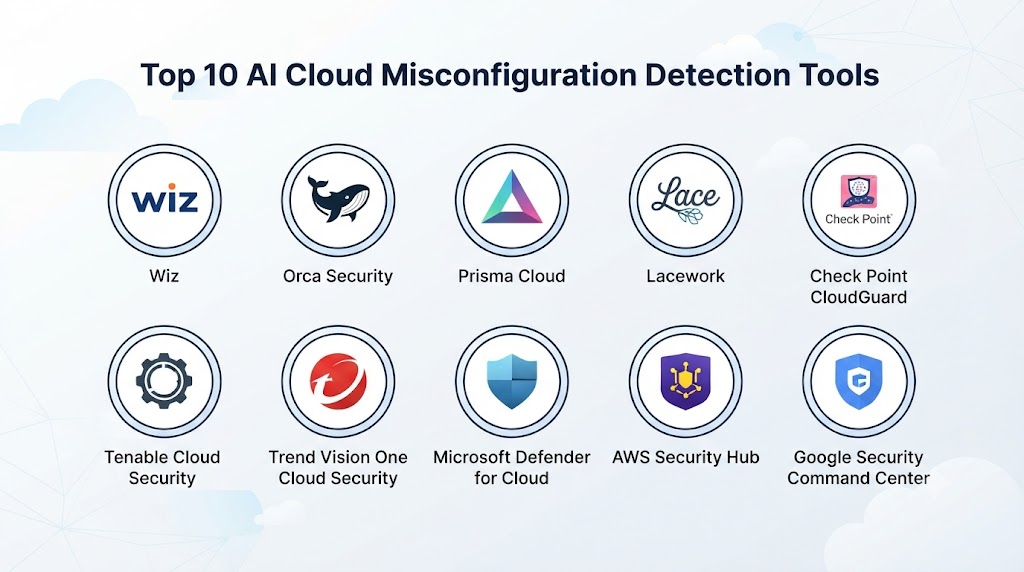
Top 10 AI Cloud Misconfiguration Detection Tools
1. Wiz
Verdict: One of the most comprehensive AI-powered cloud security platforms for identifying and prioritizing cloud misconfigurations across multi-cloud environments.
Short Description: Wiz provides agentless cloud security that continuously scans cloud environments to detect configuration weaknesses, identity risks, exposed assets, vulnerable workloads, and attack paths. Its AI-powered security graph helps organizations understand relationships between cloud resources and prioritize remediation based on actual business risk instead of isolated alerts.
Key Features
- AI-powered cloud security graph
- Cloud Security Posture Management (CSPM)
- Cloud Native Application Protection Platform (CNAPP)
- Identity risk analysis
- Attack path visualization
- Vulnerability prioritization
- Kubernetes security
- Infrastructure as Code scanning
Pros
- Excellent multi-cloud visibility
- Agentless deployment
- Strong AI risk prioritization
- Rich attack path analysis
Cons
- Premium enterprise pricing
- Advanced features require security expertise
Deployment: Cloud
Security & Compliance: Enterprise-grade compliance monitoring
Integrations & Ecosystem: AWS, Azure, Google Cloud, Kubernetes, CI/CD, SIEM, SOAR
Support & Community: Enterprise support
Pricing Model: Subscription
Best-Fit Scenarios: Large enterprise cloud security programs
2. Prisma Cloud by Palo Alto Networks
Verdict: Comprehensive AI-powered CNAPP platform with strong cloud misconfiguration detection.
Short Description: Prisma Cloud combines AI-driven cloud posture management, workload protection, identity security, and infrastructure scanning into a unified platform. It continuously monitors cloud resources, identifies misconfigurations, correlates risks, and recommends prioritized remediation across complex cloud environments.
Key Features
- CSPM
- CNAPP
- Cloud workload protection
- Identity security
- Infrastructure as Code scanning
- Kubernetes security
- Compliance monitoring
- AI risk scoring
Pros
- Broad cloud security coverage
- Excellent compliance capabilities
- Strong enterprise ecosystem
Cons
- Enterprise deployment complexity
- Licensing can be expensive
Deployment: Cloud
Security & Compliance: Enterprise compliance framework
Integrations: AWS, Azure, Google Cloud, Kubernetes, DevOps tools
Pricing: Subscription
Best-Fit: Enterprise cloud security teams
3. Microsoft Defender for Cloud
Verdict: Excellent AI-powered cloud security platform for Microsoft environments.
Short Description: Microsoft Defender for Cloud continuously evaluates cloud resources, detects security misconfigurations, recommends remediation, and uses AI to prioritize risks across Azure, AWS, and Google Cloud environments.
Key Features
- CSPM
- Secure Score
- AI recommendations
- Cloud workload protection
- Vulnerability assessment
- Compliance monitoring
- DevOps security
Pros
- Deep Azure integration
- Strong AI recommendations
- Comprehensive compliance support
Cons
- Best experience in Microsoft ecosystem
4. Orca Security
Verdict: Agentless AI cloud security platform focused on complete cloud visibility.
Short Description: Orca Security uses AI to analyze cloud assets without deploying agents, detecting cloud misconfigurations, exposed data, vulnerable workloads, and attack paths while reducing operational complexity.
Key Features
- Agentless scanning
- CSPM
- Attack path analysis
- Identity security
- Cloud workload protection
- AI risk prioritization
Pros
- Easy deployment
- Strong cloud visibility
Cons
- Enterprise pricing
5. Lacework
Verdict: AI-powered behavioral cloud security platform.
Short Description: Lacework applies machine learning to detect abnormal cloud behavior, identify configuration risks, and prioritize threats based on workload activity and cloud context.
Key Features
- Behavioral analytics
- CSPM
- Cloud workload protection
- Threat detection
- Compliance monitoring
Pros
- Strong anomaly detection
- Excellent workload visibility
Cons
- Learning curve
6. Check Point CloudGuard
Verdict: Enterprise cloud security platform with AI-powered posture management.
Short Description: CloudGuard continuously monitors cloud infrastructure for configuration issues, policy violations, and compliance risks while using AI to prioritize remediation.
Key Features
- CSPM
- Cloud workload protection
- AI risk scoring
- Compliance automation
- Threat intelligence
Pros
- Mature security platform
- Strong compliance support
Cons
- Best with Check Point ecosystem
7. Tenable Cloud Security
Verdict: AI-driven cloud exposure management platform.
Short Description: Tenable Cloud Security identifies cloud misconfigurations, identity exposures, vulnerable workloads, and compliance issues while helping organizations prioritize remediation through AI-driven exposure analysis.
Key Features
- Exposure management
- CSPM
- Identity analysis
- Compliance monitoring
- AI prioritization
Pros
- Strong exposure analytics
- Enterprise visibility
Cons
- Enterprise deployment
8. Trend Micro Cloud One
Verdict: AI-powered cloud security platform for modern workloads.
Short Description: Trend Micro Cloud One combines cloud posture management, workload protection, container security, and AI-powered analytics to detect cloud security risks before they become incidents.
Key Features
- Cloud posture management
- Workload protection
- Container security
- Compliance monitoring
- Threat intelligence
Pros
- Comprehensive workload protection
- Strong cloud integrations
Cons
- Complex licensing
9. AWS Security Hub
Verdict: Native AWS security management platform with AI-enhanced insights.
Short Description: AWS Security Hub centralizes security findings across AWS services, identifies cloud configuration issues, and helps prioritize remediation using AWS security best practices and integrations.
Key Features
- Security findings aggregation
- Compliance monitoring
- AWS integration
- Risk prioritization
- Security dashboards
Pros
- Excellent AWS integration
- Native cloud service
Cons
- AWS-focused
10. Google Security Command Center
Verdict: AI-powered cloud security platform for Google Cloud environments.
Short Description: Google Security Command Center provides centralized cloud security posture management, vulnerability detection, identity insights, and AI-assisted cloud risk prioritization.
Key Features
- Cloud asset inventory
- CSPM
- Threat detection
- Vulnerability management
- AI recommendations
Pros
- Excellent Google Cloud integration
- Strong cloud visibility
Cons
- Best for Google Cloud environments
Comparison Table
| Platform | AI Risk Prioritization | Multi-Cloud | CSPM | CNAPP | Best For |
|---|---|---|---|---|---|
| Wiz | Excellent | Excellent | Excellent | Excellent | Enterprise Cloud |
| Prisma Cloud | Excellent | Excellent | Excellent | Excellent | Large Enterprises |
| Microsoft Defender | Excellent | Excellent | Excellent | High | Microsoft Cloud |
| Orca Security | Excellent | Excellent | Excellent | High | Agentless Security |
| Lacework | High | Excellent | High | High | Behavioral Security |
| CloudGuard | High | Excellent | Excellent | High | Enterprise Security |
| Tenable Cloud Security | High | Excellent | Excellent | Medium | Exposure Management |
| Trend Micro Cloud One | High | High | High | High | Cloud Workloads |
| AWS Security Hub | Medium | AWS | High | Medium | AWS Customers |
| Google SCC | Medium | Google Cloud | High | Medium | Google Cloud |
Evaluation & Scoring Table
| Platform | AI Features 20% | Detection 20% | Integrations 15% | Automation 15% | Security 10% | Ease 10% | Value 10% | Total |
|---|---|---|---|---|---|---|---|---|
| Wiz | 20 | 20 | 15 | 15 | 10 | 9 | 9 | 98 |
| Prisma Cloud | 19 | 19 | 15 | 15 | 10 | 8 | 8 | 94 |
| Microsoft Defender | 19 | 19 | 15 | 14 | 10 | 9 | 9 | 95 |
| Orca Security | 19 | 19 | 14 | 14 | 10 | 9 | 8 | 93 |
| Lacework | 18 | 18 | 14 | 13 | 10 | 8 | 8 | 89 |
| CloudGuard | 18 | 18 | 14 | 13 | 10 | 8 | 8 | 89 |
| Tenable Cloud Security | 18 | 18 | 14 | 13 | 10 | 8 | 8 | 89 |
| Trend Micro Cloud One | 17 | 17 | 14 | 13 | 10 | 8 | 8 | 87 |
| AWS Security Hub | 16 | 17 | 13 | 12 | 10 | 9 | 9 | 86 |
| Google SCC | 16 | 17 | 13 | 12 | 10 | 9 | 9 | 86 |
Implementation Playbook
First 30 Days
- Discover cloud assets
- Connect cloud accounts
- Enable posture scanning
- Review compliance policies
Days 31–60
- Prioritize AI recommendations
- Integrate DevSecOps workflows
- Configure automated remediation
- Train security teams
Days 61–90
- Monitor attack paths
- Automate compliance reporting
- Expand multi-cloud governance
- Continuously optimize security policies
Common Mistakes
- Ignoring identity misconfigurations
- Delaying remediation
- Focusing only on compliance
- Missing Infrastructure as Code scanning
- Not securing Kubernetes environments
- Poor cloud asset inventory
- Limited automation
- Inadequate DevSecOps integration
Frequently Asked Questions
1. What is AI Cloud Misconfiguration Detection?
It uses AI to continuously identify, prioritize, and remediate cloud configuration errors before attackers exploit them.
2. How is it different from traditional CSPM?
AI adds intelligent risk prioritization, attack path analysis, and automated recommendations beyond basic rule-based detection.
3. Can these tools support multiple cloud providers?
Yes. Most enterprise platforms support AWS, Microsoft Azure, and Google Cloud.
4. Do these platforms detect identity risks?
Many modern solutions analyze IAM permissions, privileged access, and identity exposures.
5. Can AI reduce alert fatigue?
Yes. AI prioritizes findings based on actual business risk and exploitability.
6. Are these tools suitable for DevSecOps?
Yes. Many integrate with Infrastructure as Code scanning and CI/CD pipelines.
7. Do they support compliance frameworks?
Most platforms include compliance monitoring for standards such as CIS Benchmarks, PCI DSS, HIPAA, ISO 27001, and SOC 2.
8. Can they protect Kubernetes environments?
Yes. Many enterprise CNAPP platforms include Kubernetes security monitoring.
9. How often should cloud posture be scanned?
Continuous monitoring is recommended for dynamic cloud environments.
10. What should organizations consider before selecting a platform?
Evaluate AI capabilities, cloud coverage, integrations, compliance support, automation, scalability, and total cost of ownership.
Conclusion
AI Cloud Misconfiguration Detection platforms have become essential for securing modern cloud environments. Rather than overwhelming security teams with thousands of configuration findings, these solutions use artificial intelligence to identify the most critical risks, analyze attack paths, prioritize remediation, and improve overall cloud security posture. As organizations adopt multi-cloud architectures, AI-driven cloud security helps reduce operational complexity while improving visibility and response speed.Organizations should choose a platform based on their cloud strategy, security maturity, compliance requirements, and existing technology ecosystem. Solutions such as Wiz, Prisma Cloud, Microsoft Defender for Cloud, Orca Security, and Lacework provide enterprise-grade capabilities that enable security teams to proactively detect and remediate cloud misconfigurations before they become exploitable security incidents.
