Introduction
AI Customs Document Automation Tools use artificial intelligence (AI), machine learning (ML), natural language processing (NLP), intelligent document processing (IDP), and optical character recognition (OCR) to automate the preparation, validation, classification, and submission of customs and international trade documentation.
International trade requires businesses to prepare large volumes of customs declarations, commercial invoices, packing lists, certificates of origin, bills of lading, import and export permits, tariff classifications, and regulatory compliance documents. Manual document preparation is time-consuming, error-prone, and can lead to shipment delays, customs penalties, and compliance risks.
AI-powered customs document automation platforms continuously analyze shipment information, product descriptions, Harmonized System (HS) codes, tariff schedules, trade agreements, customs regulations, and supporting documents to automate document generation and identify compliance issues before submission.
These solutions combine machine learning, OCR, NLP, document intelligence, regulatory analytics, and workflow automation to improve customs accuracy, accelerate border clearance, reduce administrative costs, and enhance global trade compliance.
Modern AI customs automation platforms integrate with Enterprise Resource Planning (ERP), Transportation Management Systems (TMS), Warehouse Management Systems (WMS), Global Trade Management (GTM) platforms, customs authorities, freight forwarders, carrier systems, and document management solutions.
They support industries including manufacturing, retail, automotive, pharmaceuticals, healthcare, electronics, food and beverage, logistics, aerospace, chemicals, and global trade organizations.
Real-world Use Cases
- Customs declaration automation
- Commercial invoice generation
- HS code classification
- Tariff determination
- Import and export compliance
- Trade document validation
- Certificate of origin management
- Customs audit preparation
- Border clearance optimization
- Global trade compliance
Evaluation Criteria for Buyers
When selecting an AI Customs Document Automation Platform, consider:
- AI document processing accuracy
- Customs compliance capabilities
- OCR and NLP quality
- HS code classification support
- ERP and TMS integration
- Workflow automation
- Scalability
- Security controls
- Regulatory coverage
- Reporting capabilities
Best For
- Importers and exporters
- Global manufacturers
- Freight forwarders
- Customs brokers
- International logistics providers
Not Ideal For
Organizations that operate exclusively in domestic markets without customs or international trade requirements.
Key Trends
- AI-powered customs compliance
- Intelligent document processing
- Automated HS code classification
- Digital customs declarations
- Trade compliance automation
- AI-driven tariff analysis
- Cross-border logistics intelligence
- End-to-end trade documentation
- Paperless customs workflows
- Connected global trade ecosystems
Methodology
The platforms below were evaluated based on:
- AI automation capabilities
- Customs compliance features
- Enterprise integration
- Document intelligence
- Scalability
- Industry adoption
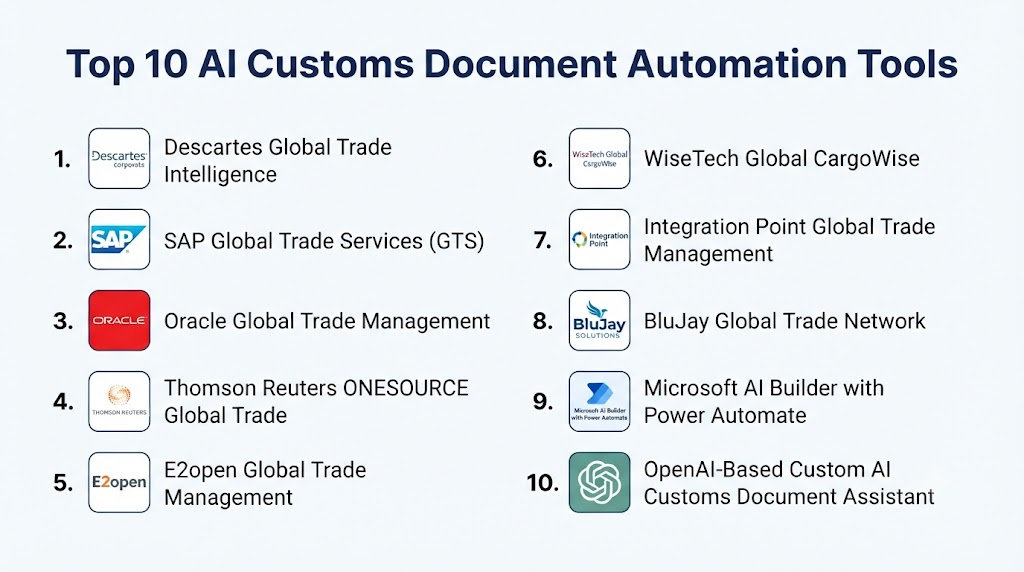
Top 10 AI Customs Document Automation Tools
1. Descartes Global Trade Intelligence
Verdict: Best overall AI-powered customs document automation platform.
Short Description: Descartes Global Trade Intelligence combines AI-driven customs documentation, trade compliance, tariff classification, and regulatory automation for international trade operations.
Key Features
- Customs declaration automation
- HS code classification
- Trade compliance
- Document validation
- Regulatory intelligence
Pros
- Comprehensive global trade platform
- Strong compliance capabilities
- Enterprise scalability
Cons
- Enterprise-focused implementation
Deployment: Cloud-based platform
Security & Compliance: Enterprise-grade security controls
Integrations & Ecosystem: ERP, TMS, WMS, GTM platforms, customs systems
Support & Community: Enterprise support
Pricing Model: Custom enterprise pricing
Best-Fit Scenarios: Global import/export operations
2. SAP Global Trade Services (GTS)
Verdict: Enterprise global trade compliance platform.
Short Description: SAP GTS provides AI-assisted customs management, import/export compliance, tariff classification, and customs documentation automation.
Key Features
- Customs compliance
- Trade documentation
- Tariff management
- HS classification
- ERP integration
Pros
- Strong SAP ecosystem
- Enterprise-grade compliance
Cons
- Requires SAP implementation expertise
3. Oracle Global Trade Management
Verdict: Comprehensive trade compliance and customs platform.
Short Description: Oracle Global Trade Management automates customs documentation, regulatory compliance, and cross-border logistics.
Key Features
- Customs automation
- Trade compliance
- Import/export documentation
- Regulatory analytics
- Shipment management
Pros
- Strong enterprise integration
- Comprehensive trade capabilities
Cons
- Best suited for Oracle environments
4. Thomson Reuters ONESOURCE Global Trade
Verdict: AI-enabled global trade compliance platform.
Short Description: ONESOURCE provides intelligent customs documentation, tariff management, regulatory compliance, and international trade automation.
Key Features
- Customs documentation
- Tariff analysis
- Compliance monitoring
- HS classification
- Regulatory reporting
Pros
- Strong regulatory expertise
- Global trade coverage
Cons
- Enterprise deployment required
5. E2open Global Trade Management
Verdict: Multi-enterprise trade compliance platform.
Short Description: E2open combines AI-powered customs automation, trade documentation, and supply chain collaboration.
Key Features
- Customs automation
- Trade documentation
- Compliance workflows
- Supply chain visibility
- Regulatory analytics
Pros
- Excellent partner collaboration
- Strong global trade capabilities
Cons
- Implementation planning required
6. WiseTech Global CargoWise
Verdict: Freight forwarding and customs management platform.
Short Description: CargoWise automates customs documentation, freight operations, customs brokerage, and international logistics workflows.
Key Features
- Customs declarations
- Freight documentation
- Brokerage workflows
- Compliance automation
- Shipment tracking
Pros
- Excellent freight forwarding support
- Strong customs brokerage features
Cons
- Best suited for logistics providers
7. Integration Point Global Trade Management
Verdict: Intelligent customs compliance platform.
Short Description: Integration Point provides AI-assisted customs management, regulatory compliance, and automated import/export documentation.
Key Features
- Customs processing
- Compliance management
- Trade documentation
- Tariff classification
- Regulatory analytics
Pros
- Global compliance coverage
- Flexible deployment
Cons
- Enterprise implementation required
8. BluJay Global Trade Network
Verdict: End-to-end logistics and customs platform.
Short Description: BluJay combines transportation management, customs documentation, trade compliance, and logistics intelligence.
Key Features
- Customs documentation
- Trade compliance
- Logistics integration
- Shipment visibility
- Regulatory workflows
Pros
- Strong logistics ecosystem
- End-to-end visibility
Cons
- Advanced AI capabilities vary
9. Microsoft AI Builder with Power Automate
Verdict: Low-code document automation platform.
Short Description: Microsoft AI Builder and Power Automate enable organizations to automate customs documents using OCR, AI document extraction, and workflow automation.
Key Features
- OCR document extraction
- Workflow automation
- AI document processing
- Integration tools
- Low-code development
Pros
- Flexible customization
- Strong Microsoft ecosystem
Cons
- Requires workflow configuration
10. OpenAI-Based Custom AI Customs Document Assistant
Verdict: Flexible AI assistant for customized customs documentation.
Short Description: Organizations can build custom AI customs assistants using large language models integrated with ERP systems, GTM platforms, TMS software, customs databases, shipment records, document repositories, and regulatory information. These assistants can summarize customs requirements, explain tariff classifications, validate shipping documents, recommend corrections, and support customs specialists while requiring compliance validation.
Key Features
- Customs document summaries
- HS code guidance
- Compliance insights
- Document validation
- Trade reporting
Pros
- Highly customizable
- Flexible integrations
- Improves documentation productivity
Cons
- Requires customs expertise
- Validation required before filing
Comparison Table
| Platform | AI Document Processing | Customs Compliance | ERP Integration | Trade Automation | Best Use |
|---|---|---|---|---|---|
| Descartes Global Trade Intelligence | Excellent | Excellent | Excellent | Excellent | Global Trade |
| SAP Global Trade Services | Excellent | Excellent | Excellent | High | SAP Enterprise |
| Oracle Global Trade Management | High | Excellent | Excellent | High | Oracle Enterprise |
| ONESOURCE Global Trade | High | Excellent | High | High | Regulatory Compliance |
| E2open Global Trade Management | High | High | High | Excellent | Multi-Enterprise Trade |
| CargoWise | High | High | High | Excellent | Freight Forwarding |
| Integration Point | High | High | High | High | Trade Compliance |
| BluJay Global Trade Network | High | High | High | High | Logistics Operations |
| Microsoft AI Builder | Medium | Medium | Excellent | High | Workflow Automation |
| OpenAI Custom | Custom | Custom | Custom | Custom | AI Customs Assistant |
Evaluation & Scoring Table
| Platform | AI Capability 20% | Compliance Intelligence 20% | Analytics 15% | Integration 15% | Security 10% | Ease 10% | Value 10% | Total |
|---|---|---|---|---|---|---|---|---|
| Descartes Global Trade Intelligence | 20 | 20 | 15 | 15 | 10 | 8 | 8 | 96 |
| SAP Global Trade Services | 19 | 20 | 15 | 15 | 10 | 8 | 8 | 95 |
| Oracle Global Trade Management | 18 | 19 | 15 | 15 | 10 | 8 | 8 | 93 |
| ONESOURCE Global Trade | 18 | 19 | 15 | 14 | 10 | 8 | 8 | 92 |
| E2open Global Trade Management | 18 | 18 | 14 | 15 | 10 | 8 | 8 | 91 |
| CargoWise | 18 | 18 | 14 | 14 | 10 | 8 | 8 | 90 |
| Integration Point | 17 | 18 | 14 | 14 | 10 | 8 | 8 | 89 |
| BluJay Global Trade Network | 17 | 17 | 14 | 14 | 10 | 8 | 8 | 88 |
| Microsoft AI Builder | 16 | 16 | 13 | 15 | 10 | 9 | 9 | 88 |
| OpenAI Custom | 20 | 16 | 12 | 15 | 8 | 7 | 9 | 87 |
Which AI Customs Document Automation Platform Is Right for You?
| If your priority is… | Recommended Platform |
|---|---|
| End-to-end global trade compliance | Descartes Global Trade Intelligence |
| SAP ecosystem | SAP Global Trade Services |
| Oracle-based trade management | Oracle Global Trade Management |
| Regulatory compliance | Thomson Reuters ONESOURCE Global Trade |
| Multi-enterprise collaboration | E2open Global Trade Management |
| Freight forwarding and customs brokerage | WiseTech Global CargoWise |
| Flexible customs compliance | Integration Point Global Trade Management |
| Logistics and trade operations | BluJay Global Trade Network |
| Low-code document automation | Microsoft AI Builder with Power Automate |
| Custom AI customs assistant | OpenAI-Based AI Assistant |
Implementation Playbook
First 30 Days
- Review customs documentation processes
- Identify required trade documents
- Collect product and tariff classification data
- Define compliance requirements
Days 31–60
- Integrate ERP, TMS, and customs systems
- Configure AI document processing
- Validate HS code classifications
- Train customs and logistics teams
Days 61–90
- Automate document generation
- Improve customs filing accuracy
- Reduce border clearance delays
- Expand trade compliance automation
Common Mistakes
- Poor product master data
- Incorrect HS code classifications
- Weak ERP integration
- Ignoring country-specific customs regulations
- Overreliance on AI-generated classifications
- Missing supporting documentation
- Limited compliance reviews
- Failure to update trade regulations
Frequently Asked Questions
1. What are AI Customs Document Automation Tools?
They are AI-powered platforms that automate the preparation, validation, classification, and management of customs and international trade documents.
2. How does AI improve customs documentation?
AI extracts information from shipping documents, classifies products, validates customs data, identifies compliance issues, and automates document workflows.
3. Can AI reduce customs clearance delays?
Yes. AI helps reduce documentation errors, improve filing accuracy, and identify missing information before submission, supporting faster customs processing.
4. Which industries use AI customs automation platforms?
Manufacturing, retail, logistics, automotive, pharmaceuticals, healthcare, food and beverage, electronics, aerospace, and global trade organizations.
5. What data is required?
Commercial invoices, packing lists, shipment records, product descriptions, tariff codes, certificates of origin, customs declarations, and regulatory documentation.
6. Can AI classify products using HS codes?
Many platforms assist with HS code recommendations and tariff classification, but organizations should verify classifications based on applicable customs regulations.
7. Do these platforms integrate with ERP, TMS, and customs systems?
Many integrate with ERP platforms, TMS software, WMS solutions, GTM platforms, customs authorities, freight forwarders, and document management systems.
8. Are AI-generated customs documents always accurate?
Accuracy depends on source data quality, regulatory updates, product information, and appropriate human review before submission.
9. How is customs and trade data protected?
Organizations should implement encryption, role-based access controls, cybersecurity measures, and enterprise data governance.
10. What should companies evaluate before adoption?
Consider document processing accuracy, customs compliance capabilities, integrations, regulatory coverage, scalability, security, reporting, and workflow automation.
Conclusion
AI Customs Document Automation Platforms are transforming international trade by automating customs documentation, improving regulatory compliance, reducing manual processing, and accelerating cross-border logistics. By combining artificial intelligence, intelligent document processing, machine learning, OCR, and trade analytics, these platforms help organizations reduce documentation errors, improve customs clearance efficiency, and strengthen global trade operations.Organizations implementing AI customs document automation solutions should prioritize high-quality product and shipment data, seamless integration with ERP and logistics systems, continuous validation of AI-generated classifications, and close collaboration between customs specialists, trade compliance teams, logistics providers, and finance departments. Platforms such as Descartes Global Trade Intelligence, SAP Global Trade Services, Oracle Global Trade Management, Thomson Reuters ONESOURCE Global Trade, and WiseTech Global CargoWise demonstrate how artificial intelligence is enabling smarter customs compliance and more efficient international trade.
