Artificial intelligence is no longer just a concept from sci-fi movies. It is actively reshaping how we work, learn, and solve problems. From the smart recommendations on your favorite streaming apps to autonomous vehicles navigating busy streets, AI is everywhere. At the core of all these technologies is a single, foundational concept: the AI model. For beginners, students, and aspiring software developers, learning how to build your first AI model is the ultimate gateway into this exciting field. It transforms AI from a mysterious “black box” into a practical tool you can control. Taking this first step demystifies machine learning and gives you the foundational skills needed to thrive in a tech-driven world.
What Is an AI Model?
To put it simply, an AI model is a mathematical formula or software program trained on a dataset to recognize patterns and make decisions without explicit human intervention. Think of it as a digital student. By reviewing thousands of examples, it learns the underlying rules of a task so it can handle new, unseen situations later.
The primary purpose of an AI model is to make predictions or classifications. For instance, if you feed a model thousands of photos of cats and dogs, it analyzes pixel patterns. Eventually, when you show it a brand-new photo, it can confidently tell you whether it is a cat or a dog.
Distinguishing AI, Machine Learning, and Deep Learning
People often use these terms interchangeably, but they represent different layers of technology:
- Artificial Intelligence (AI): The broad overarching concept of creating machines capable of mimicking human intelligence and behavior.
- Machine Learning (ML): A specific subset of AI focused on building algorithms that learn from data to improve their performance automatically over time.
- Deep Learning (DL): A specialized subfield of machine learning that uses multi-layered artificial neural networks—inspired by the human brain—to solve highly complex problems like facial recognition and natural language processing.
Why Learn to Build an AI Model?
Stepping into AI development opens up a world of possibilities, regardless of your professional background.
- Skyrocketing Career Opportunities: Companies across every industry are actively seeking professionals who understand AI development. Knowing how to train models makes you highly competitive in the job market.
- Advanced Problem-Solving: Building models changes the way you look at problems. You learn to break down chaotic, real-world challenges into structured data problems that computers can solve.
- Business Applications and Efficiency: From automating repetitive data entry tasks to predicting customer churn, AI models help businesses save millions of dollars and optimize daily operations.
- Driving Innovation: When you know how to build an AI model, you possess the power to create entirely new tools—like custom productivity helpers or unique artistic generators.
- Meeting Future Demand: As technology evolves, AI literacy will become as fundamental as knowing how to use a spreadsheet. Learning it now puts you ahead of the curve.
Prerequisites Before Building Your First AI Model
You do not need a Ph.D. to get started with AI for beginners, but having a solid foundation makes the journey much smoother.
1. Basic Python Knowledge
Python is the undisputed language of AI. Its syntax is clean, readable, and highly intuitive for beginners. You should comfortably understand variables, loops, functions, and basic data structures like lists and dictionaries.
2. Mathematics and Statistics Fundamentals
You do not need to solve complex theorems by hand, but a basic grasp of linear algebra (matrices and vectors), calculus (gradients), and statistics (mean, median, probability, and variance) will help you understand how algorithms learn.
3. Data Understanding
AI models are only as good as the data you feed them. You need to develop a curious mindset regarding data: understanding how it is collected, how variables relate to one another, and how to spot missing values.
4. Development Environment and AI Libraries
Before coding, you will need an environment to run your scripts. Tools like Jupyter Notebook or cloud platforms make this easy. You will also rely heavily on open-source libraries that handle the heavy mathematical lifting for you.
Step-by-Step Process to Build Your First AI Model
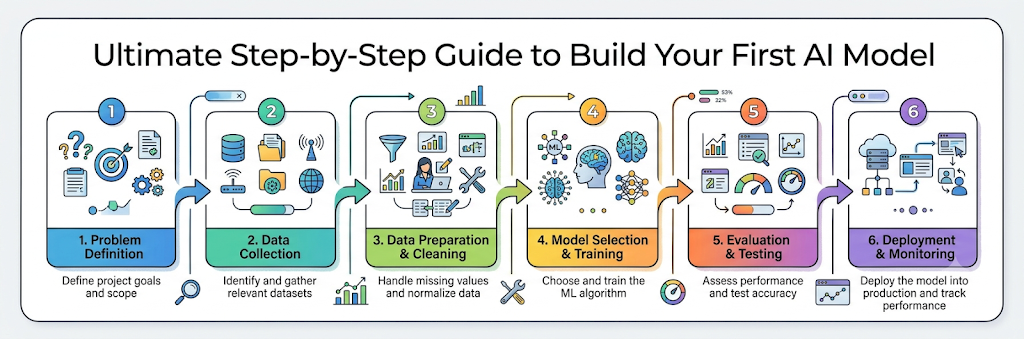
Building a model follows a structured AI workflow. Skipping steps usually leads to broken models or inaccurate predictions.
[Define Problem] ➔ [Collect & Clean Data] ➔ [Train Model] ➔ [Evaluate] ➔ [Deploy]
Step 1: Define the Problem
Start by clearly stating what you want your model to achieve. Are you predicting house prices based on square footage? Or are you classifying emails as spam or not spam? Knowing your goal dictates your data and algorithm choices.
Step 2: Collect Data
Gather the raw information required to solve your problem. This could involve downloading open-source datasets from websites like Kaggle, scraping web pages, or using public APIs.
Step 3: Clean and Prepare Data
Raw data is rarely perfect. Data preparation involves handling missing values, removing duplicate entries, correcting formatting errors, and converting text or categories into numerical formats that computers can read.
Step 4: Split Training and Testing Data
Never test your model on the exact same data it used to learn. Divide your dataset into two portions: a training set (typically 80%) to teach the model, and a testing set (20%) kept hidden until the end to see how well the model performs on new data.
Step 5: Choose a Suitable Algorithm
Select the machine learning method that best fits your problem type. For instance, if you are predicting a specific number, you will choose a regression algorithm. If you are sorting data into categories, you will use a classification algorithm.
Step 6: Train the AI Model
This is where the actual model training happens. You pass your training data into the chosen algorithm. The algorithm adjusts its internal parameters over and over until it finds the patterns linking the inputs to the correct outputs.
Step 7: Evaluate Performance
Once training is complete, run your testing data through the model. Use metrics like accuracy, precision, or mean squared error to measure how close the model’s predictions are to the actual truth.
Step 8: Improve and Fine-Tune the Model
If your initial evaluation scores are low, tweak your model. You can achieve this by adjusting settings (hyperparameters), choosing different features, or gathering more high-quality training data.
Step 9: Test with Entirely New Data
Introduce completely organic, real-world data to your model that wasn’t part of the training or testing splits. This ultimate check ensures your model has actually learned the rules rather than just memorizing your dataset.
Step 10: Deploy the Model
Integrate your finalized AI model into a live environment. This could mean turning it into a web application, a mobile feature, or an API endpoint where everyday users can input data and receive instant predictions.
Common Machine Learning Algorithms for Beginners
As you begin your AI development journey, you will frequently cross paths with these foundational algorithms.
Linear Regression
This algorithm predicts a continuous numerical value by drawing a straight line through data points. It is best used when there is a direct relationship between variables, such as predicting a person’s weight based on their height.
Logistic Regression
Despite its confusing name, this is a classification algorithm used to predict binary outcomes (yes or no). It determines the probability of an event occurring, making it ideal for tasks like predicting whether a bank transaction is fraudulent or legitimate.
Decision Trees
A decision tree breaks down data by asking a sequence of if-then questions, branching out like a tree until it reaches a conclusion. It is incredibly intuitive and frequently used for evaluating customer loan approvals based on credit score, income, and age.
Random Forest
A single decision tree can be fragile. Random Forest solves this by combining dozens of different decision trees together and taking their average or majority vote. It is incredibly robust and widely used for complex classification tasks like customer segmentation.
K-Nearest Neighbors (KNN)
KNN classifies a data point based on how closely it resembles its nearest neighbors. If you place a new data point in a cluster where most surrounding points are “Type A,” KNN assumes the new point is also “Type A.” It works beautifully for building simple recommendation systems.
Naive Bayes
Based on probability principles, Naive Bayes calculates the likelihood of an event happening based on prior knowledge. It treats every feature as completely independent, which makes it incredibly fast and popular for text classification and email spam filtering.
Support Vector Machine (SVM)
SVM finds the optimal boundary line (or hyperplane) that separates different classes of data with the widest possible margin. It is used when clear lines need to be drawn between complex datasets, such as distinguishing between benign and malignant medical tumors.
Popular Tools and Frameworks
Building an AI model from scratch does not mean writing complex math algorithms from zero. A rich ecosystem of tools exists to streamline your workflow.
- Python: The core programming language that powers modern AI development due to its simplicity and immense community support.
- Jupyter Notebook: An interactive web application that allows you to combine live code, equations, visualizations, and explanatory text in a single document.
- Scikit-learn: The ultimate beginner-friendly Python library. It provides clean, efficient tools for data mining, data analysis, and implementing standard machine learning algorithms.
- TensorFlow: An advanced, open-source framework developed by Google used for building large-scale deep learning models and neural networks.
- PyTorch: Created by Meta’s AI Research lab, PyTorch is a highly flexible, Pythonic framework loved by researchers and developers alike for deep learning projects.
- Google Colab: A free, cloud-based Jupyter notebook environment provided by Google that gives you free access to powerful hardware like GPUs directly from your browser.
- Pandas: A crucial data manipulation library that allows you to load, clean, analyze, and reshape tabular data effortlessly.
- NumPy: The fundamental package for scientific computing in Python, allowing you to perform rapid mathematical operations on massive arrays of data.
Benefits of Building AI Models
Investing time into learning how to design and build AI models delivers immense immediate and long-term rewards:
- Seamless Automation: Tedious, time-consuming tasks like sorting invoices or responding to basic customer inquiries can be completely automated.
- Highly Accurate Predictions: Well-trained models can identify subtle trends in historical data that humans easily overlook, allowing you to anticipate future outcomes.
- Truly Data-Driven Decisions: Instead of relying on gut feelings or guesswork, models allow organizations to base their strategies on concrete, verifiable data patterns.
- Radical Efficiency Gains: Shifting heavy computational workloads onto an AI model frees up valuable human hours to focus on creative strategy and empathy-driven tasks.
- Accelerated Innovation: Building custom models gives you the unique competitive edge needed to invent disruptive products and services within your niche.
- Unstoppable Career Growth: AI skills command premium salaries and offer immense job security as industries around the globe digitize.
Common Mistakes Beginners Make
When learning how to build an AI model, it is easy to fall into a few common traps. Recognizing them early will save you hours of frustration.
Poor Data Quality
Beginners often focus entirely on the algorithm while ignoring the data. If your data is messy, biased, or incomplete, your model will output useless predictions. Remember the golden rule of computer science: Garbage in, garbage out.
Overfitting
Overfitting occurs when your model learns the training data too perfectly, memorizing its specific noise and quirks rather than understanding the general pattern. While it performs flawlessly on training data, it fails miserably when introduced to new, real-world data.
Underfitting
The opposite of overfitting. Underfitting happens when your model is too simple to capture the underlying pattern in the data. For example, using a straight line to fit a highly curved dataset results in poor performance across both training and testing stages.
Choosing the Wrong Algorithm
Not all algorithms match all problems. Using a complex deep learning neural network for a tiny spreadsheet dataset is overkill, while using a simple linear regression for highly complex image data will yield terrible results.
Ignoring Model Evaluation
It is tempting to look at a high training accuracy score and assume your work is done. Never skip thorough evaluation steps using distinct validation and testing sets to verify your model’s true real-world capabilities.
Lack of Testing
Deploying a model without testing it under varied, unpredictable real-world scenarios invites unexpected failures. Continuous testing ensures your model remains accurate and reliable after integration.
Best Practices for Reliable AI Models
To build models that consistently deliver value, keep these engineering principles in mind:
- Start Simple: Always build a basic baseline model first (like a simple linear regression) before moving on to highly complex algorithms. This gives you a clear performance benchmark.
- Prioritize Data Cleaning: Spend the majority of your project time exploring, cleaning, and understanding your data. Good data beats a complex algorithm every single time.
- Document Everything: Keep track of the settings, data sources, and algorithms you test. This makes your experiments repeatable and organized.
- Use Cross-Validation: Instead of relying on a single data split, use techniques like K-fold cross-validation to ensure your model performs consistently across different subsets of your data.
- Keep Human Bias in Mind: Critically evaluate your datasets to make sure they do not reinforce historical or social biases, ensuring your model treats all inputs fairly.
Real-World Applications
AI models drive value across an incredibly diverse spectrum of industries today:
- Healthcare: Detecting early-stage anomalies in X-rays, predicting patient readmission rates, and accelerating the discovery of new life-saving pharmaceuticals.
- Finance: Detecting fraudulent credit card transactions in real-time, automating credit scoring, and guiding algorithmic stock market trading strategies.
- Retail: Powering personalized e-commerce shopping recommendations, forecasting inventory demands, and optimizing seasonal supply chains.
- Manufacturing: Anticipating heavy machinery failures before they happen through predictive maintenance sensors and managing warehouse automation.
- Education: Creating personalized adaptive learning curriculums for students and automating administrative grading workflows for instructors.
- Cybersecurity: Monitoring network traffic patterns to identify, isolate, and neutralize malicious cyber threats before data breaches occur.
- Marketing: Analyzing customer behavior to optimize ad targeting, predicting consumer churn, and automatically generating personalized email campaigns.
Future Trends in AI Development
The world of artificial intelligence changes rapidly. Staying aware of upcoming trends ensures your skills remain relevant.
Generative AI
Moving beyond simple analytical predictions, modern models can now generate completely new content, including human-like text, complex software code, high-resolution artwork, and realistic audio.
AutoML (Automated Machine Learning)
AutoML tools aim to automate the repetitive tasks of data preparation, algorithm selection, and hyperparameter tuning, making AI model building accessible to individuals with minimal coding experience.
Explainable AI (XAI)
As AI models handle critical real-world decisions, there is a massive push toward creating “Explainable AI.” These frameworks allow developers to understand exactly why a model made a specific prediction, eliminating the dangerous “black box” problem.
Edge AI
Instead of sending massive amounts of data back and forth to centralized cloud servers, Edge AI allows models to run directly on physical consumer hardware like smartphones, smartwatches, and local IoT devices.
Responsible AI
As AI integration accelerates, building models with a strict focus on ethics, fairness, environmental sustainability, transparency, and user privacy is becoming a core requirement across industries.
Foundation Models
Massive, generalized models trained on vast datasets can now be easily fine-tuned for small, highly specialized tasks, eliminating the need to build models entirely from scratch for every unique problem.
Comparison Tables
Popular Machine Learning Algorithms for Beginners
| Algorithm | Best For | Advantages | Limitations | Example Use Case |
| Linear Regression | Predicting continuous numbers | Simple to understand; ultra-fast training | Assumes strictly linear relationships | Predicting house prices based on size |
| Logistic Regression | Binary classification tasks | Outputs clear probabilities; efficient | Struggles with complex non-linear data | Identifying email as spam or not spam |
| Decision Trees | Visualizing clear decision paths | Easy to interpret; handles mixed data data types | Prone to overfitting if left unchecked | Deciding credit card application approval |
| Random Forest | High-accuracy classifications | Robust against noise; prevents overfitting | Can be slow to train on massive datasets | Predicting customer churn rates |
| K-Nearest Neighbors | Similarity-based grouping | No complex training phase; highly intuitive | Computationally expensive as data grows | Building an online movie recommendation engine |
Traditional Programming vs. AI Model Development
| Feature | Traditional Programming | AI Model Development |
| Core Input | Explicit human-written rules and data | Raw historical data and desired outcomes |
| System Output | Expected computer answers and results | A dynamic, predictive mathematical model |
| Handling New Situations | Fails unless a human manually updates the code rules | Naturally adapts based on patterns learned during training |
| Primary Skill Needed | Logical software architecture and deterministic coding | Statistical analysis, data prep, and experiment tuning |
| Key Difference | You explicitly tell the computer exactly how to solve a problem. | The computer analyzes the data to discover how to solve the problem itself. |
FAQs
What is the absolute best programming language for building an AI model?
Python is widely considered the absolute best language for beginners and industry professionals alike. It features an incredibly simple, readable syntax and boasts an enormous ecosystem of open-source libraries designed specifically for data science and machine learning.
Do I need a powerful computer with a GPU to build my first AI model?
No, you do not need a high-end computer to get started. Basic machine learning algorithms run easily on standard modern laptops. For larger projects that require heavy computation, you can use free cloud platforms like Google Colab, which provide remote access to high-performance GPUs.
What is the difference between training data and testing data?
Training data is the primary dataset your algorithm reviews to learn patterns and build its internal rules. Testing data is a separate portion of data kept hidden from the model during training, used strictly at the end to evaluate how accurately the model handles brand-new information.
How much math do I actually need to know to start building AI models?
You do not need an advanced mathematics degree to build your first model. Having a basic high school level understanding of linear algebra, introductory calculus, and fundamental statistics helps you understand how algorithms evaluate data, but modern software libraries handle the heavy math calculations automatically.
What is overfitting, and how do I prevent it?
Overfitting happens when an AI model memorizes the training data too closely, including its errors and random noise, causing it to fail on new datasets. You can prevent it by keeping your model simple, gathering more diverse training data, and utilizing techniques like cross-validation.
Where can a beginner find free datasets to practice building AI models?
There are many excellent, free public repositories online. Websites like Kaggle, the UCI Machine Learning Repository, and Google Dataset Search offer thousands of free, clean datasets covering sports, finance, healthcare, and text classification for practice.
What is the easiest machine learning algorithm for a beginner to learn first?
Linear Regression and Decision Trees are generally the best algorithms to learn first. Linear Regression provides a straightforward introduction to predicting numbers using trends, while Decision Trees offer a visual, highly logical approach to sorting data into clear categories.
How long does it take to build a basic AI model from scratch?
For a simple beginner project using a clean dataset and a library like Scikit-learn, you can write the code and train a working model in under an hour. However, real-world development projects spend days or weeks on data cleaning and optimization.
Can I build an AI model without writing any code at all?
Yes, you can. There are several “No-Code” and “Low-Code” AI platforms available today, along with automated machine learning (AutoML) tools. These platforms feature visual drag-and-drop interfaces that allow you to upload data and train models without writing software scripts.
What should I do after my first AI model is built and tested?
Once your first model is complete, try to deploy it into a basic web app using simple frameworks like Streamlit. After that, pick a slightly more complex dataset, explore different algorithms, and gradually transition toward advanced topics like deep learning.
Conclusion
Embarking on the path to build your first AI model is a step-by-step learning journey that is entirely within your reach. By breaking the process down into manageable stages—defining your problem, cleaning your data, choosing a simple algorithm, and evaluating the results—you can transform raw data into an intelligent, predictive tool. As a beginner, the key is to start small. Focus your early efforts on understanding data preparation and mastering simple projects before moving on to advanced deep learning architectures. With patience, curiosity, and consistent practice using the rich ecosystem of open-source tools available today, you will quickly develop the confidence and practical skills needed to thrive in the exciting world of artificial intelligence.
