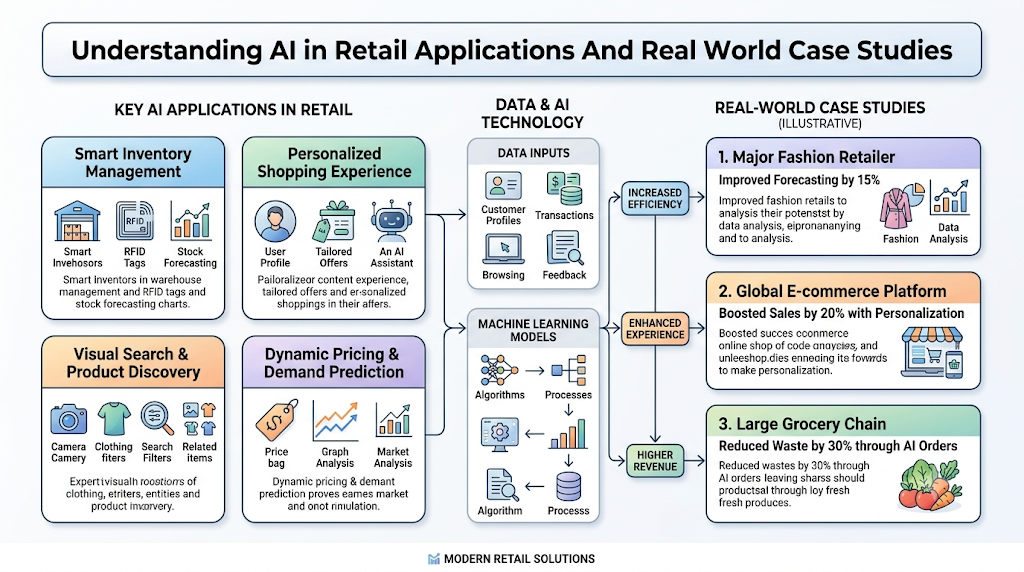
Artificial Intelligence is no longer a futuristic concept reserved for sci-fi movies. Today, it is actively transforming the retail industry from the ground up. Whether you are shopping online or walking through a physical store, intelligent algorithms are quietly working behind the scenes. They help brands guess what you want to buy next, ensure the shelves stay stocked, and make checkout lines move much faster. For modern businesses, adopting AI is no longer just an optional tech upgrade. It has become a core pillar of digital transformation. Retailers around the world are leveraging intelligent retail solutions to stay competitive, understand changing consumer habits, and run highly efficient operations. This comprehensive guide explores the core concepts of artificial intelligence in retail, highlights its most impactful applications, and looks at real-world case studies proving its value.
What Is AI in Retail?
At its core, AI in retail refers to the integration of machine learning, data analytics, automation, and computer vision into everyday retail operations. Instead of relying solely on human intuition or manual spreadsheets, businesses use software that can learn from data, recognize patterns, and make independent decisions.
Core Concepts of Retail AI
- Machine Learning (ML): Systems that analyze historical sales data to predict future shopping trends without needing explicit reprogramming.
- Computer Vision: Smart cameras that can “see” and analyze inventory levels on physical shelves or track customer movement within a store.
- Natural Language Processing (NLP): The technology powering customer service chatbots so they can understand and answer customer questions like a human agent.
Retailers are rapidly adopting smart retail practices because modern shopping generates massive amounts of data. Every click, purchase, return, and review leaves a digital footprint. AI helps businesses make sense of this data overload, turning raw numbers into actionable strategies that support ongoing digital transformation.
Why AI Is Important in Retail
The retail sector operates on razor-thin profit margins and fast-changing trends. Implementing retail technology gives businesses a distinct competitive edge by addressing several key areas:
- Better Customer Experience: Shoppers enjoy faster service, highly relevant product suggestions, and frictionless checkout processes.
- Faster Business Decisions: Instead of waiting for monthly sales reports, managers can use predictive analytics to see changes in consumer demand instantly.
- Improved Efficiency: Retail automation takes over repetitive, time-consuming tasks like data entry, manual stock counting, and basic customer support tracking.
- Reduced Operational Costs: Optimizing supply chains and preventing overstocking directly slashes warehouse storage fees and minimizes waste.
- Higher Customer Satisfaction: When customers find exactly what they need quickly and receive personalized care, their brand loyalty skyrockets.
How AI Works in Retail
To appreciate the impact of this technology, it helps to understand the continuous cycle of how an AI system functions within a retail environment.
[ Data Collection ] ---> [ Behavior Analysis ] ---> [ Machine Learning Models ]
                                                               |
                                                               v
[ Continuous Improvement ] <--- [ Automation ] <--- [ Predictions & Recs ]
- Data Collection: The system gathers data from multiple touchpoints, including website clicks, point-of-sale (POS) registers, social media trends, and local weather patterns.
- Customer Behavior Analysis: Algorithms organize this data to figure out what items are frequently bought together, what times of day are busiest, and which products are losing popularity.
- Machine Learning Models: The organized data is fed into specialized algorithms that learn the specific habits and rhythms of the retail business.
- Predictions and Recommendations: The system generates outputs, such as suggesting a winter coat to an online shopper or alerting a store manager to reorder milk before it runs out.
- Automation: The software acts on these predictions automatically—adjusting online prices, sending promotional emails, or placing orders with suppliers.
- Continuous Improvement: As new data flows in daily, the system evaluates its own accuracy, adjusts its formulas, and becomes smarter over time.
Key Applications of AI in Retail
The versatility of artificial intelligence means it can be applied to almost every corner of a retail business.
Personalized Product Recommendations
Online recommendation systems analyze a shopper’s past browsing history to display products they are highly likely to buy. This mimics the experience of having a personal shopper who remembers your exact tastes.
Smart Inventory Management
Maintaining the right balance of stock is incredibly difficult. AI monitors current stock levels across multiple warehouses, ensuring popular items are always available while preventing excess inventory from piling up.
Demand Forecasting
By analyzing past sales, economic shifts, and seasonal trends, predictive analytics tools help retailers calculate exactly how much product they will sell in the coming weeks or months.
Dynamic Pricing
Instead of keeping prices fixed, dynamic pricing algorithms adjust costs in real-time based on competitor pricing, current market demand, and even the time of day to maximize profit margins.
Customer Service Chatbots
AI-driven virtual assistants handle routine customer queries—such as tracking packages or processing simple returns—24 hours a day, freeing up human staff for complex issues.
Fraud Detection
Smart security systems analyze payment transactions instantly to flag unusual purchasing patterns, helping protect both the retailer and consumers from identity theft and credit card fraud.
Visual Search
Many modern e-commerce apps allow users to upload a photo of a clothing item or piece of furniture. The app’s visual search tool then finds identical or highly similar items available for purchase.
Voice Shopping
With the rise of smart speakers, consumers can add items to their grocery carts or complete purchases simply by speaking to an AI assistant.
Supply Chain Optimization
AI tracks shipping routes, predicts port delays, and optimizes delivery schedules, ensuring goods travel from the manufacturer to the store shelf as quickly and cheaply as possible.
In-Store Analytics
Physical stores use computer vision and IoT sensors to track foot traffic patterns. This helps managers understand which aisles attract the most attention and how to layout the store effectively.
Checkout Automation
Autonomous retail technologies allow shoppers to scan items via their smartphones or simply walk out of a store while smart sensors automatically charge their digital accounts, eliminating checkout lines entirely.
Marketing Personalization
Instead of sending generic email blasts, AI customer experience platforms segment audiences to deliver tailored discount codes and advertisements based on specific individual preferences.
Real-World AI Case Studies
1. The Smart Supermarket Chain
- Business Problem: A major regional grocery chain faced massive food waste and financial losses due to fresh produce spoiling on shelves before it could be sold.
- AI Solution: The company integrated predictive analytics software directly into their inventory and ordering systems.
- Implementation Approach: The AI analyzed three years of historical sales data, local weather forecasts, and holiday calendars to predict the exact daily demand for perishable items like milk, fruits, and vegetables.
- Measurable Outcome: Within six months, the supermarket chain reduced fresh food spoilage by 23% and boosted overall profit margins by 4%.
2. The E-Commerce Fashion Giant
- Business Problem: A global fashion website struggled with high digital shopping cart abandonment rates because users felt overwhelmed by the thousands of clothing options available.
- AI Solution: They deployed advanced recommendation systems and a personalized shopping feed for every logged-in user.
- Implementation Approach: The site tracked individual user clicks, viewing times, and style preferences to generate a custom “Style Feed” that updated in real-time as the user browsed.
- Measurable Outcome: The e-commerce brand saw a 15% increase in average order values and a significant jump in repeat customer visits.
3. The Electronics Omnichannel Retailer
- Business Problem: A nationwide electronics brand struggled to sync online inventory with their physical storefronts, leading to frustrated customers arriving to pick up items that were actually out of stock.
- AI Solution: They built a unified retail automation platform powered by smart inventory sensors.
- Implementation Approach: Real-time tracking data from physical stores and online warehouses was funneled into a central AI engine that coordinated shipping and adjusted local pickup availability automatically.
- Measurable Outcome: The retailer achieved 99% inventory accuracy across all channels and saw customer satisfaction scores lift by 18 points.
Comparison Tables
Popular AI Applications in Retail
| AI Application | Purpose | Benefits | Challenges | Common Use Cases |
| Recommendation Engines | Suggest relevant items to online shoppers | Higher sales, better engagement | Requires massive user data | Amazon’s “Frequently Bought Together” |
| Demand Forecasting | Predict future inventory needs | Reduced waste, no stockouts | Vulnerable to unpredictable events | Holiday grocery stock planning |
| Dynamic Pricing | Automatically adjust prices | Maximized profit margins | Risk of negative customer reaction | Ride-sharing apps, airline tickets |
| Customer Chatbots | Provide instant, round-the-clock support | Lower support costs, fast replies | Can struggle with complex issues | Order tracking and returns |
Traditional Retail vs. AI-Powered Retail
| Feature | Traditional Retail | AI-Powered Retail | Business Impact |
| Inventory Tracking | Manual counting and weekly logs | Real-time sensor and camera data | Massive reduction in human error and stock shortages |
| Customer Pricing | Fixed pricing changed manually | Dynamic, algorithm-driven shifts | Optimizes profit margins based on real market demand |
| Customer Service | Dependent entirely on staff hours | 24/7 support via automated bots | Drastically reduces wait times and support costs |
| Marketing Style | Mass generic ads and email blasts | Hyper-personalized ad campaigns | Drastically improves conversion rates and ad spend |
Benefits of AI in Retail
Embracing artificial intelligence offers a clear line of operational and financial rewards for businesses willing to make the investment:
- Better Customer Engagement: Shoppers stick around longer when digital platforms feel tailored to their unique tastes.
- Improved Inventory Accuracy: Real-time data feeds reduce the human errors common in manual inventory logs.
- Increased Sales: Upselling and cross-selling become effortless when data-driven recommendations pinpoint exactly what a buyer needs.
- Faster Decision-Making: Executive teams can safely pivot business strategies based on immediate data patterns rather than outdated hunches.
- Reduced Waste: Accurate ordering means far fewer items end up in clearance bins or local landfills.
- Enhanced Operational Efficiency: Employees spend less time managing repetitive admin work and more time building relationships with customers.
Common Challenges
While the benefits are clear, retailers frequently run into standard hurdles during the implementation phase:
- Data Privacy: Gathering consumer data means businesses must strictly comply with local data protection laws to maintain customer trust.
- High Implementation Costs: Building custom AI frameworks or upgrading old hardware requires a significant upfront financial investment.
- Data Quality: AI systems are only as good as the data they receive. If historical logs are messy or incomplete, the system’s predictions will be faulty.
- Integration with Legacy Systems: Getting cutting-edge AI software to communicate smoothly with decades-old cash registers and warehouse databases can be highly complex.
- Employee Training: Frontline staff and managers need time and training to learn how to interact with new digital tools.
- AI Bias: If historical data contains biased trends, the AI will repeat those mistakes, potentially alienating certain customer segments.
- Cybersecurity: Storing large amounts of digital consumer information makes retail systems a lucrative target for hackers, requiring robust security measures.
Best Practices for Success
If you are planning to introduce AI into a retail setting, keep these basic guidelines in mind:
- Start Small: Don’t try to automate your whole business overnight. Begin with a single, clear project—like a customer service chatbot or basic demand forecasting for a single product line.
- Focus on Data Quality: Clean up your existing data logs before feeding them into any new software platform.
- Keep Humans in the Loop: Use AI to assist your workforce, not replace them entirely. Human oversight is vital for handling unusual situations and providing genuine empathy.
- Prioritize Transparency: Be open with your customers about what data you collect and how you use it to improve their shopping journeys.
Future Trends
As technology marches forward, the relationship between AI and retail will only deepen. Here is what to watch for in the coming years:
- Generative AI: Retailers will use generative tools to automatically create custom marketing copy, unique product descriptions, and even virtual clothing models tailored to the buyer’s body type.
- Autonomous Stores: The expansion of completely cashierless convenience stores where checkout happens automatically via computer vision.
- AI Shopping Assistants: Highly sophisticated conversational agents that act as personal stylists or tech advisors, guiding you through complex purchases.
- Hyper-Personalization: Systems so advanced they can predict what a consumer needs before the consumer even realizes it themselves, optimizing local stock in advance.
- Robotics in Retail: Autonomous robots navigating store aisles to scan shelves for missing price tags, clean floors, and assist warehouse teams with heavy lifting.
FAQs
What is the main role of AI in retail?
The primary role of AI in retail is to analyze large sets of data to automate day-to-day operations, predict consumer buying trends, and create a highly personalized, efficient experience for shoppers.
Does using AI mean human retail workers will lose their jobs?
Not necessarily. While AI automates repetitive tasks like stock counting and basic data entry, it is designed to assist human workers. This allows staff to focus on high-value roles like direct customer care and complex problem-solving.
How do small retail businesses benefit from AI?
Small businesses can use affordable, cloud-based AI tools to automate their email marketing, manage basic inventory levels, and set up simple customer service chatbots without needing a massive tech budget.
What is predictive analytics in smart retail?
Predictive analytics uses historical sales data, seasonal trends, and algorithms to forecast future outcomes, such as which products will be in high demand next month.
How does AI help reduce food waste in supermarkets?
AI monitors past buying habits and external factors like weather to help grocery stores calculate exactly how much fresh food to order, preventing overstocking and subsequent spoilage.
What is a recommendation engine?
A recommendation engine is an AI tool used by e-commerce websites to track a user’s behavior and suggest additional products that match their specific tastes.
Is customer data safe when retailers use AI?
Data safety depends on the retailer’s cybersecurity protocols. Reputable businesses encrypt data and follow strict privacy laws to ensure personal information remains secure.
What is dynamic pricing?
Dynamic pricing is a system where an algorithm adjusts product prices in real-time based on shifts in customer demand, current inventory levels, and competitor pricing.
What is visual search in retail?
Visual search allows shoppers to upload a photo of an item into a retail app, which then uses computer vision to find the exact product or highly similar alternatives in the store’s inventory.
What is an autonomous store?
An autonomous store is a physical retail space that uses smart sensors and cameras to track what items customers pick up, allowing them to walk out and pay automatically without waiting in a traditional checkout line.
Conclusion
Artificial Intelligence is fundamentally rewriting the playbook for global retail. By turning massive streams of raw data into smart, actionable insights, intelligent retail solutions enable brands to understand their customers better than ever before. From automated warehouses to personalized online storefronts, this technology helps businesses save money, eliminate operational waste, and drive meaningful sales growth. While taking the first step toward digital transformation can feel daunting due to initial costs and technical updates, the long-term rewards are undeniable. As consumer expectations continue to rise, embracing AI is the single best way for modern retailers to build an agile, efficient, and future-proof business.
