Introduction
AI Control Tower Copilots use artificial intelligence (AI), machine learning (ML), generative AI, predictive analytics, digital twins, and supply chain intelligence to help organizations monitor, analyze, predict, and optimize end-to-end supply chain operations from a centralized command center.
Modern supply chains span suppliers, manufacturers, warehouses, transportation providers, distributors, retailers, and customers across multiple countries. Managing these interconnected operations manually has become increasingly difficult due to demand volatility, transportation disruptions, supplier risks, inventory imbalances, geopolitical events, and changing customer expectations.
Traditional supply chain control towers primarily provide dashboards and alerts, requiring planners to manually interpret information and determine corrective actions. AI-powered Control Tower Copilots go further by continuously analyzing operational data, identifying risks, explaining disruptions, recommending actions, simulating scenarios, and assisting supply chain teams through conversational AI interfaces.
These solutions combine generative AI, predictive analytics, supply chain digital twins, optimization engines, workflow automation, and natural language interfaces to improve operational visibility, accelerate decision-making, reduce disruptions, optimize inventory, and improve customer service.
Modern AI Control Tower Copilots integrate with Enterprise Resource Planning (ERP), Supply Chain Planning (SCP), Transportation Management Systems (TMS), Warehouse Management Systems (WMS), Manufacturing Execution Systems (MES), Customer Relationship Management (CRM), IoT platforms, supplier portals, and business intelligence platforms.
They support industries including manufacturing, retail, e-commerce, pharmaceuticals, healthcare, automotive, food and beverage, consumer goods, logistics, aerospace, and third-party logistics (3PL).
Real-world Use Cases
- End-to-end supply chain visibility
- Disruption detection
- Inventory optimization
- Transportation monitoring
- Supplier risk management
- Demand planning assistance
- Executive decision support
- Digital supply chain monitoring
- Exception management
- Supply chain scenario simulation
Evaluation Criteria for Buyers
When selecting an AI Control Tower Copilot Platform, consider:
- AI decision support capabilities
- End-to-end supply chain visibility
- Predictive analytics
- Digital twin support
- ERP and supply chain integration
- Workflow automation
- Scalability
- Security controls
- Reporting dashboards
- Ease of deployment
Best For
- Enterprise manufacturers
- Retail organizations
- Global supply chains
- Logistics providers
- Supply chain planning teams
Not Ideal For
Organizations with simple supply chains or limited enterprise system integration.
Key Trends
- AI-powered supply chain copilots
- Generative AI for operations
- Digital supply chain twins
- Autonomous decision support
- Predictive disruption management
- Conversational supply chain analytics
- Intelligent workflow automation
- Real-time operational visibility
- Multi-enterprise collaboration
- Connected supply chain ecosystems
Methodology
The platforms below were evaluated based on:
- AI copilot capabilities
- Supply chain intelligence
- Enterprise integration
- Analytics maturity
- Scalability
- Industry adoption
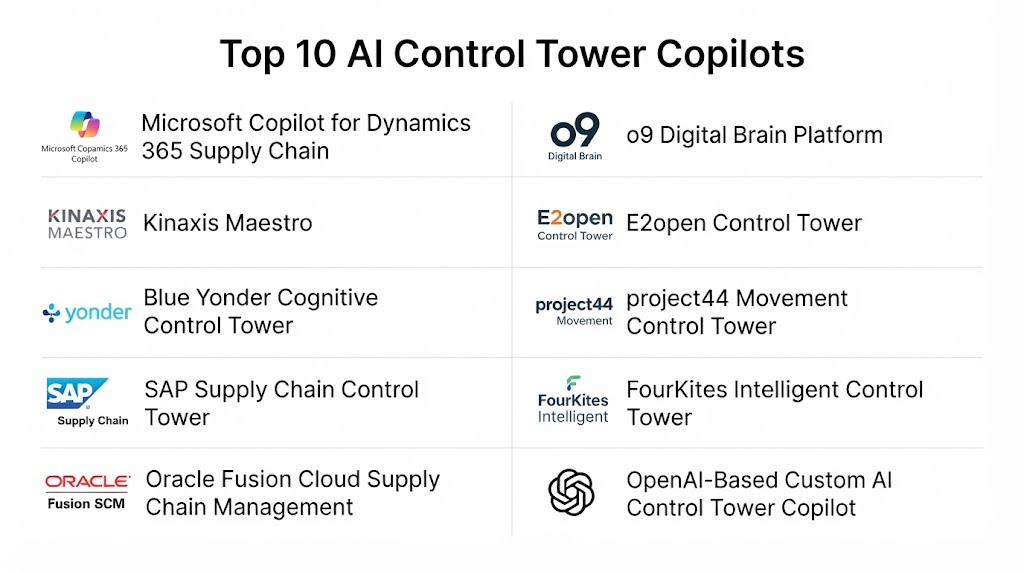
Top 10 AI Control Tower Copilots
1. Microsoft Copilot for Dynamics 365 Supply Chain
Verdict: Best overall AI-powered supply chain copilot.
Short Description: Microsoft Copilot combines generative AI, predictive analytics, and supply chain intelligence to help planners analyze disruptions, optimize operations, and automate decision support.
Key Features
- AI operational assistant
- Supply chain insights
- Predictive analytics
- Workflow automation
- Natural language queries
Pros
- Excellent Copilot experience
- Strong Microsoft ecosystem
- Enterprise scalability
Cons
- Best suited for Microsoft environments
Deployment: Cloud-based platform
Security & Compliance: Enterprise-grade security controls
Integrations & Ecosystem: ERP, TMS, WMS, Power Platform, Microsoft Fabric, Dynamics 365
Support & Community: Enterprise support
Pricing Model: Subscription and enterprise licensing
Best-Fit Scenarios: Enterprise supply chain operations
2. Kinaxis Maestro
Verdict: AI-powered supply chain orchestration platform.
Short Description: Kinaxis Maestro provides AI-assisted planning, digital supply chain orchestration, scenario analysis, and operational decision support.
Key Features
- AI planning assistant
- Scenario simulation
- Supply chain visibility
- Predictive analytics
- Decision recommendations
Pros
- Excellent real-time planning
- Strong scenario management
Cons
- Enterprise deployment required
3. Blue Yonder Cognitive Control Tower
Verdict: Intelligent supply chain control tower platform.
Short Description: Blue Yonder combines AI-driven visibility, predictive analytics, inventory intelligence, and transportation optimization through a centralized control tower.
Key Features
- End-to-end visibility
- AI recommendations
- Inventory optimization
- Transportation intelligence
- Exception management
Pros
- Comprehensive supply chain capabilities
- Strong enterprise integration
Cons
- Complex implementation
4. SAP Supply Chain Control Tower
Verdict: Enterprise supply chain visibility platform.
Short Description: SAP provides AI-assisted monitoring, predictive planning, operational visibility, and business process intelligence within its supply chain ecosystem.
Key Features
- Supply chain visibility
- Predictive insights
- Business monitoring
- AI recommendations
- ERP integration
Pros
- Strong SAP ecosystem
- Enterprise scalability
Cons
- Requires SAP expertise
5. Oracle Fusion Cloud Supply Chain Management
Verdict: AI-powered enterprise supply chain platform.
Short Description: Oracle combines generative AI, predictive planning, logistics visibility, and supply chain optimization for enterprise operations.
Key Features
- AI planning
- Operational visibility
- Predictive analytics
- Supply chain optimization
- Workflow automation
Pros
- Strong Oracle integration
- Comprehensive SCM capabilities
Cons
- Best suited for Oracle environments
6. o9 Digital Brain Platform
Verdict: Enterprise AI decision intelligence platform.
Short Description: o9 Digital Brain provides digital twins, AI planning, predictive analytics, and conversational decision support for complex supply chains.
Key Features
- Digital twin
- AI planning
- Scenario modeling
- Supply chain intelligence
- Predictive analytics
Pros
- Advanced AI capabilities
- Excellent scenario planning
Cons
- Enterprise implementation required
7. E2open Control Tower
Verdict: Multi-enterprise supply chain visibility platform.
Short Description: E2open combines supply chain collaboration, logistics visibility, predictive analytics, and AI-assisted operational intelligence.
Key Features
- Multi-enterprise visibility
- Supplier collaboration
- Transportation monitoring
- Risk management
- AI analytics
Pros
- Excellent partner connectivity
- Strong logistics visibility
Cons
- Implementation planning required
8. project44 Movement Control Tower
Verdict: Transportation-centric AI control tower.
Short Description: project44 provides AI-powered shipment visibility, logistics monitoring, predictive ETAs, and transportation intelligence.
Key Features
- Shipment visibility
- ETA prediction
- Transportation analytics
- AI alerts
- Carrier monitoring
Pros
- Excellent transportation intelligence
- Strong predictive capabilities
Cons
- Primarily focused on logistics visibility
9. FourKites Intelligent Control Tower
Verdict: End-to-end logistics intelligence platform.
Short Description: FourKites combines AI-powered visibility, predictive logistics analytics, supply chain monitoring, and automated exception management.
Key Features
- Logistics visibility
- AI recommendations
- Exception management
- Predictive ETAs
- Operational dashboards
Pros
- Strong end-to-end visibility
- Excellent predictive insights
Cons
- Enterprise deployment required
10. OpenAI-Based Custom AI Control Tower Copilot
Verdict: Flexible AI assistant for customized supply chain decision support.
Short Description: Organizations can build custom AI control tower copilots using large language models integrated with ERP systems, TMS platforms, WMS software, MES applications, supplier portals, IoT platforms, transportation data, inventory systems, and business intelligence tools. These assistants can summarize supply chain performance, explain disruptions, recommend corrective actions, answer operational questions, generate executive reports, and support planners while requiring business validation.
Key Features
- Conversational supply chain assistant
- Executive summaries
- Risk analysis
- Decision recommendations
- Operational reporting
Pros
- Highly customizable
- Flexible integrations
- Improves planner productivity
Cons
- Requires supply chain expertise
- Human validation required
Comparison Table
| Platform | AI Copilot | End-to-End Visibility | Predictive Analytics | Enterprise Integration | Best Use |
|---|---|---|---|---|---|
| Microsoft Copilot for Dynamics 365 SCM | Excellent | Excellent | Excellent | Excellent | Enterprise Supply Chains |
| Kinaxis Maestro | Excellent | Excellent | Excellent | High | Supply Chain Orchestration |
| Blue Yonder Cognitive Control Tower | Excellent | Excellent | Excellent | Excellent | Control Tower Operations |
| SAP Supply Chain Control Tower | High | Excellent | High | Excellent | SAP Ecosystem |
| Oracle Fusion SCM | High | High | Excellent | Excellent | Oracle Enterprise |
| o9 Digital Brain | Excellent | High | Excellent | High | Digital Supply Chains |
| E2open Control Tower | High | Excellent | High | High | Multi-Enterprise Networks |
| project44 Movement Control Tower | High | Excellent | High | High | Transportation Visibility |
| FourKites Intelligent Control Tower | High | Excellent | High | High | Logistics Visibility |
| OpenAI Custom | Custom | Custom | Custom | Custom | AI Supply Chain Assistant |
Evaluation & Scoring Table
| Platform | AI Capability 20% | Decision Intelligence 20% | Analytics 15% | Integration 15% | Security 10% | Ease 10% | Value 10% | Total |
|---|---|---|---|---|---|---|---|---|
| Microsoft Copilot for Dynamics 365 SCM | 20 | 20 | 15 | 15 | 10 | 8 | 8 | 96 |
| Blue Yonder Cognitive Control Tower | 20 | 20 | 15 | 15 | 10 | 8 | 8 | 96 |
| Kinaxis Maestro | 19 | 19 | 15 | 15 | 10 | 8 | 8 | 94 |
| o9 Digital Brain | 19 | 19 | 15 | 14 | 10 | 8 | 8 | 93 |
| SAP Supply Chain Control Tower | 18 | 18 | 15 | 15 | 10 | 8 | 8 | 92 |
| Oracle Fusion SCM | 18 | 18 | 15 | 15 | 10 | 8 | 8 | 92 |
| E2open Control Tower | 18 | 18 | 14 | 15 | 10 | 8 | 8 | 91 |
| FourKites Intelligent Control Tower | 18 | 18 | 14 | 14 | 10 | 8 | 8 | 90 |
| project44 Movement Control Tower | 18 | 17 | 14 | 14 | 10 | 8 | 8 | 89 |
| OpenAI Custom | 20 | 16 | 12 | 15 | 8 | 7 | 9 | 87 |
Which AI Control Tower Copilot Is Right for You?
| If your priority is… | Recommended Platform |
|---|---|
| Microsoft ecosystem | Microsoft Copilot for Dynamics 365 Supply Chain |
| Enterprise control tower | Blue Yonder Cognitive Control Tower |
| Supply chain orchestration | Kinaxis Maestro |
| SAP supply chain operations | SAP Supply Chain Control Tower |
| Oracle enterprise planning | Oracle Fusion Cloud SCM |
| Digital supply chain transformation | o9 Digital Brain Platform |
| Multi-enterprise collaboration | E2open Control Tower |
| Transportation intelligence | project44 Movement Control Tower |
| Logistics visibility | FourKites Intelligent Control Tower |
| Custom AI supply chain assistant | OpenAI-Based AI Control Tower Copilot |
Implementation Playbook
First 30 Days
- Identify critical supply chain processes
- Connect ERP, WMS, TMS, and planning systems
- Define operational KPIs
- Establish data governance standards
Days 31–60
- Configure AI models and business rules
- Validate predictive recommendations
- Build executive dashboards
- Train planners and operations teams
Days 61–90
- Automate operational monitoring
- Enable conversational AI assistance
- Optimize exception management
- Expand predictive decision support
Common Mistakes
- Poor master data quality
- Weak enterprise system integration
- Ignoring change management
- Overreliance on AI-generated recommendations
- Limited cross-functional collaboration
- Poor KPI definition
- Inadequate user training
- Failure to continuously improve AI models
Frequently Asked Questions
1. What are AI Control Tower Copilots?
They are AI-powered assistants that help organizations monitor supply chain operations, identify disruptions, recommend corrective actions, and support operational decision-making.
2. How does AI improve supply chain control towers?
AI continuously analyzes operational data, predicts risks, explains disruptions, recommends actions, and enables natural language interaction with supply chain information.
3. Can AI automate supply chain decision-making?
AI can automate routine workflows and provide recommendations, but important operational and strategic decisions should still be reviewed by experienced teams.
4. Which industries use AI Control Tower Copilots?
Manufacturing, retail, e-commerce, pharmaceuticals, healthcare, automotive, food and beverage, logistics, aerospace, and consumer goods.
5. What data is required?
ERP transactions, inventory records, transportation data, supplier information, warehouse operations, demand forecasts, production schedules, IoT data, and customer orders.
6. Can AI predict supply chain disruptions?
Yes. Many platforms identify patterns that indicate potential delays, inventory shortages, transportation risks, supplier issues, or capacity constraints.
7. Do these platforms integrate with ERP, WMS, and TMS systems?
Many integrate with ERP platforms, WMS software, TMS solutions, MES applications, CRM systems, IoT platforms, and business intelligence tools.
8. Are AI-generated recommendations always accurate?
Their effectiveness depends on data quality, operational context, business rules, and ongoing validation by supply chain professionals.
9. How is enterprise supply chain data protected?
Organizations should implement encryption, role-based access controls, cybersecurity measures, audit logging, and enterprise data governance.
10. What should companies evaluate before adoption?
Consider AI capabilities, end-to-end visibility, predictive analytics, integrations, scalability, digital twin support, workflow automation, security, and operational compatibility.
Conclusion
AI Control Tower Copilots are transforming enterprise supply chain management by providing intelligent operational assistance, predictive risk detection, conversational analytics, and faster decision-making. By combining artificial intelligence, machine learning, generative AI, predictive analytics, and digital supply chain intelligence, these platforms help organizations improve visibility, optimize operations, strengthen resilience, and accelerate business outcomes.Organizations implementing AI Control Tower Copilots should prioritize high-quality enterprise data, seamless integration with ERP, WMS, TMS, and planning platforms, continuous validation of AI-generated recommendations, and close collaboration between supply chain planners, logistics teams, procurement, manufacturing, and executive leadership. Platforms such as Microsoft Copilot for Dynamics 365 Supply Chain, Blue Yonder Cognitive Control Tower, Kinaxis Maestro, SAP Supply Chain Control Tower, and o9 Digital Brain Platform demonstrate how artificial intelligence is enabling smarter, more connected, and more resilient supply chain operations.
