Introduction
AI Store Footfall Forecasting Tools use artificial intelligence (AI), machine learning (ML), predictive analytics, computer vision, location intelligence, and demand forecasting to predict customer traffic across retail stores. These platforms help retailers optimize staffing, inventory allocation, promotions, store operations, and customer experiences by accurately forecasting when and where shoppers are likely to visit.
Retail foot traffic is influenced by numerous factors including seasonality, weather, holidays, local events, promotions, marketing campaigns, competitor activity, economic conditions, and changing consumer behavior. Traditional forecasting methods often rely on historical averages and manual planning, making it difficult to respond to rapidly changing demand patterns.
AI-powered footfall forecasting platforms continuously analyze historical store visits, Point of Sale (POS) transactions, weather forecasts, public holidays, local events, online browsing behavior, marketing campaigns, mobility data, and external market signals to generate highly accurate traffic predictions.
These solutions combine predictive analytics, time-series forecasting, demand sensing, location intelligence, digital twins, workforce optimization, and scenario planning to improve labor scheduling, inventory planning, merchandising, customer service, and operational efficiency.
Modern AI footfall forecasting platforms integrate with Enterprise Resource Planning (ERP), Point of Sale (POS) systems, Workforce Management (WFM), Customer Relationship Management (CRM), inventory systems, video analytics platforms, IoT sensors, people counting systems, and business intelligence solutions.
They support industries including retail, grocery, shopping malls, fashion, consumer electronics, pharmacies, restaurants, hospitality, convenience stores, specialty retail, and omnichannel commerce.
Real-world Use Cases
- Store traffic forecasting
- Workforce scheduling
- Inventory allocation
- Promotion planning
- Queue management
- Store operations optimization
- Regional demand forecasting
- Mall traffic prediction
- Staffing optimization
- Customer experience improvement
Evaluation Criteria for Buyers
When selecting an AI Store Footfall Forecasting Platform, consider:
- Forecast accuracy
- AI prediction capabilities
- Real-time analytics
- POS and workforce integration
- Location intelligence
- Scenario planning
- Scalability
- Security controls
- Reporting dashboards
- Ease of deployment
Best For
- Retail organizations
- Grocery chains
- Shopping malls
- Restaurants
- Omnichannel retailers
Not Ideal For
Businesses without physical retail locations or customer traffic monitoring requirements.
Key Trends
- AI-powered traffic forecasting
- Computer vision analytics
- Smart retail operations
- Workforce optimization
- Hyper-local forecasting
- Real-time demand sensing
- Digital store twins
- Customer journey analytics
- AI-assisted staffing
- Intelligent retail planning
Methodology
The platforms below were evaluated based on:
- AI forecasting capabilities
- Traffic prediction accuracy
- Enterprise integration
- Analytics maturity
- Scalability
- Industry adoption
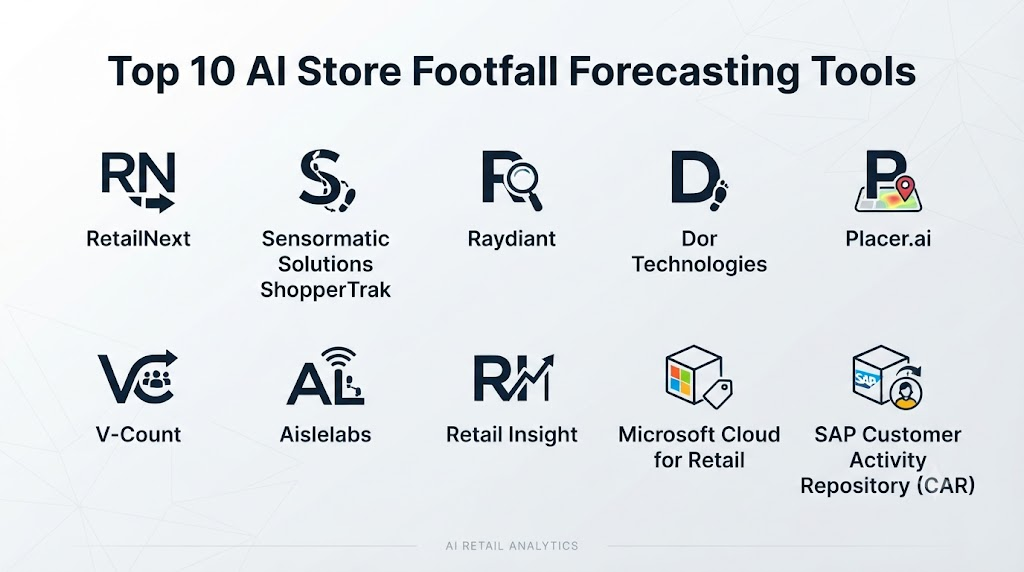
Top 10 AI Store Footfall Forecasting Tools
1. RetailNext
Verdict: Best overall AI-powered store footfall forecasting platform.
Short Description: RetailNext combines AI-driven traffic forecasting, in-store analytics, customer journey intelligence, and operational insights to help retailers optimize store performance.
Key Features
- Footfall forecasting
- Customer journey analytics
- Occupancy monitoring
- Traffic heatmaps
- Predictive analytics
Pros
- Excellent in-store analytics
- Strong forecasting accuracy
- Enterprise scalability
Cons
- Enterprise deployment required
Deployment: Cloud-based platform
Security & Compliance: Enterprise-grade security controls
Integrations & Ecosystem: POS, ERP, CRM, workforce management, video analytics, IoT sensors
Support & Community: Enterprise support
Pricing Model: Custom enterprise pricing
Best-Fit Scenarios: Large retail chains
2. Sensormatic Solutions
Verdict: AI-powered retail traffic intelligence platform.
Short Description: Sensormatic provides people counting, footfall forecasting, shopper analytics, and retail performance intelligence.
Key Features
- People counting
- Footfall analytics
- Customer behavior
- Occupancy monitoring
- Traffic forecasting
Pros
- Strong retail specialization
- Extensive deployment experience
Cons
- Hardware deployment may be required
3. ShopperTrak (Sensormatic)
Verdict: Enterprise retail traffic analytics platform.
Short Description: ShopperTrak combines AI forecasting, customer counting, store analytics, and operational intelligence.
Key Features
- Traffic forecasting
- Store analytics
- Occupancy monitoring
- Conversion analytics
- AI reporting
Pros
- Strong retail analytics
- Excellent traffic insights
Cons
- Primarily focused on physical retail
4. Dor Technologies
Verdict: Intelligent people-counting platform.
Short Description: Dor Technologies provides AI-powered footfall analytics, customer counting, staffing insights, and retail forecasting.
Key Features
- Customer counting
- Footfall forecasting
- Store analytics
- Workforce planning
- AI dashboards
Pros
- Easy deployment
- Strong operational insights
Cons
- Best suited for small and medium retail environments
5. RetailNext Traffic Analytics
Verdict: Enterprise customer traffic intelligence platform.
Short Description: RetailNext combines customer movement analytics, AI forecasting, occupancy tracking, and merchandising insights.
Key Features
- Traffic analytics
- Customer movement
- AI forecasting
- Occupancy analysis
- Store optimization
Pros
- Comprehensive analytics
- Strong customer insights
Cons
- Enterprise implementation recommended
6. Microsoft Azure Maps + AI Analytics
Verdict: Intelligent location analytics platform.
Short Description: Microsoft Azure combines location intelligence, AI forecasting, mobility analytics, and retail planning.
Key Features
- Location analytics
- Traffic forecasting
- AI insights
- Mobility intelligence
- Cloud integration
Pros
- Strong Microsoft ecosystem
- Flexible deployment
Cons
- Requires custom retail implementation
7. Zebra Prescriptive Analytics
Verdict: AI-powered retail operations platform.
Short Description: Zebra combines traffic analytics, workforce optimization, inventory intelligence, and store performance analytics.
Key Features
- Traffic forecasting
- Workforce optimization
- Store analytics
- Inventory insights
- AI recommendations
Pros
- Excellent retail operations support
- Strong enterprise capabilities
Cons
- Best suited for Zebra ecosystem users
8. Placer.ai
Verdict: Location intelligence and mobility analytics platform.
Short Description: Placer.ai provides location analytics, mobility trends, competitive benchmarking, and retail traffic forecasting using aggregated location data.
Key Features
- Location intelligence
- Mobility analytics
- Competitive benchmarking
- Footfall trends
- Market insights
Pros
- Strong market intelligence
- Excellent location analytics
Cons
- Forecast quality depends on available mobility data
9. TIBCO Spotfire with AI Forecasting
Verdict: Enterprise analytics and forecasting platform.
Short Description: TIBCO Spotfire combines AI-powered forecasting, retail analytics, visualization, and operational dashboards.
Key Features
- Predictive analytics
- Traffic forecasting
- Retail dashboards
- AI visualization
- Business intelligence
Pros
- Powerful analytics platform
- Flexible reporting
Cons
- Requires analytics expertise
10. OpenAI-Based Custom AI Store Footfall Forecasting Assistant
Verdict: Flexible AI assistant for customized retail traffic intelligence.
Short Description: Organizations can build custom AI footfall forecasting assistants using large language models integrated with POS systems, ERP platforms, workforce management software, people-counting sensors, video analytics, weather services, local event calendars, inventory systems, and business intelligence platforms. These assistants can summarize traffic forecasts, explain customer trends, recommend staffing adjustments, identify demand patterns, and support store managers while requiring operational validation.
Key Features
- Traffic summaries
- Staffing recommendations
- Demand insights
- Operational reporting
- Executive dashboards
Pros
- Highly customizable
- Flexible integrations
- Improves operational decision-making
Cons
- Requires retail analytics expertise
- Human validation recommended
Comparison Table
| Platform | AI Forecasting | Footfall Analytics | Workforce Planning | Enterprise Integration | Best Use |
|---|---|---|---|---|---|
| RetailNext | Excellent | Excellent | Excellent | Excellent | Enterprise Retail |
| Sensormatic Solutions | Excellent | Excellent | High | High | Retail Traffic Analytics |
| ShopperTrak | High | Excellent | High | High | Store Performance |
| Dor Technologies | High | High | High | High | SMB Retail |
| RetailNext Traffic Analytics | High | Excellent | High | High | Customer Journey Analytics |
| Microsoft Azure Maps + AI | High | High | Medium | Excellent | Custom Retail Solutions |
| Zebra Prescriptive Analytics | High | High | Excellent | High | Retail Operations |
| Placer.ai | High | High | Medium | High | Location Intelligence |
| TIBCO Spotfire | High | High | Medium | High | Retail Analytics |
| OpenAI Custom | Custom | Custom | Custom | Custom | AI Retail Assistant |
Evaluation & Scoring Table
| Platform | AI Capability 20% | Forecast Accuracy 20% | Analytics 15% | Integration 15% | Security 10% | Ease 10% | Value 10% | Total |
|---|---|---|---|---|---|---|---|---|
| RetailNext | 20 | 20 | 15 | 15 | 10 | 8 | 8 | 96 |
| Sensormatic Solutions | 19 | 20 | 15 | 14 | 10 | 8 | 8 | 94 |
| ShopperTrak | 18 | 19 | 15 | 14 | 10 | 8 | 8 | 92 |
| Zebra Prescriptive Analytics | 18 | 18 | 15 | 15 | 10 | 8 | 8 | 92 |
| RetailNext Traffic Analytics | 18 | 18 | 15 | 14 | 10 | 8 | 8 | 91 |
| Placer.ai | 18 | 18 | 14 | 14 | 10 | 9 | 8 | 91 |
| Microsoft Azure Maps + AI | 18 | 17 | 14 | 15 | 10 | 8 | 8 | 90 |
| Dor Technologies | 17 | 17 | 14 | 14 | 10 | 9 | 9 | 90 |
| TIBCO Spotfire | 17 | 17 | 15 | 14 | 10 | 8 | 8 | 89 |
| OpenAI Custom | 20 | 16 | 12 | 15 | 8 | 7 | 9 | 87 |
Which AI Store Footfall Forecasting Platform Is Right for You?
| If your priority is… | Recommended Platform |
|---|---|
| Enterprise retail traffic forecasting | RetailNext |
| Store traffic intelligence | Sensormatic Solutions |
| Physical retail analytics | ShopperTrak |
| Small and medium retail stores | Dor Technologies |
| Customer journey analytics | RetailNext Traffic Analytics |
| Custom location intelligence | Microsoft Azure Maps + AI Analytics |
| Retail workforce optimization | Zebra Prescriptive Analytics |
| Market and mobility insights | Placer.ai |
| Advanced business analytics | TIBCO Spotfire |
| Custom AI retail assistant | OpenAI-Based AI Assistant |
Implementation Playbook
First 30 Days
- Audit existing traffic data sources
- Collect historical footfall and POS data
- Define forecasting KPIs
- Identify external demand signals
Days 31–60
- Integrate POS, ERP, workforce management, and sensor systems
- Configure AI forecasting models
- Validate traffic predictions
- Train store operations teams
Days 61–90
- Automate workforce scheduling
- Optimize inventory allocation
- Improve customer service planning
- Expand predictive retail analytics
Common Mistakes
- Poor people-counting data quality
- Weak POS integration
- Ignoring weather and event data
- Overreliance on AI forecasts without operational review
- Limited workforce planning integration
- Infrequent model retraining
- Poor cross-functional collaboration
- Failure to monitor forecast accuracy
Frequently Asked Questions
1. What are AI Store Footfall Forecasting Tools?
They are AI-powered platforms that predict customer traffic in physical retail locations using historical data, external signals, and predictive analytics.
2. How does AI improve footfall forecasting?
AI analyzes historical store visits, POS transactions, weather, holidays, promotions, local events, mobility data, and customer behavior to forecast future traffic.
3. Can AI improve workforce scheduling?
Yes. Accurate traffic forecasts help retailers schedule employees more effectively, reducing labor costs while maintaining customer service levels.
4. Which industries use AI footfall forecasting platforms?
Retail, grocery, shopping malls, fashion, restaurants, pharmacies, convenience stores, hospitality, consumer electronics, and specialty retail.
5. What data is required?
Store traffic counts, POS transactions, workforce schedules, weather data, promotional calendars, local events, inventory information, and customer behavior data.
6. Can AI predict traffic spikes during promotions or holidays?
Yes. Many platforms incorporate promotional schedules, holidays, seasonal trends, and external events to forecast demand spikes more accurately.
7. Do these platforms integrate with ERP and POS systems?
Many integrate with ERP platforms, POS systems, workforce management software, CRM solutions, inventory systems, video analytics platforms, IoT sensors, and business intelligence tools.
8. Are AI-generated traffic forecasts always accurate?
Performance depends on data quality, forecasting models, external conditions, sensor accuracy, and continuous model validation.
9. How is customer and store data protected?
Organizations should implement encryption, role-based access controls, cybersecurity measures, enterprise data governance, audit logging, and comply with applicable privacy regulations.
10. What should companies evaluate before adoption?
Consider forecasting accuracy, analytics capabilities, integrations, scalability, workforce planning support, reporting, security, ease of deployment, and operational compatibility.
Conclusion
AI Store Footfall Forecasting platforms are transforming physical retail by enabling predictive traffic forecasting, intelligent workforce planning, optimized inventory allocation, and data-driven store operations. By combining artificial intelligence, machine learning, predictive analytics, computer vision, and location intelligence, these platforms help retailers improve customer experiences, increase operational efficiency, reduce labor costs, and maximize store performance.Organizations implementing AI store footfall forecasting solutions should prioritize high-quality traffic and sales data, seamless integration with ERP, POS, workforce management, and analytics platforms, continuous validation of AI-generated forecasts, and close collaboration between store operations, merchandising, workforce planning, inventory management, and executive leadership. Platforms such as RetailNext, Sensormatic Solutions, ShopperTrak, Zebra Prescriptive Analytics, and Placer.ai demonstrate how artificial intelligence is enabling smarter retail operations and more efficient physical store management.
