Introduction
AI Visual Search for Shopping tools use artificial intelligence (AI), computer vision, machine learning (ML), image recognition, deep learning, and multimodal search to help customers discover products using images instead of text. Users can upload a photo, capture an image with a smartphone, or select an item from social media, and the AI identifies visually similar products available for purchase.
Consumers increasingly discover products through social media, screenshots, influencer content, and real-world photos. Traditional keyword-based search often struggles when shoppers do not know a product’s name or cannot accurately describe it. AI-powered visual search bridges this gap by recognizing colors, patterns, shapes, materials, styles, brands, and product attributes directly from images.
These platforms combine computer vision, image embeddings, semantic understanding, recommendation engines, and personalization to improve product discovery, increase conversions, reduce search friction, and enhance customer engagement.
Modern AI visual search platforms integrate with E-commerce Platforms, Product Information Management (PIM), Customer Relationship Management (CRM), Customer Data Platforms (CDP), Enterprise Resource Planning (ERP), Digital Asset Management (DAM), inventory systems, and marketing platforms.
They support industries including fashion, apparel, footwear, furniture, home décor, beauty, consumer electronics, jewelry, automotive parts, retail, marketplaces, and luxury goods.
Real-world Use Cases
- Image-based product search
- Similar product recommendations
- Fashion discovery
- Furniture matching
- Home décor inspiration
- Visual merchandising
- Mobile shopping
- Social commerce
- Image catalog search
- Product identification
Evaluation Criteria for Buyers
When selecting an AI Visual Search Platform, consider:
- Image recognition accuracy
- Visual similarity matching
- AI model quality
- Mobile support
- API flexibility
- Product catalog integration
- Scalability
- Security controls
- Analytics dashboards
- Ease of deployment
Best For
- E-commerce businesses
- Fashion retailers
- Online marketplaces
- Consumer brands
- Digital commerce platforms
Not Ideal For
Organizations without image-rich product catalogs or online shopping experiences.
Key Trends
- Multimodal AI search
- Visual commerce
- AI-powered image recognition
- Mobile-first shopping
- Social commerce integration
- Personalized visual discovery
- Visual recommendation engines
- Generative AI shopping assistants
- Intelligent product matching
- Context-aware visual search
Methodology
The platforms below were evaluated based on:
- AI visual recognition capabilities
- Image search quality
- Enterprise integration
- Analytics maturity
- Scalability
- Industry adoption
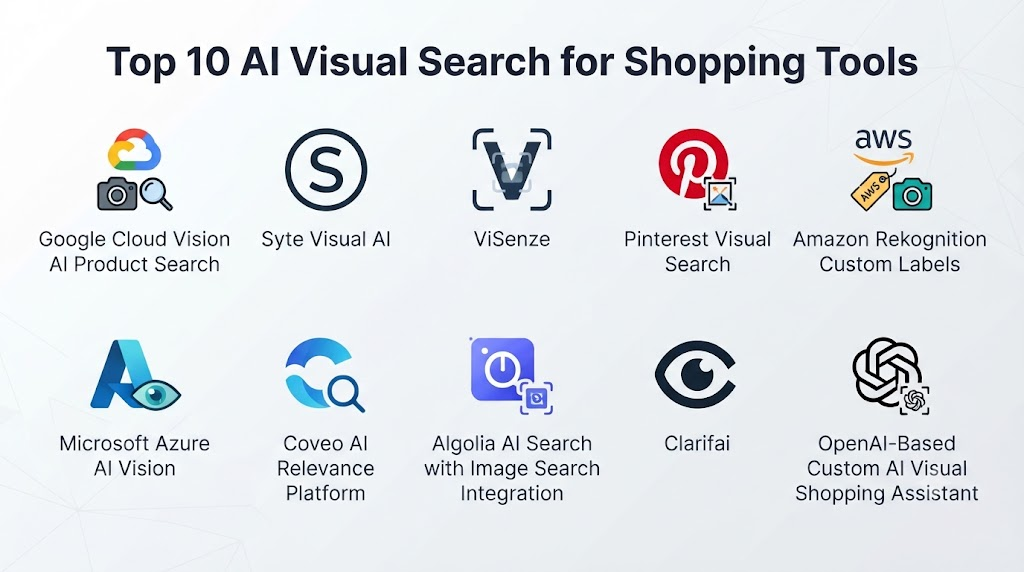
Top 10 AI Visual Search for Shopping Tools
1. Google Cloud Vision AI Product Search
Verdict: Best overall AI-powered visual shopping search platform.
Short Description: Google Cloud Vision AI Product Search enables retailers to build image-based product discovery experiences using advanced computer vision and machine learning.
Key Features
- Image recognition
- Visual similarity search
- Product identification
- Custom product catalogs
- API integration
Pros
- Excellent recognition accuracy
- Enterprise scalability
- Strong Google AI capabilities
Cons
- Best suited for Google Cloud environments
Deployment: Cloud-based platform
Security & Compliance: Enterprise-grade security controls
Integrations & Ecosystem: E-commerce platforms, ERP, PIM, DAM, Google Cloud services
Support & Community: Extensive enterprise support
Pricing Model: Usage-based and enterprise pricing
Best-Fit Scenarios: Large-scale visual commerce
2. Syte Visual AI
Verdict: Enterprise visual commerce platform.
Short Description: Syte provides AI-powered visual search, product recommendations, camera shopping, and merchandising optimization for retailers.
Key Features
- Visual search
- Similar product discovery
- Camera shopping
- Product recommendations
- Merchandising
Pros
- Strong fashion and retail capabilities
- Excellent visual matching
Cons
- Enterprise deployment recommended
3. ViSenze
Verdict: AI-powered product discovery platform.
Short Description: ViSenze combines computer vision, multimodal search, recommendation engines, and merchandising intelligence for digital commerce.
Key Features
- Visual search
- AI recommendations
- Product tagging
- Image recognition
- Smart merchandising
Pros
- Excellent retail specialization
- Strong image understanding
Cons
- Primarily focused on commerce use cases
4. Pinterest Visual Search
Verdict: Visual inspiration and product discovery platform.
Short Description: Pinterest enables shoppers to discover visually similar products using computer vision and image recognition technologies.
Key Features
- Visual discovery
- Image matching
- Style recommendations
- Product inspiration
- Similar item search
Pros
- Excellent consumer engagement
- Strong lifestyle discovery
Cons
- Primarily optimized for Pinterest experiences
5. Amazon Rekognition Custom Labels
Verdict: Flexible computer vision platform.
Short Description: Amazon Rekognition Custom Labels enables businesses to build customized image recognition and visual search applications for commerce.
Key Features
- Image classification
- Object detection
- Custom AI models
- Product recognition
- API integration
Pros
- Highly customizable
- Strong AWS ecosystem
Cons
- Requires implementation expertise
6. Microsoft Azure AI Vision
Verdict: Enterprise computer vision platform.
Short Description: Azure AI Vision provides image recognition, visual search capabilities, object detection, and AI-powered product identification.
Key Features
- Computer vision
- Image analysis
- Product recognition
- Object detection
- API services
Pros
- Strong Microsoft ecosystem
- Enterprise scalability
Cons
- Requires custom implementation for retail experiences
7. Coveo AI Relevance Platform
Verdict: AI-powered search and discovery platform.
Short Description: Coveo combines AI-powered search, recommendations, and visual product discovery to improve digital shopping experiences.
Key Features
- AI search
- Product discovery
- Personalized recommendations
- Search relevance
- Commerce analytics
Pros
- Strong enterprise capabilities
- Excellent personalization
Cons
- Broader search platform beyond visual search
8. Algolia AI Search with Image Search Integration
Verdict: Developer-friendly commerce search platform.
Short Description: Algolia combines AI-powered search with image search integrations to support personalized product discovery and visual commerce.
Key Features
- AI search
- Image search integration
- Product discovery
- Personalized ranking
- Search analytics
Pros
- Excellent developer experience
- Flexible APIs
Cons
- Visual search depends on integration architecture
9. Clarifai
Verdict: Enterprise AI computer vision platform.
Short Description: Clarifai provides image recognition, visual similarity search, object detection, and custom AI models for retail and commerce applications.
Key Features
- Computer vision
- Image recognition
- Visual search
- Custom AI models
- Image analytics
Pros
- Powerful AI platform
- Flexible deployment
Cons
- Requires technical implementation
10. OpenAI-Based Custom AI Visual Shopping Assistant
Verdict: Flexible AI assistant for conversational visual shopping.
Short Description: Organizations can build custom AI visual shopping assistants using large language models integrated with computer vision systems, product catalogs, CRM platforms, PIM solutions, inventory databases, and e-commerce platforms. These assistants can analyze uploaded images, recommend visually similar products, compare alternatives, explain product features, and support conversational shopping while requiring business validation.
Key Features
- Conversational visual search
- Product comparison
- Image-based recommendations
- Personalized shopping
- Product explanations
Pros
- Highly customizable
- Flexible integrations
- Enhances customer engagement
Cons
- Requires high-quality image and catalog data
- Human oversight recommended for merchandising rules
Comparison Table
| Platform | Visual AI | Image Matching | Personalization | Enterprise Integration | Best Use |
|---|---|---|---|---|---|
| Google Cloud Vision AI Product Search | Excellent | Excellent | Excellent | Excellent | Enterprise Visual Commerce |
| Syte Visual AI | Excellent | Excellent | High | High | Fashion Retail |
| ViSenze | Excellent | Excellent | High | High | Product Discovery |
| Pinterest Visual Search | High | Excellent | High | Medium | Consumer Inspiration |
| Amazon Rekognition Custom Labels | High | High | Medium | Excellent | Custom Visual AI |
| Microsoft Azure AI Vision | High | High | Medium | Excellent | Enterprise Vision Applications |
| Coveo AI Relevance Platform | High | High | High | High | Search & Discovery |
| Algolia AI Search | High | High | High | High | Commerce Search |
| Clarifai | High | High | Medium | High | Computer Vision Solutions |
| OpenAI Custom | Custom | Custom | Custom | Custom | AI Visual Shopping Assistant |
Evaluation & Scoring Table
| Platform | AI Capability 20% | Visual Recognition 20% | Analytics 15% | Integration 15% | Security 10% | Ease 10% | Value 10% | Total |
|---|---|---|---|---|---|---|---|---|
| Google Cloud Vision AI Product Search | 20 | 20 | 15 | 15 | 10 | 8 | 8 | 96 |
| Syte Visual AI | 19 | 20 | 15 | 14 | 10 | 8 | 8 | 94 |
| ViSenze | 19 | 19 | 15 | 14 | 10 | 8 | 8 | 93 |
| Amazon Rekognition Custom Labels | 18 | 18 | 15 | 15 | 10 | 8 | 8 | 92 |
| Microsoft Azure AI Vision | 18 | 18 | 15 | 15 | 10 | 8 | 8 | 92 |
| Coveo AI Relevance Platform | 18 | 18 | 14 | 14 | 10 | 8 | 8 | 90 |
| Algolia AI Search | 18 | 17 | 14 | 14 | 10 | 9 | 9 | 91 |
| Pinterest Visual Search | 17 | 18 | 14 | 13 | 10 | 9 | 8 | 89 |
| Clarifai | 17 | 17 | 14 | 14 | 10 | 8 | 8 | 88 |
| OpenAI Custom | 20 | 16 | 12 | 15 | 8 | 7 | 9 | 87 |
Which AI Visual Search Platform Is Right for You?
| If your priority is… | Recommended Platform |
|---|---|
| Enterprise visual commerce | Google Cloud Vision AI Product Search |
| Fashion and lifestyle retail | Syte Visual AI |
| AI-powered product discovery | ViSenze |
| Consumer visual inspiration | Pinterest Visual Search |
| Custom computer vision solutions | Amazon Rekognition Custom Labels |
| Microsoft ecosystem | Microsoft Azure AI Vision |
| AI search and discovery | Coveo AI Relevance Platform |
| Developer-first implementation | Algolia AI Search |
| Enterprise computer vision | Clarifai |
| Conversational AI shopping | OpenAI-Based AI Visual Shopping Assistant |
Implementation Playbook
First 30 Days
- Audit product images and metadata
- Organize product catalog
- Define visual search KPIs
- Identify customer discovery journeys
Days 31–60
- Integrate e-commerce, PIM, and inventory systems
- Configure AI visual search models
- Validate image matching accuracy
- Train merchandising and digital commerce teams
Days 61–90
- Launch visual search across web and mobile
- Optimize recommendation quality
- Improve product discovery
- Expand personalized visual shopping experiences
Common Mistakes
- Poor-quality product images
- Incomplete product metadata
- Weak catalog organization
- Ignoring mobile user experience
- Overreliance on AI without merchandising rules
- Limited personalization
- Infrequent AI model updates
- Failure to monitor conversion performance
Frequently Asked Questions
1. What is AI Visual Search for Shopping?
It is AI-powered technology that allows shoppers to search for products using images instead of text.
2. How does AI visual search work?
AI analyzes image features such as shape, color, texture, style, and objects, then matches them with visually similar products in a product catalog.
3. Can AI visual search increase sales?
Yes. Faster product discovery and more relevant recommendations can improve conversion rates, increase average order value, and enhance customer engagement.
4. Which industries use AI visual search?
Fashion, apparel, footwear, furniture, home décor, beauty, consumer electronics, jewelry, automotive, retail, and online marketplaces.
5. What data is required?
High-quality product images, product metadata, inventory information, customer interaction data, and product catalogs.
6. Can AI identify visually similar products?
Yes. Most platforms compare image features and recommend products with similar styles, colors, materials, or designs.
7. Do these platforms integrate with e-commerce systems?
Many integrate with e-commerce platforms, CRM systems, ERP software, PIM solutions, inventory systems, DAM platforms, and marketing tools.
8. Are AI-generated visual matches always accurate?
Performance depends on image quality, catalog completeness, AI model quality, and continuous optimization.
9. How is customer image data protected?
Organizations should implement encryption, role-based access controls, privacy safeguards, cybersecurity measures, and enterprise data governance while complying with applicable privacy regulations.
10. What should companies evaluate before adoption?
Consider image recognition accuracy, visual matching quality, personalization capabilities, integrations, scalability, analytics, security, API flexibility, and operational compatibility.
Conclusion
AI Visual Search for Shopping platforms are transforming digital commerce by enabling image-based product discovery, intelligent visual matching, personalized shopping experiences, and faster purchase decisions. By combining artificial intelligence, computer vision, machine learning, and recommendation technologies, these platforms help organizations improve customer engagement, increase conversions, strengthen product discovery, and enhance digital shopping experiencesOrganizations implementing AI visual search solutions should prioritize high-quality product imagery, complete product metadata, seamless integration with ERP, PIM, CRM, and e-commerce platforms, continuous validation of AI-generated matches, and close collaboration between merchandising, digital commerce, marketing, and customer experience teams. Platforms such as Google Cloud Vision AI Product Search, Syte Visual AI, ViSenze, Amazon Rekognition Custom Labels, and Bloomreach Discovery demonstrate how artificial intelligence is enabling smarter visual commerce and more intuitive online shopping.
