Introduction
AI Personalized Search for E-commerce platforms use artificial intelligence (AI), machine learning (ML), natural language processing (NLP), semantic search, vector search, and customer behavior analytics to deliver highly relevant, personalized search results that improve product discovery, customer experience, and conversion rates.
Modern online shoppers expect search experiences that understand intent rather than simply matching keywords. Traditional keyword-based search engines often fail to recognize synonyms, spelling mistakes, contextual meaning, customer preferences, and evolving shopping behavior, leading to poor search relevance and lost sales.
AI-powered personalized search platforms continuously analyze search queries, browsing history, purchase patterns, click behavior, product attributes, customer profiles, inventory availability, pricing, and merchandising rules to rank products according to each shopper’s individual preferences.
These solutions combine semantic search, vector embeddings, recommendation engines, generative AI, predictive analytics, merchandising optimization, and real-time personalization to improve product discovery, increase conversions, reduce search abandonment, and enhance customer satisfaction.
Modern AI search platforms integrate with E-commerce Platforms, Customer Relationship Management (CRM), Customer Data Platforms (CDP), Enterprise Resource Planning (ERP), Product Information Management (PIM), Inventory Management Systems, marketing platforms, and analytics tools.
They support industries including retail, fashion, consumer electronics, grocery, healthcare, automotive, home improvement, luxury goods, B2B commerce, marketplaces, and direct-to-consumer brands.
Real-world Use Cases
- Personalized product search
- Semantic search
- Intelligent autocomplete
- AI ranking
- Personalized merchandising
- Product discovery
- Search intent recognition
- Voice search
- Visual search support
- Customer-specific search results
Evaluation Criteria for Buyers
When selecting an AI Personalized Search Platform, consider:
- Search relevance
- AI personalization quality
- Semantic search capabilities
- Real-time ranking
- Product catalog integration
- API flexibility
- Scalability
- Security controls
- Analytics dashboards
- Ease of deployment
Best For
- E-commerce businesses
- Online marketplaces
- Retail organizations
- Digital commerce platforms
- Consumer brands
Not Ideal For
Organizations without digital product catalogs or customer interaction data.
Key Trends
- Generative AI search
- Semantic product search
- Vector search
- Hyper-personalization
- Conversational commerce
- Real-time search ranking
- AI merchandising
- Visual search
- Voice-enabled shopping
- Autonomous product discovery
Methodology
The platforms below were evaluated based on:
- AI search capabilities
- Personalization quality
- Enterprise integration
- Analytics maturity
- Scalability
- Industry adoption
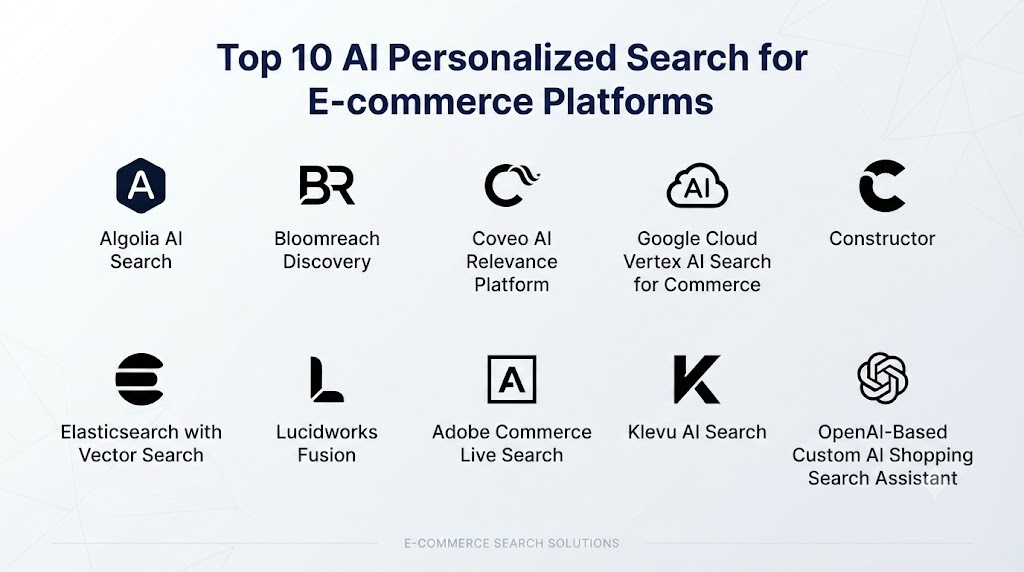
Top 10 AI Personalized Search for E-commerce Platforms
1. Algolia AI Search
Verdict: Best overall AI-powered personalized search platform.
Short Description: Algolia AI Search combines semantic search, AI-powered ranking, personalized search results, recommendations, and developer-friendly APIs for modern e-commerce experiences.
Key Features
- AI search
- Semantic ranking
- Personalized results
- Autocomplete
- Search analytics
Pros
- Excellent search relevance
- Fast performance
- Strong developer ecosystem
Cons
- Advanced personalization depends on quality behavioral data
Deployment: Cloud-based platform
Security & Compliance: Enterprise-grade security controls
Integrations & Ecosystem: Shopify, Adobe Commerce, Salesforce Commerce Cloud, BigCommerce, CRM, CDP
Support & Community: Extensive enterprise support
Pricing Model: Usage-based and enterprise pricing
Best-Fit Scenarios: Large-scale e-commerce search
2. Bloomreach Discovery
Verdict: AI-powered commerce discovery platform.
Short Description: Bloomreach Discovery provides semantic search, AI merchandising, personalized ranking, and intelligent product discovery.
Key Features
- Semantic search
- Personalized ranking
- AI merchandising
- Search analytics
- Product discovery
Pros
- Excellent commerce optimization
- Strong merchandising capabilities
Cons
- Enterprise deployment recommended
3. Coveo AI Relevance Platform
Verdict: Enterprise AI relevance platform.
Short Description: Coveo combines AI-powered search, recommendation engines, customer intent analysis, and personalized product discovery.
Key Features
- AI search
- Personalized ranking
- Relevance optimization
- Customer analytics
- Recommendations
Pros
- Strong enterprise search
- Excellent AI relevance
Cons
- Broad platform beyond e-commerce
4. Google Cloud Vertex AI Search for Commerce
Verdict: Enterprise AI commerce search platform.
Short Description: Google Cloud provides AI-powered retail search, semantic understanding, recommendations, and personalized shopping experiences.
Key Features
- Semantic search
- AI ranking
- Personalized search
- Product recommendations
- Retail analytics
Pros
- Advanced Google AI capabilities
- Strong semantic understanding
Cons
- Best suited for Google Cloud users
5. Constructor
Verdict: Retail search and product discovery platform.
Short Description: Constructor combines AI-powered search, product recommendations, merchandising optimization, and shopper behavior analytics.
Key Features
- Personalized search
- AI recommendations
- Product discovery
- Merchandising
- Search analytics
Pros
- Strong retail specialization
- Excellent search quality
Cons
- Enterprise implementation recommended
6. Elasticsearch with Vector Search
Verdict: Flexible AI-powered search platform.
Short Description: Elasticsearch enables semantic search, vector search, AI ranking, and customized search experiences for enterprise commerce.
Key Features
- Vector search
- Semantic search
- Full-text search
- AI ranking
- API flexibility
Pros
- Highly customizable
- Strong developer ecosystem
Cons
- Requires implementation expertise
7. Lucidworks Fusion
Verdict: AI-powered enterprise search platform.
Short Description: Lucidworks Fusion provides AI search, intent recognition, personalization, and intelligent product discovery.
Key Features
- AI search
- Customer intent
- Personalized ranking
- Search analytics
- Recommendations
Pros
- Strong enterprise search
- Flexible deployment
Cons
- Technical implementation required
8. Adobe Commerce Live Search
Verdict: AI-powered Adobe commerce search platform.
Short Description: Adobe Commerce Live Search provides AI-driven search relevance, personalized ranking, merchandising, and product recommendations.
Key Features
- AI search
- Personalized ranking
- Merchandising
- Recommendations
- Commerce analytics
Pros
- Excellent Adobe Commerce integration
- Strong merchandising tools
Cons
- Best suited for Adobe Commerce users
9. Klevu AI Search
Verdict: Intelligent e-commerce search platform.
Short Description: Klevu provides AI-powered site search, merchandising, product recommendations, and conversion optimization.
Key Features
- AI search
- Product discovery
- Smart autocomplete
- Merchandising
- Search analytics
Pros
- Easy implementation
- Strong e-commerce capabilities
Cons
- Advanced enterprise customization is more limited
10. OpenAI-Based Custom AI Shopping Search Assistant
Verdict: Flexible AI assistant for conversational product search.
Short Description: Organizations can build custom AI shopping assistants using large language models integrated with product catalogs, CRM systems, CDPs, ERP software, inventory databases, pricing systems, and e-commerce platforms. These assistants can answer shopping questions, recommend products, compare alternatives, explain product features, and provide conversational search experiences while requiring business validation.
Key Features
- Conversational search
- Product comparisons
- Personalized recommendations
- Natural language shopping
- Customer assistance
Pros
- Highly customizable
- Flexible integrations
- Enhances customer engagement
Cons
- Requires high-quality product data
- Human oversight recommended for business policies
Comparison Table
| Platform | AI Search | Personalization | Semantic Search | Enterprise Integration | Best Use |
|---|---|---|---|---|---|
| Algolia AI Search | Excellent | Excellent | Excellent | Excellent | Enterprise E-commerce |
| Bloomreach Discovery | Excellent | Excellent | Excellent | High | Commerce Discovery |
| Coveo AI Relevance Platform | Excellent | High | Excellent | High | Enterprise Search |
| Google Cloud Vertex AI Search for Commerce | Excellent | Excellent | Excellent | Excellent | Retail AI Search |
| Constructor | High | Excellent | High | High | Retail Commerce |
| Elasticsearch with Vector Search | High | High | Excellent | High | Custom Search |
| Lucidworks Fusion | High | High | Excellent | High | Enterprise Search |
| Adobe Commerce Live Search | High | High | High | Excellent | Adobe Commerce |
| Klevu AI Search | High | High | High | High | E-commerce Search |
| OpenAI Custom | Custom | Custom | Custom | Custom | AI Shopping Assistant |
Evaluation & Scoring Table
| Platform | AI Capability 20% | Search Relevance 20% | Analytics 15% | Integration 15% | Security 10% | Ease 10% | Value 10% | Total |
|---|---|---|---|---|---|---|---|---|
| Algolia AI Search | 20 | 20 | 15 | 15 | 10 | 8 | 8 | 96 |
| Google Cloud Vertex AI Search for Commerce | 20 | 20 | 15 | 15 | 10 | 8 | 8 | 96 |
| Bloomreach Discovery | 19 | 19 | 15 | 14 | 10 | 8 | 8 | 93 |
| Coveo AI Relevance Platform | 19 | 19 | 15 | 14 | 10 | 8 | 8 | 93 |
| Constructor | 18 | 19 | 15 | 14 | 10 | 8 | 8 | 92 |
| Adobe Commerce Live Search | 18 | 18 | 15 | 15 | 10 | 8 | 8 | 92 |
| Elasticsearch with Vector Search | 18 | 18 | 14 | 14 | 10 | 8 | 9 | 91 |
| Lucidworks Fusion | 17 | 18 | 14 | 14 | 10 | 8 | 8 | 89 |
| Klevu AI Search | 17 | 17 | 14 | 14 | 10 | 9 | 8 | 89 |
| OpenAI Custom | 20 | 16 | 12 | 15 | 8 | 7 | 9 | 87 |
Which AI Personalized Search Platform Is Right for You?
| If your priority is… | Recommended Platform |
|---|---|
| Overall AI search | Algolia AI Search |
| AI commerce discovery | Bloomreach Discovery |
| Enterprise search relevance | Coveo AI Relevance Platform |
| Google Cloud ecosystem | Google Cloud Vertex AI Search for Commerce |
| Retail product discovery | Constructor |
| Custom semantic search | Elasticsearch with Vector Search |
| Enterprise AI search | Lucidworks Fusion |
| Adobe Commerce integration | Adobe Commerce Live Search |
| Easy e-commerce deployment | Klevu AI Search |
| Conversational shopping | OpenAI-Based AI Shopping Assistant |
Implementation Playbook
First 30 Days
- Audit product catalog quality
- Review customer search behavior
- Define search performance KPIs
- Identify personalization opportunities
Days 31–60
- Integrate CRM, CDP, ERP, and e-commerce systems
- Configure AI search models
- Validate search relevance
- Train merchandising teams
Days 61–90
- Deploy personalized search
- Optimize ranking algorithms
- Improve product discovery
- Expand conversational shopping capabilities
Common Mistakes
- Poor product metadata
- Weak customer behavior data
- Ignoring synonym management
- Overreliance on AI ranking without merchandising rules
- Limited inventory synchronization
- Poor search analytics
- Infrequent model tuning
- Failure to measure conversion improvements
Frequently Asked Questions
1. What is AI Personalized Search for E-commerce?
It is an AI-powered search technology that delivers personalized product search results based on customer behavior, preferences, intent, and contextual signals.
2. How does AI improve e-commerce search?
AI analyzes search queries, browsing history, purchase behavior, product attributes, and customer preferences to rank products more effectively than traditional keyword search.
3. Can AI increase online sales?
Yes. Better search relevance and personalization can improve conversion rates, increase average order value, reduce search abandonment, and enhance customer satisfaction.
4. Which industries use AI personalized search?
Retail, e-commerce, fashion, grocery, consumer electronics, healthcare, automotive, home improvement, marketplaces, and direct-to-consumer brands.
5. What data is required?
Product catalogs, customer profiles, browsing history, search queries, purchase records, inventory information, pricing, and interaction events.
6. Can AI understand natural language search queries?
Yes. Many platforms use natural language processing and semantic search to understand conversational queries, synonyms, misspellings, and shopping intent.
7. Do these platforms integrate with CRM and e-commerce systems?
Many integrate with CRM platforms, CDPs, ERP systems, e-commerce platforms, PIM solutions, inventory systems, analytics tools, and marketing platforms.
8. Are AI-generated search rankings always accurate?
Performance depends on product metadata quality, customer interaction data, model tuning, merchandising rules, and continuous optimization.
9. How is customer search data protected?
Organizations should implement encryption, role-based access controls, cybersecurity measures, enterprise data governance, and comply with applicable privacy regulations.
10. What should companies evaluate before adoption?
Consider search relevance, personalization quality, semantic search capabilities, integrations, scalability, analytics, API flexibility, security, and operational compatibility.
Conclusion
AI Personalized Search for E-commerce platforms is transforming digital shopping by enabling intelligent product discovery, semantic search, real-time personalization, and conversational commerce. By combining artificial intelligence, machine learning, semantic search, predictive analytics, and customer behavior modeling, these platforms help organizations improve search relevance, increase conversions, strengthen customer loyalty, and enhance the overall shopping experience.Organizations implementing AI personalized search solutions should prioritize high-quality product catalogs, accurate customer interaction data, seamless integration with CRM, CDP, ERP, and e-commerce platforms, continuous validation of AI-generated rankings, and close collaboration between merchandising, marketing, search optimization, and customer experience teams. Platforms such as Algolia AI Search, Google Cloud Vertex AI Search for Commerce, Bloomreach Discovery, Constructor, and Adobe Commerce Live Search demonstrate how artificial intelligence is enabling smarter search experiences and more personalized digital commerce.
