Introduction
AI Computer Vision Loss Prevention Tools use artificial intelligence (AI), computer vision, machine learning (ML), deep learning, video analytics, and behavioral analysis to detect theft, fraud, shrinkage, and suspicious activities across retail stores, warehouses, and distribution centers. These platforms help organizations reduce inventory losses, improve security, and enhance operational compliance through real-time monitoring and intelligent alerts.
Retail shrinkage continues to be a major challenge, driven by shoplifting, employee theft, self-checkout fraud, organized retail crime, inventory errors, and operational mistakes. Traditional CCTV systems require manual monitoring, making it difficult to detect incidents quickly or consistently.
AI-powered computer vision platforms continuously analyze live video feeds from surveillance cameras to recognize suspicious behavior, identify policy violations, detect unusual activities, monitor self-checkout transactions, and generate real-time alerts for security teams.
These solutions combine object detection, person tracking, activity recognition, facial attribute analysis (where permitted), anomaly detection, behavioral analytics, video search, and predictive intelligence to reduce shrinkage, improve employee safety, strengthen compliance, and increase operational efficiency.
Modern AI loss prevention platforms integrate with Enterprise Resource Planning (ERP), Point of Sale (POS) systems, Video Management Systems (VMS), Physical Security Information Management (PSIM), inventory systems, access control platforms, incident management software, and business intelligence tools.
They support industries including retail, grocery, convenience stores, shopping malls, warehouses, logistics, manufacturing, hospitality, healthcare, airports, and financial institutions.
Real-world Use Cases
- Shoplifting detection
- Self-checkout fraud detection
- Employee theft monitoring
- Suspicious behavior detection
- Inventory shrinkage reduction
- Restricted area monitoring
- Queue monitoring
- Safety compliance
- Warehouse security
- Incident investigation
Evaluation Criteria for Buyers
When selecting an AI Computer Vision Loss Prevention Platform, consider:
- AI detection accuracy
- Real-time video analytics
- POS integration
- Camera compatibility
- Incident management
- Scalability
- Security controls
- Privacy features
- Reporting dashboards
- Ease of deployment
Best For
- Retail chains
- Grocery stores
- Warehouses
- Shopping malls
- Distribution centers
Not Ideal For
Organizations without video surveillance infrastructure or requiring only basic CCTV recording.
Key Trends
- AI-powered video analytics
- Intelligent retail security
- Self-checkout monitoring
- Behavioral anomaly detection
- Real-time incident alerts
- Edge AI vision processing
- Privacy-aware computer vision
- AI-assisted investigations
- Smart surveillance
- Automated shrinkage analytics
Methodology
The platforms below were evaluated based on:
- AI vision capabilities
- Loss prevention effectiveness
- Enterprise integration
- Analytics maturity
- Scalability
- Industry adoption
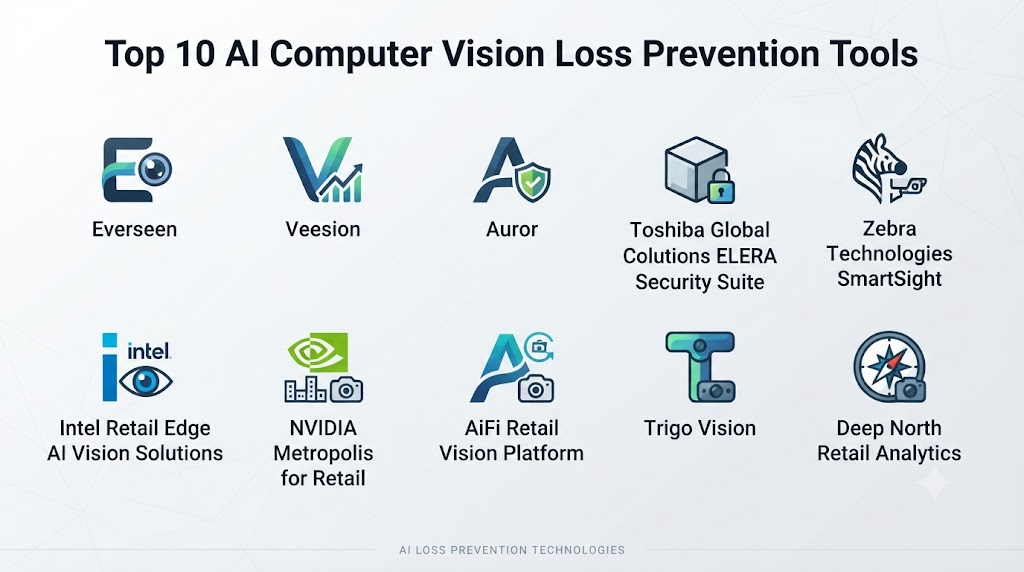
Top 10 AI Computer Vision Loss Prevention Tools
1. Everseen
Verdict: Best overall AI-powered retail loss prevention platform.
Short Description: Everseen combines computer vision, AI-powered self-checkout monitoring, behavioral analytics, and real-time fraud detection to reduce retail shrinkage.
Key Features
- Self-checkout monitoring
- Theft detection
- Behavioral analytics
- Real-time alerts
- Video analytics
Pros
- Excellent retail specialization
- High detection accuracy
- Enterprise scalability
Cons
- Primarily designed for retail environments
Deployment: Cloud, edge, and hybrid deployment
Security & Compliance: Enterprise-grade security controls
Integrations & Ecosystem: POS, VMS, ERP, CCTV, inventory systems
Support & Community: Enterprise support
Pricing Model: Custom enterprise pricing
Best-Fit Scenarios: Large retail chains
2. Veesion
Verdict: AI-powered gesture recognition platform.
Short Description: Veesion uses computer vision and gesture analysis to identify suspicious behavior associated with shoplifting without requiring facial recognition.
Key Features
- Gesture recognition
- Suspicious behavior detection
- Real-time alerts
- Video analytics
- Incident reporting
Pros
- Privacy-conscious approach
- Easy camera integration
Cons
- Focused primarily on shoplifting detection
3. Auror Retail Crime Intelligence
Verdict: Retail crime intelligence platform.
Short Description: Auror combines AI-assisted investigations, incident reporting, organized retail crime analytics, and evidence management.
Key Features
- Incident management
- Crime intelligence
- AI analytics
- Case management
- Investigation workflows
Pros
- Strong investigation capabilities
- Excellent collaboration tools
Cons
- Complements rather than replaces video analytics
4. Motorola Solutions Avigilon
Verdict: Enterprise AI video analytics platform.
Short Description: Avigilon combines AI-powered video analytics, object detection, behavioral monitoring, and intelligent surveillance for enterprise security.
Key Features
- Video analytics
- Object detection
- Behavioral monitoring
- Facial matching (where permitted)
- Smart search
Pros
- Excellent enterprise security
- Strong AI analytics
Cons
- Premium enterprise deployment
5. BriefCam
Verdict: Intelligent video analytics platform.
Short Description: BriefCam provides AI-powered video summarization, object tracking, behavioral analytics, and rapid incident investigation.
Key Features
- Video summarization
- Object tracking
- Smart search
- Behavioral analytics
- Incident investigation
Pros
- Excellent forensic search
- Strong analytics capabilities
Cons
- Requires existing video infrastructure
6. Axis Communications AI Analytics
Verdict: AI-powered edge video analytics platform.
Short Description: Axis provides intelligent camera analytics, intrusion detection, people counting, object recognition, and retail security monitoring.
Key Features
- Edge AI analytics
- Intrusion detection
- People counting
- Object recognition
- Smart surveillance
Pros
- Strong edge processing
- Excellent camera ecosystem
Cons
- Best suited for Axis hardware environments
7. Milestone Systems XProtect with AI
Verdict: Enterprise video management platform.
Short Description: Milestone combines AI-powered video analytics, centralized surveillance management, and third-party AI integrations.
Key Features
- Video management
- AI analytics
- Incident search
- Camera integration
- Security dashboards
Pros
- Flexible integrations
- Enterprise scalability
Cons
- AI functionality depends on integrated analytics partners
8. Cisco Meraki Vision Portal
Verdict: Cloud-managed intelligent video platform.
Short Description: Cisco Meraki provides AI-powered video analytics, occupancy monitoring, motion detection, and operational intelligence.
Key Features
- Cloud video analytics
- Motion detection
- Occupancy monitoring
- AI insights
- Remote management
Pros
- Easy cloud management
- Strong networking ecosystem
Cons
- Best suited for Meraki deployments
9. Intel Geti with OpenVINO Vision Solutions
Verdict: Custom AI vision development platform.
Short Description: Intel enables organizations to build customized computer vision models for theft detection, anomaly detection, and retail security using AI acceleration.
Key Features
- Custom vision models
- Object detection
- Anomaly detection
- Edge AI deployment
- Model optimization
Pros
- Highly customizable
- Strong edge AI performance
Cons
- Requires AI development expertise
10. OpenAI-Based Custom AI Loss Prevention Assistant
Verdict: Flexible AI assistant for intelligent security operations.
Short Description: Organizations can build custom AI loss prevention assistants using large language models integrated with video analytics platforms, POS systems, ERP software, VMS solutions, inventory databases, incident management systems, and business intelligence platforms. These assistants can summarize incidents, explain suspicious activities, generate investigation reports, identify operational risks, and support security teams while requiring human review before enforcement actions.
Key Features
- Incident summaries
- Investigation support
- Security reporting
- Risk analysis
- Operational insights
Pros
- Highly customizable
- Flexible integrations
- Improves investigation efficiency
Cons
- Requires existing vision systems
- Human review recommended for enforcement decisions
Comparison Table
| Platform | AI Vision | Real-Time Detection | POS Integration | Enterprise Integration | Best Use |
|---|---|---|---|---|---|
| Everseen | Excellent | Excellent | Excellent | Excellent | Retail Loss Prevention |
| Veesion | Excellent | Excellent | High | High | Shoplifting Detection |
| Auror Retail Crime Intelligence | High | High | High | High | Crime Intelligence |
| Motorola Solutions Avigilon | Excellent | Excellent | Medium | Excellent | Enterprise Security |
| BriefCam | High | High | Medium | High | Video Investigation |
| Axis Communications AI Analytics | High | High | Medium | High | Edge AI Security |
| Milestone XProtect with AI | High | High | Medium | Excellent | Video Management |
| Cisco Meraki Vision Portal | High | High | Medium | High | Cloud Video Analytics |
| Intel Geti with OpenVINO | High | High | Custom | High | Custom AI Vision |
| OpenAI Custom | Custom | Custom | Custom | Custom | AI Security Assistant |
Evaluation & Scoring Table
| Platform | AI Capability 20% | Detection Accuracy 20% | Analytics 15% | Integration 15% | Security 10% | Ease 10% | Value 10% | Total |
|---|---|---|---|---|---|---|---|---|
| Everseen | 20 | 20 | 15 | 15 | 10 | 8 | 8 | 96 |
| Veesion | 19 | 20 | 15 | 14 | 10 | 9 | 8 | 95 |
| Motorola Solutions Avigilon | 19 | 19 | 15 | 15 | 10 | 8 | 8 | 94 |
| Auror Retail Crime Intelligence | 18 | 18 | 15 | 15 | 10 | 8 | 8 | 92 |
| BriefCam | 18 | 18 | 15 | 14 | 10 | 8 | 8 | 91 |
| Axis Communications AI Analytics | 18 | 18 | 14 | 14 | 10 | 8 | 8 | 90 |
| Milestone XProtect with AI | 17 | 18 | 14 | 15 | 10 | 8 | 8 | 90 |
| Cisco Meraki Vision Portal | 17 | 17 | 14 | 14 | 10 | 9 | 8 | 89 |
| Intel Geti with OpenVINO | 18 | 17 | 14 | 14 | 10 | 7 | 8 | 88 |
| OpenAI Custom | 20 | 16 | 12 | 15 | 8 | 7 | 9 | 87 |
Which AI Computer Vision Loss Prevention Platform Is Right for You?
| If your priority is… | Recommended Platform |
|---|---|
| Retail loss prevention | Everseen |
| Shoplifting detection | Veesion |
| Retail crime investigations | Auror Retail Crime Intelligence |
| Enterprise video security | Motorola Solutions Avigilon |
| Video search and investigations | BriefCam |
| Edge AI surveillance | Axis Communications AI Analytics |
| Enterprise video management | Milestone XProtect with AI |
| Cloud-managed surveillance | Cisco Meraki Vision Portal |
| Custom AI vision development | Intel Geti with OpenVINO Vision Solutions |
| AI-powered investigation assistant | OpenAI-Based AI Assistant |
Implementation Playbook
First 30 Days
- Audit existing CCTV and camera infrastructure
- Identify high-risk locations
- Define shrinkage and security KPIs
- Review incident response workflows
Days 31–60
- Integrate POS, VMS, ERP, and inventory systems
- Configure AI detection models
- Validate alert accuracy
- Train security and store operations teams
Days 61–90
- Deploy real-time monitoring
- Optimize incident response
- Improve shrinkage reporting
- Expand AI-powered investigations
Common Mistakes
- Poor camera placement
- Low-quality video feeds
- Weak POS integration
- Excessive false alerts
- Overreliance on AI without human review
- Ignoring privacy and compliance requirements
- Limited employee training
- Failure to measure shrinkage reduction
Frequently Asked Questions
1. What are AI Computer Vision Loss Prevention Tools?
They are AI-powered platforms that analyze video streams to detect theft, fraud, suspicious behavior, and operational risks in retail and other physical environments.
2. How does AI improve loss prevention?
AI continuously analyzes camera feeds, recognizes behavioral patterns, identifies unusual activities, and generates alerts for potential incidents without requiring constant manual monitoring.
3. Can AI detect self-checkout fraud?
Yes. Many platforms monitor item scanning, product movement, and customer actions to identify potential self-checkout errors or fraudulent activity.
4. Which industries use AI loss prevention platforms?
Retail, grocery, shopping malls, warehouses, logistics, manufacturing, hospitality, healthcare, airports, and financial institutions.
5. What data is required?
Video feeds, POS transactions, inventory records, incident reports, access control logs, and operational data.
6. Can AI replace human security teams?
No. AI assists security personnel by detecting potential issues and prioritizing investigations, but important security and enforcement decisions should remain under human supervision.
7. Do these platforms integrate with existing security systems?
Many integrate with VMS platforms, CCTV systems, ERP software, POS systems, access control solutions, inventory systems, and incident management applications.
8. Are AI-generated alerts always accurate?
Performance depends on camera quality, AI model accuracy, environmental conditions, operational configuration, and continuous validation.
9. How is video and customer data protected?
Organizations should implement encryption, role-based access controls, audit logging, cybersecurity measures, enterprise data governance, and comply with applicable privacy and surveillance regulations.
10. What should companies evaluate before adoption?
Consider detection accuracy, camera compatibility, POS integration, analytics, scalability, privacy controls, reporting, security, ease of deployment, and operational compatibility.
Conclusion
AI Computer Vision Loss Prevention platforms are transforming retail and enterprise security by enabling intelligent surveillance, automated theft detection, behavioral analytics, and proactive incident response. By combining artificial intelligence, computer vision, machine learning, and real-time video analytics, these platforms help organizations reduce shrinkage, improve operational visibility, strengthen compliance, and protect people and assets.Organizations implementing AI computer vision loss prevention solutions should prioritize high-quality video infrastructure, seamless integration with POS, ERP, VMS, and inventory systems, continuous validation of AI-generated alerts, and close collaboration between security teams, store operations, compliance officers, and executive leadership. Platforms such as Everseen, Veesion, Auror Retail Crime Intelligence, Motorola Solutions Avigilon, and BriefCam demonstrate how artificial intelligence is enabling smarter, faster, and more effective loss prevention across modern retail environments.
