Introduction
AI Omnichannel Personalization Platforms use artificial intelligence (AI), large language models (LLMs), machine learning (ML), predictive analytics, customer data intelligence, and real-time decisioning to deliver personalized customer experiences across websites, mobile apps, email, SMS, social media, in-store channels, contact centers, and digital advertising. These platforms help organizations increase customer engagement, improve conversion rates, strengthen loyalty, and maximize customer lifetime value.
Modern customers interact with brands across multiple digital and physical touchpoints before making purchasing decisions. Traditional rule-based personalization often struggles to keep pace with changing customer behavior, fragmented customer data, and rapidly evolving preferences.
AI-powered omnichannel personalization platforms continuously analyze customer profiles, browsing behavior, purchase history, loyalty activity, location, engagement patterns, campaign responses, support interactions, product preferences, and contextual signals to deliver highly personalized recommendations and experiences in real time.
These solutions combine recommendation engines, customer segmentation, journey orchestration, predictive analytics, experimentation, content personalization, dynamic offers, next-best-action recommendations, and generative AI to create consistent and individualized customer journeys across every channel.
Modern AI personalization platforms integrate with Customer Relationship Management (CRM), Customer Data Platforms (CDP), Enterprise Resource Planning (ERP), Product Information Management (PIM), e-commerce platforms, marketing automation systems, customer service applications, analytics platforms, and business intelligence solutions.
They support industries including retail, e-commerce, banking, insurance, healthcare, travel, hospitality, telecommunications, media, education, consumer goods, and software-as-a-service (SaaS).
Real-world Use Cases
- Personalized product recommendations
- Dynamic website personalization
- Omnichannel marketing
- Customer journey orchestration
- Personalized promotions
- Next-best-action recommendations
- Loyalty optimization
- Customer retention
- AI-powered customer engagement
- Cross-channel campaign optimization
Evaluation Criteria for Buyers
When selecting an AI Omnichannel Personalization Platform, consider:
- Personalization accuracy
- AI recommendation quality
- Customer journey orchestration
- CRM and CDP integration
- Real-time decisioning
- Experimentation capabilities
- Scalability
- Security controls
- Analytics dashboards
- Ease of deployment
Best For
- Enterprise retailers
- E-commerce businesses
- Financial institutions
- Consumer brands
- Omnichannel organizations
Not Ideal For
Organizations with limited customer interaction channels or very small customer datasets.
Key Trends
- Generative AI personalization
- Real-time customer decisioning
- Predictive customer journeys
- AI-powered recommendation engines
- Dynamic content optimization
- Hyper-personalization
- Customer data intelligence
- AI-assisted experimentation
- Omnichannel engagement automation
- Customer journey optimization
Methodology
The platforms below were evaluated based on:
- AI personalization capabilities
- Customer intelligence
- Enterprise integration
- Automation maturity
- Scalability
- Industry adoption
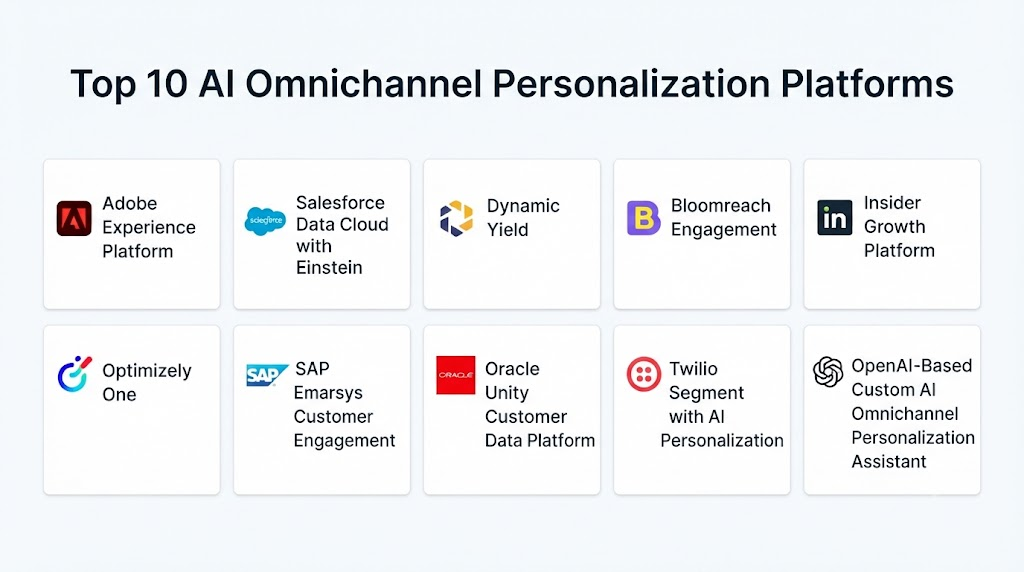
Top 10 AI Omnichannel Personalization Platforms
1. Adobe Experience Platform
Verdict: Best overall AI-powered omnichannel personalization platform.
Short Description: Adobe Experience Platform combines customer data, AI-driven personalization, journey orchestration, predictive analytics, and real-time customer experiences across digital channels.
Key Features
- Customer profiles
- AI personalization
- Journey orchestration
- Predictive analytics
- Real-time decisioning
Pros
- Excellent personalization capabilities
- Strong enterprise ecosystem
- Highly scalable
Cons
- Enterprise implementation complexity
Deployment: Cloud-based platform
Security & Compliance: Enterprise-grade security controls
Integrations & Ecosystem: CRM, CDP, ERP, CMS, e-commerce platforms, marketing automation, analytics
Support & Community: Enterprise support
Pricing Model: Enterprise subscription
Best-Fit Scenarios: Enterprise digital experience management
2. Salesforce Data Cloud with Einstein
Verdict: AI-powered customer personalization platform.
Short Description: Salesforce combines unified customer profiles, predictive AI, personalized recommendations, and omnichannel engagement across sales, service, and marketing.
Key Features
- Customer intelligence
- AI recommendations
- Journey orchestration
- Predictive analytics
- CRM integration
Pros
- Excellent CRM integration
- Strong customer intelligence
Cons
- Best suited for Salesforce environments
3. Dynamic Yield
Verdict: Enterprise AI personalization platform.
Short Description: Dynamic Yield delivers AI-powered personalization, recommendation engines, experimentation, and customer journey optimization.
Key Features
- Product recommendations
- Personalization
- A/B testing
- Customer segmentation
- AI optimization
Pros
- Excellent experimentation tools
- Strong commerce personalization
Cons
- Enterprise-focused deployment
4. Bloomreach Engagement
Verdict: AI-powered customer engagement platform.
Short Description: Bloomreach combines customer analytics, AI personalization, omnichannel marketing, and personalized commerce experiences.
Key Features
- Customer engagement
- AI personalization
- Omnichannel campaigns
- Behavioral analytics
- Product recommendations
Pros
- Strong digital commerce support
- Excellent customer analytics
Cons
- Best suited for commerce businesses
5. Insider Growth Platform
Verdict: AI-driven customer experience platform.
Short Description: Insider provides AI-powered customer segmentation, predictive marketing, journey orchestration, and personalized customer engagement.
Key Features
- Predictive segmentation
- Journey orchestration
- AI recommendations
- Omnichannel engagement
- Personalization
Pros
- Strong omnichannel capabilities
- Easy campaign management
Cons
- Enterprise implementation recommended
6. Optimizely One
Verdict: AI-powered digital experience platform.
Short Description: Optimizely combines AI-driven experimentation, website personalization, content optimization, and customer journey intelligence.
Key Features
- Website personalization
- Experimentation
- AI optimization
- Customer insights
- Content personalization
Pros
- Strong testing capabilities
- Excellent content optimization
Cons
- Primarily focused on digital experiences
7. SAP Emarsys Customer Engagement
Verdict: Enterprise omnichannel marketing platform.
Short Description: SAP Emarsys provides AI-driven customer engagement, predictive marketing, personalized campaigns, and customer lifecycle automation.
Key Features
- AI marketing
- Lifecycle automation
- Personalized campaigns
- Customer segmentation
- Omnichannel engagement
Pros
- Strong enterprise marketing
- Comprehensive customer journeys
Cons
- Best suited for enterprise organizations
8. Oracle Unity Customer Data Platform
Verdict: AI-powered customer intelligence platform.
Short Description: Oracle Unity combines customer data unification, AI personalization, predictive analytics, and cross-channel engagement.
Key Features
- Customer data
- AI recommendations
- Predictive analytics
- Personalization
- Journey analytics
Pros
- Strong Oracle ecosystem
- Comprehensive customer intelligence
Cons
- Oracle implementation required
9. Twilio Segment with AI Personalization
Verdict: Customer data and personalization platform.
Short Description: Twilio Segment enables unified customer profiles, real-time personalization, AI-driven audience segmentation, and omnichannel engagement.
Key Features
- Customer profiles
- Real-time personalization
- AI segmentation
- Journey orchestration
- Analytics
Pros
- Excellent customer data platform
- Flexible integrations
Cons
- Requires configuration for advanced personalization
10. OpenAI-Based Custom AI Omnichannel Personalization Assistant
Verdict: Flexible AI assistant for intelligent customer personalization.
Short Description: Organizations can build custom AI omnichannel personalization assistants using large language models integrated with CRM systems, CDPs, ERP platforms, PIM solutions, e-commerce platforms, marketing automation software, customer support applications, analytics tools, and loyalty systems. These assistants can generate personalized recommendations, explain customer behavior, recommend next-best actions, optimize customer journeys, create dynamic marketing content, and support marketing teams while requiring business validation before launching customer-facing campaigns.
Key Features
- Personalized recommendations
- Customer journey insights
- Dynamic content generation
- Next-best-action suggestions
- Marketing analytics
Pros
- Highly customizable
- Flexible integrations
- Supports complex customer journeys
Cons
- Requires unified customer data
- Human review recommended for customer-facing campaigns
Comparison Table
| Platform | AI Personalization | Journey Orchestration | Customer Intelligence | Enterprise Integration | Best Use |
|---|---|---|---|---|---|
| Adobe Experience Platform | Excellent | Excellent | Excellent | Excellent | Enterprise Experience |
| Salesforce Data Cloud with Einstein | Excellent | Excellent | Excellent | Excellent | CRM Personalization |
| Dynamic Yield | Excellent | High | High | High | Commerce Personalization |
| Bloomreach Engagement | Excellent | High | High | High | Digital Commerce |
| Insider Growth Platform | High | Excellent | High | High | Omnichannel Marketing |
| Optimizely One | High | High | High | High | Digital Experience |
| SAP Emarsys Customer Engagement | High | Excellent | High | Excellent | Enterprise Marketing |
| Oracle Unity Customer Data Platform | High | High | Excellent | Excellent | Customer Data Platform |
| Twilio Segment with AI Personalization | High | High | Excellent | High | Customer Data |
| OpenAI Custom | Custom | Custom | Custom | Custom | AI Personalization Assistant |
Evaluation & Scoring Table
| Platform | AI Capability 20% | Personalization Quality 20% | Analytics 15% | Integration 15% | Security 10% | Ease 10% | Value 10% | Total |
|---|---|---|---|---|---|---|---|---|
| Adobe Experience Platform | 20 | 20 | 15 | 15 | 10 | 8 | 8 | 96 |
| Salesforce Data Cloud with Einstein | 20 | 19 | 15 | 15 | 10 | 8 | 8 | 95 |
| Dynamic Yield | 19 | 19 | 15 | 14 | 10 | 8 | 8 | 93 |
| Bloomreach Engagement | 19 | 19 | 15 | 14 | 10 | 8 | 8 | 93 |
| Insider Growth Platform | 18 | 18 | 15 | 14 | 10 | 9 | 9 | 93 |
| Optimizely One | 18 | 18 | 15 | 14 | 10 | 9 | 8 | 92 |
| SAP Emarsys Customer Engagement | 18 | 18 | 15 | 15 | 10 | 8 | 8 | 92 |
| Oracle Unity Customer Data Platform | 18 | 18 | 15 | 15 | 10 | 8 | 8 | 92 |
| Twilio Segment with AI Personalization | 18 | 17 | 14 | 15 | 10 | 9 | 9 | 92 |
| OpenAI Custom | 20 | 17 | 13 | 15 | 8 | 7 | 9 | 89 |
Which AI Omnichannel Personalization Platform Is Right for You?
| If your priority is… | Recommended Platform |
|---|---|
| Enterprise customer experience | Adobe Experience Platform |
| CRM-driven personalization | Salesforce Data Cloud with Einstein |
| Commerce personalization | Dynamic Yield |
| Digital commerce engagement | Bloomreach Engagement |
| Omnichannel marketing | Insider Growth Platform |
| Website optimization and experimentation | Optimizely One |
| Enterprise customer lifecycle marketing | SAP Emarsys Customer Engagement |
| Unified customer data | Oracle Unity Customer Data Platform |
| Customer data activation | Twilio Segment with AI Personalization |
| Custom AI personalization assistant | OpenAI-Based AI Assistant |
Implementation Playbook
First 30 Days
- Audit customer data sources
- Define personalization goals and KPIs
- Review customer journeys
- Identify high-value customer segments
Days 31–60
- Integrate CRM, CDP, ERP, PIM, and marketing platforms
- Configure AI personalization models
- Validate recommendations and customer journeys
- Train marketing and customer experience teams
Days 61–90
- Launch omnichannel personalization campaigns
- Optimize customer journeys
- Improve engagement and conversion rates
- Expand AI-driven customer intelligence
Common Mistakes
- Fragmented customer data
- Weak identity resolution
- Limited cross-channel integration
- Generic personalization rules
- Infrequent AI model updates
- Ignoring customer consent and privacy requirements
- Overreliance on automation without testing
- Failure to measure personalization performance
Frequently Asked Questions
1. What are AI Omnichannel Personalization Platforms?
They are AI-powered platforms that deliver personalized customer experiences across websites, mobile apps, email, SMS, social media, physical stores, and other customer touchpoints.
2. How does AI personalize customer experiences?
AI analyzes customer profiles, browsing behavior, purchase history, preferences, engagement patterns, and contextual signals to recommend products, personalize content, and optimize customer journeys.
3. Can AI improve customer retention?
Yes. Personalized experiences improve customer engagement, strengthen loyalty, increase repeat purchases, and reduce customer churn.
4. Which industries use AI omnichannel personalization platforms?
Retail, e-commerce, banking, insurance, healthcare, travel, hospitality, telecommunications, media, education, consumer goods, and SaaS.
5. What data is required?
Customer profiles, purchase history, browsing behavior, loyalty information, marketing interactions, product preferences, support history, and engagement metrics.
6. Can AI personalize experiences in real time?
Yes. Many platforms provide real-time recommendations, personalized offers, dynamic content, and next-best-action guidance based on live customer interactions.
7. Do these platforms integrate with CRM and marketing systems?
Many integrate with CRM systems, CDPs, ERP platforms, marketing automation tools, e-commerce platforms, customer support systems, analytics platforms, and loyalty programs.
8. Are AI-generated recommendations always accurate?
Recommendation quality depends on customer data quality, AI model performance, business rules, contextual information, and continuous optimization.
9. How is customer data protected?
Organizations should implement encryption, role-based access controls, cybersecurity measures, enterprise data governance, audit logging, consent management, and comply with applicable privacy regulations.
10. What should companies evaluate before adoption?
Consider personalization quality, customer journey capabilities, integrations, scalability, explainability, analytics, security, experimentation features, reporting, and operational compatibility.
Conclusion
AI Omnichannel Personalization Platforms are transforming customer engagement by enabling intelligent recommendations, personalized customer journeys, dynamic content delivery, and real-time decisioning across every customer touchpoint. By combining artificial intelligence, machine learning, predictive analytics, customer data intelligence, and journey orchestration, these platforms help organizations improve customer satisfaction, increase conversions, strengthen loyalty, and maximize long-term customer value.Organizations implementing AI omnichannel personalization solutions should prioritize unified customer data, seamless integration with CRM, CDP, ERP, PIM, marketing automation, and e-commerce platforms, continuous validation of AI-generated recommendations, and close collaboration between marketing teams, customer experience leaders, sales, analytics specialists, and executive leadership. Platforms such as Adobe Experience Platform, Salesforce Data Cloud with Einstein, Dynamic Yield, Bloomreach Engagement, and Insider Growth Platform demonstrate how artificial intelligence is enabling smarter, more personalized, and more effective customer experiences across modern digital commerce.
