Introduction
AI Subtitle & Caption Generation Tools use artificial intelligence (AI), automatic speech recognition (ASR), natural language processing (NLP), large language models (LLMs), machine learning (ML), and generative AI to automatically transcribe spoken audio, generate subtitles, create closed captions, translate content into multiple languages, and improve video accessibility. These platforms help organizations accelerate video production, expand global reach, improve accessibility, and reduce the time and cost associated with manual transcription and captioning.
Video content has become a primary communication channel across marketing, education, entertainment, customer support, corporate training, and social media. Traditional subtitle creation often requires manual transcription, timestamp alignment, proofreading, and translation. AI-powered subtitle generation platforms automate these tasks while delivering high transcription accuracy and multilingual support.
Modern AI subtitle and caption generation platforms support speech-to-text transcription, automatic subtitle synchronization, multilingual translation, speaker identification, punctuation restoration, subtitle editing, closed caption generation, keyword extraction, searchable transcripts, and accessibility compliance.
These solutions combine speech recognition, generative AI, language translation, audio analysis, workflow automation, and API integrations to improve productivity and streamline multimedia localization.
Modern AI subtitle generation platforms integrate with Digital Asset Management (DAM), Content Management Systems (CMS), Learning Management Systems (LMS), Customer Relationship Management (CRM), video editing software, collaboration tools, cloud storage, and media production platforms.
They support industries including media, entertainment, education, healthcare, software, marketing, advertising, corporate communications, e-commerce, publishing, customer support, and legal services.
Real-world Use Cases
- Automatic subtitle generation
- Closed caption creation
- Video transcription
- Podcast transcription
- Meeting transcription
- Multilingual subtitle translation
- Educational content accessibility
- Social media captioning
- Corporate training localization
- Searchable video archives
Evaluation Criteria for Buyers
When selecting an AI Subtitle & Caption Generation Platform, consider:
- Transcription accuracy
- Subtitle synchronization
- Language support
- Translation quality
- Editing capabilities
- API availability
- Workflow automation
- Scalability
- Security controls
- Ease of deployment
Best For
- Media companies
- Educational institutions
- Marketing teams
- Video creators
- Enterprise communication teams
Not Ideal For
Organizations with minimal video or audio content.
Key Trends
- AI speech recognition
- Real-time caption generation
- Multilingual subtitle translation
- Speaker identification
- Live transcription
- AI accessibility automation
- Video search optimization
- Enterprise transcription workflows
- AI meeting documentation
- Global video localization
Methodology
The platforms below were evaluated based on:
- Speech recognition quality
- Subtitle accuracy
- Enterprise integration
- Workflow automation
- Scalability
- Industry adoption
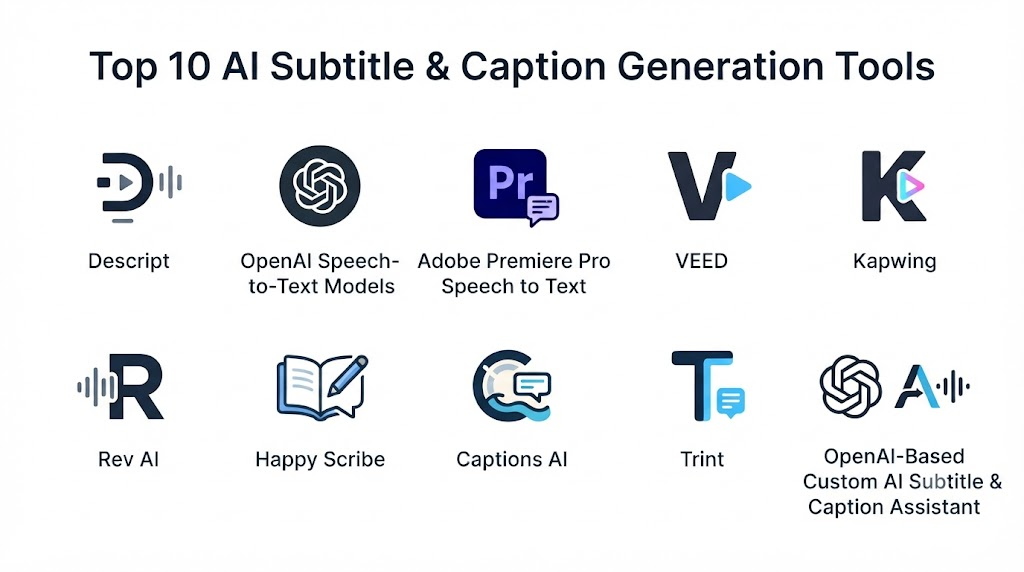
Top 10 AI Subtitle & Caption Generation Tools
1. Descript
Verdict: Best overall AI subtitle and caption generation platform.
Short Description: Descript combines AI transcription, subtitle generation, audio editing, video editing, speaker identification, and collaborative content production.
Key Features
- Speech-to-text
- Subtitle generation
- Audio editing
- Video editing
- Speaker identification
Pros
- Excellent transcription accuracy
- Strong editing capabilities
- Easy collaboration
Cons
- Advanced enterprise features require higher-tier plans
Deployment: Cloud-based platform
Security & Compliance: Enterprise-grade security controls
Integrations & Ecosystem: Video editors, CMS, DAM, collaboration tools
Support & Community: Enterprise and community support
Pricing Model: Subscription-based
Best-Fit Scenarios: Professional multimedia production
2. OpenAI Speech-to-Text Models
Verdict: Best for conversational transcription and subtitle generation.
Short Description: OpenAI provides high-quality speech recognition, multilingual transcription, subtitle generation, and API-driven speech processing for enterprise applications.
Key Features
- Speech recognition
- Transcription
- Subtitle generation
- Multilingual support
- API integration
Pros
- Excellent transcription quality
- Strong developer ecosystem
Cons
- Enterprise workflow customization may require API development
3. Adobe Premiere Pro Speech to Text
Verdict: Best for professional video editing workflows.
Short Description: Adobe Premiere Pro provides AI-powered transcription, subtitle generation, caption editing, and seamless integration with professional video production.
Key Features
- Speech-to-text
- Caption generation
- Timeline editing
- Subtitle styling
- Video editing integration
Pros
- Excellent editing workflow
- Strong Creative Cloud integration
Cons
- Best suited for Adobe users
4. VEED
Verdict: AI-powered online subtitle generation platform.
Short Description: VEED enables automatic subtitle creation, caption editing, multilingual translation, and social media video optimization.
Key Features
- Auto subtitles
- Caption editing
- Translation
- Video editing
- Social media optimization
Pros
- User-friendly interface
- Fast subtitle generation
Cons
- Advanced enterprise workflows are limited
5. Kapwing
Verdict: AI subtitle platform for content creators.
Short Description: Kapwing combines subtitle generation, AI transcription, collaborative editing, and online video production.
Key Features
- Auto captions
- AI transcription
- Subtitle editing
- Video collaboration
- Translation
Pros
- Easy collaboration
- Beginner-friendly
Cons
- Enterprise customization is limited
6. Rev AI
Verdict: Enterprise speech recognition platform.
Short Description: Rev AI provides AI-powered transcription, subtitle generation, speech recognition APIs, and enterprise-scale speech processing.
Key Features
- Speech recognition
- AI transcription
- Subtitle APIs
- Language processing
- Developer tools
Pros
- Strong API ecosystem
- Enterprise scalability
Cons
- Editing workflows require additional tools
7. Happy Scribe
Verdict: AI transcription and subtitle platform.
Short Description: Happy Scribe provides automated transcription, subtitle generation, multilingual translation, and collaborative editing.
Key Features
- Transcription
- Subtitle generation
- Translation
- Speaker identification
- Collaboration
Pros
- Strong language support
- Good editing tools
Cons
- Premium features require higher plans
8. Captions AI
Verdict: AI-powered caption generation platform.
Short Description: Captions AI combines automatic captions, subtitle editing, AI dubbing support, and creator-focused video production.
Key Features
- AI captions
- Subtitle editing
- Video editing
- Translation
- Social media optimization
Pros
- Excellent creator workflows
- Fast editing
Cons
- More creator-focused than enterprise-focused
9. Trint
Verdict: Enterprise transcription and caption platform.
Short Description: Trint enables AI transcription, subtitle generation, collaborative editing, searchable transcripts, and newsroom workflows.
Key Features
- Transcription
- Subtitle generation
- Collaboration
- Searchable transcripts
- Workflow automation
Pros
- Strong enterprise collaboration
- Excellent transcript management
Cons
- Enterprise-focused pricing
10. OpenAI-Based Custom AI Subtitle & Caption Assistant
Verdict: Flexible AI assistant for enterprise transcription and localization.
Short Description: Organizations can build custom AI subtitle and caption assistants using large language models integrated with DAM platforms, CMS systems, Learning Management Systems (LMS), video editing software, media asset management platforms, collaboration tools, and enterprise workflows. These assistants can generate transcripts, subtitles, multilingual translations, accessibility captions, searchable content summaries, and quality review recommendations while supporting human validation before publication.
Key Features
- Automatic transcription
- Subtitle generation
- Translation assistance
- Accessibility support
- Workflow automation
Pros
- Highly customizable
- Flexible enterprise integrations
- Accelerates multilingual content production
Cons
- Human review recommended before publishing
- High-quality source audio improves transcription accuracy
Comparison Table
| Platform | Transcription Accuracy | Subtitle Editing | Multilingual Support | Enterprise Integration | Best Use |
|---|---|---|---|---|---|
| Descript | Excellent | Excellent | High | High | Multimedia Production |
| OpenAI Speech-to-Text Models | Excellent | High | Excellent | High | AI Transcription |
| Adobe Premiere Pro Speech to Text | Excellent | Excellent | High | Excellent | Professional Video Editing |
| VEED | High | High | High | Medium | Online Video Creation |
| Kapwing | High | High | High | Medium | Creator Content |
| Rev AI | Excellent | Medium | High | Excellent | Enterprise APIs |
| Happy Scribe | High | High | Excellent | High | Multilingual Transcription |
| Captions AI | High | High | High | Medium | Social Media Content |
| Trint | High | Excellent | High | Excellent | Enterprise Collaboration |
| OpenAI Custom | Custom | Custom | Custom | Custom | AI Caption Assistant |
Evaluation & Scoring Table
| Platform | AI Capability 20% | Accuracy 20% | Editing 15% | Integration 15% | Security 10% | Ease 10% | Value 10% | Total |
|---|---|---|---|---|---|---|---|---|
| Descript | 20 | 20 | 15 | 14 | 10 | 9 | 9 | 97 |
| OpenAI Speech-to-Text Models | 20 | 20 | 14 | 14 | 10 | 9 | 8 | 95 |
| Adobe Premiere Pro Speech to Text | 19 | 20 | 15 | 15 | 10 | 8 | 8 | 95 |
| VEED | 18 | 18 | 14 | 13 | 9 | 10 | 9 | 91 |
| Kapwing | 18 | 18 | 14 | 13 | 9 | 10 | 9 | 91 |
| Rev AI | 19 | 19 | 12 | 15 | 10 | 8 | 8 | 91 |
| Happy Scribe | 18 | 18 | 14 | 13 | 10 | 9 | 9 | 91 |
| Captions AI | 18 | 17 | 14 | 13 | 9 | 10 | 9 | 90 |
| Trint | 18 | 18 | 15 | 14 | 10 | 8 | 8 | 91 |
| OpenAI Custom | 20 | 18 | 13 | 15 | 8 | 8 | 9 | 91 |
Which AI Subtitle & Caption Generation Platform Is Right for You?
| If your priority is… | Recommended Platform |
|---|---|
| Professional multimedia editing | Descript |
| AI-powered transcription | OpenAI Speech-to-Text Models |
| Professional video production | Adobe Premiere Pro Speech to Text |
| Online video editing | VEED |
| Creator-friendly workflows | Kapwing |
| Enterprise speech APIs | Rev AI |
| Multilingual transcription | Happy Scribe |
| Social media captions | Captions AI |
| Enterprise collaboration | Trint |
| Custom AI subtitle assistant | OpenAI-Based AI Assistant |
Implementation Playbook
First 30 Days
- Identify primary video workflows
- Define accessibility and localization goals
- Select pilot content
- Review language requirements
Days 31–60
- Integrate DAM, CMS, LMS, and video editing platforms
- Configure AI transcription workflows
- Validate subtitle quality
- Train production teams
Days 61–90
- Scale automated caption generation
- Standardize quality review processes
- Optimize multilingual localization
- Measure accessibility improvements
Common Mistakes
- Using poor-quality source audio
- Publishing subtitles without proofreading
- Ignoring speaker identification errors
- Weak translation review
- Limited accessibility testing
- Poor workflow integration
- Inadequate timestamp validation
- Failure to verify technical terminology
Frequently Asked Questions
1. What are AI Subtitle & Caption Generation Tools?
They are AI-powered platforms that automatically transcribe speech, generate subtitles, create closed captions, and translate video content into multiple languages.
2. How does AI generate subtitles?
AI uses automatic speech recognition, language models, and timing algorithms to convert spoken audio into synchronized text captions.
3. Can AI create subtitles in multiple languages?
Yes. Many platforms support multilingual transcription, translation, subtitle localization, and language-specific caption formatting.
4. Which industries use AI subtitle generation platforms?
Media, entertainment, education, healthcare, marketing, advertising, software, publishing, corporate communications, and e-commerce.
5. What data is required?
Video files, audio recordings, language preferences, speaker information, technical terminology, and localization requirements.
6. Can AI generate subtitles for live events?
Many platforms support real-time or near-real-time caption generation for meetings, webinars, live broadcasts, and online events, although performance depends on audio quality and platform capabilities.
7. Do these platforms integrate with enterprise software?
Many integrate with DAM platforms, CMS systems, Learning Management Systems (LMS), video editing software, collaboration platforms, cloud storage, and media production tools.
8. Are AI-generated subtitles always accurate?
Subtitle quality depends on audio clarity, speaker accents, background noise, language complexity, and AI model performance. Human review is recommended before publication.
9. How are transcripts and media assets protected?
Organizations should implement encryption, access controls, secure storage, audit logging, governance policies, and comply with applicable privacy and regulatory requirements.
10. What should companies evaluate before adoption?
Consider transcription accuracy, subtitle synchronization, multilingual support, editing features, integrations, scalability, governance, security, workflow automation, and operational compatibility.
Conclusion
AI Subtitle & Caption Generation Tools are transforming multimedia production by enabling automatic transcription, intelligent subtitle creation, multilingual localization, and scalable accessibility workflows. By combining artificial intelligence, automatic speech recognition, natural language processing, and generative AI, these platforms help organizations improve accessibility, accelerate video production, reduce localization costs, and expand global audience engagement.Organizations implementing AI subtitle and caption generation solutions should prioritize high-quality source audio, robust quality assurance processes, seamless integration with DAM, CMS, LMS, video editing, and media production platforms, continuous review of AI-generated captions, and close collaboration between content creators, localization specialists, accessibility teams, and executive leadership. Platforms such as Descript, OpenAI Speech-to-Text Models, Adobe Premiere Pro Speech to Text, Rev AI, and Happy Scribe demonstrate how artificial intelligence is enabling faster, smarter, and more scalable multimedia localization.
