Introduction
AI Disaster Response Forecasting Tools use artificial intelligence, machine learning, predictive analytics, geospatial intelligence, and real-time data processing to help governments, emergency organizations, and humanitarian agencies predict, prepare for, and respond to natural and human-caused disasters.
Disasters such as floods, wildfires, hurricanes, earthquakes, storms, and extreme weather events can cause significant damage to communities, infrastructure, and ecosystems. Emergency teams often need to make rapid decisions using incomplete and changing information.
Traditional disaster management approaches rely on historical data, weather reports, field observations, and manual analysis. While valuable, these methods may not always provide enough speed or predictive accuracy during fast-changing situations.
AI-powered disaster response forecasting platforms analyze large volumes of data from weather systems, satellites, sensors, geographic information systems, historical events, and real-time monitoring sources to identify risks and support emergency planning.
These tools help organizations:
- Predict disaster risks
- Improve emergency preparedness
- Forecast environmental threats
- Optimize resource allocation
- Support evacuation planning
- Improve response coordination
- Reduce disaster impact
AI disaster response forecasting solutions are used by:
- Government emergency agencies
- Disaster management organizations
- Humanitarian groups
- Climate research organizations
- Insurance companies
- Infrastructure operators
- Smart city programs
Modern platforms combine AI forecasting, satellite analytics, geospatial intelligence, climate modeling, predictive algorithms, and emergency management workflows.
The goal of these solutions is to help organizations anticipate disasters earlier and make faster, data-driven decisions.
How AI Disaster Response Forecasting Works
Data Collection
AI systems analyze:
- Weather data
- Satellite imagery
- Sensor information
- Geographic data
- Historical disaster records
- Climate information
Predictive Modeling
Machine learning identifies:
- Risk patterns
- Environmental changes
- Disaster probability
- Impact areas
Real-Time Monitoring
AI tracks:
- Weather changes
- Ground conditions
- Infrastructure risks
- Population movement
Risk Forecasting
Platforms provide:
- Early warnings
- Risk scores
- Impact predictions
- Emergency recommendations
Response Planning
Organizations use insights for:
- Evacuation planning
- Resource distribution
- Emergency coordination
Common Use Cases
- Flood forecasting
- Wildfire prediction
- Hurricane tracking
- Storm analysis
- Earthquake risk assessment
- Climate risk modeling
- Emergency planning
- Infrastructure protection
- Humanitarian response
- Disaster recovery planning
Why AI Disaster Response Forecasting Tools Matter
Early Warning Capability
AI helps identify risks before disasters escalate.
Faster Emergency Decisions
Organizations can respond using real-time insights.
Better Resource Planning
Teams can position resources before emergencies occur.
Improved Risk Assessment
AI identifies patterns difficult for humans to analyze manually.
Enhanced Community Protection
Forecasting supports better preparedness and response.
Evaluation Criteria for Buyers
Forecast Accuracy
Platforms should provide reliable predictions.
Real-Time Data Processing
Solutions should analyze changing conditions quickly.
Geospatial Intelligence
Tools should support mapping and location-based analysis.
Integration Capability
Important integrations include:
- Weather systems
- Satellite platforms
- GIS systems
- Emergency management platforms
- Sensor networks
Scalability
Solutions should support large geographic areas.
Reliability
Disaster systems require dependable performance.
Data Security
Organizations need secure data handling.
Key Trends
AI-Powered Early Warning Systems
Organizations are using AI to improve disaster prediction.
Satellite-Based Disaster Intelligence
AI is improving analysis of satellite and remote sensing data.
Climate Risk Analytics
Businesses and governments are using AI for climate-related planning.
Real-Time Emergency Intelligence
AI is helping organizations monitor rapidly changing conditions.
Digital Twins for Disaster Planning
Virtual models are being used to simulate disaster scenarios.
Humanitarian AI Applications
Organizations are applying AI to improve disaster relief operations.
Methodology
The following platforms were evaluated using:
- AI forecasting capabilities
- Disaster analytics features
- Real-time monitoring
- Geospatial intelligence
- Integration support
- Ease of use
- Security and reliability
- Support and community
- Price and value
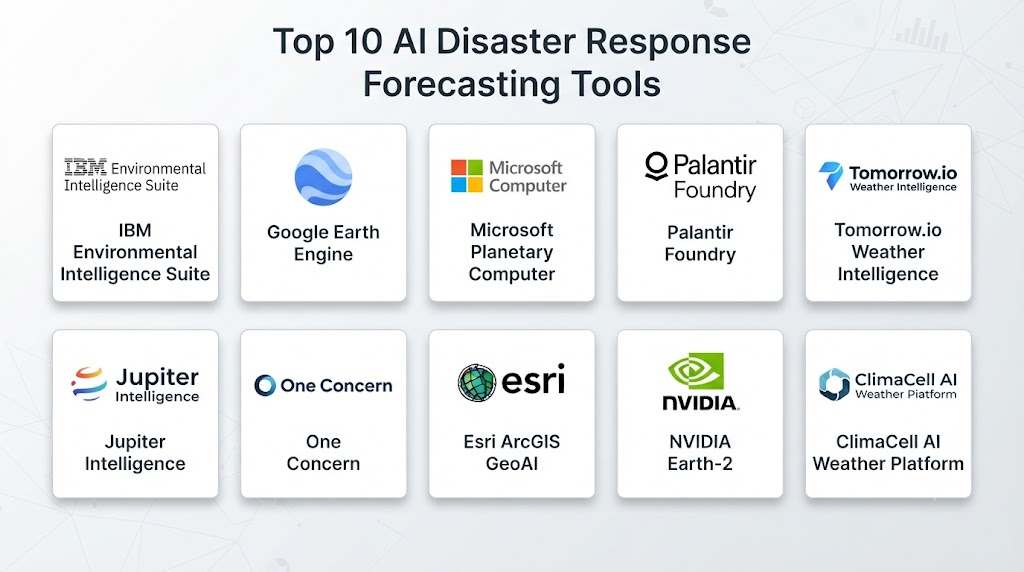
Top 10 AI Disaster Response Forecasting Tools
1. IBM Environmental Intelligence Suite
IBM Environmental Intelligence Suite provides AI-powered environmental monitoring and risk forecasting capabilities.
Key Features
- Weather intelligence
- Environmental monitoring
- AI forecasting
- Climate risk analysis
- Geospatial analytics
- Disaster insights
- Risk dashboards
- Data integration
- Predictive analytics
- Alert management
Pros
- Strong AI analytics
- Enterprise environmental intelligence
- Supports climate risk analysis
- Good integration capabilities
- Scalable platform
Cons
- Enterprise-focused
- Requires implementation
- Complex configuration
Platforms
Cloud-based platform.
Deployment or Support
Cloud deployment.
Security & Compliance
Enterprise security controls.
Integrations & Ecosystem
Weather systems, data platforms, enterprise applications, and analytics tools.
Support & Community
Enterprise support.
2. Google Earth Engine
Google Earth Engine provides geospatial analysis capabilities using satellite and environmental data.
Key Features
- Satellite imagery analysis
- Environmental monitoring
- Geographic analytics
- Climate modeling
- Disaster mapping
- Data processing
- Machine learning models
- Remote sensing
- Visualization
- Research tools
Pros
- Powerful geospatial analytics
- Large environmental datasets
- Strong research capabilities
- Scalable processing
- Global coverage
Cons
- Requires technical expertise
- Data science knowledge needed
- Development effort required
Platforms
Cloud platform.
Deployment or Support
Cloud deployment.
Security & Compliance
Google Cloud security controls.
Integrations & Ecosystem
Satellite data, geospatial systems, and analytics platforms.
Support & Community
Developer and research community support.
3. Microsoft Planetary Computer
Microsoft Planetary Computer provides environmental data and geospatial computing capabilities.
Key Features
- Earth observation data
- Environmental datasets
- Geospatial analytics
- Climate monitoring
- Data processing
- Mapping capabilities
- AI model support
- Research tools
- Cloud computing
- Data exploration
Pros
- Large environmental datasets
- Cloud scalability
- Strong data ecosystem
- Supports research and analysis
- Integration flexibility
Cons
- Requires technical expertise
- Primarily data-focused
- Development effort needed
Platforms
Cloud platform.
Deployment or Support
Cloud deployment.
Security & Compliance
Microsoft cloud security controls.
Integrations & Ecosystem
Geospatial systems, cloud services, and analytics platforms.
Support & Community
Developer community support.
4. Palantir Foundry
Palantir Foundry provides data integration and operational intelligence capabilities for disaster management.
Key Features
- Data integration
- Risk analysis
- Geospatial intelligence
- Scenario modeling
- Operational dashboards
- Decision support
- Workflow management
- Predictive analytics
- Collaboration tools
- Data visualization
Pros
- Strong data integration
- Good operational intelligence
- Handles complex datasets
- Supports emergency planning
- Enterprise scalability
Cons
- Requires expertise
- Complex implementation
- Enterprise-focused
Platforms
Cloud and enterprise platforms.
Deployment or Support
Cloud and private deployment.
Security & Compliance
Enterprise security controls.
Integrations & Ecosystem
Government systems, databases, GIS platforms, and enterprise applications.
Support & Community
Enterprise support.
5. Tomorrow.io Weather Intelligence
Tomorrow.io provides AI-powered weather forecasting and environmental intelligence.
Key Features
- Weather forecasting
- Climate analytics
- Risk alerts
- Weather monitoring
- Predictive models
- API access
- Environmental insights
- Real-time data
- Weather visualization
- Decision support
Pros
- Strong weather intelligence
- Real-time forecasting
- API capabilities
- Useful operational insights
- Scalable platform
Cons
- Weather-focused
- Requires integration
- Data requirements vary
Platforms
Cloud platform.
Deployment or Support
Cloud deployment.
Security & Compliance
Security controls vary.
Integrations & Ecosystem
Weather systems, applications, and operational platforms.
Support & Community
Customer support.
6. Jupiter Intelligence
Jupiter Intelligence provides climate risk analytics and forecasting capabilities.
Key Features
- Climate risk modeling
- Hazard forecasting
- Flood analysis
- Wildfire risk insights
- Risk visualization
- Data analytics
- Scenario modeling
- Decision support
- Reporting
- Climate intelligence
Pros
- Strong climate risk analysis
- Useful hazard modeling
- Supports planning decisions
- Good visualization
- Enterprise capabilities
Cons
- Specialized platform
- Requires climate data expertise
- Enterprise-focused
Platforms
Cloud platform.
Deployment or Support
Cloud deployment.
Security & Compliance
Security controls vary.
Integrations & Ecosystem
Risk systems, analytics platforms, and business applications.
Support & Community
Customer support.
7. One Concern
One Concern provides AI-powered disaster resilience and risk modeling solutions.
Key Features
- Disaster risk prediction
- Digital twin modeling
- Climate risk analytics
- Infrastructure assessment
- Impact forecasting
- Scenario simulation
- Risk visualization
- Emergency planning
- Data analysis
- Decision support
Pros
- Strong disaster modeling
- Focused on resilience planning
- Useful simulations
- Supports infrastructure planning
- AI-driven insights
Cons
- Specialized use cases
- Requires implementation
- Enterprise deployment
Platforms
Cloud platform.
Deployment or Support
Cloud deployment.
Security & Compliance
Security controls vary.
Integrations & Ecosystem
GIS platforms, infrastructure systems, and government tools.
Support & Community
Professional support.
8. Esri ArcGIS GeoAI
Esri ArcGIS GeoAI provides geospatial analytics and AI capabilities for mapping and disaster management.
Key Features
- GIS analytics
- Spatial AI
- Disaster mapping
- Satellite analysis
- Risk assessment
- Geospatial modeling
- Data visualization
- Emergency management tools
- Mapping workflows
- Analytics
Pros
- Strong GIS capabilities
- Widely used mapping platform
- Good disaster management tools
- Extensive ecosystem
- Flexible analytics
Cons
- Requires GIS expertise
- Configuration needed
- Enterprise-focused
Platforms
Cloud and enterprise platforms.
Deployment or Support
Cloud and enterprise deployment.
Security & Compliance
Enterprise security controls.
Integrations & Ecosystem
GIS systems, government platforms, databases, and analytics tools.
Support & Community
Large user community.
9. NVIDIA Earth-2
NVIDIA Earth-2 provides AI-based climate simulation and forecasting capabilities.
Key Features
- Climate simulation
- AI forecasting
- Weather modeling
- Digital twins
- High-performance computing
- Data analysis
- Climate visualization
- Scientific modeling
- AI acceleration
- Research tools
Pros
- Advanced AI computing
- Strong simulation capabilities
- Supports climate research
- High-performance processing
- Innovative technology
Cons
- Requires technical expertise
- Research-focused
- Infrastructure requirements
Platforms
Cloud and computing platforms.
Deployment or Support
Enterprise and research deployment.
Security & Compliance
Security depends on deployment.
Integrations & Ecosystem
AI systems, computing platforms, and research environments.
Support & Community
Developer and research support.
10. ClimaCell AI Weather Platform
ClimaCell provides AI-powered weather intelligence solutions.
Key Features
- Weather forecasting
- Real-time weather data
- Risk alerts
- Weather analytics
- API access
- Environmental monitoring
- Forecast modeling
- Operational insights
- Data visualization
- Decision support
Pros
- Real-time weather intelligence
- Useful APIs
- Operational forecasting
- Scalable cloud platform
- Easy integration
Cons
- Weather-specific
- Requires external integrations
- Scope depends on data
Platforms
Cloud platform.
Deployment or Support
Cloud deployment.
Security & Compliance
Security controls vary.
Integrations & Ecosystem
Weather applications, APIs, and business systems.
Support & Community
Customer support.
Comparison Table
| Tool Name | Best For | Platform(s) Supported | Deployment | Standout Feature | Public Rating |
|---|---|---|---|---|---|
| IBM Environmental Intelligence Suite | Environmental forecasting | Cloud | Cloud | AI climate insights | N/A |
| Google Earth Engine | Satellite analysis | Cloud | Cloud | Geospatial analytics | N/A |
| Microsoft Planetary Computer | Earth data analysis | Cloud | Cloud | Environmental datasets | N/A |
| Palantir Foundry | Disaster operations | Cloud | Hybrid | Data intelligence | N/A |
| Tomorrow.io | Weather forecasting | Cloud | Cloud | Weather intelligence | N/A |
| Jupiter Intelligence | Climate risk | Cloud | Cloud | Risk modeling | N/A |
| One Concern | Disaster resilience | Cloud | Cloud | Impact prediction | N/A |
| Esri ArcGIS GeoAI | GIS disaster analysis | Cloud/Enterprise | Hybrid | Spatial intelligence | N/A |
| NVIDIA Earth-2 | Climate simulation | Cloud | Enterprise | AI modeling | N/A |
| ClimaCell | Weather intelligence | Cloud | Cloud | Forecast APIs | N/A |
Weighted Evaluation
| Tool Name | Core Features 25% | Ease of Use 15% | Integrations & Ecosystem 15% | Security & Compliance 10% | Performance & Reliability 10% | Support & Community 10% | Price/Value 15% | Total |
|---|---|---|---|---|---|---|---|---|
| IBM Environmental Intelligence Suite | 25 | 13 | 14 | 10 | 10 | 10 | 11 | 93 |
| Google Earth Engine | 24 | 11 | 15 | 10 | 10 | 10 | 12 | 92 |
| Microsoft Planetary Computer | 23 | 12 | 15 | 10 | 10 | 10 | 12 | 92 |
| Palantir Foundry | 24 | 11 | 15 | 10 | 10 | 10 | 10 | 90 |
| Tomorrow.io | 23 | 14 | 13 | 10 | 10 | 10 | 12 | 92 |
| Jupiter Intelligence | 23 | 13 | 13 | 10 | 10 | 10 | 11 | 90 |
| One Concern | 24 | 12 | 13 | 10 | 10 | 10 | 10 | 89 |
| Esri ArcGIS GeoAI | 25 | 12 | 15 | 10 | 10 | 10 | 10 | 92 |
| NVIDIA Earth-2 | 24 | 10 | 14 | 10 | 10 | 10 | 10 | 88 |
| ClimaCell Weather Platform | 22 | 14 | 13 | 10 | 10 | 10 | 12 | 91 |
Which AI Disaster Response Forecasting Tool Is Right for You?
Choose IBM Environmental Intelligence Suite when organizations need enterprise environmental forecasting.
Choose Google Earth Engine when satellite and geospatial analysis are priorities.
Choose Microsoft Planetary Computer when environmental data analysis is required.
Choose Palantir Foundry when disaster operations need advanced data integration.
Choose Tomorrow.io when weather forecasting intelligence is the priority.
Choose Jupiter Intelligence when climate risk assessment is required.
Choose One Concern when disaster resilience planning is important.
Choose Esri ArcGIS GeoAI when GIS-based disaster management is needed.
Choose NVIDIA Earth-2 when advanced climate simulation is required.
Choose ClimaCell Weather Platform when operational weather intelligence is needed.
Implementation Playbook
Phase 1: Define Disaster Management Goals
- Identify disaster risks
- Define forecasting requirements
- Select geographic areas
- Establish response workflows
- Set success metrics
Phase 2: Prepare Data Sources
- Connect weather systems
- Integrate satellite data
- Collect historical records
- Configure GIS information
- Establish security controls
Phase 3: Deploy AI Forecasting
- Train predictive models
- Configure risk monitoring
- Generate alerts
- Create dashboards
- Connect emergency workflows
Phase 4: Measure Performance
- Improve prediction accuracy
- Reduce response time
- Monitor forecasts
- Analyze outcomes
- Improve planning
Phase 5: Maintain Disaster Intelligence
- Update models
- Review new risks
- Improve data sources
- Monitor system performance
- Maintain governance
Common Mistakes
- Using outdated data sources
- Ignoring human expertise
- Poor model validation
- Lack of emergency integration
- Over-relying on predictions
- Ignoring local conditions
- Weak data governance
- Not updating AI models
FAQs
1. What are AI Disaster Response Forecasting Tools?
AI Disaster Response Forecasting Tools use artificial intelligence to predict risks, analyze environmental data, and support emergency planning.
2. How does AI help disaster management?
AI analyzes large datasets to identify risks, forecast events, and improve response decisions.
3. Can AI predict all disasters?
No. AI improves forecasting capabilities but cannot eliminate uncertainty.
4. What disasters can AI help forecast?
AI can support flood, wildfire, storm, climate, and environmental risk forecasting.
5. Are these tools used by governments?
Yes. Governments and emergency organizations use AI forecasting for preparedness and response.
6. How accurate are AI disaster forecasts?
Accuracy depends on data quality, models, environmental conditions, and geographic factors.
7. Can AI support evacuation planning?
Yes. AI insights can help organizations analyze risks and plan responses.
8. Do these platforms use satellite data?
Many solutions use satellite imagery and geospatial information.
9. Are AI disaster tools useful for businesses?
Yes. Businesses use them for climate risk assessment and operational planning.
10. What should organizations consider before choosing an AI disaster forecasting tool?
Organizations should evaluate accuracy, data sources, integrations, scalability, reliability, and cost.
Conclusion
AI Disaster Response Forecasting Tools are transforming emergency management by combining artificial intelligence, environmental intelligence, geospatial analytics, and predictive modeling.IBM Environmental Intelligence Suite, Google Earth Engine, Microsoft Planetary Computer, Esri ArcGIS GeoAI, and Tomorrow.io provide powerful forecasting capabilities, while Palantir, One Concern, Jupiter Intelligence, and NVIDIA support advanced disaster planning and simulation.The most effective disaster response strategy combines AI-powered forecasting with experienced emergency teams, reliable data sources, and strong preparedness planning. AI should help organizations anticipate risks earlier and make better decisions to protect communities and infrastructure.
