Introduction
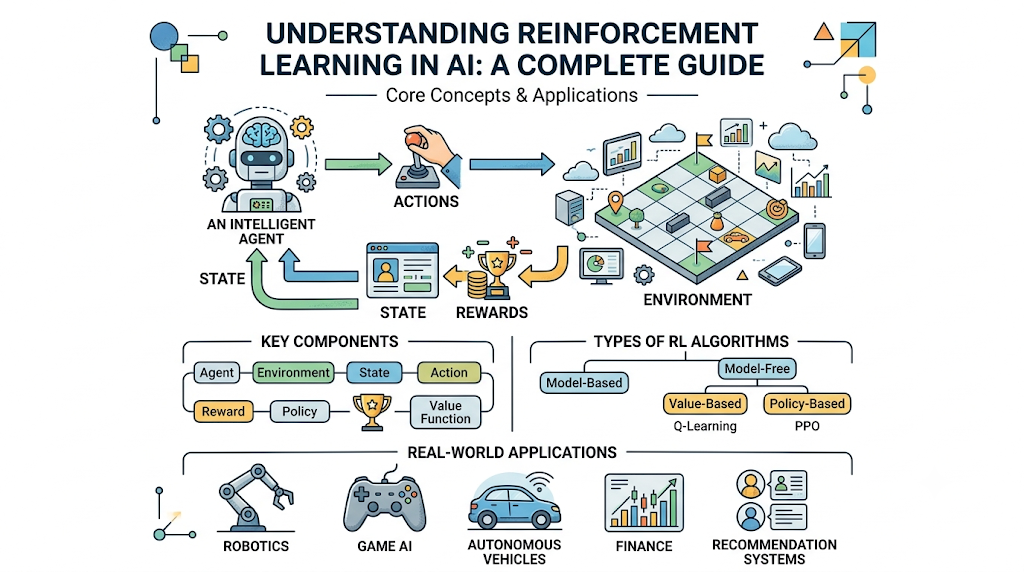
Artificial Intelligence has transformed how machines interact with the world. While classic Machine Learning techniques teach systems using pre-existing datasets or patterns, Reinforcement Learning in AI takes inspiration from biological learning. It mirrors how humans and animals learn: by interacting with an environment, making mistakes, and earning rewards for positive outcomes. From mastering complex strategy games like Go and chess to enabling self-driving cars, power grids, and autonomous robotics, Reinforcement Learning (RL) has driven some of the most remarkable breakthroughs in modern technology. In this comprehensive guide for AIUniverse.xyz, we will break down Understanding Reinforcement Learning in AI. We’ll cover how RL works, its underlying mathematical foundations, real-world industry use cases, key algorithms, and a step-by-step career learning roadmap.
What is Reinforcement Learning?
Reinforcement Learning (RL) is a branch of Machine Learning where an autonomous agent learns to make optimal decisions by interacting with a dynamic environment through trial and error.
Unlike supervised learning, which requires labeled ground-truth answers, an RL system learns strictly through consequences. The agent receives feedback in the form of rewards (positive reinforcement) or penalties (negative reinforcement) based on the actions it performs. Over time, the agent optimizes its choices to maximize cumulative rewards over long horizons.
+---------------------------------------------------+
|                  ENVIRONMENT                      |
|                                                   |
|   State (S_t)  ------>  [ AGENT ]                 |
|   Reward (R_t) ------>  [ AGENT ]                 |
|                                                   |
|                         [ AGENT ] ----> Action(A_t)
+---------------------------------------------------+
An intuitive dynamic is a child learning to ride a bicycle:
- Falling off balance yields a quick penalty (instability or minor scrapes).
- Maintaining balance yields a reward (smooth forward motion).
- Through trial, error, and physical adjustment, the child develops the muscle memory and balance required to ride smoothly—without ever reading a manual on Newtonian physics.
Why Reinforcement Learning is Important in Artificial Intelligence
Traditional AI Models often struggle in unpredictable, continuous environments where static datasets fail to represent real-world complexity. Reinforcement Learning in AI bridges this gap by enabling adaptive, long-term decision-making.
                              +---------------------------------------+
                              |   Reinforcement Learning Advantages   |
                              +---------------------------------------+
                                                  |
       +------------------------------------------+------------------------------------------+
       |                                          |                                          |
       v                                          v                                          v
+-----------------------------+        +-----------------------------+        +-----------------------------+
| Sequential Decision Making  |        | Zero Pre-Labeled Data Needs |        |  Adaptability & Optimization|
| Evaluates multi-step impact |        | Learns directly from trial  |        | Dynamic adjustment to novel |
| rather than single output.  |        | and environmental feedback. |        | dynamic environments.       |
+-----------------------------+        +-----------------------------+        +-----------------------------+
1. Sequential Decision Making
Unlike standard classification tasks that judge isolated inputs, RL evaluates sequential actions over time. It accounts for how an action taken right now affects downstream conditions ten or one hundred steps into the future.
2. Zero Need for Pre-Labeled Historical Data
In scenarios where massive labeled datasets do not exist—such as navigating unexplored terrain or designing complex supply chain paths—an RL agent generates its own experience through environmental interaction.
3. Continuous Adaptability
RL systems dynamically adjust when conditions change. For instance, an RL-driven heating, ventilation, and air conditioning (HVAC) system in a smart building continuously adapts energy consumption based on fluctuating weather, room occupancy, and energy prices.
How Reinforcement Learning Works
The foundational principle of RL rests on the Markov Decision Process (MDP) framework. The agent observes its current situation, chooses an action, observes the environment’s response, and updates its strategy accordingly.
       +-------------------+
       |    Environment    |
       +-------------------+
          /             ^
  State / Reward       Action
        v                 \
       +-------------------+
       |       Agent       |
       +-------------------+
The Exploration vs. Exploitation Dilemma
A fundamental challenge in AI Learning via RL is balancing exploration and exploitation:
- Exploration: Trying unfamiliar actions to discover potentially higher rewards.
- Exploitation: Choosing known actions that reliably deliver the highest historical reward.
Example: Consider visiting a local restaurant. Exploitation means ordering your favorite dish because you know it tastes great. Exploration means trying a brand-new menu item. It might turn out worse, but you might discover an option you enjoy even more. Balancing both strategies is critical for an RL agent to avoid getting stuck in suboptimal routines.
Core Components of Reinforcement Learning
To gain a deep understanding of RL, it helps to break the architecture down into its seven core components:
                          +---------------------------------------+
                          |      Core Components of RL Systems    |
                          +---------------------------------------+
                                              |
       +-------------------+------------------+------------------+-------------------+
       |                   |                  |                  |                   |
       v                   v                  v                  v                   v
+--------------+    +--------------+   +--------------+   +--------------+    +--------------+
|    Agent     |    | Environment  |   |    State     |   |    Action    |    |    Reward    |
| Decision-    |    | The external |   | Current snapshot |  Choices made   | Feedback signal |
| maker/Learner|    | world/system |   | of conditions|   | by the agent |    | (+/- score)  |
+--------------+    +--------------+   +--------------+   +--------------+    +--------------+
                                              |                  |
                                              +---------+--------+
                                                        |
                                                        v
                                             +--------------------+
                                             | Policy & Value     |
                                             | Mapping strategy   |
                                             | & future payoff    |
                                             +--------------------+
| Component | Definition | Real-World Example (Autonomous Car) |
| Agent | The decision-making software entity. | The self-driving AI software system. |
| Environment | The external world or simulator the agent interacts with. | The road, surrounding vehicles, weather, and traffic signals. |
| State ($S$) | The current snapshot or situation of the environment. | Current speed, lane location, distance to nearest car, and traffic light status. |
| Action ($A$) | The set of valid moves or choices available to the agent. | Accelerating, braking, turning left, or turning right. |
| Reward ($R$) | The numerical feedback signal sent back by the environment. | $+10$ for reaching a destination safely, $-100$ for colliding, $-1$ for harsh braking. |
| Policy ($\pi$) | The strategy or brain mapping states to optimal actions. | Rules learned to maintain safe distances and match speed limits. |
| Value Function ($V$) | The predicted long-term cumulative reward from a state. | Estimating overall safety and travel time for selecting Highway A over Local Route B. |
Reinforcement Learning Workflow (Step-by-Step)
The standard loop of Reinforcement Learning in AI follows a clear, iterative process:
+-----------------------------------------------------------------------------------+
|                         REINFORCEMENT LEARNING WORKFLOW                           |
+-----------------------------------------------------------------------------------+
|                                                                                   |
|   Step 1: Initialization ---> Agent sets up policy & state (S_0)                   |
|                                                                                   |
|   Step 2: Action Selection -> Agent picks Action (A_t) based on Policy (π)        |
|                                                                                   |
|   Step 3: Environment Exec -> Environment transitions to State (S_t+1)            |
|                                                                                   |
|   Step 4: Feedback Loop ----> Environment returns Reward (R_t)                    |
|                                                                                   |
|   Step 5: Policy Update -----> Agent updates Value Function/Policy via loss       |
|                                                                                   |
|   Step 6: Iteration ---------> Repeat until convergence or terminal state         |
|                                                                                   |
+-----------------------------------------------------------------------------------+
- Step 1: Initialization — The agent initializes its policy and value estimations randomly or with baseline parameters, receiving an initial state ($S_0$) from the environment.
- Step 2: Action Selection — Based on its current policy and exploration strategy (e.g., $\epsilon$-greedy), the agent chooses an action ($A_t$).
- Step 3: Environment Execution — The environment receives the action, transitions into a new state ($S_{t+1}$), and calculates the immediate reward ($R_t$).
- Step 4: Feedback Reception — The agent reads $S_{t+1}$ and $R_t$.
- Step 5: Policy & Value Update — The agent updates its parameters, refining its policy to favor actions that yielded higher returns.
- Step 6: Iteration — Steps 2 through 5 repeat millions of times until the agent converges on an optimal policy ($\pi^*$).
Types of Reinforcement Learning
RL approaches are generally divided into three operational paradigms:
                                  +------------------------------------+
                                  |     Reinforcement Learning Types   |
                                  +------------------------------------+
                                                    |
        +-------------------------------------------+-------------------------------------------+
        |                                           |                                           |
        v                                           v                                           v
+-------------------------------+           +-------------------------------+           +-------------------------------+
|     Value-Based Learning      |           |     Policy-Based Learning     |           |     Actor-Critic Methods      |
| Maps state-action pairs to    |           | Optimizes policy directly     |           | Hybrid: Actor proposes actions|
| predicted long-term values.   |           | without value function step.  |           | Critic evaluates performance. |
+-------------------------------+           +-------------------------------+           +-------------------------------+
1. Value-Based Reinforcement Learning
The goal is to estimate the expected cumulative reward for states or state-action pairs. The agent chooses the action associated with the highest value.
- Example: Q-Learning creates a lookup table (Q-Table) of values for every state-action combination.
2. Policy-Based Reinforcement Learning
Instead of learning a value function to infer actions, policy-based methods directly optimize the policy function ($\pi(a\vert{}s)$) that maps states directly to probabilities of taking each action.
- Example: REINFORCE algorithm, which works well in continuous action spaces like robotic limb manipulations.
3. Actor-Critic Methods
Actor-Critic architectures combine value-based and policy-based methods into a single unified framework:
- The Actor: Updates the policy based on directional guidance from the critic.
- The Critic: Evaluates the quality of the action taken by calculating value functions.
Popular Reinforcement Learning Algorithms
To build robust AI Applications, developers and Machine Learning Engineers rely on several established RL algorithms:
+---------------------------------------------------------------------------------------------------+
|                                  RL ALGORITHM TAXONOMY                                            |
+---------------------------------------------------------------------------------------------------+
|                                                                                                   |
|   [ Model-Free RL ]                                                                               |
|    |                                                                                              |
|    +---> [ Value-Based ] -------> Q-Learning, Deep Q-Networks (DQN)                              |
|    |                                                                                              |
|    +---> [ Policy-Based ] ------> REINFORCE                                                       |
|    |                                                                                              |
|    +---> [ Actor-Critic ] ------> A2C / A3C, PPO (Proximal Policy Optimization), SAC              |
|                                                                                                   |
|   [ Model-Based RL ] ------------> Dyna-Q, Monte Carlo Tree Search (MCTS / AlphaZero)             |
|                                                                                                   |
+---------------------------------------------------------------------------------------------------+
Q-Learning
A model-free, off-policy tabular algorithm that computes Q-values, representing the quality of taking a specific action in a given state. Suitable for small, discrete state spaces.
Deep Q-Networks (DQN)
Combines traditional Q-Learning with Deep Neural Networks. DQNs replace the Q-table with a deep learning model, enabling AI to process high-dimensional inputs like visual pixels in video games.
Proximal Policy Optimization (PPO)
A policy gradient method developed by OpenAI. PPO balances ease of implementation, sample complexity, and tuning ease by preventing sudden, large policy updates during training. It is widely used in robotics and LLM alignment (RLHF).
Asynchronous Advantage Actor-Critic (A3C)
Uses multiple parallel worker threads interacting with independent instances of an environment simultaneously. This stabilizes neural network training while speeding up performance.
Deep Deterministic Policy Gradient (DDPG)
An actor-critic, off-policy algorithm designed specifically for continuous action spaces, such as controlling physical motors, steering angles, or throttle valves.
Difference Between Reinforcement Learning, Supervised Learning, and Unsupervised Learning
Understanding where RL fits within the broader Machine Learning landscape helps clarify its unique capabilities.
| Feature | Supervised Learning | Unsupervised Learning | Reinforcement Learning |
| Data Source | Labeled training datasets | Unlabeled, raw datasets | Environment interaction logs |
| Primary Goal | Map inputs to targets ($Y = f(X)$) | Find hidden patterns or clusters | Maximize cumulative reward over time |
| Feedback Mechanism | Immediate correction per sample | No explicit feedback or ground truth | Delayed rewards/penalties |
| Decision Type | Static / One-off predictions | Pattern identification | Sequential decision-making |
| Classic Example | Spam email classification | Customer segmentation | Autonomous drone flight |
| Human Intervention | High (manual data labeling) | Low (algorithm finds clusters) | Medium (reward function design) |
Model-Based vs Model-Free Reinforcement Learning
Within Reinforcement Learning Algorithms, another key divide centers on whether the agent builds an internal model of the world:
                                  +------------------------------------+
                                  |     Model-Based vs Model-Free      |
                                  +------------------------------------+
                                                    |
        +-------------------------------------------+-------------------------------------------+
        |                                                                                       |
        v                                                                                       v
+-----------------------------------------------+                       +-----------------------------------------------+
|             Model-Based RL                    |                       |               Model-Free RL                   |
| The agent learns or uses an internal map      |                       | The agent skips internal modeling and directly|
| predicting state transitions and rewards.     |                       | maps states to values or actions.             |
|                                               |                       |                                               |
| * Advantage: Highly sample-efficient.          |                       | * Advantage: Simpler to compute in complex    |
| * Disadvantage: Hard to build accurate models.|                       |   environments.                               |
| * Example: AlphaZero (uses MCTS).             |                       | * Example: Q-Learning, PPO, DQN.              |
+-----------------------------------------------+                       +-----------------------------------------------+
Deep Reinforcement Learning Explained
When environment states become too complex for simple mathematical lookup tables, standard RL reaches its limits. This is where Deep Reinforcement Learning (DRL) comes in.
+--------------------------+       +--------------------------+       +--------------------------+
|  Reinforcement Learning  |   +   |      Deep Learning       |   =   | Deep Reinforcement Learn |
| (Trial-and-Error Engine) |       |  (Perception Neural Nets)|       |  (End-to-End Control AI) |
+--------------------------+       +--------------------------+       +--------------------------+
By connecting Deep Neural Networks—such as Convolutional Neural Networks (CNNs) for vision or Transformers for sequences—DRL enables agents to process raw inputs like video feeds, sensor arrays, or unstructured text.
[ Camera Feed / Raw Pixels ]
           |
           v
+-------------------------------------------------------+
| Deep Neural Network (Feature Extraction)              |
+-------------------------------------------------------+
           |
           v
[ Policy / Action Selection: Steer Left 12° ]
Breakthrough Milestones in Deep RL
- DeepMind’s DQN (2015): Mastered dozens of Atari 2600 arcade games directly from raw visual pixels, often exceeding human performance.
- AlphaGo (2016): Combined Deep RL with Monte Carlo Tree Search to defeat world champion Go player Lee Sedol, a milestone once thought decades away.
- RLHF in Generative AI: Powers modern large language models, training them to give helpful, aligned responses based on human feedback rankings.
Real-World Applications of Reinforcement Learning
Beyond academic benchmarks, AI Applications powered by RL are transforming major industries worldwide.
                                +----------------------------------------+
                                |    Real-World RL Industry Domains      |
                                +----------------------------------------+
                                                    |
     +-------------------+------------------+-------+-----------+--------------------+
     |                   |                  |                   |                    |
     v                   v                  v                   v                    v
+----------+        +----------+       +----------+        +----------+         +----------+
| Robotics |        | Gaming   |       |Healthcare|        | Finance  |         |Vehicles  |
| Precision|        | Complex  |       | Treatment|        | Algorith |         |Dynamic   |
| assembly |        | strategy |       | planning |        | trading  |         | navigation|
+----------+        +----------+       +----------+        +----------+         +----------+
Reinforcement Learning in Robotics
In Robotics AI, training physical hardware in the real world can be slow and risky. Engine teams use physics engines to train robots in simulation first. Through billions of virtual trials, robots learn fine motor skills like picking up fragile objects, walking over rough ground, or assembling components, before transferring those skills to physical hardware.
Reinforcement Learning in Gaming
Game developers use RL to create adaptive non-player characters (NPCs) that adjust to player behavior in real time, rather than relying on scripted routines. Systems like OpenAI Five (Dota 2) and AlphaStar (StarCraft II) showcase how RL agents can coordinate multi-agent teams under partial information.
Reinforcement Learning in Healthcare
In medicine, RL algorithms help optimize long-term treatment plans for chronic conditions. By viewing treatments as actions and patient health indicators as states, RL assists doctors in identifying drug dosages that maximize long-term wellness while minimizing side effects.
Reinforcement Learning in Finance
Financial institutions leverage RL for dynamic portfolio rebalancing, algorithmic execution, and automated risk management. RL agents adapt trading strategies in real time based on market volatility, order book liquidity, and execution costs.
Reinforcement Learning in Autonomous Vehicles
Self-driving systems rely on Deep RL to handle challenging driving scenarios, such as merging onto high-speed highways, making left turns through oncoming traffic, or reacting to unpredictable pedestrian movements.
Benefits of Reinforcement Learning
+------------------------------------------------------------------------------------+
|                         KEY ADVANTAGES OF REINFORCEMENT LEARNING                   |
+------------------------------------------------------------------------------------+
|                                                                                    |
|   1. Long-Term Optimization: Focuses on future returns rather than quick payoffs.  |
|                                                                                    |
|   2. Autonomous Adaptability: Learns directly from changing environments.           |
|                                                                                    |
|   3. Novel Strategy Discovery: Finds unexpected solutions humans might miss.       |
|                                                                                    |
|   4. Unstructured Data Handling: Processes raw visual, temporal, and spatial input.|
|                                                                                    |
+------------------------------------------------------------------------------------+
- Solves Complex, Unstructured Problems: Handles tasks where explicit step-by-step algorithms are impossible to hand-code.
- Discovers Novel Strategies: Uncovers unconventional solutions that human designers might overlook (such as AlphaGo’s famous Move 37).
- Optimizes for Long Horizons: Evaluates delayed returns rather than defaulting to short-term, greedy choices.
- Enables End-to-End Learning: Processes raw sensor signals directly into actuation controls without needing manual feature design.
Challenges and Limitations
Despite its capabilities, RL faces several practical deployment challenges:
                                  +------------------------------------+
                                  |     Core Bottlenecks in RL         |
                                  +------------------------------------+
                                                    |
        +-------------------------------------------+-------------------------------------------+
        |                                           |                                           |
        v                                           v                                           v
+-------------------------------+           +-------------------------------+           +-------------------------------+
|      Sample Inefficiency      |           |     Reward Function Design    |           |       Sim-to-Real Gap         |
| Requires millions of trials   |           | Poor rewards trigger unintended|           | Virtual performance often fails|
| to reach stable policies.     |           | or exploitative agent hacks.  |           | in messy physical worlds.     |
+-------------------------------+           +-------------------------------+           +-------------------------------+
- High Sample Inefficiency: RL algorithms often require millions of interaction steps to learn basic tasks, making real-world training time-consuming and resource-intensive.
- Reward Function Engineering: Designing balanced reward functions is notoriously difficult. If a reward function contains loopholes, the agent may “hack” the system—maximizing its score without actually achieving the intended real-world goal.
- Safety Concerns in Real-World Training: Exploration in physical settings can be dangerous. An autonomous car cannot safely crash thousands of times during its learning phase.
- The Sim-to-Real Gap: Policies that perform well in computer simulations often struggle when deployed in the physical world due to unmodeled friction, lighting variations, or sensor noise.
Popular Tools and Frameworks
Building RL projects requires dedicated libraries, training environments, and execution frameworks:
| Category | Tool / Framework | Purpose & Primary Description |
| Environments | Farama Gymnasium (formerly OpenAI Gym) | The standard API benchmark interface for developing and comparing RL algorithms. |
| Environments | Unity ML-Agents | An open-source plugin that allows games and 3D simulations to serve as training grounds. |
| RL Libraries | Ray RLLib | An enterprise-grade, highly scalable framework for distributed RL workloads across clusters. |
| RL Libraries | Stable-Baselines3 | A set of reliable, clean PyTorch implementations of core RL algorithms. |
| Simulation | NVIDIA Isaac Gym / Lab | High-performance GPU-accelerated physics simulation built for robotics research. |
| Deep Learning | PyTorch & TensorFlow | Foundational neural network libraries used to build deep value functions and policies. |
Career Opportunities in Reinforcement Learning
As industries shift from passive analytics to autonomous decision-making systems, demand for engineers specialized in RL continues to expand.
                          +----------------------------------------+
                          |   Career Paths in Reinforcement Learning|
                          +----------------------------------------+
                                              |
       +-------------------+------------------+-------------------+-------------------+
       |                   |                  |                   |                   |
       v                   v                  v                   v                   v
+--------------+    +--------------+   +--------------+    +--------------+    +--------------+
| AI Research  |    | Robotics     |   | Autonomous   |    | Quantitative |    | MLOps/RL     |
| Scientist    |    | Engineer     |   | Systems Eng  |    | Trader       |    | Architect    |
| Designs next-|    | Builds physical  | Controls     |    | Builds market|    | Scalable     |
| gen algorithms|   | RL controls  |   | self-driving |    | trading agents|   | infrastructure|
+--------------+    +--------------+   +--------------+    +--------------+    +--------------+
Prominent Job Roles:
- Reinforcement Learning Scientist: Researches and designs next-generation RL algorithms, architectures, and theoretical frameworks.
- Robotics AI Engineer: Implements deep RL models onto robotic hardware for motion planning, grasping, and adaptive control.
- Autonomous Vehicle Engineer: Builds decision-making and planning stacks for self-driving cars, delivery bots, and drones.
- Quantitative Trading Developer: Designs automated trading agents that optimize market execution and manage portfolio risk.
- AI Systems Architect (RLOps): Builds scalable compute clusters and pipeline infrastructure to train and serve RL agents in production.
Skills Required to Learn Reinforcement Learning
To succeed in an AI Career focused on RL, you should build a solid foundation across these core areas:
[ Mathematical Foundations ] ---> Probability, Linear Algebra, Multivariable Calculus, MDPs
             |
             v
[ Programming Foundations  ] ---> Python, Object-Oriented Architecture, Data Structures
             |
             v
[ Core Machine Learning    ] ---> Supervised/Unsupervised Deep Learning, PyTorch/TensorFlow
             |
             v
[ Specialized RL Expertise ] ---> Gymnasium, Stable-Baselines3, Reward Shaping, Policy Gradients
- Mathematics & Statistics: Strong grasp of probability, linear algebra, multivariable calculus, and Markov Decision Processes.
- Programming Proficiency: Fluency in Python and object-oriented software design.
- Core Deep Learning: Understanding neural network architectures, backpropagation, optimization techniques, and frameworks like PyTorch or TensorFlow.
- Domain Knowledge: Familiarity with simulation engines (Gymnasium, Isaac Sim, Mujoco) and specialized RL frameworks (Stable-Baselines3, Ray RLlib).
Learning Roadmap for Beginners
If you are starting your journey into AI Education, follow this structured roadmap:
+-----------------------------------------------------------------------------------+
|                        REINFORCEMENT LEARNING LEARNING ROADMAP                    |
+-----------------------------------------------------------------------------------+
|                                                                                   |
|  Phase 1: Foundations (Months 1–2)                                                 |
|  * Master Python, NumPy, Linear Algebra, Probability, Calculus                    |
|                                                                                   |
|  Phase 2: Core ML & Deep Learning (Months 3–4)                                    |
|  * Study Supervised/Unsupervised Learning, Neural Nets using PyTorch               |
|                                                                                   |
|  Phase 3: Classical Reinforcement Learning (Months 5–6)                           |
|  * Learn MDPs, Dynamic Programming, Monte Carlo Methods, Q-Learning               |
|                                                                                   |
|  Phase 4: Deep Reinforcement Learning (Months 7–8)                                |
|  * Build DQNs, Policy Gradients, Actor-Critic models, and use Gymnasium           |
|                                                                                   |
|  Phase 5: Advanced Topics & Portfolio Projects (Months 9+)                        |
|  * Study PPO, SAC, RLHF, and deploy a complete RL project to GitHub               |
|                                                                                   |
+-----------------------------------------------------------------------------------+
Best Practices
When building AI Training pipelines for RL agents, keep these field-tested practices in mind:
- Start with Simplified Baseline Environments: Test your algorithms on standard environments like
CartPole-v1before tackling complex continuous tasks. - Keep Reward Functions Simple: Avoid over-engineering rewards. Complex reward functions can lead to unintended behaviors or reward hacking.
- Normalize Input States and Scale Rewards: Scale state features and keep reward values bounded to maintain stable neural network gradients.
- Use Multiple Random Seeds: RL outcomes can vary between runs. Always evaluate model performance across multiple random seeds to ensure reliable results.
- Track Metrics Beyond Total Reward: Monitor loss curves, average episode lengths, Q-value estimates, and policy entropy to detect instability early.
Common Mistakes Beginners Make
Avoid these frequent pitfalls when starting out with Reinforcement Learning in AI:
+------------------------------------------------------------------------------------+
|                         COMMON BEGINNER PITFALLS TO AVOID                          |
+------------------------------------------------------------------------------------+
|                                                                                    |
|  [X] Skipping Foundations: Jumping directly to Deep RL without understanding MDPs. |
|                                                                                    |
|  [X] Poor Exploration: Misconfiguring epsilon-decay, causing prematurely frozen    |
|      suboptimal policies.                                                          |
|                                                                                    |
|  [X] Underestimating Hyperparameters: Using default learning rates or batch sizes |
|      unsuited for specific RL environments.                                        |
|                                                                                    |
|  [X] Misinterpreting Sample Complexity: Expecting Deep RL models to converge in a  |
|      few hundred iterations instead of millions.                                   |
|                                                                                    |
+------------------------------------------------------------------------------------+
Future Trends of Reinforcement Learning
Looking ahead, several emerging trends are shaping the next generation of Artificial Intelligence:
                                  +------------------------------------+
                                  |        Future Trends in RL         |
                                  +------------------------------------+
                                                    |
        +-------------------------------------------+-------------------------------------------+
        |                                           |                                           |
        v                                           v                                           v
+-------------------------------+           +-------------------------------+           +-------------------------------+
| Multi-Agent Systems (MARL)    |           |   RLHF & Reasoning Alignment  |           | Off-Policy Safe Exploration   |
| Multiple agents collaborate or|           | Fine-tuning LLMs and complex  |           | Guaranteed safety boundaries  |
| compete in shared workspaces. |           | agentic reasoning chains.     |           | for real physical deployments.|
+-------------------------------+           +-------------------------------+           +-------------------------------+
1. Multi-Agent Reinforcement Learning (MARL)
Focuses on training multiple autonomous agents that cooperate or compete within shared environments. Applications include smart traffic grid coordination, swarm robotics, and automated warehouse management.
2. RLHF and LLM Alignment
Reinforcement Learning from Human Feedback remains central to aligning Large Language Models. Future variations emphasize automated feedback loops (RLAIF) and reward-guided reasoning steps to improve accuracy and safety.
3. Safe Reinforcement Learning
Researchers are developing constrained optimization techniques that enforce safety boundaries during exploration. This ensures agents learn effectively without taking dangerous or destructive actions in physical settings.
4. Model-Based Offline RL
Offline RL trains agents on existing historical datasets without requiring live interactions during training. This approach opens up new opportunities in fields where real-time exploration is costly or unsafe, such as healthcare and industrial automation.
Frequently Asked Questions
What is Reinforcement Learning in AI in simple words?
Reinforcement Learning is a way to train AI models by letting them interact with an environment through trial and error. The AI earns rewards for good actions and penalties for bad ones, learning to make better choices over time.
How does Reinforcement Learning differ from Supervised Learning?
Supervised learning trains models on labeled examples with clear correct answers. Reinforcement learning trains agents through direct environment interaction, using delayed rewards rather than explicit correct labels.
What are the main components of a Reinforcement Learning system?
The main components are the Agent (learner), Environment (world), State (current situation), Action (choice made), Reward (feedback score), Policy (strategy mapping states to actions), and Value Function (predicted long-term payoff).
What is Deep Reinforcement Learning?
Deep Reinforcement Learning combines classical RL algorithms with Deep Neural Networks. This allows AI agents to process high-dimensional inputs—such as raw video frames or complex sensor data—and handle complicated environments.
What is the Exploration vs. Exploitation dilemma?
It is the challenge an RL agent faces when choosing between trying new, unfamiliar actions to discover potentially higher rewards (exploration) or choosing known actions that reliably yield high rewards (exploitation).
Is Python required for Reinforcement Learning?
Yes. Python is the primary language used in RL development due to its rich ecosystem of libraries, including PyTorch, TensorFlow, Farama Gymnasium, and Stable-Baselines3.
What is Q-Learning?
Q-Learning is a value-based RL algorithm that computes Q-values to measure the quality of taking a specific action in a given state. It helps the agent identify optimal choices for discrete state-action spaces.
What is RLHF and why is it important?
Reinforcement Learning from Human Feedback (RLHF) is a technique used to fine-tune AI models—such as Large Language Models—using human preference rankings. It helps ensure outputs are helpful, accurate, and safe.
Can Reinforcement Learning be used without a simulator?
While possible through Offline RL, training live agents directly in the real world without a simulator is often slow, expensive, and potentially unsafe. Simulators remain the standard for initial training in most applications.
How long does it take to learn Reinforcement Learning for a beginner?
A beginner with basic programming and math skills can master core RL concepts within 6 to 9 months of consistent study following a structured learning roadmap.
Conclusion
Understanding Reinforcement Learning in AI is key to unlocking the next generation of autonomous decision-making systems. By moving beyond static datasets toward continuous, trial-and-error adaptation, RL enables AI to tackle complex challenges across robotics, gaming, healthcare, finance, and autonomous vehicles. While challenges like sample efficiency and reward engineering persist, advancements in Deep RL, multi-agent systems, and human-aligned model training continue to expand what AI can achieve.
