You open your phone, and it unlocks by looking at your face. You type a message, and it finishes your sentence before you do. You ask a voice assistant a question, and it answers back in seconds.
None of this feels like magic to you anymore. But behind each of these actions, a Deep Learning model is working quietly, using Artificial Intelligence to make sense of data and give you a result.
If you have ever wondered how a computer “learns” to recognize a face or predict a word, this blog is for you. Let’s break it down in simple terms. For more beginner-friendly AI and Deep Learning content, visit AIUniverse.xyz.
What Is Artificial Intelligence?
Artificial Intelligence, or AI, means teaching computers to do tasks that normally need human thinking.
This includes things like recognizing images, understanding language, or making decisions based on data.
Simple example: When your email app sorts spam messages automatically, that’s AI at work. It looks at patterns and decides what’s junk and what’s not.
AI is a broad idea. It covers many methods, and Deep Learning is one of them.
What Is Machine Learning?
Machine Learning is a part of AI. It focuses on teaching computers to learn from data, instead of following fixed rules.
Instead of programming every single rule by hand, you give the computer many examples. The computer studies these examples and learns patterns on its own.
Simple example: If you show a Machine Learning system thousands of emails marked as “spam” or “not spam,” it learns to tell the difference by itself.
Machine Learning is how AI systems get smarter without needing constant human instructions.
What Is Deep Learning?
Deep Learning is a part of Machine Learning. It uses something called neural networks, which have many layers.
These layers help the system learn complex patterns from large amounts of data.
Simple example: A Deep Learning model can look at thousands of photos of cats and dogs. Over time, it learns to tell the two apart, just from patterns in the pixels.
Deep Learning works best when there is a lot of data to learn from.
AI vs Machine Learning vs Deep Learning
These three terms are related, but they are not the same thing.
| Area | Artificial Intelligence | Machine Learning | Deep Learning |
|---|---|---|---|
| Meaning | The broad idea of smart machines | A method to learn from data | A method using neural networks |
| Main idea | Copy human-like decisions | Learn patterns from examples | Learn deep, complex patterns |
| Data use | Varies widely | Needs structured data | Needs large amounts of data |
| Learning style | Rule-based or learned | Learns from past data | Learns through layered networks |
| Common use | Chatbots, automation | Spam filters, recommendations | Image and speech recognition |
Think of it like this: AI is the big goal, Machine Learning is one way to reach it, and Deep Learning is a more advanced version of Machine Learning.
What Are Deep Learning Models?
A Deep Learning model is a system trained to find patterns in data and use those patterns to make predictions.
You feed it data. It studies the data over many rounds. Slowly, it builds an internal understanding of what matters and what doesn’t.
Once trained, the model can look at new data and give a useful output, like identifying an object or predicting a number.
How AI Works Inside Deep Learning Models
The process behind a Deep Learning model follows a few clear steps.
1. Data collection
First, you gather data. This could be images, text, audio, or numbers.
2. Data preparation
Next, the data gets cleaned and organized. Messy or incomplete data can confuse the model.
3. Model training
The model looks at the data again and again, trying to find patterns.
4. Pattern learning
Slowly, the model starts to understand which features matter most.
5. Model testing
The model is tested on new data it hasn’t seen before, to check how well it learned.
6. Prediction
Once trained, the model can make predictions on fresh, real-world data.
7. Model improvement
Over time, the model can be retrained with better or more data to improve its results.
Role of Neural Networks
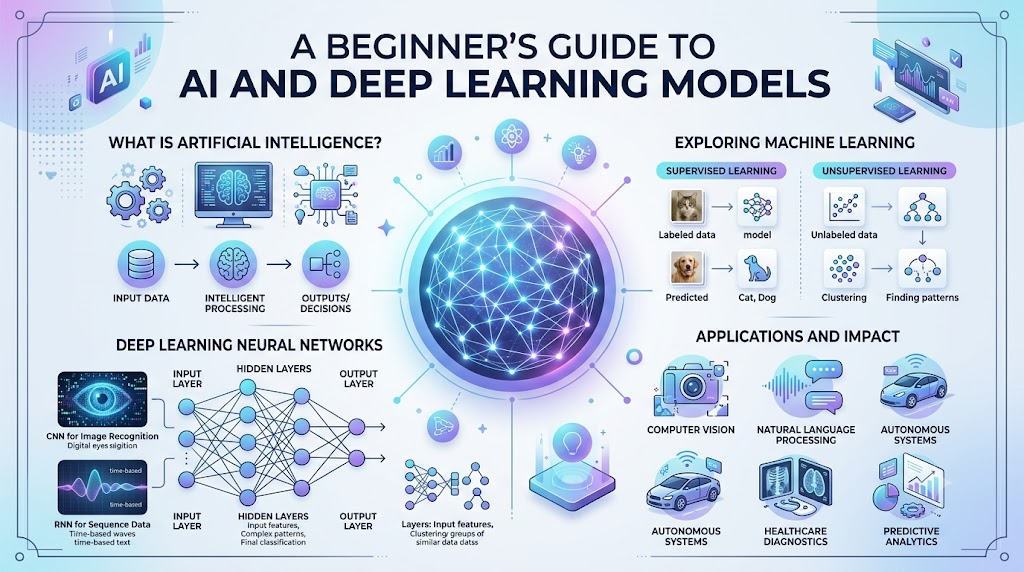
Neural networks are the backbone of Deep Learning. They are loosely inspired by how the human brain works.
A neural network has three main parts:
- Input layer – This is where data enters the model.
- Hidden layers – These layers process the data and find patterns. A “deep” network has many hidden layers.
- Output layer – This gives the final result, like a prediction or a label.
Inside these layers are neurons, which are small units that process small pieces of information. Each connection between neurons has a weight, which tells the model how important that connection is.
Simple example: Imagine a network trying to recognize a handwritten number. Early layers might notice simple shapes like lines and curves. Later layers combine these shapes to recognize the full number.
How Deep Learning Models Learn
Learning happens through repeated practice, much like a student solving many practice problems.
Here’s the basic idea:
- Training data – The model studies many labeled examples.
- Predictions – The model makes a guess based on what it has learned so far.
- Errors – The model compares its guess with the correct answer.
- Loss – This is a number that shows how wrong the guess was.
- Model updates – The model adjusts its internal weights to reduce future errors.
- Repeated training – This process repeats thousands of times, until the model gets better.
Each round of training helps the model make smaller and smaller mistakes.
Role of Data in Deep Learning
Data is the fuel that powers every Deep Learning model.
- Amount of data – More data usually helps the model learn better patterns.
- Data quality – Clean, accurate data leads to more reliable results.
- Training data – This is the data used to teach the model.
- Testing data – This is separate data used to check how well the model learned.
- Clean data – Data free from errors, duplicates, or noise.
- Different types of data – Images, text, audio, and numbers all need different handling.
Poor data can lead to poor results, no matter how good the model design is. This is why data quality matters just as much as the model itself.
Common Types of Deep Learning Models
There are several types of Deep Learning models, each suited to different tasks.
- Artificial Neural Networks (ANNs) – The basic building block, useful for simple pattern recognition.
- Convolutional Neural Networks (CNNs) – Best for image-related tasks, like photo recognition.
- Recurrent Neural Networks (RNNs) – Good for sequences, like text or time-based data.
- Long Short-Term Memory (LSTM) – A type of RNN that handles longer sequences well, like sentences.
- Transformers – Powerful models used in modern language tools, including chatbots and translation systems.
Each model type is built for a specific kind of problem. Choosing the right one depends on the task at hand.
Real-World Uses of AI in Deep Learning
Deep Learning already shows up in many parts of daily life.
- Image recognition – Identifying objects, faces, or scenes in photos.
- Speech recognition – Converting spoken words into text.
- Language translation – Translating text from one language to another.
- Text understanding – Summarizing or analyzing written content.
- Recommendation systems – Suggesting movies, products, or songs you might like.
- Fraud detection – Spotting unusual patterns in financial transactions.
- Medical image analysis – Helping doctors review scans and images.
- Autonomous systems – Supporting self-driving cars and robotics.
These examples show how widely Deep Learning is already used, often without people noticing.
Simple Example: How a Deep Learning Model Recognizes an Image
Let’s walk through a basic example.
An image is given to a Deep Learning model, say a photo of a dog.
The model processes the image through several layers. Early layers pick up simple details, like edges and shapes.
Later layers combine these details into more complex patterns, like ears, fur texture, and body shape.
Finally, the model produces a prediction: “This is a dog,” along with a confidence score.
No complex math is needed to understand this. The model is simply learning to connect small details into a bigger picture.
Why Deep Learning Models Are Useful
Deep Learning models offer several practical strengths.
- Finding patterns in large datasets – They can spot patterns humans might miss.
- Handling complex data – They work well with images, audio, and text.
- Supporting image and speech tasks – Many modern apps rely on this.
- Automating predictions – Once trained, models can make fast predictions.
- Improving results with more useful training data – More quality data often means better accuracy.
These strengths make Deep Learning valuable across many industries, from healthcare to finance to entertainment.
Challenges of Deep Learning Models
Deep Learning is powerful, but it comes with real challenges.
- Large data needs – Good models often need huge amounts of data.
- Training time – Training can take hours, days, or even weeks.
- Computing needs – Powerful hardware is often required.
- Model errors – Models can still make mistakes, especially with new or unusual data.
- Bias in data – If training data is biased, the model’s results can be biased too.
- Difficult model interpretation – It can be hard to explain exactly why a model made a decision.
- Overfitting – Sometimes a model learns the training data too closely and struggles with new data.
- Model maintenance – Models need regular updates as real-world data changes.
Deep Learning models can be difficult to understand because their internal decisions may not always be easy to explain. This issue is widely discussed in research on explainable AI.
AI and Explainability in Deep Learning
Sometimes, people want to know why a model reached a certain result.
For example, if a model rejects a loan application or flags a pattern in a medical image, people naturally want an explanation.
This is where explainability becomes important. Researchers work on ways to make Deep Learning models easier to understand, so their decisions can be reviewed and trusted.
This blog does not offer medical or financial advice. It simply explains why explainability matters in AI systems.
How Deep Learning Models Can Improve Over Time
Models are not static. They can be updated with better data, testing, and fine-tuning.
Feedback from real-world use also helps teams spot where a model struggles.
That said, models do not automatically become better on their own. Improvement takes deliberate effort, testing, and monitoring by the people who manage them.
Best Practices for Learning Deep Learning
If you are just starting out, here are some helpful steps:
- Learn basic AI concepts first.
- Understand Machine Learning basics.
- Learn how neural networks work.
- Practice with small datasets.
- Try simple models before complex ones.
- Study your model’s results carefully.
- Learn from mistakes and errors.
- Move to advanced models step by step.
Going step by step helps you build a strong foundation, instead of feeling overwhelmed early on.
AI, Machine Learning, and Deep Learning: Simple Example
Here’s one example that ties all three ideas together.
AI: The goal is to build a system that can recognize objects in photos.
Machine Learning: The system learns this skill by studying many labeled photo examples.
Deep Learning: A neural network with many layers studies complex visual patterns across thousands of images to get better at this task.
This single example shows how each concept builds on the one before it.
Future of AI and Deep Learning
- Deep Learning will likely keep growing in areas like computer vision, natural language processing, and speech systems.
- Generative AI, which creates text, images, and other content, continues to rely heavily on Deep Learning methods.
- Automation and smarter software tools will likely keep expanding too.
- That said, Deep Learning is not expected to replace all human work. It works best as a tool that supports people, not a full replacement for human judgment.
FAQs
1. What is AI in Deep Learning?
AI in Deep Learning refers to how Artificial Intelligence uses neural networks with many layers to learn patterns and make predictions from data.
2. How are AI and Deep Learning related?
Deep Learning is a specific method within Machine Learning, which itself is a part of AI. It’s one way to achieve AI’s broader goals.
3. What is a Deep Learning model?
It’s a trained system that studies data, learns patterns, and uses those patterns to make predictions or generate results.
4. How does a Deep Learning model learn?
It learns by processing data repeatedly, comparing its guesses to correct answers, and adjusting its internal settings to reduce errors.
5. What role does data play in Deep Learning?
Data is essential. The amount and quality of data directly affect how well a model learns and performs.
6. What are neural networks?
Neural networks are layered systems that process data through input, hidden, and output layers to find patterns, inspired loosely by the human brain.
7. What are some common Deep Learning models?
Common types include Artificial Neural Networks, Convolutional Neural Networks, Recurrent Neural Networks, LSTM networks, and Transformers.
8. Where is Deep Learning used in real life?
It’s used in image recognition, speech recognition, language translation, recommendation systems, fraud detection, and more.
9. What are the main challenges of Deep Learning?
Challenges include needing large amounts of data, long training times, high computing needs, and difficulty explaining model decisions.
10. Is Deep Learning part of AI?
Yes. Deep Learning is a specialized method within Machine Learning, which is itself a branch of Artificial Intelligence.
Conclusion
Artificial Intelligence, Machine Learning, and Deep Learning are connected, but each plays a different role. AI is the broad goal of building smart systems. Machine Learning helps systems learn from data. Deep Learning takes this further, using layered neural networks to find complex patterns.
Understanding this connection helps you make sense of the AI tools you use every day, from face unlock to voice assistants to recommendation systems. As you continue learning, focus on the basics first, then build up to more advanced models step by step.
