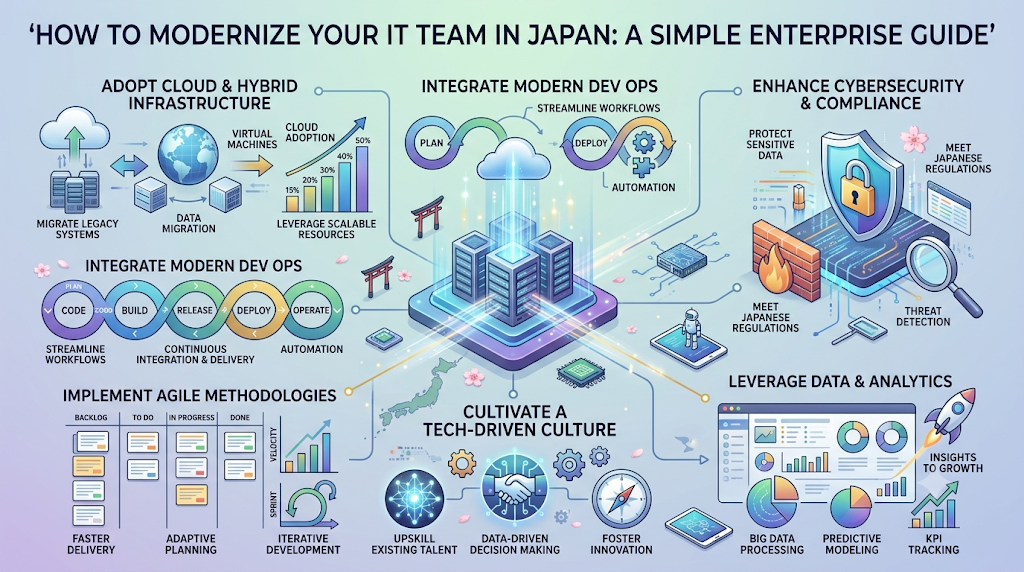
Companies today must update their computer software very fast to stay ahead. Many businesses across Japan now face large skill gaps among their engineering staff. Leaders want to adopt modern cloud tools, but changing old ways of working feels overwhelming. New tools come out every month, and teams often do not know where to start. When projects get complex, delays happen, and mistakes cost money. Because of these challenges, companies need trusted guidance to build strong digital teams. A dedicated technical learning and advisory partner like DevOpsSchool.jp helps Japanese enterprises learn practical skills, fix slow workflows, and build reliable cloud systems with confidence.
What is DevOpsSchool.jp?
DevOpsSchool.jp is a dedicated platform that helps businesses grow their technical skills. It guides companies through three main areas: corporate training, hands-on consulting, and ongoing technical support.
First, the platform provides classroom and online courses for enterprise teams. These courses focus on real-world practice rather than just dry theory. Second, its specialists work side by side with engineering departments. They help companies set up modern cloud tools and fix broken processes. Third, it offers continuous assistance so teams never feel stuck when hard problems arise. In short, it helps companies build better digital products with less stress.
Building Strong Internal Engineering Skills
Software delivery moves very slowly when engineers work in separate, isolated groups. Developers write code, and system operators try to keep servers running. When these two groups do not communicate well, deployments cause errors and delays. Modern engineering practices solve this issue by bringing both teams together.
A structured DevOps corporate training Japan program gives your staff shared practices and clear workflows. Teams learn to write small code changes and test them right away. As a result, software moves from a developer’s laptop to real customers in minutes instead of months. When companies invest in a practical DevOps 研修, their engineers learn to spot bugs early. This hands-on training builds deep confidence across internal teams. Because the lessons use real project examples, your staff can use their new knowledge the very next day.
Hands-On Expert Guidance for Transformations
Changing the way a large enterprise builds software is not simple. Many groups buy shiny software tools but keep their old habits. This mistake leads to wasted budgets and confused workers.
Working with a seasoned DevOps consultant Japan helps your leadership choose the right path forward. These advisors review your current systems, spot bottlenecks, and design clean workflows. They also train team leaders to guide daily work with less friction. Through focused DevOps コンサルティング, companies avoid painful trial-and-error mistakes. Outside experts share proven blueprints from other successful transformations. They help you set realistic targets, track team progress, and protect critical business operations during every phase of change.
Mastering Cloud-Native Infrastructure Tools
Modern computer applications run differently than they did ten years ago. Today, businesses package software into lightweight units called containers. A container holds an application and everything it needs to run properly anywhere.
Managing thousands of containers by hand is impossible. This is where Kubernetes helps. Kubernetes is a system that starts, stops, and heals containers automatically. Enrolling your engineers in a comprehensive Kubernetes 研修 teaches them how to keep apps healthy without manual work.
Next, teams need to build servers and networks quickly without human mistakes. Writing server settings as text files is called infrastructure as code. Through a practical Terraform 研修, engineers learn to launch cloud networks using simple script files. This approach makes server setups safe, repeatable, and easy to audit.
Core Technical Training Tracks
The table below outlines four key learning paths that modern enterprise teams need today.
| Training Domain | Core Tool/Focus | Business Benefit | Target Team |
| DevOps Foundations | CI/CD Pipelines and Git | Releases software updates faster with fewer bugs | Developers and Sysadmins |
| Container Management | Kubernetes and Docker | Scales online applications up or down automatically | Cloud and Platform Engineers |
| Infrastructure as Code | Terraform and Cloud APIs | Sets up safe, repeatable server networks in minutes | Infrastructure and Operations Teams |
| Site Reliability | Monitoring and Error Budgets | Prevents system crashes and preserves client trust | Operations and SRE Engineers |
Ensuring System Reliability and Uptime
When an online business service goes down, companies lose money and user trust. Modern engineering teams use Site Reliability Engineering, or SRE, to keep systems online. SRE uses software rules to handle daily server operations.
Instead of fighting fires, engineers set up automated monitors that spot slow pages before customers notice. They also create error budgets, which help teams balance fast feature releases with stable uptime. Joining an intensive SRE 研修 gives your engineers concrete skills to track system health. Your team learns to build clear dashboards, measure latency, and handle sudden traffic spikes smoothly.
Integrating Security into Daily Delivery
In traditional companies, security reviews happen at the very end of a project. If security inspectors find a serious bug, the entire release gets delayed for weeks. Even worse, hidden vulnerabilities can slip into production systems unnoticed.
Modern teams move security checks into the earliest stages of software creation. We call this practice DevSecOps. An enterprise DevSecOps 研修 teaches developers to scan code for weak spots with every save. Automated tools check third-party libraries for known flaws before code merges. By finding risks early, your engineers save money and protect sensitive business data.
Scaling AI and Machine Learning Pipelines
Many enterprises now build artificial intelligence models to predict trends and automate tasks. However, moving an AI model from a data scientist’s notebook into a live customer product is hard. Models can become inaccurate over time if data changes.
Teams need MLOps to test, package, and deploy machine learning models automatically. A focused MLOps 研修 teaches data teams to build repeatable testing pipelines for their algorithms. Engineers learn to track data versions, retrain models on new information, and monitor live predictions. This automation ensures your company’s smart apps stay accurate and dependable day after day.
Continuous Technical Assistance for Enterprise Teams
Even the best-trained teams encounter strange server bugs and tricky cloud errors. When an outage occurs, your staff needs fast access to experienced specialists who know how to solve tough problems.
Having dependable DevOps support Japan ensures your business always has expert backup. Skilled advisors help your staff review production code, tune cloud databases, and fix broken delivery pipelines. This ongoing safety net keeps your teams moving forward without fear of costly downtime.
Evaluating Training and Consulting Providers in Japan
Choosing the right technical partner requires careful thought. Use this comparison table to evaluate your options.
| Evaluation Factor | What to Look For | Why It Matters for Japanese Enterprises |
| Practical Hands-on Labs | Real cloud sandboxes with interactive exercises | Engineers retain skills better by doing real work rather than watching slides. |
| Bilingual or Local Expertise | Deep knowledge of local enterprise work cultures | Smooth communication prevents misunderstandings during large team changes. |
| Custom Learning Paths | Content tailored to your exact tech stack | Avoids wasting time on generic tools your company does not use. |
| Post-Training Support | Ongoing Q&A, code reviews, and mentorship | Helps engineers apply new skills to production projects without getting stuck. |
Real-Life Scenarios: How Teams Transform
Here is how modern engineering practices solve everyday problems inside real enterprise teams:
- Shifting Legacy Systems to Containers: An enterprise IT department spent days setting up testing servers for every minor release. After hands-on container training, the team packaged its legacy applications into portable Docker images. Now, new testing environments start in under two minutes, saving hundreds of engineering hours every month.
- Automating Slow Manual Deployments: A software team spent entire weekends deploying code updates by hand. Human errors were common, and rollbacks were painful. By introducing automated delivery pipelines, the team now pushes updates during normal work hours with zero downtime.
- Improving Live Platform Stability: An online retail service suffered frequent slowdowns during busy holiday sales. After adopting site reliability engineering principles, the engineers built real-time alert systems and self-healing servers. The platform now handles massive traffic spikes without dropping customer transactions.
Common Mistakes to Avoid in Tech Transformations
Avoid these eight frequent pitfalls when updating your company’s technical workflows:
- Buying Tools Before Training People: Tools cannot fix bad habits. Always train your team on clear workflows before buying expensive software licenses.
- Skipping Hands-On Lab Work: Reading lecture slides does not build real ability. Engineers must practice in live cloud environments to master new concepts.
- Leaving Security for the Final Week: Finding safety flaws right before a major release causes stressful delays. Run automated security tests on every commit.
- Ignoring System Observability: You cannot fix what you cannot see. Set up detailed system dashboards and logging tools from day one.
- Trying to Change Everything at Once: Huge, sweeping changes overwhelm workers. Pick one small application, improve its delivery, and celebrate that early win.
- Treating Ops and Devs as Rivals: When developers and operators blame each other, progress halts. Give both groups shared goals for speed and system uptime.
- Forgetting Automated Testing: Fast delivery pipelines only work if you trust your tests. Write solid automated test suites to catch bugs before users do.
- Neglecting Post-Training Mentorship: Skills fade quickly if engineers do not use them right away. Provide expert backup so teams can safely apply new practices.
How DevOpsSchool.jp Can Help
DevOpsSchool.jp helps enterprises navigate complex cloud transformations with ease. The platform creates custom learning programs designed around your company’s exact technical stack and business targets.
All instructors bring years of real industry experience to every session. They do not just teach theory; they show your staff how to solve actual production problems. Courses feature interactive labs where engineers build real pipelines and cloud networks. Furthermore, delivery formats stay flexible. You can choose private corporate bootcamps, online interactive workshops, or embedded consulting services. With supportive guidance, your teams gain the practical skills needed to drive long-term business success.
A Simple 7-Step Upskilling Roadmap
Follow this clear, step-by-step path to upgrade your engineering capabilities:
- Step 1: Goal — Identify your main business bottlenecks, such as slow releases or frequent server downtime.
- Step 2: Search — Research modern methodologies and specialized technical training platforms that address your specific challenges.
- Step 3: Shortlist — Pick training providers that offer hands-on cloud labs and enterprise consulting services.
- Step 4: Compare — Review course outlines, instructor qualifications, and practical exercises against your team’s current skill gaps.
- Step 5: Ask — Speak with training advisors to see if they can customize their content to match your company’s tech stack.
- Step 6: Verify — Check client testimonials and ask how the provider supports students after formal classes end.
- Step 7: Decide — Select your program, set clear learning dates, and begin your team’s transformation journey.
Frequently Asked Questions
Question 1: What is the main benefit of modern cloud training for enterprises?
Modern technical training helps your engineering staff build, test, and release software faster. It removes manual bottlenecks and reduces costly human mistakes. By learning automated tools, your teams spend less time fixing emergency bugs and more time building features that delight customers. This investment creates a more agile, confident, and productive workforce across your entire business.
Question 2: How long does a corporate technical training course usually take?
Most corporate training programs run between three to five intensive days, depending on the course depth. Some enterprises prefer half-day sessions spread over two weeks so engineers can balance daily job duties. Weekend workshops and self-paced mentoring options are also common. The final schedule can match your team’s work rhythm and project delivery deadlines.
Question 3: Can our training program use our company’s existing cloud tools?
Yes, corporate learning programs can adapt to your specific technology environment. Instructors can use your preferred cloud platforms, such as AWS, Microsoft Azure, or Google Cloud. Exercises can mirror the tools your engineers use every day. Customizing the course ensures your staff can apply their new skills immediately to their current work assignments.
Question 4: What is the difference between consulting and corporate training?
Corporate training focuses on teaching your employees new technical skills through lectures, demos, and hands-on exercises. Consulting involves outside experts working directly on your infrastructure to fix processes, design systems, and solve immediate problems. Many enterprises choose a hybrid approach, combining both training and advisory services to achieve fast and lasting improvements across their departments.
Question 5: Why is hands-on practice more effective than video lectures?
Watching video lectures teaches concepts, but it does not prepare engineers for real-world server problems. Hands-on labs force students to type commands, configure live networks, and troubleshoot broken code in real cloud sandboxes. This active practice builds muscle memory and deep problem-solving skills, allowing engineers to handle production challenges safely and independently.
Question 6: How do we measure the return on investment for technical training?
You can measure return on investment by tracking key delivery metrics before and after the training program. Look at deployment frequency, lead time for code changes, and mean time to restore broken services. When training succeeds, software releases happen more frequently, customer-reported bugs drop significantly, and teams spend much less time on manual server maintenance.
Question 7: Do our engineers need prior experience before joining advanced classes?
It depends on the specific course track. Foundational classes only require basic programming knowledge or general Linux command-line familiarity. Advanced classes, such as container orchestration or automated infrastructure, benefit from some prior system administration experience. Good training providers offer pre-training study materials so every team member starts the course with equal confidence.
Question 8: How does site reliability engineering help reduce business costs?
Site reliability engineering reduces costs by automating routine operational tasks and preventing expensive system outages. When services go down, businesses lose customer sales and hurt their market reputation. SRE practices establish automated monitors and rapid recovery systems that catch errors early. This keeps web platforms stable while freeing engineers to build valuable business features.
Question 9: What is the best way to keep software secure during fast releases?
The best way is to automate security scans inside your software delivery pipeline. Rather than checking code manually at the end of a project, run automated security checks on every code update. This method spots weak dependencies and risky code instantly. As a result, developers can fix security issues right away without delaying product release schedules.
Question 10: Can non-technical managers participate in these learning tracks?
Yes, managers benefit greatly from foundational overview sessions. These high-level modules explain modern workflows, business benefits, and team communication patterns without requiring managers to write complex code. Understanding these modern methods helps leaders set realistic project deadlines, allocate sensible budgets, and build healthy work cultures where engineering teams can succeed.
Question 11: How do outside advisors help speed up technical transformations?
Outside advisors bring rich experience from many successful projects. They know which common traps cause transformations to stall, and they help you avoid those expensive mistakes. Advisors assess your current bottlenecks, recommend proven tools, and help leaders set realistic milestones. Their objective guidance keeps your projects on schedule and aligned with strategic business goals.
Question 12: How should our enterprise prepare before starting a training track?
Start by identifying the main technical challenges your engineering teams face today. Survey your team to understand their current skill levels and daily frustrations. Ensure attendees have clear time set aside so project work does not interrupt their learning. Finally, share your core business objectives with your training partner so they can tailor the lessons.
Conclusion
Modernizing enterprise software delivery requires a clear balance of educated people, reliable processes, and effective automation tools. By investing in hands-on team learning, your engineers gain the confidence needed to deploy software rapidly and safely. Building solid automated pipelines and adopting modern reliability practices protects your business against costly downtime and security vulnerabilities. Choosing an experienced education and consulting partner ensures your organization avoids common mistakes and reaches its digital goals faster. With the dedicated guidance and practical programs provided by DevOpsSchool.jp, your enterprise can build high-performing engineering teams that drive lasting digital success.
