Navigating the artificial intelligence event calendar can be overwhelming. With hundreds of global gatherings ranging from theoretical machine learning symposiums to enterprise-focused deployment expose, choosing where to invest your travel budget and time requires clear alignment with your professional objectives. Attending the wrong event means walking away with high-level summaries instead of actionable architectural patterns or breakthrough research insights.
Selecting the right conference depends on whether your focus lies in pushing foundational research boundaries, scaling production infrastructure, or evaluating enterprise AI strategies. This article examines the premier artificial intelligence conferences, how they differ in focus and audience, and how to maximize your return on investment when attending.
The Core Categories of AI Conferences
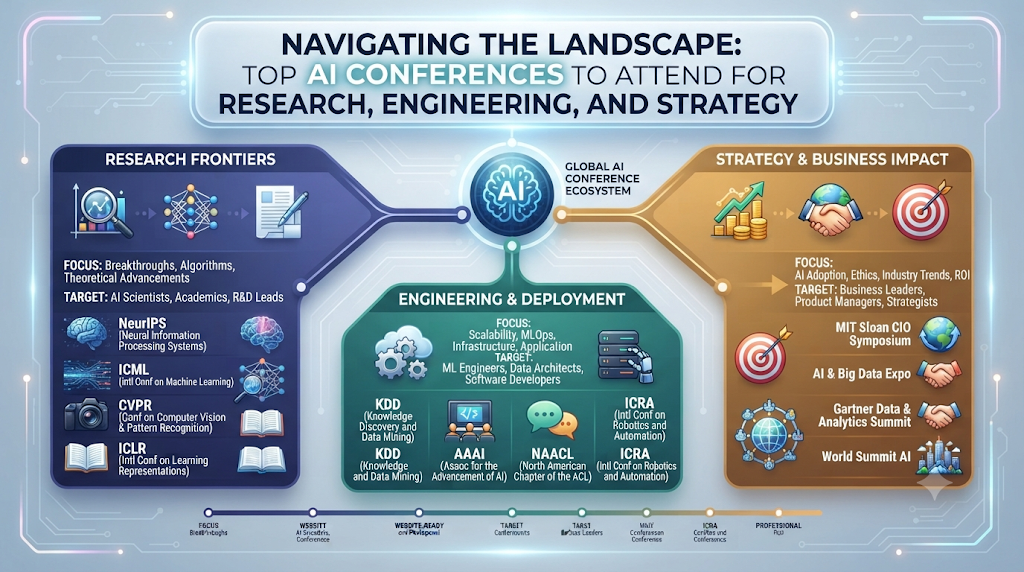
Artificial intelligence events generally fall into three distinct tiers based on their primary audience and content depth.
[ Academic & Research Symposia ] ──> NeurIPS, ICML, ICLR, AAAI
[ Enterprise & Engineering ]     ──> Databricks Data + AI Summit, NVIDIA GTC, AWS Summits
[ Applied Industry & Strategy ]   ──> Ai4, The AI Summit, Gartner Data & Analytics Summit
1. Academic and Research Symposia
Events like NeurIPS (Conference on Neural Information Processing Systems), ICML (International Conference on Machine Learning), and ICLR (International Conference on Learning Representations) represent the gold standard for foundational AI research. These gatherings are designed for research scientists, PhD candidates, and advanced machine learning engineers focused on algorithmic innovation, optimization theory, and neural network architecture design.
2. Enterprise Engineering and Infrastructure Conferences
Conferences such as the Databricks Data + AI Summit, NVIDIA GTC, and cloud-specific developer summits bridge the gap between research and production. Their primary focus is MLOps, vector database scaling, distributed training efficiency, and hardware acceleration. These venues target systems architects, data engineers, and ML platform teams building scalable AI systems.
3. Applied Industry and Strategy Summits
Events like Ai4 or The AI Summit cater to enterprise leaders, Chief Data Officers (CDOs), product managers, and industry operators. Rather than diving into mathematical derivations or code repositories, these conferences focus on return on investment (ROI), regulatory compliance, governance frameworks, and sector-specific adoption case studies in healthcare, finance, and manufacturing.
Evaluating the Major Global AI Events
Choosing specific events requires looking closely at their technical depth, community focus, and structural makeup.
NeurIPS (Conference on Neural Information Processing Systems)
- Best For: Research scientists, algorithmic developers, and deep learning theoreticians.
- Focus: Peer-reviewed papers covering reinforcement learning, large language model scaling laws, computer vision, and cognitive science.
- Trade-offs: Highly academic with limited focus on immediate enterprise deployment or business tooling. Securing a registration spot can be highly competitive.
ICML and ICLR
- Best For: Machine learning researchers and core algorithm developers.
- Focus: ICML covers broad machine learning methodologies, while ICLR focuses specifically on deep learning representations, optimization dynamics, and generative architectures.
- Trade-offs: Expect dense, highly technical poster sessions and oral presentations that require a strong mathematical foundation to fully appreciate.
NVIDIA GTC (GPU Technology Conference)
- Best For: Systems architects, robotics engineers, and hardware-accelerated infrastructure teams.
- Focus: High-performance computing, distributed training clusters, edge AI deployment, and CUDA optimization.
- Trade-offs: Heavily weighted toward hardware ecosystems and proprietary tooling, though essential for understanding the bleeding edge of compute scale.
Databricks Data + AI Summit
- Best For: Data engineers, analytics leaders, and MLOps practitioners.
- Focus: Unified data governance, lakehouse architectures, fine-tuning open-weight models, and scalable data pipelines.
- Trade-offs: Tends to center heavily around specific data tooling ecosystems, though practical architecture takeaways apply broadly.
Maximizing Value: A Pre-Conference Planning Workflow
Simply walking the exhibition hall or attending random keynotes rarely yields professional growth. To extract tangible value from an AI conference, follow a structured preparation workflow:
- Define Your Primary Objective: Determine whether your goal is to source technical solutions to a specific scaling bottleneck, evaluate vendor tools, recruit engineering talent, or absorb new research directions.
- Pre-Filter the Schedule: Review accepted paper lists or session catalogs weeks in advance. Prioritize workshop tracks and lightning talks over generic keynote presentations, which are usually published online later.
- Target Specific Researchers and Engineers: Many conferences publish attendee or speaker directories. Reach out to practitioners whose work aligns with your current projects to schedule brief hallway chats or coffee meetups.
- Prepare Technical Questions: When attending poster sessions or technical talks, avoid generic questions. Bring specific inquiries regarding edge cases, hardware constraints, or training stability observed in your own production environments.
Advantages, Limitations, and When NOT to Attend
Advantages
- Accelerated Learning: Absorb months of developmental progress in a few concentrated days of technical presentations.
- Peer Benchmarking: Discover how engineering teams at other organizations solve similar data scale, latency, or governance problems.
- Direct Access: Engage directly with authors of core open-source libraries or foundational research papers.
Limitations
- High Financial and Time Cost: Registration fees, international travel, and lodging can strain budgets, particularly for smaller organizations.
- Information Overload: The sheer volume of concurrent tracks and high-energy marketing presentations can make it difficult to retain actionable insights.
When NOT to Attend
- Early Exploration Stages: If your organization has not yet defined its data strategy or established a baseline machine learning pipeline, spending resources on advanced research conferences like NeurIPS or ICML will yield low return. Foundational training or internal team alignment should take precedence.
- Purely Budget-Constrained Periods: If travel budgets are tight, virtual developer summits and open-access repositories (such as arXiv and conference video archives) provide 80% of the technical insight at zero financial cost.
Risks, Failure Modes, and Prevention
- Falling for Vendor Hype: Exhibitor floors are heavily populated with marketing teams rebranding traditional analytics as revolutionary artificial intelligence. Prevention: Anchor your schedule in peer-reviewed technical tracks, hands-on developer labs, and independent architectural discussions rather than vendor keynotes.
- The “Tourist” Trap: Wandering aimlessly between sessions without taking structured notes or identifying implementation pathways. Prevention: Assign specific session debrief responsibilities to team members if attending as a group, and mandate a post-conference internal summary presentation.
- Ignoring Localized Meetups: Overlooking smaller, highly targeted local AI meetups or specialized regional workshops in favor of massive global expos that offer less direct networking value. Prevention: Balance large annual conferences with focused, community-driven regional events.
Frequently Asked Questions
Q1. What is the difference between an academic AI conference and an industry AI summit?
Academic conferences like NeurIPS and ICML focus on peer-reviewed theoretical research, novel algorithms, and mathematical foundations. Industry summits like Ai4 or The AI Summit focus on enterprise deployment, business strategy, vendor evaluation, and operational use cases.
Q2. Are academic AI conferences accessible to software engineers without a research background?
While engineers can attend, papers presented at top-tier research symposia require a strong background in probability, linear algebra, and machine learning theory. Engineers focused purely on application development and MLOps often find greater value at infrastructure-focused developer summits.
Q3. How early should one register and book accommodation for major AI conferences?
For major events like NeurIPS, GTC, or the Data + AI Summit, registration and lodging should be secured 4 to 6 months in advance. Early-bird registration windows frequently close months before the event, and nearby hotels sell out rapidly.
Q4. Can virtual passes replace in-person attendance at AI conferences?
Virtual passes are effective for consuming recorded technical talks and keynote presentations at a lower cost. However, they cannot replicate spontaneous hallway networking, deep technical discussions during poster sessions, or hands-on hardware lab access.
Q5. How do I decide which technical sessions to attend when multiple tracks run concurrently?
Prioritize sessions that address immediate technical roadblocks your team is facing or explore emerging paradigms that your roadmap will touch in the next 6 to 12 months. Download presentation slides or recordings for missed sessions to review later.
Q6. What makes an AI conference worth the financial investment for an enterprise team?
An AI conference is worth the investment if your team directly solves a critical architectural bottleneck, establishes partnerships with key technology providers, or recruits specialized talent that would otherwise take months to source.
Q7. Do major AI conferences publish their accepted papers and presentations online?
Yes. Organizations like NeurIPS, ICML, and ICLR maintain open-access digital libraries containing all accepted papers, supplementary materials, and recorded presentations free of charge.
Q8. How can startups maximize their presence at major AI conferences without massive sponsorship budgets?
Startups can leverage academic poster sessions, hackathons, co-located satellite workshops, and informal community networking events to connect with prospective clients, investors, and engineering talent without paying for expensive exhibition booths.
Q9. What are co-located workshops, and why are they important?
Co-located workshops are specialized, smaller-scale sessions held immediately before or after the main conference. They focus on niche sub-domains (such as efficient transformers or AI safety), offering deeper technical discussions and closer interaction with experts than broad main tracks.
Q10. How should attendees follow up after an AI conference concludes?
Compile a centralized summary document or internal slide deck within one week of returning, highlighting key architectural takeaways, tool evaluations, and strategic recommendations. Follow up directly with new professional contacts to share resources or continue discussions.
Conclusion
Choosing the right AI conference requires aligning event focus with your professional goals—whether that means exploring foundational mathematics at research symposia or scaling production workloads at engineering summits. Strategic preparation, careful track selection, and structured internal follow-up transform these gatherings from costly excursions into powerful catalysts for technical and strategic execution.