Last updated: 27 November 2026
To fit artificial intelligence into manufacturing, start with one costly, measurable problem, not a technology. Check that you have data describing it, test a model alongside the current process, and connect its output to a decision someone already makes. Expand only when the result beats your baseline.
AI should slot into the way the plant runs. Existing controls, safety systems and quality procedures stay in charge while the model earns trust. This guide covers where AI fits, how to connect it, how to run a pilot and what to watch for.
How to fit artificial intelligence into manufacturing: the short version
- Name the problem. For example, unplanned stops on one line or escaped defects on one product.
- Measure the baseline. Record current downtime, scrap, rework or planning error.
- Check the data. Confirm that signals, timestamps and outcomes exist and can be linked.
- Pick the simplest method. A rule or control chart may be enough.
- Run in shadow mode. The model predicts, but nobody acts on it yet.
- Move to advice. Operators or engineers decide, and their decisions are logged.
- Scale with ownership. Assign monitoring, retraining, security and rollback before adding lines.
Where AI fits on the factory floor and beyond
NIST researchers published a smart manufacturing roadmap in July 2026 that covers established uses such as sensing, digital twins, robotics and supply chain optimization. It also covers newer approaches, including physics-informed AI, generative AI and foundation models.
The table below is a practical starting comparison. The risk ratings are editorial guidance, and your process may differ.
| Use case | Data you need | Typical method | First metric | Starting risk |
|---|---|---|---|---|
| Predictive maintenance | Vibration, temperature, current, failure and repair history | Anomaly detection or failure prediction | Unplanned downtime, false alarms | Low to medium if advisory |
| Visual inspection | Labeled images under real lighting | Computer vision | Missed defects, false rejects | Medium |
| Process optimization | Settings, material lots, quality results | Regression, physics-informed models | Scrap, yield, energy per unit | High if it changes setpoints |
| Demand and production planning | Orders, inventory, lead times, capacity | Forecasting and optimization | Forecast error, late orders | Low to medium |
| Knowledge assistant | Manuals, procedures, maintenance notes | Language model with document retrieval | Time to find correct answers | Medium, since wrong answers can look convincing |
Match the method to the job
- Fixed rules suit known limits, such as a temperature that must never be exceeded.
- Statistical process control suits stable processes where you want to spot drift.
- Machine learning suits patterns across many variables that are hard to write as rules.
- Generative AI suits text-heavy work, such as searching procedures or drafting shift summaries.
How AI connects to your plant systems
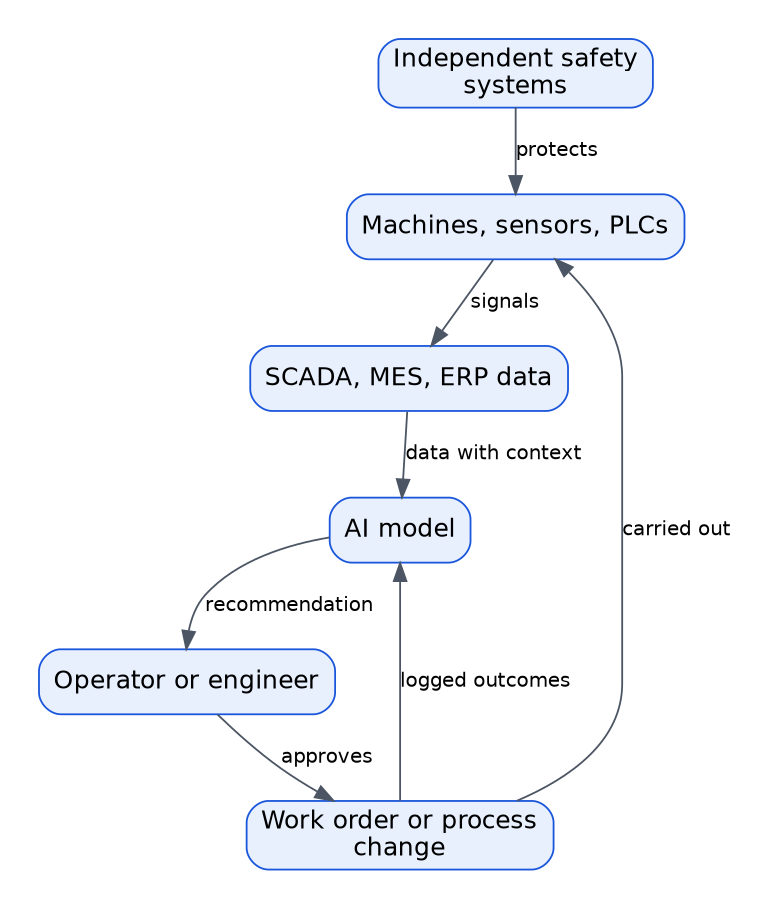
Most plants already have layers of technology. Sensors and programmable logic controllers (PLCs) run machines. SCADA systems supervise them. A manufacturing execution system (MES) tracks production, and ERP handles orders, stock and finance.
An AI project usually reads from several of these layers, then returns a recommendation to one of them. A maintenance warning, for instance, is most useful when it becomes a reviewed work order rather than another dashboard.
Edge, on-site or cloud?
| Location | Good fit | Main trade-off |
|---|---|---|
| Edge device near the machine | Fast inspection decisions, poor connectivity | Many devices to patch and update |
| Plant server | Sensitive data, several lines on one site | You operate the infrastructure |
| Cloud | Model training, multi-site analysis, planning | Network dependence and data transfer controls |
A common mix is to train centrally and run the model close to the process. Decide what happens if the network, server or model fails before you deploy any of these.
Choose a first project that can succeed
A good first project has a frequent problem, a named owner, usable data, a clear action and a low cost if the model is wrong. Rare failures are hard starting points because there are few examples to learn from or test against.
Estimate value before building. Here is a hypothetical example for one quarter:
- A line has 6 unplanned stops of 3 hours each, at $2,000 per hour, so the loss is $36,000.
- You assume early warnings could avoid one third of that loss, or $12,000.
- You expect 10 false alarms costing $200 each, or $2,000.
- The estimated benefit is $10,000, before software, hardware, integration and staff time.
If the total cost cannot be recovered in a period your business accepts, choose another problem.
Get your manufacturing data ready
NIST’s manufacturing AI research program points out that data from SCADA, MES, ERP and streaming sensors needs context before intelligent systems can use it reliably. A column of temperatures means little without the machine, product, recipe and time it belongs to.
- Synchronize clocks across machines and systems.
- Use consistent names and units for assets, signals and defect types.
- Link process records to batches or serial numbers.
- Record maintenance actions and inspection outcomes, not only alarms.
- Note sensor replacements, recalibrations and process changes.
- Keep a test set from a later time period that training never sees.
Synthetic data can help where real examples are scarce. NIST notes that its quality and the uncertainty it introduces need to be measured, so still validate against real production data.
Move from pilot to production in stages
Write pass and fail criteria before the pilot starts. Include accuracy, response time, operator workload, running cost and what triggers a shutdown of the model.
| Stage | What the AI does | Evidence needed to advance |
|---|---|---|
| Offline test | Scores historical data | Beats the current method on unseen data |
| Shadow mode | Scores live data with no effect | Holds up across shifts, products and material lots |
| Advisory | Recommends; a person decides | Measured improvement and acceptable false alarms |
| Bounded action | Acts within fixed limits with override | Safety and engineering sign-off, tested fallback |
Many use cases should stay advisory. In production, monitor input data, prediction quality and business results. Version each model and keep a quick route back to the previous version or manual process.
Safety, security and regulation
Protect operational technology
In December 2025, CISA and partner agencies published joint principles for integrating AI into operational technology (OT). The four themes are understanding AI risks, assessing whether a use case belongs in OT, setting up governance and assurance, and building safety and security into AI-enabled systems.
For a plant team, the practical points include:
- Keep a person in the loop rather than letting AI actively control OT infrastructure unchecked.
- Design failsafes so AI can fail without disrupting critical operations.
- Favor designs that send data out of the OT network over giving AI services persistent access into it.
- Ask vendors how AI is embedded in their products, where models are hosted and for a software bill of materials.
- Do not rely on a large language model to make safety decisions.
NIST SP 800-82 Revision 3 is a useful general reference for OT security, although it is not an AI-specific guide.
Check EU rules if you sell or operate there
The EU Machinery Regulation, 2023/1230, applies from 20 January 2027, less than two months from this article’s date of 27 November 2026. Substantial modifications to existing machines after that date can also bring it into play.
The AI Act was amended in 2026 by Regulation (EU) 2026/1744. High-risk obligations for the stand-alone uses listed in Annex III now apply from 2 December 2027, and those for AI in products under Annex I from 2 August 2028.
Machinery is now treated differently: it moved to Section B of Annex I, with AI-specific health and safety requirements to be added to the Machinery Regulation through delegated acts applying from 2 August 2028. Ask qualified compliance staff how this affects your equipment and any AI used to manage workers.
Bring operators and engineers in early
Operators know which sensor drifts, which alarm gets ignored and which workaround never reaches the database. Involve them in labeling data, setting thresholds and designing the screen they will use.
Show why an alert fired where possible, state what action is expected and make disagreement easy to record. Keep manual skills and procedures current so the line can run without the model.
Hands-on exercise: set an inspection threshold
This exercise shows why accuracy alone is not enough. A vision model gives each part a defect score, and you choose the rejection threshold using business costs. The data and costs are invented, and the Python code has not been tested here.
# (model defect score, true label: 1 = defective)
results = [(0.02, 0), (0.10, 0), (0.15, 0), (0.30, 0), (0.35, 1),
           (0.55, 0), (0.60, 1), (0.80, 1), (0.92, 1), (0.97, 1)]

COST_MISS = 40.0          # defective part shipped
COST_FALSE_REJECT = 3.0   # good part rejected

for step in range(1, 10):
    t = step / 10
    missed = sum(1 for s, y in results if y == 1 and s < t)
    false_rej = sum(1 for s, y in results if y == 0 and s >= t)
    cost = missed * COST_MISS + false_rej * COST_FALSE_REJECT
    print(f"threshold={t:.1f} missed={missed} "
          f"false_rejects={false_rej} cost={cost:.0f}")
Worked by hand, thresholds 0.2 and 0.3 give the lowest cost, 6, with no missed defects and two false rejects. Now swap the two costs. The best listed threshold becomes 0.6, with one missed defect and a cost of 3.
The model did not change, but the right decision did. With real data, choose the threshold on a validation set, then confirm it on separate later production data.
Common mistakes and how to fix them
| Problem | Likely cause | What to try |
|---|---|---|
| Great offline results, poor live results | Data leakage or changed conditions | Split by time and compare live inputs with training data |
| Operators ignore alerts | Too many false alarms or no clear action | Retune thresholds and attach a response step |
| Inspection accuracy drops | Lighting, camera position or product changed | Control the imaging setup, relabel and revalidate |
| Pilot never scales | Custom integration and no owner | Standardize data names and interfaces; fund support |
| Benefit cannot be proved | No baseline | Measure before deployment and compare like with like |
FAQ
Do we need to replace old machines?
Not necessarily. Existing controller data or added sensors may be enough for monitoring. Check signal quality, access and safety implications before connecting anything.
Can a small manufacturer use AI?
Yes, if the problem is narrow and worth solving. A packaged inspection or maintenance tool may be more practical than a custom model. Ask who owns the data, how performance is measured and how you can leave the service.
How much data is enough?
There is no universal number. You need examples covering the normal variation and the events you want to detect. Test on unseen periods to find the gaps.
Should AI control machines directly?
Not as a starting point. Begin in shadow or advisory mode. Any automated action needs fixed limits, human override, a tested fallback and safety review, with protective functions kept independent of the model.
What should we do this week?
Pick one recurring loss, name its owner, record its baseline and trace the data from the machine to the final outcome. The gaps you find will define your first task.