Last updated: 27 November 2026
Python is considered the top programming language mainly because it leads TIOBE, one of the most widely cited popularity indexes, and because it combines readable code with a huge role in data science, AI and automation. In the November 2026 TIOBE index, Python rates 20.86%, compared with 8.35% for C++ and 2.42% for JavaScript.
That answer needs one important qualification. Other major measures put JavaScript or TypeScript first. “Top” depends on what is being counted, so this guide explains both why Python wins where it does and where it does not.
Is Python really the top programming language?
It is on some scoreboards. Here is the picture from recent sources, as of late November 2026.
| Source | What it measures | Python | JavaScript | C++ |
|---|---|---|---|---|
| TIOBE, November 2026 | Search-engine-based popularity signals | 1st, 20.86% | 6th, 2.42% | 4th, 8.35% |
| Stack Overflow Developer Survey 2026 | Languages respondents report using | 58.0% | 62.0% | 24.3% |
| GitHub Octoverse 2026 | Contributors by language | 2nd | 3rd | Not in top 3 |
| RedMonk, January 2026 | GitHub pull requests and Stack Overflow activity | 2nd | 1st | Tied 7th |
Python is clearly ahead of C++ in all four. Against JavaScript, the result is split: Python leads in TIOBE and on GitHub contributor rank, while JavaScript leads in the Stack Overflow survey and RedMonk.
TypeScript also matters here. GitHub ranks it first by contributors, ahead of Python. Between September 2025 and September 2026, TypeScript added 3.62 million monthly contributors, Python 3.23 million and JavaScript 1.82 million.
Python’s TIOBE lead is large, but its rating is 2.51 points lower than in November 2025. A popularity lead is not fixed.
What these rankings do not tell you
- TIOBE draws on search results from many sites. It does not measure which language is best or how much code exists in each.
- Stack Overflow reflects the people who answered the survey. Developers can select several languages, so percentages do not add to 100.
- GitHub sees activity on GitHub, not all private or offline software work.
- RedMonk says its goal is not a statistically valid picture of current usage. It looks for signals about future adoption.
Why Python ranks so highly
No ranking proves a single cause. The reasons below are well-grounded explanations based on how the language and its ecosystem work.
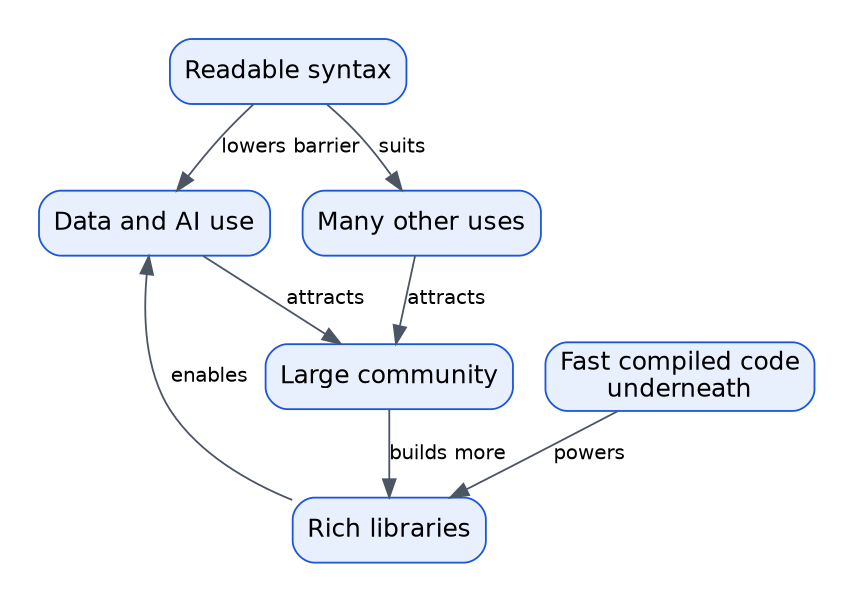
1. The code is easy to read
Python uses indentation to group statements, where JavaScript and C++ use braces. The official design FAQ argues that this keeps what the reader sees in line with what the interpreter does.
Here is a small example that counts the most common words in a piece of text. It has not been tested here.
from collections import Counter

text = "data beats opinion and clean data beats messy data"
counts = Counter(text.split())

for word, total in counts.most_common(3):
    print(f"{word}: {total}")
There are no type declarations, manual memory management or build step in this script. That helps beginners, and also analysts and scientists whose main job is not software engineering.
2. It connects simple syntax to fast compiled code
Plain Python loops are generally slow compared with compiled C++. Many Python programs avoid doing heavy work in those loops. NumPy, for example, runs array operations in precompiled C code.
# Requires: pip install numpy (not tested here)
import numpy as np

prices = np.array([10.0, 12.5, 8.0])
quantities = np.array([3, 2, 5])

revenue = prices * quantities   # element-wise, no Python loop
print(revenue.sum())
You write a short expression, and compiled code does the repetitive part. This pattern lets Python act as a convenient control layer over high-performance libraries.
3. It is central to data and AI work
Libraries such as NumPy, pandas, scikit-learn and PyTorch give Python users a path from loading data to training models in one language. Tutorials, examples and colleagues tend to follow the libraries, which reinforces the choice.
AI coding tools are part of the current picture too. GitHub reports detected AI involvement in about 41.1% of merged pull requests for Python, and 44.1% for TypeScript. That shows heavy AI-assisted activity in both, not that either is better.
4. One language covers many jobs
Python is used for scripts, automation, web back ends, testing, data pipelines, research and teaching. A team can reuse the same skills and tooling across several of these tasks.
5. The language keeps improving
Python 3.15 was released on 9 October 2026. It added lazy imports, a built-in frozendict type and UTF-8 as the default encoding.
It also upgraded the just-in-time (JIT) compiler, which remains experimental. The official notes report a 7 to 8% geometric mean gain on the pyperformance suite on x86-64 Linux over the standard interpreter. Individual results vary widely, including some that are slower.
Python has also offered an optional free-threaded build since 3.13, which can run without the global interpreter lock (GIL). It is not the default. It adds single-threaded overhead, and an extension module not marked as compatible can turn the GIL back on.
Python vs JavaScript vs C++
| Factor | Python | JavaScript | C++ |
|---|---|---|---|
| Typical strength | Data, AI, automation, back ends | Interactive web apps, front and back end | Engines, games, embedded and performance-critical systems |
| Typing | Dynamic, optional type hints | Dynamic, TypeScript adds static types | Static |
| Execution | Interpreted bytecode in standard CPython, experimental JIT | Engines commonly use JIT compilation | Usually compiled ahead of time to native code |
| Raw compute speed | Slower in pure Python, fast libraries help | Often much faster than pure Python | Generally the highest of the three |
| Memory control | Automatic | Automatic | Fine-grained, more responsibility |
| Runs natively in browsers | No | Yes | No, but can target WebAssembly |
| Learning curve | Gentle start | Easy start, some surprising behaviors | Steep |
Where JavaScript is the better choice
If your product lives in a web browser, JavaScript or TypeScript is the natural option. One language can serve both the user interface and the server.
Where C++ is the better choice
Choose C++ when you need predictable latency, tight memory control or direct access to hardware. Many fast libraries that Python users depend on are written in compiled languages, including C and C++. The languages often work together more than they compete.
How to choose a language for your project
- Start with the platform. A browser, a microcontroller and a data notebook have different needs.
- Check the libraries. Confirm that mature, maintained packages exist for your core task.
- Measure before optimizing. Find the slow part first, then decide whether a library or compiled extension solves it.
- Consider your team. Existing skills and code often matter more than ranking position.
- Plan for maintenance. In larger Python codebases, use type hints, tests, a linter and pinned dependencies.
Common mistakes and fixes
- Reading one ranking as the verdict. Compare at least two sources with different methods.
- Looping over large arrays in pure Python. Use vectorized NumPy or pandas operations where they fit.
- Expecting threads to speed up CPU-heavy code. In the default build, the GIL limits parallel Python execution. Try multiprocessing, suitable native libraries, or test the free-threaded build.
- Installing everything globally. Give each project its own virtual environment.
- Upgrading without checking dependencies. Confirm your packages support a new Python version first.
# macOS or Linux (not tested here)
python3 -m venv .venv
source .venv/bin/activate
python -m pip install numpy
Hands-on exercise: see why libraries matter
This short experiment compares a Python loop with a NumPy operation. Run it inside the virtual environment above. It has not been tested here, and your timings will depend on your machine.
import timeit
import numpy as np

n = 1_000_000
data_list = list(range(n))
data_array = np.arange(n, dtype=np.int64)

def loop_version():
    total = 0
    for x in data_list:
        total += x * x
    return total

def numpy_version():
    return int(np.sum(data_array * data_array))

assert loop_version() == numpy_version()

print("loop :", timeit.timeit(loop_version, number=10))
print("numpy:", timeit.timeit(numpy_version, number=10))
Then try three changes. Set n to 10 and compare again. Replace the loop with sum(x * x for x in data_list). Finally, note which version your teammates would find easiest to maintain.
FAQ
Why is Python ranked above JavaScript if more survey respondents use JavaScript?
The rankings count different things. TIOBE relies on search-based signals, while the Stack Overflow survey asks people what they use. In the 2026 survey, JavaScript was at 62.0% and Python at 58.0%.
Is Python faster than C++?
Generally no, for code executed purely in Python. A Python program can still perform well when most of the work happens inside optimized compiled libraries.
Is Python still the top language on GitHub?
No. GitHub’s 2026 report places TypeScript first by contributors, Python second and JavaScript third.
Should a beginner learn Python first?
It is a strong first choice for data, AI and automation. If you mainly want to build websites, start with JavaScript. If you are aiming at game engines or embedded systems, C++ may be worth the steeper climb.
Will Python stay on top?
Nobody can say for certain. GitHub forecasts that TypeScript and Python will each be near 13 million monthly contributors by September 2027, with TypeScript slightly ahead. Treat that as a projection.
Bottom line
Python’s reputation as the top programming language rests on a large TIOBE lead, readable syntax, a deep data and AI ecosystem and wide usefulness. It is not first on every measure, and it is not the right tool for every job. Pick the language that fits your platform, libraries and team.