Introduction
The Certified AIOps Engineer program is a highly specialized learning path designed for technical professionals who want to lead the next generation of IT operations. This guide is built for engineers and managers who recognize that traditional, manual monitoring is no longer sufficient for complex, cloud-native environments. By integrating artificial intelligence and machine learning into the operational lifecycle, you can move from a reactive state of “firefighting” to a proactive state of intelligent system management. This guide provides a clear roadmap to help you evaluate the various certification levels available at aiopsschool and decide which path aligns with your long-term career goals.
What is the Certified AIOps Engineer?
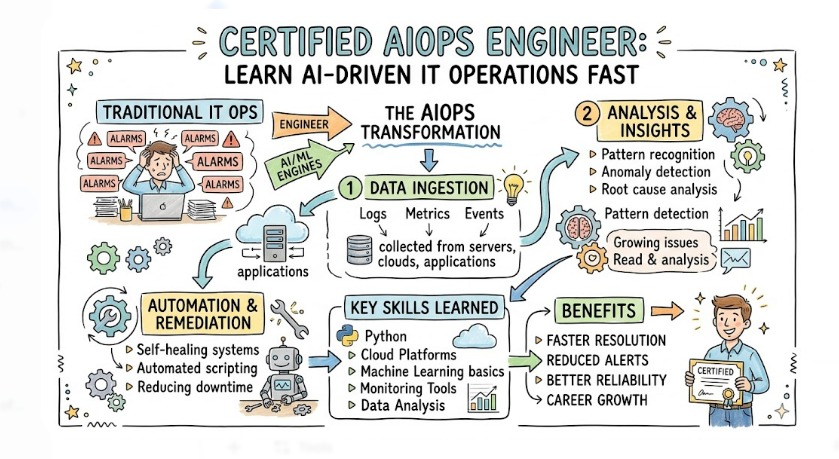
The Certified AIOps Engineer designation represents a mastery of data-driven operations within modern enterprise environments. It exists because the scale of modern telemetry—logs, metrics, and traces—has far surpassed the ability of human operators to process and act upon in real-time. This certification is not just about learning a specific tool; it is about understanding the fundamental logic of algorithmic automation and how it applies to infrastructure health.
It emphasizes a production-focused approach where engineers learn to build systems that can observe, learn, and eventually act autonomously. By aligning with modern engineering workflows, this program ensures that professionals can handle the complexity of microservices and multi-cloud architectures. It validates your ability to transform raw data into actionable business intelligence that improves system reliability and user experience.
Who Should Pursue Certified AIOps Engineer?
This certification is designed for a broad range of technical roles, including DevOps engineers, Site Reliability Engineers (SREs), and Platform Engineers who are responsible for maintaining high-scale systems. Cloud architects and infrastructure leads will also find immense value in learning how to design self-healing environments. Security professionals can use these principles for better anomaly detection and threat hunting across massive datasets.
Even for engineering managers and technical leaders, this certification provides the strategic oversight needed to lead digital transformation initiatives. Whether you are a beginner looking to enter the field of intelligent automation or a seasoned expert wanting to validate your skills, this guide is applicable. It holds significant relevance for the tech-heavy Indian market as well as global enterprises looking for elite talent.
Why Certified AIOps Engineer is Valuable and Beyond
In an era where digital services must be available 24/7, the demand for AIOps expertise is at an all-time high. Organizations are moving away from static, rule-based alerts that often lead to alert fatigue and missed incidents. Obtaining this certification ensures that you remain relevant in a job market that increasingly prizes machine learning and data engineering skills within the operations domain.
The longevity of this skill set is high because it focuses on the underlying principles of data science applied to infrastructure. Unlike certifications that focus on a single tool that might become obsolete, the logic of AIOps is universal across all cloud providers and tech stacks. It offers a strong return on career investment by qualifying you for high-paying roles that require a blend of operations and data science knowledge.
Certified AIOps Engineer Certification Overview
The certification program is delivered through a structured online curriculum and is hosted on the primary provider website mentioned in the introduction. It uses a combination of deep-dive video modules, extensive reading materials, and hands-on laboratory exercises to ensure a well-rounded learning experience. The assessment approach is rigorous, testing both conceptual understanding and the practical ability to implement AIOps workflows.
The structure is tiered, allowing learners to progress from basic concepts to advanced architectural design. Ownership of the certification lies with industry experts who continuously update the content to reflect the latest advancements in the field. This ensures that the knowledge you gain is current and immediately applicable to real-world production environments.
Certified AIOps Engineer Certification Tracks & Levels
The program is organized into three primary levels: Foundation, Professional, and Advanced. Each level is designed to build upon the previous one, ensuring a logical progression of skills. Specialization tracks are also available for those who want to focus on specific domains such as SRE-driven automation or FinOps-focused cost optimization using predictive analytics.
The foundation level focuses on terminology and data ingestion, while the professional level dives into model training and automated incident response. The advanced level is reserved for those who must design and govern enterprise-wide AIOps strategies. This tiered approach allows professionals to align their learning with their current job responsibilities and future career aspirations.
Complete Certified AIOps Engineer Certification Table
| Track | Level | Who it’s for | Prerequisites | Skills Covered | Recommended Order |
| 1. Operations Track | Foundation | Associate Engineers | Basic Linux and Ops | Data collection, Alerts | 1. First |
| 2. Engineering Track | Professional | DevOps / SRE | Python, Monitoring | ML Models, Anomaly | 2. Second |
| 3. Architecture Track | Advanced | Technical Leads | Cloud Architecture | System Design, Strategy | 3. Third |
| 4. Analytics Track | Specialist | Data Engineers | SQL, Statistics | Predictive Analytics | 4. Optional |
Detailed Guide for Each Certified AIOps Engineer Certification
Certified AIOps Engineer – Foundation Level
What it is
This certification validates your understanding of the basic concepts of artificial intelligence in operations. It covers the fundamental workflow of how data is collected, cleaned, and prepared for analysis.
Who should take it
It is ideal for junior administrators, support engineers, and fresh graduates who want a solid starting point. It is also great for managers who need to understand the “what” and “why” of AIOps.
Skills you’ll gain
- Understanding the five stages of the AIOps lifecycle.
- Learning how to differentiate between logs, metrics, and traces.
- Identifying the core benefits of event correlation and noise reduction.
- Gaining familiarity with the basic toolset used in modern observability.
Real-world projects you should be able to do
- Setting up a basic telemetry pipeline to collect logs from a web server.
- Creating a dashboard that visualizes system performance in real-time.
- Configuring basic alerting thresholds to reduce redundant notifications.
Preparation plan
- 7-14 days: Read the official study guide and memorize key AIOps terminology.
- 30 days: Complete the online modules and engage in the community forums for clarity.
- 60 days: Conduct basic hands-on labs using open-source monitoring tools.
Common mistakes
- Focusing only on the definitions without understanding how they apply to real systems.
- Skipping the data quality section, which is the most critical part of AIOps.
Best next certification after this
- Same-track option: Certified AIOps Engineer Professional.
- Cross-track option: DevOps Foundation.
- Leadership option: ITIL Foundation.
Certified AIOps Engineer – Professional Level
What it is
This level focuses on the “how” of AIOps, requiring you to implement machine learning models. It validates your ability to automate root cause analysis and incident remediation.
Who should take it
Experienced SREs and DevOps professionals who are actively managing production systems should take this. It is for those who want to build the “self-healing” aspects of an environment.
Skills you’ll gain
- Training and deploying models for pattern recognition in log data.
- Implementing automated event clustering to identify systemic issues.
- Building predictive models for capacity planning and cost forecasting.
- Integrating AIOps insights into existing ITSM and CI/CD tools.
Real-world projects you should be able to do
- Deploying an anomaly detection engine on a microservices cluster.
- Building a system that automatically triggers a rollback when AI detects performance degradation.
- Automating the creation of incident tickets with pre-filled root cause data.
Preparation plan
- 7-14 days: Refresh your knowledge of Python and basic statistical models.
- 30 days: Deep dive into specific AIOps algorithms like K-means and decision trees.
- 60 days: Perform advanced lab exercises involving high-volume production datasets.
Common mistakes
- Over-engineering a solution with complex models when simple thresholds would work.
- Failing to validate the accuracy of the model against historical data.
Best next certification after this
- Same-track option: Certified AIOps Engineer Advanced.
- Cross-track option: Kubernetes Administrator (CKA).
- Leadership option: Technical Team Lead Certification.
Certified AIOps Engineer – Advanced Level
What it is
This is the peak certification for architects and leaders responsible for enterprise strategy. It validates your ability to design scalable, secure, and cost-effective AIOps frameworks.
Who should take it
Principal engineers, technical directors, and chief architects who set the operational roadmap for their company. It is for those who handle organizational-level challenges.
Skills you’ll gain
- Designing multi-cloud AIOps architectures that scale globally.
- Establishing governance frameworks for autonomous operations.
- Measuring and communicating the business value and ROI of AIOps.
- Leading cultural shifts toward data-driven operational mindsets.
Real-world projects you should be able to do
- Drafting a complete AIOps transformation roadmap for a Fortune 500 company.
- Designing a centralized data lake for all operational telemetry.
- Implementing a governance policy for AI-driven automated changes.
Preparation plan
- 7-14 days: Study case studies of successful and failed AIOps implementations.
- 30 days: Analyze architectural patterns for high-scale data ingestion and processing.
- 60 days: Create a mock architectural design and present it for peer review.
Common mistakes
- Ignoring the human and cultural factors that can derail an AI initiative.
- Focusing purely on technology without aligning it with business objectives.
Best next certification after this
- Same-track option: AI Ethics and Policy Specialist.
- Cross-track option: Solutions Architect Professional.
- Leadership option: Chief Technology Officer (CTO) Program.
Choose Your Learning Path
1. DevOps Path
For those in the DevOps path, the focus is on integrating AI into the software delivery pipeline. This involves using machine learning to predict build failures and automate the testing of code quality. By mastering these skills, you ensure that the speed of delivery does not compromise the stability of the system. It allows you to create a feedback loop where production data informs the development process automatically.
2. DevSecOps Path
The DevSecOps path emphasizes the use of AIOps for proactive security monitoring and automated response. You will learn to use anomaly detection to identify zero-day threats and unusual access patterns that traditional security tools might miss. This path is essential for protecting modern cloud environments where the attack surface is constantly shifting. It bridges the gap between traditional security and intelligent operations.
3. SRE Path
Site Reliability Engineers use this path to achieve the highest levels of system uptime and performance. The focus is on reducing manual toil by automating repetitive tasks through intelligent systems. You will learn to manage error budgets more effectively by using predictive analytics to foresee potential outages before they occur. It is the definitive path for those who value reliability and high-scale engineering.
4. AIOps Path
This dedicated path is for professionals who want to become pure specialists in the field of intelligent operations. You will dive deep into the mathematics of machine learning and the architecture of high-speed data pipelines. This path prepares you to be the primary consultant and architect for any organization’s AIOps journey. It is the most direct route to becoming an industry-recognized subject matter expert.
5. MLOps Path
The MLOps path focuses on the lifecycle management of the machine learning models themselves. While AIOps uses models to manage systems, MLOps provides the framework to ensure those models are properly trained, deployed, and monitored. This path is critical for any organization that relies on AI for its core business operations. It combines the best of data science, software engineering, and systems operations.
6. DataOps Path
DataOps is the foundation upon which all successful AIOps initiatives are built. This path teaches you how to ensure that the data flowing into your AI models is accurate, timely, and complete. You will learn to apply DevOps principles to data management, including versioning and automated testing of data pipelines. It is a vital role for ensuring that the “intelligence” in your systems is based on high-quality information.
7. FinOps Path
The FinOps path combines financial accountability with operational data to optimize cloud spending. You will learn to use AI to forecast cloud costs and identify areas where resources are being wasted. This path is highly valued by management because it directly impacts the company’s bottom line. It allows engineers to take ownership of the financial impact of their technical decisions using data-driven insights.
Role → Recommended Certified AIOps Engineer Certifications
| Role | Recommended Certifications |
| 1. DevOps Engineer | Foundation, Professional |
| 2. SRE | Professional, Advanced |
| 3. Platform Engineer | Foundation, Professional |
| 4. Cloud Engineer | Foundation, Professional |
| 5. Security Engineer | Professional, Analytics Specialist |
| 6. Data Engineer | DataOps Specialist, Professional |
| 7. FinOps Practitioner | Foundation, FinOps Specialist |
| 8. Engineering Manager | Foundation, Advanced |
Next Certifications to Take After Certified AIOps Engineer
1. Same Track Progression
After reaching the advanced level, the next logical step is to dive deeper into specialized AI niches. This could include deep learning for time-series data or natural language processing for automated log summarization. Staying within the track allows you to maintain your status as a top-tier specialist. It ensures you are the first person a company calls when they face a unique and complex automation challenge.
2. Cross-Track Expansion
Broadening your horizons into related fields like Kubernetes or specific cloud platforms will make you a more versatile professional. Understanding how AIOps interacts with serverless functions or container orchestration gives you a more holistic view of the technical landscape. This expansion prevents you from being limited to a single technology stack and increases your market value. It allows you to apply intelligent operations to a wider variety of environments.
3. Leadership & Management Track
For those who want to transition into leadership, certifications in engineering management are the best next step. You can use your deep technical knowledge of AIOps to lead large-scale digital transformation projects. This path allows you to influence organizational strategy and manage the budgets that fund major automation initiatives. It prepares you for roles like Director of Engineering or VP of Infrastructure.
Training & Certification Support Providers for Certified AIOps Engineer
1. DevOpsSchool
DevOpsSchool is a leading provider of technical training that focuses on the practical application of automation tools. They offer a comprehensive curriculum that helps engineers move from traditional roles into the modern DevOps ecosystem. Their programs are known for being hands-on and instructor-led, providing students with the chance to work on real-world projects. They have a strong community presence and offer ongoing support to their alumni. It is an excellent choice for those who want a structured and interactive learning environment with plenty of peer interaction.
2. Cotocus
Cotocus provides high-end consulting and training services specifically designed for enterprise-level technology adoption. They focus on complex technical challenges and provide tailored learning paths that help organizations upskill their teams quickly. Their instructors are experienced consultants who bring a wealth of practical knowledge to the classroom. The training at Cotocus is highly professional and focused on achieving specific business outcomes. They are well-regarded for their ability to explain difficult concepts in a way that is easy for engineers to understand and implement.
3. Scmgalaxy
Scmgalaxy is a vast repository of technical knowledge and community-driven tutorials for the modern engineer. They offer a wide range of certification preparation materials that are accessible and easy to follow. Their focus is on the tools and methodologies that drive continuous integration and deployment. By participating in their community, you gain access to a wealth of shared experience from professionals around the world. It is a great resource for self-paced learners who want to stay updated on the latest trends in configuration management and automation.
4. BestDevOps
BestDevOps specializes in providing cutting-edge training for engineers who want to stay at the forefront of the cloud-native movement. Their programs are designed to be intensive and high-impact, focusing on the most relevant tools in the industry. They offer a mix of live training and recorded content, making it flexible for working professionals. Their emphasis is on building deep technical competency in areas like containerization and cloud security. It is a go-to provider for those who want to quickly gain the skills needed for high-demand roles in the tech industry.
5. devsecopsschool.com
Devsecopsschool.com is dedicated to the integration of security into the development and operations lifecycle. They recognize that in the modern world, security must be automated and continuous. Their courses provide engineers with the tools and techniques needed to protect complex systems without slowing down delivery. They cover everything from automated vulnerability scanning to cloud security posture management. It is a vital resource for any engineer who wants to specialize in building secure and resilient systems. Their training is practical and focused on real-world threat scenarios.
6. sreschool.com
Sreschool.com focuses exclusively on the principles and practices of Site Reliability Engineering. They offer a deep dive into the methodologies developed by top tech companies to manage systems at scale. Their curriculum covers observability, incident management, and the reduction of operational toil. The training is designed to help engineers think like software developers when solving operational problems. It is the perfect place for those who want to master the SRE role and lead their organization toward higher levels of reliability. Their labs are realistic and highly challenging.
7. aiopsschool.com
Aiopsschool.com is the primary training destination for anyone pursuing the Certified AIOps Engineer designation. They provide the most detailed and up-to-date curriculum available for this specific certification. Their courses are built by industry veterans who have successfully implemented AIOps at a global scale. Students get access to proprietary tools and specialized datasets that are essential for mastering intelligent operations. It is the definitive choice for those who want to lead the next wave of operational transformation. They offer a clear path from foundation to advanced expertise.
12.8. dataopsschool.com
Dataopsschool.com provides specialized training in the discipline of managing data as a product. They teach engineers how to build robust, automated data pipelines that are essential for any AI-driven initiative. Their curriculum bridges the gap between data science and operations, ensuring that the entire data lifecycle is managed effectively. Professionals who train here learn how to ensure data quality and reliability at scale. It is an essential resource for organizations that want to build a truly data-driven culture. Their training is highly relevant for the modern data-heavy environment.
12.9. finopsschool.com
Finopsschool.com is the leader in training for cloud financial management and cost optimization. They provide the skills needed to align cloud spending with actual business value. Their courses teach engineers how to use data and AI to identify cost-saving opportunities and manage complex cloud budgets. As organizations continue to scale their cloud usage, the expertise provided here is becoming increasingly valuable. It is a great choice for those who want to add a strong business and financial dimension to their technical skill set. Their training is practical and focused on ROI.
Frequently Asked Questions (General)
- How difficult is the Certified AIOps Engineer exam for a beginner?
The foundation level is designed to be accessible for beginners, but the professional and advanced levels are significantly more challenging. You will need a strong grasp of both operations and basic data concepts to pass the higher-level assessments.
- How much time should I dedicate to studying every day?
Most successful candidates spend about one to two hours per day over a period of 30 to 60 days. Consistency is more important than long, infrequent study sessions because the material is technical and requires time to absorb.
- Are the certification exams conducted in a proctored environment?
Yes, all exams are proctored online to ensure the integrity and value of the certification. You will need a stable internet connection and a webcam to complete the assessment from your location.
- Is there a specific programming language I should learn first?
Python is the most widely used language in the field of AIOps and machine learning. Having a basic understanding of Python will make it much easier to complete the labs and understand the models.
- What happens if I fail the exam on my first attempt?
Most programs offer a retake policy, though there may be a waiting period before you can try again. It is recommended that you review your score report and focus your additional study on the areas where you were weak.
- Is the certification recognized by large global enterprises?
Yes, the certification is recognized by major companies looking for engineers who can handle the complexity of modern cloud infrastructure. It serves as a strong validation of your skills during the hiring process.
- Does the certification focus more on tools or on theory?
The program strikes a balance between the two. While it teaches the underlying theory of AI and machine learning, it also includes extensive hands-on labs using popular industry tools to ensure practical competency.
- Can I take the certification if I don’t have a background in data science?
Absolutely, the foundation level is specifically designed to teach you the data science concepts you need from scratch. You don’t need a formal degree in data science to succeed in this program.
- How often is the course content updated to reflect new technology?
The content is reviewed and updated at least once a year by industry experts. This ensures that the training remains relevant as new tools and methodologies emerge in the fast-paced AIOps market.
- Is there a discount for groups or corporate teams?
Many training providers offer corporate packages for teams looking to upskill together. You should contact the support team of the provider to inquire about group pricing and custom training options.
- What is the difference between AIOps and traditional monitoring?
Traditional monitoring tells you when something is broken based on fixed rules, while AIOps uses data to predict when something might break and identifies the likely root cause automatically.
- Will this certification help me get a job in India?
Yes, India has a massive demand for skilled DevOps and SRE professionals who understand AI. This certification will significantly differentiate you from other candidates in the local job market.
FAQs on Certified AIOps Engineer
- What are the specific machine learning models covered in the professional track?
The track covers several key models including clustering for event grouping, regression for forecasting, and random forests for classification. You will learn how each model applies to specific operational challenges like anomaly detection and noise reduction.
- How does the certification handle the concept of “black box” AI?
The program emphasizes explainable AI, teaching you how to understand why a model made a specific decision. This is critical for building trust with engineering teams who need to know the reasoning behind automated actions.
- Can I use the skills from this certification with any cloud provider like AWS or Azure?
Yes, the principles of AIOps are cloud-agnostic. While you might use specific cloud tools during the labs, the logic of data ingestion, model training, and incident response applies to all major cloud environments.
- Does the curriculum cover the ethics of automated remediation?
Yes, the advanced level specifically addresses the governance and ethics of allowing AI to make changes to production systems. It teaches you how to implement safety rails and manual review steps where necessary.
- Is there a focus on open-source AIOps tools?
The certification covers a mix of open-source and enterprise-grade tools. This ensures that you are prepared to work in a variety of environments, whether the company uses a custom stack or a vendor-provided platform.
- How does AIOps impact the Mean Time To Resolution (MTTR)?
AIOps significantly reduces MTTR by automating the root cause analysis process. Instead of engineers manually digging through logs, the AI provides the most likely cause immediately, allowing for faster fixes.
- What is the role of a “Human-in-the-loop” in the AIOps workflow?
The certification teaches that while AI handles the data processing, humans are still essential for high-level decision-making and model refinement. It focuses on how AI can augment human intelligence rather than replace it.
- Does the program provide career guidance or job placement assistance?
Most providers offer career resources, including resume reviews and interview preparation specifically for AIOps roles. They also have networks with hiring partners who are looking for certified professionals.
Conclusion
As someone who has navigated the technical landscape for many years, I can tell you that the most successful engineers are those who anticipate where the industry is going. The shift toward AIOps is one of the most significant changes in the history of IT operations. It is not just about adding a new tool to your belt; it is about adopting a completely new way of thinking about system health and reliability.
Is the certification worth it? If you want to work on the most challenging and interesting problems in tech, the answer is a resounding yes. It provides you with a unique blend of skills that are in incredibly high demand but in very short supply. By becoming a Certified AIOps Engineer, you are not just getting a piece of paper; you are gaining a strategic advantage that will serve you for the rest of your career. Take the first step today and start with the foundation level—your future self will thank you for it.
