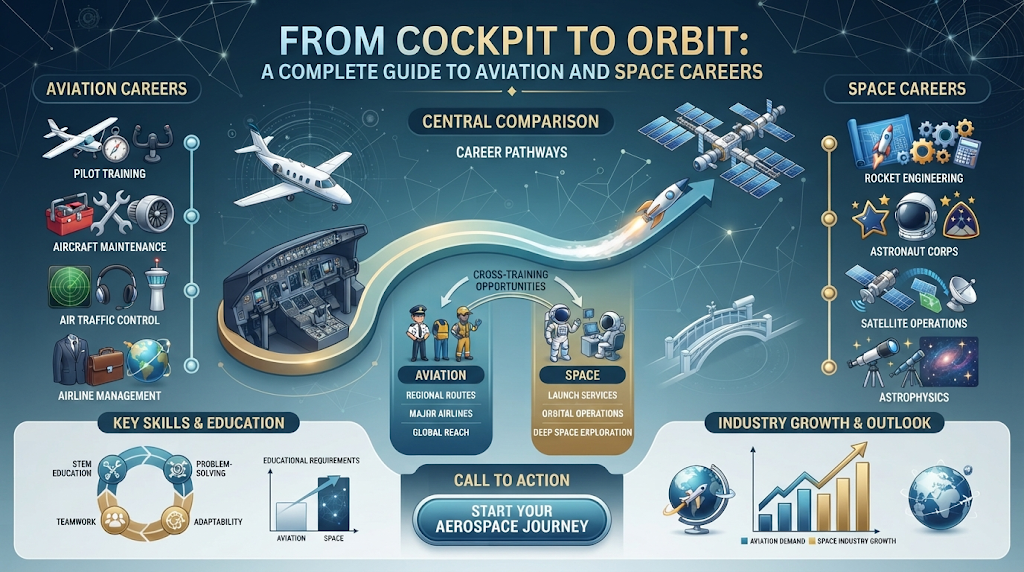
Imagine sitting in a classroom or at your desk, looking at two very different dreams. On one side, you picture yourself in a commercial cockpit, guiding a passenger jet safely across continents. On the other side, you imagine floating inside an orbital laboratory, working hundreds of kilometers above Earth. Both paths demand discipline, sharp thinking, and technical skill, yet they follow completely separate training systems. At AstroPilot, we break down aviation and space education so students and career seekers can explore both worlds with clarity.
Understanding how to become an airline pilot alongside how to become an astronaut helps you plan your studies, finances, and timeline realistically. You do not need an engineering degree or prior flying experience to read this guide. Everything here starts from the ground up. You will learn how flight works, how pilot licenses build upon one another, what space agencies look for in candidates, and how to use tools like flight simulators wisely.
Understanding the Core Concepts of Flight and Space
Before looking at rules or career steps, it helps to separate how airplanes fly from how spacecraft travel.
How Airplanes Stay Aloft
Aviation covers everything involved in building, flying, and maintaining aircraft. Most commercial airliners use fixed wings shaped to create aerodynamic lift as air flows over them. Jet engines push the plane forward, air moves across the wings, and lift holds the aircraft in the sky.
Commercial aviation means flying passengers or cargo for payment. Every airline flight follows strict rules managed by air traffic control (ATC)—specialists on the ground who guide pilots safely through busy skies. Inside the cockpit, two pilots usually share the workload. The Captain holds final command of the flight, while the First Officer assists with flying, navigation, radio calls, and safety checklists.
What Pilot Licenses and Ratings Mean
A pilot license (called a certificate in the United States) is legal permission from a national aviation authority to fly an aircraft. Think of it like a driver’s license, except with stricter medical, written, and practical flight tests.
A rating is an extra skill added to your license. For example, an instrument rating lets you fly inside clouds using cockpit gauges, while a multi-engine rating lets you fly planes with two or more engines.
How Astronauts Work Beyond the Atmosphere
An astronaut is a trained crew member who operates spacecraft, runs science experiments in space, repairs orbital hardware, and supports deep-space missions.
Spaceflight begins where Earth’s atmosphere thins out. Wings cannot generate lift in space because there is no air. Instead, rockets burn fuel to push a spacecraft upward and sideways at tremendous speed. Once in space, gravity and speed govern every movement.
Where Aviation and Spaceflight Meet
Flying an airliner and flying a spacecraft are different jobs, yet they share key habits. Both rely on calm teamwork, clear communication, checklist discipline, and quick problem-solving under pressure. Many early astronauts were military test pilots, and modern space agencies still use aviation-style simulators to train crews.
Why Learning Aviation and Space Fundamentals Matters
Even if you have not chosen a final career yet, learning how flight and space systems work builds strong lifelong skills.
- Clearer career planning: Knowing the exact steps prevents wasted money on the wrong courses or unrealistic expectations.
- Stronger STEM habits: Aviation and space concepts turn abstract school math and physics into real, practical tools you can see in action.
- High-reliability mindset: Aviation has one of the best safety records in modern transport because crews follow structured procedures and learn from every mistake.
- Awareness of new technology: Electric test aircraft, smarter cockpit displays, reusable rockets, and commercial space stations are actively changing how humans travel.
Keep one truth in mind from day one: earning a degree or a license opens doors, but it never guarantees a job or spaceflight seat. Preparation, health, timing, and persistence all matter.
A Practical Roadmap: How to Become an Airline Pilot
Airline hiring rules and flight hours vary by country. Always check the official website of your local authority—such as the FAA in the United States, DGCA in India, EASA in Europe, UK CAA in the United Kingdom, Transport Canada in Canada, or CASA in Australia—before spending money on training.
Here is the standard ten-step progression most airline pilots follow:
- Confirm your target country’s rules: Choose where you have the legal right to work and study that country’s licensing system.
- Pass an aviation medical exam first: Visit an approved aviation medical examiner early to verify your eyesight, hearing, and general health meet pilot standards.
- Complete student pilot registration: Apply for student pilot clearance or a student license so you can legally fly solo during training.
- Earn your Private Pilot License (PPL): Learn basic aircraft control, takeoffs, landings, weather reading, and navigation between airports.
- Add an Instrument Rating (IR): Train to fly safely in clouds, rain, or low visibility by trusting your cockpit instruments.
- Earn your Commercial Pilot License (CPL): Sharpen your flying precision and pass advanced exams so you can legally be paid to fly.
- Add a Multi-Engine Rating (ME): Learn how to handle larger aircraft with two or more engines, including emergency procedures if one engine fails.
- Build flight hours and real experience: Gain the total flying time airlines require, often by working as a certified flight instructor or flying regional charter routes.
- Meet Airline Transport Pilot License (ATPL) standards: Complete advanced airline theory exams and accumulate required multi-crew and cross-country experience.
- Apply for airline assessments: Prepare for technical tests, simulator evaluations, and panel interviews, then keep renewing your medical and flight checks throughout your career.
Comparing Pilot Licenses and Aviation Qualifications
Every stage of pilot training unlocks new privileges. The table below shows how the main qualifications fit together.
| Qualification | Main Purpose | What You Can Do | Typical Requirements (Varies by Country) |
| Student Pilot | Starting flight lessons | Fly with an instructor and complete approved solo practice flights | Minimum age, basic medical clearance, and instructor sign-off |
| Private Pilot License (PPL) | Personal and hobby flying | Fly yourself and passengers for free; cannot earn money flying | Ground school exams, minimum flight hours, solo cross-country flights, and flight test |
| Instrument Rating (IR) | All-weather navigation | Fly in clouds and low visibility using cockpit instruments and ATC guidance | Instrument ground study, simulator/flight hours, and instrument flight test |
| Multi-Engine Rating (ME) | Twin-engine aircraft | Operate aircraft with more than one engine safely | Multi-engine flight training, engine-out drills, and practical checkride |
| Commercial Pilot License (CPL) | Entry into paid flying | Work as a paid pilot in approved commercial operations | Higher flight hours than PPL, strict maneuver standards, written and flight exams |
| Flight Instructor (CFI / FI) | Teaching new pilots | Train students in ground school and aircraft while building flight hours | Valid commercial/instrument credentials, teaching exam, and instructional flight test |
| Airline Transport Pilot License (ATPL) | Airline Captain level | Act as Pilot in Command on large commercial airliners | High total flight hours, night/instrument/cross-country experience, and ATPL exams |
Look closely at private pilot license requirements versus commercial pilot license requirements. A PPL teaches you how to fly safely for yourself, while a CPL demands higher accuracy, deeper technical knowledge, and more flight hours because paying passengers rely on your skill. Later, airline transport pilot license requirements raise the bar even further by demanding substantial real-world flight experience before you can command a major airliner.
Choosing a Flight Training Path
Aspiring pilots usually pick between two training styles:
- Integrated courses: Full-time, structured academy programs that take beginners from zero flight hours to commercial readiness on a fixed schedule.
- Modular courses: Step-by-step training where you pay for and complete one license or rating at a time, making it easier to work or study alongside flying.
You can train at local flight clubs, dedicated aviation academies, or universities that combine a bachelor’s degree with flight lessons.
Understanding Pilot Training Programs in the USA
Students researching pilot training programs in the USA will see two FAA terms everywhere: Part 61 and Part 141.
- Part 61 schools follow flexible schedules tailored to each student’s pace. They work well for part-time learners, though FAA minimum flight hours for certain certificates are higher.
- Part 141 schools follow an FAA-approved syllabus with strict lesson stages and progress checks. Because the structure is tightly regulated, students can qualify for some licenses with fewer minimum flight hours.
Before enrolling anywhere, check the school’s official approval status, inspect its aircraft maintenance records, ask for a full itemized cost estimate, and avoid any program promising guaranteed airline placement.
How Flight Simulators Support Student Pilots
A flight simulator is software or hardware that recreates an aircraft cockpit, flight controls, weather, and airports on a screen.
Used properly, simulators save time and money. Beginners can practice starting engines, tuning radios, reading navigation charts, scanning instruments, and handling engine emergencies from home before stepping into a real airplane.
Picking the Best Flight Simulator Software for Student Pilots
When searching for the best flight simulator software for student pilots, two home platforms stand out: Microsoft Flight Simulator and X-Plane.
- Microsoft Flight Simulator offers realistic global terrain, live weather, and visual landmarks that help students practice visual navigation and airport approaches.
- X-Plane is widely respected for its aerodynamic physics modeling and detailed instrument panels, making it popular for practicing procedures and radio navigation.
Still, every student must respect simulator limits. Home software is an entertainment and study tool—not certified flight training. A desk chair cannot replicate turbulence, runway crosswinds, physical G-forces, or real cockpit stress. Home simulator hours never replace a licensed flight instructor or official aircraft flight hours.
The Path to Becoming an Astronaut
Unlike airline hiring, astronaut recruitment happens only when a national space agency—such as NASA, ESA, or ISRO—announces an open selection cycle for upcoming missions.
Who Space Agencies Select
You do not have to be a pilot to become an astronaut. While test pilots and military aviators remain vital for flying spacecraft, modern crews also include engineers, physicists, doctors, biologists, and computer scientists. Most agencies require strong STEM credentials (Science, Technology, Engineering, and Mathematics), several years of professional or research experience, citizenship of the recruiting country or member state, and strict medical fitness.
Inside Astronaut Candidate Training
Once selected, candidates spend roughly two years in basic astronaut training before being assigned to a mission. Training includes:
- Spacecraft systems: Learning how life support, power grids, computers, and thrusters operate.
- Mission simulations: Practicing launch, docking, and emergency failures inside full-scale spacecraft mockups.
- Spacewalk preparation: Training underwater in giant neutral-buoyancy pools to simulate weightlessness while wearing bulky spacesuits.
- Survival and teamwork: Completing wilderness and water survival courses, plus learning crew communication and stress management.
For young learners exploring astronaut training for students, the smartest early steps are excelling in math and science, joining robotics or aviation clubs, staying physically active, and building strong teamwork habits.
Spaceflight Basics for Beginners
Grasping spaceflight basics for beginners becomes easy once you understand how gravity and speed work together.
Why Spacecraft Stay in Orbit
Many people think there is zero gravity in space. In truth, Earth’s gravity at the altitude of the International Space Station is still nearly 90 percent as strong as on the ground.
A spacecraft stays in orbit because a launch vehicle (rocket) accelerates it sideways to an orbital velocity of roughly 28,000 kilometers per hour. As gravity pulls the spacecraft downward, the craft moves forward so fast that Earth curves away underneath it. The spacecraft keeps falling around Earth without hitting it.
What Microgravity Really Is
Astronauts float inside an orbiting space station because the station, the astronauts, and every tool inside are falling together at the exact same rate. Scientists call this condition microgravity—apparent weightlessness caused by continuous free fall.
Returning Safely Through Re-entry
To come home, a spacecraft fires thrusters to slow down slightly. Gravity then pulls it back into the upper atmosphere. Air friction heats the outside of the capsule to extreme temperatures during re-entry, so heat shields protect the crew until parachutes open for a safe landing on land or ocean.
Pilot Training vs. Astronaut Training: Side-by-Side Comparison
Looking at pilot training vs astronaut training shows how two high-skill professions differ in structure, cost, and daily life.
| Feature | Airline Pilot Training | Astronaut Training |
| Who Runs It | Civil aviation authorities and approved flight schools | Government space agencies (NASA, ESA, ISRO, etc.) |
| Entry Requirements | Secondary school completion, medical certificate, and flight training funds | STEM/technical degree, professional experience, and agency medical clearance |
| Training Duration | Typically 18 months to 4+ years depending on full-time vs. modular pace | Roughly 2 years of basic candidate training plus mission-specific prep |
| Core Focus | Aircraft handling, weather, navigation, air law, and passenger safety | Orbital mechanics, spacecraft systems, robotics, research, and spacewalks |
| Work Environment | Commercial airliner flight decks on domestic and international routes | Space capsules, orbital stations, labs, and mission control centers |
| Selection Odds | Competitive airline interviews, but thousands of pilots are hired globally | Extremely small selection classes chosen every few years |
Despite these differences, both careers reward identical core traits: situational awareness (knowing what is happening around you at every moment), calm decision-making, honest teamwork, and strict respect for safety rules.
Rewards, Challenges, and Honest Trade-Offs
Every aviation and space path brings major rewards alongside real sacrifices.
- Airline pilot pros and cons: You enjoy dynamic travel, technical mastery, and structured career progression. On the other hand, flight training is expensive, medical checks happen every year or six months, schedules include weekends and holidays, and airline hiring slows down during economic downturns.
- Astronaut pros and cons: You work on historic exploration and cutting-edge science, yet selection chances are tiny, training is physically exhausting, and spaceflight carries real operational hazards.
Understanding both sides early helps you stay motivated without falling for unrealistic hype.
Key Skills Every Beginner Can Start Building Today
You do not need to wait until college or flight school to build aviation and space readiness:
- Practice clear math and physics: Focus on mental arithmetic, percentages, rates, vectors, and basic forces.
- Communicate briefly and clearly: Pilots and astronauts speak calmly and accurately so there is zero confusion on the radio.
- Read and speak strong English: English is the international language of aviation and most orbital space operations.
- Stay calm under pressure: Practice breaking big problems into small steps instead of panicking when things go wrong.
- Work well in teams: Join group projects, sports, or STEM clubs where everyone depends on each other.
Ten Common Mistakes That Slow Beginners Down
- Skipping the medical check: Discovering a disqualifying vision or health issue after paying for lessons wastes time and money.
- Mixing licensing rules across countries: FAA, DGCA, and EASA rules do not automatically transfer without extra exams or flight checks.
- Confusing license levels: Thinking a PPL lets you earn money, or assuming a CPL equals full airline captain qualification, causes poor planning.
- Choosing a school on marketing alone: Always verify official regulatory approval and talk to current students first.
- Underestimating total costs: Budget for exam fees, headsets, charts, living costs, and extra flight hours beyond legal minimums.
- Treating home simulators as real flight time: Use simulators for procedures, not as a replacement for real cockpit lessons.
- Believing only pilots become astronauts: Scientists, engineers, and doctors regularly earn astronaut spots.
- Relying on outdated online forums: Aviation rules and agency criteria change, so verify facts on official websites.
- Rushing through ground theory: Weak knowledge of weather, navigation, and aircraft systems makes flight tests much harder.
- Expecting guaranteed jobs: Treat every license as a qualification you must back up with professionalism and interview prep.
Practical Next Steps for Your Journey
If you want to move forward this month, keep your action plan simple:
- Step 1: Visit your national aviation authority’s website and read the beginner guide to student pilot medical and licensing rules.
- Step 2: Book an introductory “discovery flight” at a local approved flight school to see how a small training aircraft feels in the air.
- Step 3: If spaceflight inspires you, read official astronaut selection pages from NASA, ESA, or ISRO to see what degrees and experience recent recruits held.
- Step 4: Set up a structured study habit using aviation books, free weather briefings, and disciplined simulator practice.
What the Future Holds for Aviation and Space Exploration
Both industries are evolving fast, creating fresh learning opportunities for today’s students:
- Smarter training tools: Virtual reality cockpit trainers and data-driven flight debriefing tools are helping students spot mistakes faster.
- Cleaner aircraft technology: Engineers are actively testing hybrid-electric regional planes, sustainable aviation fuels, and automated flight assistance systems.
- Expanding orbital operations: Commercial spacecraft now carry crews to low Earth orbit, reusable rockets have lowered launch costs, and international programs are preparing new lunar and orbital missions.
How AstroPilot Helps You Learn
AstroPilot serves as an independent educational hub designed to make aviation and space concepts accessible to everyday readers. Instead of operating as a flight school, licensing regulator, or job agency, AstroPilot publishes clear career roadmaps, licensing breakdowns, simulator tutorials, and spaceflight explainers so you can explore your options before making major commitments.
Frequently Asked Questions
1. How do I start learning how to become an airline pilot with zero experience?
Start by checking the student pilot age, education, and medical rules set by your country’s aviation authority, such as the FAA, DGCA, or EASA. Once you confirm medical eligibility, book an introductory flight at an approved flight school to experience basic controls before enrolling in ground school and Private Pilot License training.
2. What is the main difference between private pilot license requirements and commercial pilot license requirements?
A Private Pilot License lets you fly non-commercially with family or friends, whereas a Commercial Pilot License allows you to be paid for flying. Commercial training requires significantly more flight hours, stricter maneuvering tolerances, and deeper technical and operational exams than a private license.
3. What do airline transport pilot license requirements usually include?
An Airline Transport Pilot License is the top pilot qualification needed to command scheduled airliners. Depending on the country, candidates must hold commercial and instrument qualifications, pass advanced airline theory exams, and log substantial total, cross-country, night, and instrument flight hours.
4. How do pilot training programs in the USA differ between Part 61 and Part 141?
In the United States, FAA Part 61 programs offer flexible, student-paced scheduling that works well alongside school or work. Part 141 programs use an FAA-approved structured syllabus with formal stage checks and often allow students to qualify for certain licenses with fewer minimum flight hours.
5. Can someone learn how to become an astronaut without a military or airline pilot background?
Yes. Modern space agencies select candidates from engineering, physical sciences, biological sciences, medicine, and computer science in addition to test pilots. Strong technical achievements, teamwork, leadership, and strict medical fitness matter just as much as flying experience for mission specialist roles.
6. What is the best approach to astronaut training for students in school or college?
Students should focus on building strong grades and hands-on skills in STEM subjects like physics, mathematics, engineering, and coding. Joining robotics teams, science fairs, sports, or aviation clubs also builds the teamwork, physical fitness, and problem-solving habits that space agencies value.
7. What are the biggest differences in pilot training vs astronaut training?
Pilot training follows a clear licensing ladder run by aviation schools and civil authorities, leading toward commercial cockpit jobs. Astronaut training happens only after winning a rare spot in a space agency selection cycle and focuses on orbital operations, spacecraft systems, science payloads, and spacewalks.
8. What are the most important spaceflight basics for beginners to learn first?
Beginners should start with gravity, orbital velocity, and microgravity. Spacecraft stay in orbit by moving sideways at extreme speed while gravity curves their path around Earth, creating continuous free fall that makes astronauts appear weightless.
9. Which is the best flight simulator software for student pilots practicing at home?
Microsoft Flight Simulator and X-Plane are two of the most useful desktop simulators for student pilots. Both allow beginners to practice cockpit checklists, instrument scanning, navigation charts, and radio procedures at home before paying for expensive aircraft hours.
10. Does practicing on a home flight simulator reduce the real flight hours needed for a license?
No. Home computer simulators are great study aids, but aviation authorities do not count uncertified home software toward official flight-hour minimums. Only specific aviation-approved simulators used under authorized instruction rules can count toward select training credits.
11. How long does it usually take to complete commercial pilot training?
Full-time integrated students often finish initial commercial and instrument qualifications in roughly 18 to 24 months, weather and aircraft availability permitting. Modular or part-time students may take two to four years, and building enough hours for major airlines takes additional time.
12. Why should aspiring pilots check medical rules before paying for flight school?
Commercial and airline pilots must hold higher-class aviation medical certificates covering vision, color perception, cardiovascular health, and neurological fitness. Completing your medical exam early ensures you do not invest in flight lessons only to face an unexpected medical restriction later.
Conclusion
Whether your goal is commanding a commercial airliner or contributing to human spaceflight, success begins with solid fundamentals and realistic planning. Airline pilots progress through clearly defined licenses and flight-hour milestones under national aviation regulators, while astronauts are selected through competitive space agency cycles backed by strong STEM or test-flying backgrounds. Start by checking official requirements, strengthening your math, science, and communication habits, and taking one structured step at a time.