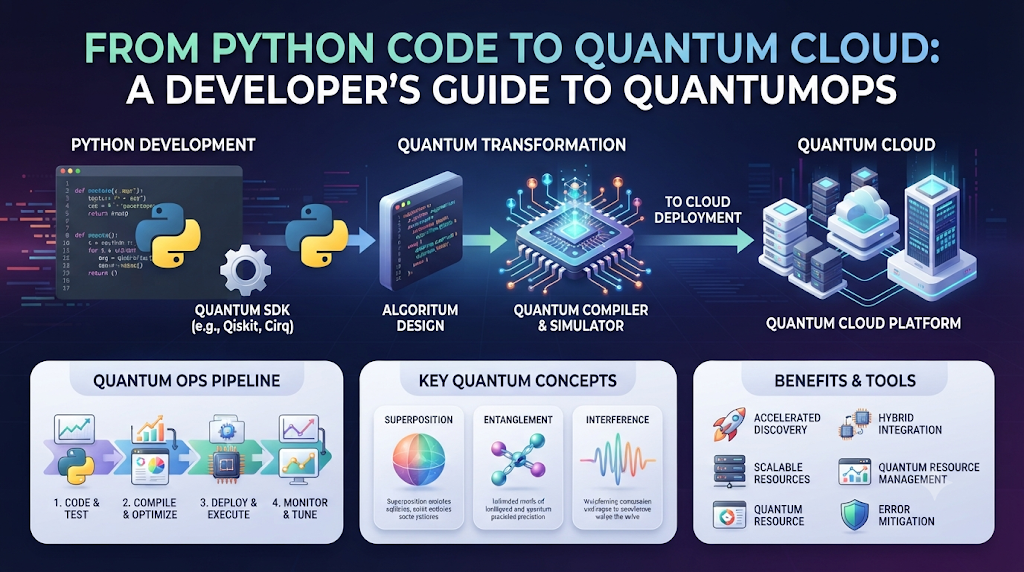
If you write Python scripts, deploy cloud containers, or manage APIs, you already possess half the skills needed to work with quantum computers. Bridging the remaining gap is the exact focus of quantum cloud computing training and modern QuantumOps practices.
For decades, quantum hardware sat behind locked laboratory doors, accessible only to PhD physicists. Today, major cloud platforms expose real quantum processors through standard REST APIs and open-source Python packages. Yet running code on a quantum chip feels very different from deploying a microservice. Developers and architects must account for probabilistic answers, hardware noise, specialized compilers, and tight loops with classical servers.
This guide explores quantum technology from the perspective of a working software developer transitioning into cloud quantum engineering. You will learn how quantum systems process logic, how cloud jobs execute step by step, how major platforms compare, and how to build practical skills for this growing field.
Shifting Your Mindset: Classical Logic vs. Quantum Computing
Every programmer understands how normal computers handle variables and memory. Quantum hardware changes those underlying rules in three fundamental ways.
Classical Bits vs. Quantum Qubits
Your laptop, smartphone, and cloud servers store every piece of data as bits. A bit is binary and rigid—it is strictly 0 or 1. Even massive software platforms simply move billions of these binary digits through standard logic gates.
Quantum processors replace bits with qubits (quantum bits). Instead of locking immediately into 0 or 1, a qubit uses quantum mechanics to hold a flexible mathematical blend of both states while a program runs.
Three core behaviors drive every quantum algorithm:
- Superposition: While a quantum program runs, a qubit stays in a blended state of
0and1simultaneously. The moment a sensor measures the qubit at the end, that blend collapses into a single definite0or1. - Entanglement: Two or more qubits can become tightly linked together. Once entangled, measuring one qubit immediately reveals the state of its partner, even across separate parts of a chip.
- Quantum Interference: Programmers craft quantum operations so wrong answers cancel each other out like overlapping sound waves, while right answers amplify and show up most often when measured.
Gates, Circuits, and Simulators
In everyday coding, functions update variables. In quantum coding, quantum gates transform qubit states. Placing several gates in order forms a quantum circuit.
Because physical quantum processors are expensive and limited in number, engineers test their circuits first on a quantum simulator. A simulator is regular software running on classical CPUs or GPUs that mimics how an ideal quantum chip behaves.
Where Quantum Cloud Solves Real Engineering Problems
Quantum processors will never replace web servers, relational databases, or mobile apps. Classical cloud servers handle everyday business tasks far faster and cheaper. Instead, quantum chips act as specialized co-processors for specific mathematical bottlenecks.
Organizations investing in quantum computing for software engineers and technical teams focus on four primary workloads:
- Supply Chain and Route Optimization: Planning delivery routes across thousands of trucks, warehouses, and shifting weather patterns creates millions of combinations. Quantum optimization algorithms search huge solution spaces efficiently.
- Chemistry and Material Simulation: Modeling how atoms interact inside new medicines, fertilizers, or electric vehicle batteries requires quantum-level physics. Quantum chips simulate molecular behavior far more naturally than classical servers.
- Financial Risk and Portfolio Modeling: Banks test quantum circuits to price complex financial derivatives, detect subtle fraud patterns, and balance market risk.
- Quantum-Safe Network Security: Powerful future quantum computers could crack today’s standard public-key encryption. Security engineers are already upgrading networks to protect sensitive data against future threats.
A Realistic Engineering View: Today’s quantum hardware is noisy and still scaling up. Enterprises currently use cloud quantum platforms for research, prototype benchmarking, and workforce training—not to replace daily production servers.
Step-by-Step: Inside a Cloud Quantum Job Lifecycle
When you submit a quantum program from your terminal or CI/CD pipeline, the workload moves through seven clear stages:
- Problem Translation: Engineers map a complex optimization or chemistry problem into a mathematical format that qubits can represent.
- Circuit Authoring: A developer writes the quantum gates in Python using an open-source software development kit (SDK).
- Local Simulator Testing: Automated unit tests run the circuit on a local simulator to catch logic bugs before spending cloud credits.
- Hardware Transpilation: Every physical quantum chip has strict wiring rules. A transpiler rewrites your abstract circuit so it matches the exact native gates and physical layout of the target chip.
- Authenticated Cloud Dispatch: The compiled circuit travels through an encrypted cloud API gateway into a shared job queue.
- Multi-Shot Sampling: Because quantum results follow probability rules, the processor runs the exact same circuit 1,000 to 10,000 times (called shots) to build a reliable statistical chart of outcomes.
- Classical Post-Processing: The cloud returns bitstring counts, and a classical server extracts the best business answer.
Comparing Top Quantum Cloud Platforms and Toolkits
Cloud providers eliminate the burden of buying, cooling, or calibrating physical quantum chips. Professionals taking a Qiskit programming course or AWS Braket training regularly work across these four ecosystems:
| Platform / Toolkit | Core Developer Strength | Primary Language | Accessible Hardware | Ideal Use Case |
| Qiskit & IBM Quantum | Mature ecosystem and low-latency runtime | Python | IBM superconducting processors | Developers wanting deep circuit control and fast runtime execution |
| Amazon Braket | Single API across multiple hardware brands | Python | IonQ, Rigetti, IQM, QuEra | Cloud teams already managing IAM, S3, and billing inside AWS |
| Microsoft Azure Quantum | Long-term qubit resource estimation and Q# | Q#, Python | Quantinuum, IonQ, Atom Computing | Microsoft-centric teams planning future hardware scale |
| Google Cirq | Fine-grained gate timing and noise control | Python | Google quantum chips (approved access) + simulators | Engineers testing hardware-specific layouts and pulse schedules |
Qiskit and IBM Quantum
Qiskit is the most widely adopted open-source Python SDK for quantum computing. Paired with IBM Quantum Cloud, it offers standardized primitives—called Sampler and Estimator—that streamline how developers collect bitstring probabilities and expectation values. Qiskit Runtime places classical containers right beside quantum processors to cut network delays.
Amazon Braket
Amazon Braket gives cloud engineers one unified service to test circuits on managed simulators and run them across different hardware makers, including trapped-ion and neutral-atom chips. Braket integrates cleanly with AWS IAM for permissions, Amazon S3 for data storage, and CloudWatch for operational alerts.
Microsoft Azure Quantum
Azure Quantum pairs Microsoft’s Q# programming language with cloud access to third-party quantum processors. Its Azure Quantum Resource Estimator helps solution architects calculate how many physical qubits a future fault-tolerant system will require to run specific enterprise workloads.
Google Cirq
Cirq is built around the physical constraints of near-term noisy processors. It gives engineers direct control over qubit grid placement and gate timing so they can minimize errors during execution.
Hands-On Tutorial: Building a Three-Qubit GHZ Entangled State in Python
To see multi-qubit entanglement in action, let us build a Greenberger-Horne-Zeilinger (GHZ) state—a classic three-qubit entangled circuit—using Python and Qiskit.
Prerequisites
- Python 3.10 or newer
- Qiskit SDK installed (
pip install qiskit)
Python Code Example
Python
from qiskit import QuantumCircuit
from qiskit.primitives import StatevectorSampler

# Create a circuit with 3 qubits and 3 classical readout bits
ghz = QuantumCircuit(3, 3)

# Step 1: Place qubit 0 into an equal superposition of 0 and 1
ghz.h(0)

# Step 2: Entangle qubit 0 with qubit 1, then qubit 1 with qubit 2
ghz.cx(0, 1)
ghz.cx(1, 2)

# Step 3: Measure all 3 qubits into the classical register
ghz.measure([0, 1, 2], [0, 1, 2])

# Run 1,000 shots on a local state-vector simulator
sampler = StatevectorSampler()
job = sampler.run([ghz], shots=1000)
counts = job.result()[0].data.c.get_counts()

print("GHZ Entanglement Counts:", counts)
Line-by-Line Walkthrough
QuantumCircuit(3, 3)allocates three qubits (starting in state000) and three classical bits to record final measurements.ghz.h(0)applies a Hadamard gate to qubit 0, putting it into a 50/50 superposition of0and1.ghz.cx(0, 1)links qubit 0 and qubit 1 so they share the exact same state.ghz.cx(1, 2)extends that entanglement link to qubit 2, locking all three qubits together.StatevectorSampler()executes 1,000 simulated runs on your local CPU.
Expected Output: You will see roughly 500 counts of '000' and 500 counts of '111' (for example, {'000': 498, '111': 502}). None of the other six combinations ('001', '010', etc.) appear, proving that all three qubits collapse together as a single correlated system.
System Architecture of a Quantum Cloud Stack
From a backend engineering perspective, a cloud quantum service connects four distinct infrastructure tiers:
- Cryogenic Hardware Tier: Superconducting quantum chips sit inside dilution refrigerators cooled to roughly 15 millikelvin. Extreme cold prevents ambient heat from disturbing fragile qubit states.
- Classical Control Tier: Room-temperature servers and custom electronics convert digital circuit commands into microwave or laser pulses that steer qubits and read back measurements.
- Cloud Orchestration Tier: Job schedulers, circuit compilers, and containerized runtimes manage multi-user queues, hardware calibrations, and telemetry logs.
- Enterprise Security Tier: Identity providers, role-based access control (RBAC), encrypted API tunnels, and private network endpoints keep proprietary algorithms and datasets isolated.
Hybrid Quantum-Classical Systems in Everyday Practice
Because current quantum chips cannot store databases, host user interfaces, or execute complex branching loops, almost every real application relies on hybrid quantum classical computing training and architecture.
In a hybrid workflow, classical cloud servers and quantum processors divide responsibilities in a continuous loop:
- Classical Cloud Node: Cleans raw business data, sets starting parameters for the quantum circuit, scores output quality, and runs classical optimization algorithms.
- Quantum Processing Unit: Executes parameterized quantum circuits to explore complex mathematical states and returns measurement counts.
This loop repeats dozens or hundreds of times per job. Cloud frameworks co-locate the classical optimizer and the quantum hardware inside the same data center so network latency does not slow down execution.
Weighing Technical Benefits and Current Limitations
Teams exploring quantum computing for IT managers and developers must balance genuine architectural benefits against physical hardware constraints.
Key Benefits
- Zero Hardware Maintenance: Cloud access eliminates multi-million-dollar capital costs for cryogenic cooling, cleanrooms, and specialized physics maintenance.
- Standard DevOps Compatibility: Teams store quantum circuits in Git, automate simulator unit tests in CI/CD pipelines, and monitor usage through existing cloud dashboards.
- Hardware Diversity: Developers can benchmark the same algorithm across superconducting, trapped-ion, and neutral-atom chips through one cloud provider.
Current Limitations
- Short Coherence Windows: Qubits lose their quantum state within microseconds. Circuits with too many sequential gates accumulate noise and produce unreliable outputs.
- Error Correction Overhead: Building one fault-tolerant “logical qubit” currently requires bundling dozens or hundreds of noisy physical qubits together.
- Queue Delays and Shot Expenses: Shared cloud QPUs have wait lines, and running thousands of shots per optimization step can inflate cloud bills without proper quotas.
Career Pathways and Skills in QuantumOps
Transitioning into quantum cloud engineering builds directly on existing Python, DevOps, and cloud architecture skills rather than requiring a physics PhD.
- Software Engineers: Develop fluency in Python, vectors and matrices, probability, and SDKs like Qiskit or Cirq.
- Cloud and DevOps Engineers: Manage IAM permissions, containerized hybrid runtimes, automated simulator testing, and FinOps cost alerts.
- Solution Architects: Design end-to-end systems that link classical cloud storage, APIs, and remote QPUs securely.
Professionals seeking structured upskilling often enroll in a quantum computing certification course or a specialized quantum computing architecture course. At QuantumOps School, advertised learning tracks align directly with four enterprise roles:
- QuantumOps Architect: Covers hybrid cloud system design, hardware modality selection, and enterprise security governance.
- QuantumOps Engineer: Focuses on hands-on circuit programming, transpilation optimization, and automated cloud SDK pipelines.
- QuantumOps Manager: Equips IT leaders to conduct readiness assessments, manage vendor budgets, and lead cross-functional teams.
- QuantumOps Professional: Builds core fluency across qubits, gates, simulators, and cloud job execution.
Earning a QuantumOps certification demonstrates practical capability in bridging quantum SDKs with cloud operations, especially when backed by working GitHub repositories.
Governance and FinOps Rules for Enterprise IT
IT managers can keep quantum initiatives secure, predictable, and cost-effective by enforcing four straightforward rules:
- Mandate Simulator-First Policies: Require developers to validate every circuit on free local simulators before submitting jobs to paid cloud QPUs.
- Set Hard Cloud Budgets: Configure billing alerts and maximum shot limits per workspace so runaway hybrid loops never create surprise cloud expenses.
- Start Post-Quantum Security Audits: Inventory internal APIs, TLS certificates, and key management services to plan migrations toward NIST-approved quantum-safe encryption.
- Build Cross-Functional Pods: Pair business domain specialists (in logistics, finance, or chemistry) with Python developers and cloud architects so prototypes solve real business bottlenecks.
Common Mistakes Developers Make
- Using Quantum Circuits for Routine Tasks: Never send standard sorting, SQL queries, or web rendering workloads to a QPU. Classical CPUs execute them millions of times faster and cheaper.
- Treating Ideal Simulators as Hardware Guarantees: A circuit that achieves 100% accuracy on a noise-free laptop simulator will experience gate errors on a real QPU. Always test with hardware noise models enabled.
- Ignoring Physical Qubit Connectivity: If two qubits in your circuit are not physically wired together on the chip, the compiler inserts extra
SWAPgates that add noise and lower accuracy. - Overlooking Classical Data Latency: Slow serialization or cross-region network hops between your classical server and the QPU can bottleneck hybrid loops.
Best Practices for Building Quantum Software
- Keep Circuits Shallow: Minimize two-qubit gates (
CNOT,CZ), as they carry significantly higher error rates than single-qubit rotations. - Adopt Portable Standards: Write circuits using open formats like OpenQASM 3.0 so your team can benchmark across IBM, AWS, and Azure without rewriting core logic.
- Automate Simulator Testing in CI/CD: Run fast quantum unit tests automatically on every pull request in GitHub Actions or GitLab CI.
- Benchmark Against Classical Solvers: Always measure quantum prototype performance against strong classical algorithms to verify genuine value.
Future Trends in Quantum Cloud Development
- Logical Qubit Scaling: Hardware providers are shifting focus from raw physical qubit counts toward error-corrected logical qubits capable of running deeper algorithms.
- Tighter HPC and QPU Integration: Supercomputing centers and cloud providers are wiring quantum processors directly into GPU clusters to accelerate hybrid scientific computing.
- Higher-Level Quantum Functions: Cloud vendors are introducing pre-built domain functions so enterprise developers can solve optimization or chemistry tasks without coding low-level gates.
- Global Post-Quantum Cryptography Mandates: Financial regulators and government agencies are setting firm compliance timelines for upgrading enterprise networks to quantum-resistant encryption.
How QuantumOps School Supports Your Learning Journey
QuantumOps School helps bridge the gap between emerging quantum technology and practical IT operations. Through its advertised Architect, Engineer, Manager, and Professional learning paths, the platform offers instructor-led training, hands-on labs, circuit simulations, technical case studies, and capstone projects covering Qiskit, Cirq, AWS Braket, IBM Quantum, and Azure Quantum.
For organizations planning enterprise adoption, QuantumOps School also offers quantum computing consulting services covering quantum cloud integration, hybrid system architecture, workload optimization, and quantum security readiness.
Frequently Asked Questions (FAQs)
1. What does QuantumOps mean for software developers and IT teams?
QuantumOps is the set of software engineering, system architecture, and IT operations practices used to build, test, deploy, and govern quantum and hybrid quantum-classical workloads in cloud environments.
2. Do Python developers need a physics degree to learn quantum programming?
No. Python developers can build and execute quantum circuits using SDKs like Qiskit and Cirq with a basic grasp of probability, logic gates, and simple linear algebra.
3. How do cloud platforms provide access to quantum processors?
Cloud providers like IBM Quantum, Amazon Braket, and Microsoft Azure Quantum host physical quantum processors in specialized data centers and expose them via secure web APIs and Python SDKs.
4. Why do quantum programs execute thousands of shots?
Quantum measurements produce probabilistic outcomes rather than a single fixed value. Running a circuit 1,000 or more times (shots) builds a statistical distribution showing the most likely answer.
5. What is the difference between a quantum simulator and a QPU?
A quantum simulator is classical software on a CPU or GPU that calculates ideal circuit outcomes without hardware errors. A QPU (Quantum Processing Unit) is physical quantum hardware that experiences environmental noise and gate errors.
6. Why are hybrid quantum-classical architectures standard today?
Current quantum chips have limited qubit counts and short coherence times, making them unsuitable for storing files or running classical loops. Hybrid systems let classical servers manage data and optimization while QPUs execute targeted quantum circuits.
7. What does a Qiskit programming course cover?
A Qiskit programming course teaches developers how to build quantum circuits in Python, run local simulations, optimize circuits through transpilation, and execute jobs on IBM Quantum cloud backends.
8. How does AWS Braket training help cloud engineers?
AWS Braket training teaches cloud engineers how to write circuits with the Braket SDK, test on managed simulators, access multiple QPU hardware vendors, and control security and costs using AWS IAM and S3.
9. What is circuit transpilation in a quantum cloud workflow?
Transpilation is the compilation step that translates an abstract quantum circuit into the specific native gate set and physical qubit wiring topology of a chosen quantum processor.
10. How can IT managers prepare their teams for quantum computing?
IT managers should begin by auditing systems for post-quantum cryptography upgrades, enforcing simulator-first policies to control cloud costs, and upskilling architects and developers.
11. How do QuantumOps Architect and Engineer roles differ?
A QuantumOps Engineer focuses on coding quantum circuits, running simulations, and automating CI/CD pipelines, while a QuantumOps Architect designs end-to-end hybrid cloud infrastructure, security, and vendor strategy.
12. Will quantum computers replace classical cloud servers?
No. Quantum processors act as specialized accelerators for complex optimization and molecular simulation tasks, while classical servers continue running everyday applications, databases, and websites.
Conclusion
Quantum cloud computing has transformed specialized physics hardware into an accessible cloud service for everyday developers. By mastering qubits, multi-qubit entanglement, circuit transpilation, and hybrid cloud workflows, software engineers and IT leaders can build practical prototypes today while preparing their systems for fault-tolerant quantum computing.
Your best first step is hands-on coding: install Qiskit or the Amazon Braket SDK in Python, run a three-qubit GHZ entanglement circuit on your local simulator, and see firsthand how quantum correlations work.