Introduction
Account Takeover ATO Protection Tools help businesses detect and stop attackers who try to access real user accounts using stolen passwords, phishing, credential stuffing, bot attacks, session hijacking, or social engineering. In plain English, these tools watch login attempts, device behavior, user actions, risk signals, and suspicious account changes to decide whether access should be allowed, challenged, blocked, or reviewed.
ATO protection matters now because customer accounts often contain payment methods, personal data, loyalty points, stored addresses, banking access, subscription controls, and business-critical permissions. Attackers are using automation, AI-assisted phishing, malware, stolen credentials, and MFA bypass tactics to move faster than traditional password-based defenses.
Real-world use cases include:
- Blocking credential stuffing attacks on login pages
- Detecting suspicious session behavior after login
- Stopping fraudulent password resets and profile changes
- Protecting fintech, banking, e-commerce, gaming, and SaaS accounts
- Reducing account abuse, payment fraud, and loyalty-point theft
Evaluation Criteria for Buyers:
- Real-time login risk scoring
- Bot and credential stuffing detection
- Device fingerprinting and IP intelligence
- Behavioral biometrics and session monitoring
- Adaptive MFA and step-up authentication support
- API and SDK integration options
- False-positive reduction
- Case management and investigation workflows
- Privacy, compliance, and data controls
- Scalability, latency, and uptime
Best for: ATO protection tools are best for security teams, fraud teams, identity teams, product teams, fintech companies, banks, marketplaces, SaaS platforms, e-commerce brands, gaming companies, travel platforms, and enterprises that manage large user accounts or high-value customer actions.
Not ideal for: These tools may not be ideal for very small websites with limited login volume, static brochure sites, or businesses that only need basic password protection and standard MFA. In those cases, built-in identity provider controls, CAPTCHA, rate limiting, passwordless authentication, or basic bot protection may be enough before investing in a dedicated ATO protection platform.
Key Trends in Account Takeover ATO Protection Tools
- Passkeys and phishing-resistant MFA are becoming more important: Businesses are moving beyond passwords and SMS OTPs toward stronger authentication methods that reduce phishing and credential replay risk.
- Behavioral biometrics are moving into mainstream fraud defense: Tools increasingly analyze typing rhythm, mouse movement, touchscreen behavior, navigation patterns, and session anomalies to identify suspicious users.
- Bot mitigation and ATO protection are converging: Credential stuffing, fake login attempts, automated password resets, and scripted account abuse require bot detection and account risk scoring to work together.
- Continuous session monitoring is replacing login-only security: Modern ATO tools do not stop after login. They monitor risky behavior such as payment method changes, address changes, password resets, withdrawals, and abnormal account activity.
- AI-driven phishing is increasing pressure on identity teams: Attackers can create more convincing messages, fake pages, and social engineering flows, so ATO tools must combine authentication, risk scoring, and user behavior analysis.
- Risk-based authentication is becoming standard: Instead of forcing every user through the same MFA step, platforms challenge only risky sessions based on device, location, behavior, history, and transaction context.
- Graph intelligence is becoming useful for fraud rings: Advanced tools connect users, devices, IPs, cards, addresses, phone numbers, and accounts to detect coordinated takeover attempts.
- Privacy and compliance are becoming buying criteria: Buyers now evaluate data minimization, regional data handling, audit logs, access control, encryption, and retention practices before selecting a tool.
- ATO protection is expanding beyond consumer apps: SaaS platforms, workforce apps, B2B portals, developer platforms, and financial dashboards also need protection from account compromise.
- Security teams want explainable risk signals: A simple risk score is not enough. Analysts need reason codes, attack indicators, device details, and timeline views to understand why a session is risky.
How We Selected These Tools Methodology
- Selected tools with strong recognition in ATO protection, bot mitigation, identity security, fraud prevention, or behavioral risk detection.
- Prioritized platforms that support real-time login protection, account risk scoring, bot defense, or post-login monitoring.
- Considered fit across e-commerce, fintech, banking, SaaS, marketplaces, gaming, and enterprise identity environments.
- Evaluated feature depth across device intelligence, behavioral analytics, adaptive authentication, rules, APIs, dashboards, and case review.
- Considered integration strength with identity providers, web apps, mobile apps, APIs, WAFs, SIEM tools, and fraud operations workflows.
- Reviewed practical buyer fit across SMB, mid-market, enterprise, developer-first, and high-risk digital businesses.
- Considered performance expectations such as low-latency decisions, uptime, large-scale bot handling, and attack burst resilience.
- Avoided invented ratings, certifications, or unsupported compliance claims.
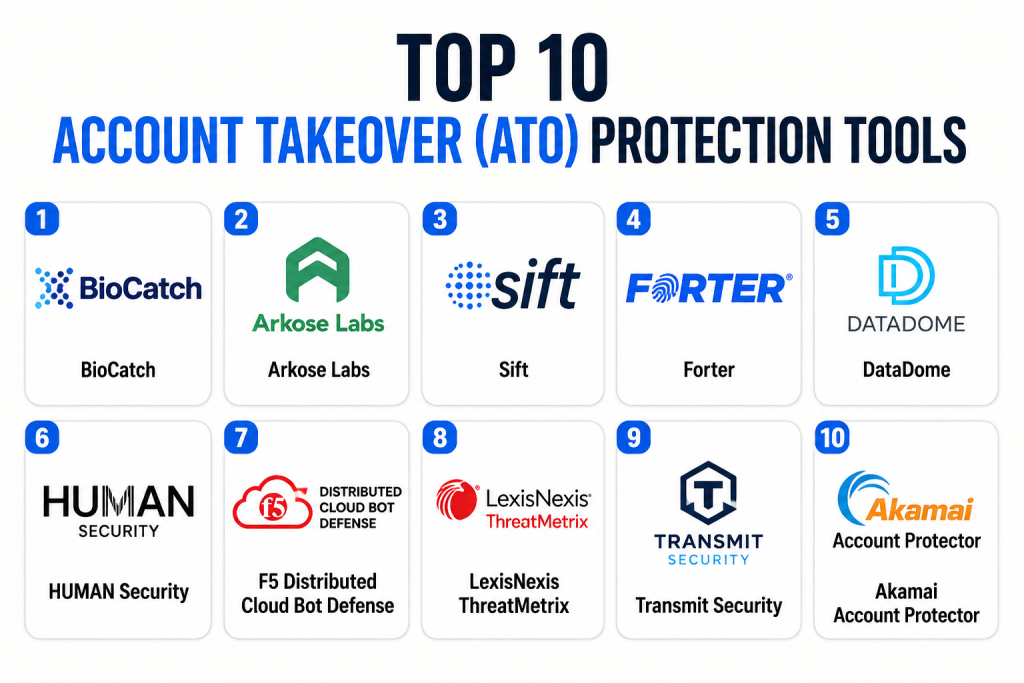
Top 10 Account Takeover ATO Protection Tools
1- BioCatch
Short description: BioCatch is a behavioral biometrics and digital fraud detection platform used to identify account takeover, social engineering, mule activity, and suspicious user behavior. It focuses on how users interact with digital sessions rather than relying only on static credentials or device checks. The platform is especially relevant for banks, fintechs, digital wallets, payment companies, and enterprises that need continuous session risk detection. BioCatch can help detect when a real account is being controlled by someone behaving differently from the legitimate user. It is useful for teams that want behavioral intelligence across login, navigation, transaction, and high-risk account actions. Its strongest value appears in high-volume environments where behavioral patterns can improve fraud detection quality.
Key Features
- Behavioral biometrics and session behavior analysis
- Account takeover detection
- Device and activity anomaly monitoring
- Real-time fraud risk signals
- Continuous monitoring after login
- Digital fraud and scam detection support
- Risk insights for fraud investigation teams
Pros
- Strong behavioral analytics for ATO detection
- Useful for financial services and high-risk digital journeys
- Helps detect suspicious activity even after login
Cons
- May be more suitable for enterprise or high-volume environments
- Requires careful data integration and tuning
- Pricing and deployment details are usually business-specific
Platforms / Deployment
Web
Cloud / Hybrid / Varies by enterprise agreement
Security & Compliance
BioCatch operates in sensitive fraud and financial services environments. Buyers should verify current certifications, access controls, encryption, audit logs, and regional compliance documentation directly during procurement.
SOC 2: Not publicly stated
ISO 27001: Not publicly stated
GDPR: Relevant in applicable regions
SSO/SAML: Varies / N/A
MFA: Varies / N/A
RBAC and audit logs: Varies / N/A
Integrations & Ecosystem
BioCatch integrates into digital banking, fintech, and account journey workflows to provide behavioral risk intelligence during user sessions.
- Web and mobile app telemetry
- Fraud operations workflows
- Transaction monitoring systems
- Identity and authentication flows
- Case management workflows
- Enterprise risk systems
Support & Community
BioCatch generally supports enterprise buyers with implementation guidance, documentation, and fraud expertise. Support depth depends on contract, deployment scope, and customer size. Buyers should confirm onboarding timeline, technical assistance, model tuning support, and escalation processes.
2- Arkose Labs
Short description: Arkose Labs is a fraud and abuse prevention platform focused on stopping bots, credential stuffing, fake account creation, account takeover attempts, and automated attacks. It is widely used by businesses that need protection at login, registration, checkout, password reset, and other high-risk user flows. Arkose combines risk scoring with adaptive challenges to increase attacker cost while reducing friction for legitimate users. It is especially useful for marketplaces, gaming platforms, fintechs, social platforms, e-commerce companies, and high-traffic consumer apps. The platform is strong where automated abuse and human-assisted fraud are both concerns. Buyers should assess challenge experience, integration complexity, and how it affects conversion.
Key Features
- Bot and credential stuffing protection
- Account takeover defense
- Adaptive risk-based challenges
- Login and registration protection
- Abuse prevention for digital platforms
- Real-time risk decisioning
- Attack analytics and fraud reporting
Pros
- Strong fit for high-volume bot and abuse prevention
- Useful for login, signup, and account recovery protection
- Adaptive challenges can raise attacker cost
Cons
- Challenge experience must be tested for user friction
- May be more than small websites need
- Implementation requires careful placement across user flows
Platforms / Deployment
Web / iOS / Android
Cloud
Security & Compliance
Arkose Labs supports fraud prevention workflows that process risk and behavioral signals. Specific certifications, controls, and compliance details should be verified directly.
SOC 2: Not publicly stated
ISO 27001: Not publicly stated
GDPR: Relevant in applicable regions
SSO/SAML: Varies / N/A
MFA: Varies / N/A
RBAC and audit logs: Varies / N/A
Integrations & Ecosystem
Arkose Labs integrates with web and mobile applications to protect high-risk interaction points from bots and fraud attempts.
- Web and mobile SDKs
- APIs
- Login and registration workflows
- Password reset flows
- Fraud and security dashboards
- SIEM and security operations workflows where supported
Support & Community
Arkose Labs provides enterprise onboarding, documentation, implementation support, and fraud expertise. Buyers should confirm account management, support levels, tuning assistance, and reporting access before rollout.
3- Sift
Short description: Sift is a digital trust and fraud prevention platform that supports account takeover detection, payment fraud prevention, account abuse detection, and chargeback-related workflows. It uses event-based risk modeling to analyze user behavior across login, account activity, payment actions, and suspicious journeys. Sift is a strong fit for marketplaces, e-commerce platforms, fintechs, digital goods companies, and subscription businesses with complex user behavior. It can help teams identify takeover risk before fraud moves into payment abuse, promo abuse, or account changes. The platform is useful when businesses need both risk scoring and operational review tools. Its value depends on sending rich event data and tuning decisions around real fraud outcomes.
Key Features
- Account takeover risk detection
- Payment fraud and account abuse scoring
- Event-based machine learning
- Custom rules and decision workflows
- Case management and analyst review
- Risk signals and reason codes
- APIs and real-time fraud decisions
Pros
- Strong coverage across multiple fraud use cases
- Useful for marketplaces and digital platforms
- Combines scoring with investigation workflows
Cons
- Requires good data mapping for best results
- May need fraud operations maturity
- Pricing and implementation may vary by business scale
Platforms / Deployment
Web
Cloud
Security & Compliance
Sift handles fraud, transaction, user, and behavioral data. Buyers should review vendor security documentation, privacy terms, data retention, and access controls during procurement.
SOC 2: Not publicly stated
ISO 27001: Not publicly stated
GDPR: Relevant in applicable regions
SSO/SAML: Varies / N/A
MFA: Varies / N/A
RBAC and audit logs: Varies / N/A
Integrations & Ecosystem
Sift integrates through APIs and event tracking to score user actions across the full account journey.
- REST APIs
- Event tracking
- Webhooks
- Payment and checkout workflows
- Login and account activity signals
- Case review dashboards
Support & Community
Sift provides documentation, onboarding support, fraud resources, and customer success guidance. Support quality and depth may vary by contract and implementation complexity. Teams with strong technical and fraud operations resources can usually extract more value from the platform.
4- Forter
Short description: Forter is a digital commerce trust platform that helps businesses make identity-based fraud decisions across account creation, login, checkout, payments, returns, and other customer actions. It is often used by enterprise e-commerce brands, marketplaces, travel companies, and digital platforms that want to distinguish legitimate customers from risky actors. Forter can support account takeover detection by analyzing identity, behavior, device, and transaction context across the customer journey. It is valuable when fraud risk does not stop at login and continues into payment fraud, policy abuse, or account changes. The platform is especially relevant for high-volume businesses that want automated decisions with less customer friction. Buyers should evaluate fit based on traffic volume, fraud type, and regional operations.
Key Features
- Account protection and takeover risk detection
- Payment fraud decisioning
- Identity-based risk intelligence
- Customer journey fraud coverage
- Automated approve, decline, and review decisions
- Returns and abuse detection support
- Merchant analytics and reporting
Pros
- Strong fit for enterprise commerce and marketplaces
- Covers ATO along with payment and policy abuse
- Helps reduce friction for trusted customers
Cons
- May be too advanced for very small businesses
- Enterprise deployment may require planning
- Pricing and contract terms are usually custom
Platforms / Deployment
Web
Cloud
Security & Compliance
Forter works with sensitive customer, identity, and transaction data. Security and compliance documentation should be reviewed directly with the vendor during evaluation.
SOC 2: Not publicly stated
ISO 27001: Not publicly stated
GDPR: Relevant in applicable regions
SSO/SAML: Varies / N/A
MFA: Varies / N/A
RBAC and audit logs: Varies / N/A
Integrations & Ecosystem
Forter integrates into customer journey and commerce workflows to support risk decisions across login, checkout, and account activity.
- APIs
- E-commerce integrations
- Payment and checkout workflows
- Login and account event signals
- Fraud operations dashboards
- Returns and policy workflows
Support & Community
Forter offers enterprise-focused onboarding, account support, and implementation resources. Buyers should confirm support SLAs, technical integration help, reporting access, and operational review workflows before final selection.
5- DataDome
Short description: DataDome is a bot and online fraud protection platform that helps stop credential stuffing, account takeover attempts, scraping, fake account creation, and automated abuse. It is especially useful for businesses with high-traffic websites, mobile apps, APIs, and login endpoints exposed to bot attacks. DataDome focuses on real-time bot detection and response, helping businesses block malicious automation before it reaches critical account flows. It is a strong fit for e-commerce, ticketing, travel, media, marketplaces, and SaaS platforms facing large-scale automated attacks. The platform can reduce pressure on authentication systems by filtering malicious traffic early. Buyers should test performance impact, false positives, and integration fit across web, mobile, and API surfaces.
Key Features
- Bot detection and mitigation
- Credential stuffing protection
- ATO attempt prevention
- API protection
- Real-time traffic analysis
- Device and behavioral signals
- Dashboard and attack analytics
Pros
- Strong for automated login abuse and bot traffic
- Protects web, mobile, and API surfaces
- Useful for high-traffic digital businesses
Cons
- Focuses more on bot-driven ATO than full fraud operations
- May need additional tools for post-login fraud monitoring
- Tuning is important to avoid blocking legitimate users
Platforms / Deployment
Web / iOS / Android
Cloud / Hybrid / Varies by setup
Security & Compliance
DataDome handles bot, device, traffic, and behavioral risk data. Buyers should verify security documentation, compliance coverage, encryption, and access control features directly.
SOC 2: Not publicly stated
ISO 27001: Not publicly stated
GDPR: Relevant in applicable regions
SSO/SAML: Varies / N/A
MFA: Varies / N/A
RBAC and audit logs: Varies / N/A
Integrations & Ecosystem
DataDome integrates at different traffic layers to detect and block malicious automation before it causes account abuse.
- Web server integrations
- CDN and edge integrations
- Mobile SDKs
- API protection
- Security dashboards
- SIEM and monitoring workflows where supported
Support & Community
DataDome provides documentation, onboarding, and technical support. Businesses should validate implementation options, traffic routing requirements, real-time response controls, and support levels based on their architecture.
6- HUMAN Security
Short description: HUMAN Security is a cyberfraud defense platform focused on protecting digital businesses from bots, account abuse, credential stuffing, fake account creation, scraping, payment abuse, and other automated threats. It is useful for organizations where ATO risk begins with malicious automation against login, registration, and account recovery endpoints. HUMAN is relevant for media, advertising, e-commerce, marketplaces, financial services, and large digital platforms. The platform helps security and fraud teams identify non-human traffic and suspicious automation patterns before they become account compromise events. It can be valuable when bot traffic affects both security and business operations. Buyers should assess whether their main ATO problem is bot-driven, human-driven, or a mix of both.
Key Features
- Bot detection and mitigation
- Credential stuffing protection
- Account abuse prevention
- Automated traffic classification
- Fraud and cyber threat intelligence
- Web, mobile, and API protection
- Dashboards and security analytics
Pros
- Strong for bot-driven account takeover defense
- Useful across security, fraud, and business abuse use cases
- Good fit for large-scale digital platforms
Cons
- May need complementary tools for behavioral biometrics or identity verification
- Enterprise implementation may require technical planning
- Pricing and packaging are typically business-specific
Platforms / Deployment
Web / iOS / Android
Cloud / Hybrid / Varies by enterprise setup
Security & Compliance
HUMAN Security operates in cyberfraud and bot defense environments. Buyers should verify security certifications, access controls, data protection, and compliance documentation directly.
SOC 2: Not publicly stated
ISO 27001: Not publicly stated
GDPR: Relevant in applicable regions
SSO/SAML: Varies / N/A
MFA: Varies / N/A
RBAC and audit logs: Varies / N/A
Integrations & Ecosystem
HUMAN integrates with web, app, API, and traffic security workflows to detect and mitigate automated abuse.
- Web application integrations
- Mobile app protection
- API protection
- Edge and security infrastructure
- Fraud and security dashboards
- SIEM and security operations workflows where supported
Support & Community
HUMAN offers enterprise documentation, onboarding assistance, technical support, and security expertise. Buyers should confirm implementation scope, managed services options, response workflows, and escalation paths.
7- F5 Distributed Cloud Bot Defense
Short description: F5 Distributed Cloud Bot Defense helps organizations detect and mitigate malicious automation, credential stuffing, fake login attempts, scraping, and account takeover attempts across web and mobile applications. It is well suited for enterprises that already use F5 security infrastructure or need bot defense across complex digital environments. The platform focuses on protecting login pages, account creation flows, checkout journeys, and APIs from automated threats. It is especially relevant for financial services, e-commerce, travel, insurance, and high-traffic digital properties. F5’s value comes from combining bot defense with broader application security expertise. Buyers should evaluate deployment model, integration requirements, and whether they need broader app security coverage.
Key Features
- Bot mitigation and automated threat detection
- Credential stuffing protection
- Login and account flow protection
- Web and mobile app defense
- API abuse protection
- Real-time risk and traffic analysis
- Security infrastructure integration
Pros
- Strong fit for enterprises with complex app security needs
- Useful for credential stuffing and bot-driven ATO prevention
- Can align with broader F5 security environments
Cons
- May be too infrastructure-heavy for small teams
- Implementation can require security engineering involvement
- May need complementary fraud tools for post-login behavior
Platforms / Deployment
Web / iOS / Android
Cloud / Hybrid / Varies by architecture
Security & Compliance
F5 provides enterprise security infrastructure and bot defense capabilities. Buyers should verify specific product certifications, access controls, logging, and compliance coverage directly.
SOC 2: Not publicly stated for this specific product
ISO 27001: Not publicly stated for this specific product
GDPR: Relevant in applicable regions
SSO/SAML: Varies / N/A
MFA: Varies / N/A
RBAC and audit logs: Varies / N/A
Integrations & Ecosystem
F5 Distributed Cloud Bot Defense integrates into application delivery and security environments to protect public-facing applications and APIs.
- Web application protection
- Mobile app protection
- API security workflows
- Edge and cloud security environments
- Security dashboards
- Enterprise security operations tools
Support & Community
F5 provides enterprise support, documentation, and professional services options. Support depth can vary by contract and deployment model. Buyers should confirm onboarding, tuning support, incident response workflows, and security operations integrations.
8- LexisNexis ThreatMetrix
Short description: LexisNexis ThreatMetrix is a digital identity and fraud risk platform used to assess trust across devices, identities, locations, transactions, and digital behavior. It is commonly used by financial institutions, fintechs, e-commerce platforms, insurance companies, and digital businesses that need risk intelligence for login and transaction decisions. ThreatMetrix can help detect account takeover by identifying suspicious device changes, abnormal login patterns, identity inconsistencies, and risky network signals. It is useful when businesses need broad digital identity intelligence rather than only bot blocking. The platform is especially relevant for enterprises with high fraud exposure and complex risk workflows. Buyers should evaluate integration needs, data governance, and regional compliance requirements.
Key Features
- Digital identity risk intelligence
- Device fingerprinting and recognition
- Account takeover risk signals
- Login and transaction risk scoring
- Network and behavioral risk indicators
- Fraud analytics and investigation support
- Enterprise identity and fraud workflows
Pros
- Strong digital identity risk capabilities
- Useful for financial services and large enterprises
- Supports login and transaction risk decisions
Cons
- May be complex for small businesses
- Implementation and pricing are typically enterprise-oriented
- Requires careful privacy and data governance review
Platforms / Deployment
Web
Cloud / Hybrid / Varies by enterprise agreement
Security & Compliance
ThreatMetrix operates in digital identity and fraud risk environments. Buyers should verify current certifications, privacy terms, data handling, access controls, and regulatory support directly.
SOC 2: Not publicly stated for this specific product
ISO 27001: Not publicly stated for this specific product
GDPR: Relevant in applicable regions
SSO/SAML: Varies / N/A
MFA: Varies / N/A
RBAC and audit logs: Varies / N/A
Integrations & Ecosystem
ThreatMetrix integrates into login, identity, transaction, and fraud decisioning workflows to provide digital identity intelligence.
- APIs
- Device intelligence workflows
- Identity verification flows
- Login and transaction scoring
- Fraud operations systems
- Enterprise analytics environments
Support & Community
LexisNexis Risk Solutions provides enterprise support, documentation, and account services. Buyers should validate implementation support, data onboarding, contract terms, compliance documentation, and technical service levels.
9- Transmit Security
Short description: Transmit Security provides identity security, fraud prevention, passkey, authentication, and risk-based protection capabilities for digital businesses. It is relevant for companies that want to reduce account takeover risk by combining modern authentication with identity verification, device intelligence, and fraud signals. Transmit Security can support passwordless login, adaptive authentication, bot detection, and account protection use cases depending on product configuration. It is useful for fintechs, banks, insurers, retailers, and enterprises looking to modernize customer identity while improving security. Its strength is combining customer identity access management and fraud prevention. Buyers should evaluate which modules they need and how well they integrate with existing identity systems.
Key Features
- Customer identity and access management
- Passkey and passwordless authentication support
- Risk-based authentication
- Account takeover protection signals
- Bot and fraud prevention capabilities
- Identity verification and journey orchestration options
- APIs and SDKs for digital apps
Pros
- Strong fit for businesses modernizing customer identity
- Supports phishing-resistant and adaptive authentication strategies
- Useful when ATO protection and login experience must work together
Cons
- May require broader identity architecture changes
- Product packaging should be reviewed carefully
- Not always a simple plug-in replacement for existing systems
Platforms / Deployment
Web / iOS / Android
Cloud / Hybrid / Varies by enterprise setup
Security & Compliance
Transmit Security operates in identity and authentication environments. Buyers should verify current certifications, access controls, encryption, audit logs, data privacy, and compliance scope directly.
SOC 2: Not publicly stated
ISO 27001: Not publicly stated
GDPR: Relevant in applicable regions
SSO/SAML: Varies / N/A
MFA: Supported depending on configuration
RBAC and audit logs: Varies / N/A
Integrations & Ecosystem
Transmit Security integrates with customer identity, authentication, and fraud prevention workflows across web and mobile channels.
- APIs and SDKs
- Identity provider integrations
- Passkey and passwordless flows
- Mobile and web app authentication
- Risk-based step-up workflows
- Customer journey orchestration
Support & Community
Transmit Security provides documentation, technical onboarding, and enterprise support. Buyers should clarify implementation services, migration support, developer resources, and long-term identity roadmap alignment.
10- Akamai Account Protector
Short description: Akamai Account Protector helps businesses detect and stop account takeover activity by analyzing login behavior, bot signals, user intent, and suspicious authentication patterns. It is especially useful for organizations already using Akamai’s edge, CDN, application security, or bot management ecosystem. Account Protector can help identify credential stuffing, suspicious login attempts, and account misuse without relying only on static authentication checks. It is relevant for e-commerce, financial services, media, travel, gaming, and high-traffic digital businesses. The platform’s strength is edge-scale visibility and account protection close to the traffic layer. Buyers should evaluate how it fits with existing identity, fraud, and security tools.
Key Features
- Account takeover detection
- Credential stuffing protection
- Bot and malicious automation signals
- Login risk analysis
- Behavioral and intent-based signals
- Integration with Akamai security ecosystem
- Security analytics and reporting
Pros
- Strong fit for businesses already using Akamai
- Useful for high-traffic login protection
- Combines bot and account risk signals
Cons
- Less attractive for teams outside Akamai’s ecosystem
- May need additional fraud tools for full customer journey protection
- Enterprise setup and tuning may require security expertise
Platforms / Deployment
Web
Cloud / Edge
Security & Compliance
Akamai provides enterprise-grade security infrastructure and traffic protection capabilities. Buyers should verify Account Protector-specific controls, compliance documentation, logging, and data handling directly.
SOC 2: Not publicly stated for this specific product
ISO 27001: Not publicly stated for this specific product
GDPR: Relevant in applicable regions
SSO/SAML: Varies / N/A
MFA: Varies / N/A
RBAC and audit logs: Varies / N/A
Integrations & Ecosystem
Akamai Account Protector integrates with Akamai’s broader edge and application security ecosystem to protect login and account flows.
- Akamai security products
- Edge protection workflows
- Bot management capabilities
- Login and authentication flows
- Security dashboards
- SIEM and monitoring workflows where supported
Support & Community
Akamai provides enterprise documentation, support, professional services, and account management options. Buyers should confirm implementation scope, tuning support, incident workflow, and integration with existing security operations.
Comparison Table Top 10
| Tool Name | Best For | Platform Supported | Deployment | Standout Feature | Public Rating |
|---|---|---|---|---|---|
| BioCatch | Banks, fintechs, and behavioral ATO detection | Web | Cloud / Hybrid | Behavioral biometrics and session anomaly detection | N/A |
| Arkose Labs | Bot-driven ATO and credential stuffing defense | Web, iOS, Android | Cloud | Adaptive challenges that raise attacker cost | N/A |
| Sift | Marketplaces and digital fraud teams | Web | Cloud | Event-based ATO and fraud risk scoring | N/A |
| Forter | Enterprise commerce and identity-based fraud defense | Web | Cloud | Customer journey risk decisions | N/A |
| DataDome | High-traffic bot and login protection | Web, iOS, Android | Cloud / Hybrid | Real-time bot mitigation for login abuse | N/A |
| HUMAN Security | Large-scale cyberfraud and automation defense | Web, iOS, Android | Cloud / Hybrid | Bot and automated abuse protection | N/A |
| F5 Distributed Cloud Bot Defense | Enterprise app security and credential stuffing protection | Web, iOS, Android | Cloud / Hybrid | Bot defense integrated with app security | N/A |
| LexisNexis ThreatMetrix | Digital identity and device risk intelligence | Web | Cloud / Hybrid | Device and identity trust intelligence | N/A |
| Transmit Security | Passwordless identity and risk-based authentication | Web, iOS, Android | Cloud / Hybrid | Passkeys plus adaptive identity protection | N/A |
| Akamai Account Protector | Edge-scale login and account protection | Web | Cloud / Edge | Akamai ecosystem account risk detection | N/A |
Evaluation & Scoring of Account Takeover ATO Protection Tools
| Tool Name | Core 25% | Ease 15% | Integrations 15% | Security 10% | Performance 10% | Support 10% | Value 15% | Weighted Total 0–10 |
| BioCatch | 9 | 7 | 8 | 8 | 9 | 8 | 7 | 8.10 |
| Arkose Labs | 9 | 8 | 8 | 8 | 9 | 8 | 8 | 8.35 |
| Sift | 8 | 8 | 8 | 8 | 8 | 8 | 8 | 8.00 |
| Forter | 9 | 8 | 8 | 8 | 9 | 8 | 8 | 8.40 |
| DataDome | 8 | 8 | 8 | 8 | 9 | 8 | 8 | 8.20 |
| HUMAN Security | 8 | 7 | 8 | 8 | 9 | 8 | 7 | 7.95 |
| F5 Distributed Cloud Bot Defense | 8 | 7 | 8 | 8 | 9 | 8 | 7 | 7.95 |
| LexisNexis ThreatMetrix | 9 | 7 | 8 | 8 | 8 | 8 | 7 | 7.95 |
| Transmit Security | 8 | 8 | 8 | 8 | 8 | 8 | 8 | 8.00 |
| Akamai Account Protector | 8 | 7 | 8 | 8 | 9 | 8 | 7 | 7.95 |
These scores are comparative and designed for shortlisting, not final vendor ranking. A higher score means stronger general fit across common buyer needs, but the best tool depends on your architecture, fraud type, user volume, login risk, and identity stack. A bank may value BioCatch or ThreatMetrix more, while a high-traffic e-commerce platform may prioritize Arkose, DataDome, HUMAN, or Akamai. Always test tools against real login data, attack patterns, false positives, and user friction before full rollout.
Which Account Takeover ATO Protection Tool Is Right for You?
Solo / Freelancer
Solo founders, freelancers, and small websites usually do not need an enterprise ATO platform unless they handle sensitive accounts or financial actions. Start with strong password rules, passkeys where possible, MFA, rate limiting, CAPTCHA, and built-in identity provider protections. If login abuse becomes frequent, a lighter bot protection or fraud API can be considered. For most solo operators, simplicity and cost control matter more than advanced behavioral analytics.
SMB
SMBs should prioritize tools that are easy to deploy, reduce credential stuffing, and do not create too much user friction. DataDome, Arkose Labs, Sift, or Transmit Security may be relevant depending on whether the main problem is bots, login fraud, or identity modernization. E-commerce SMBs should also check fraud tools already available through their payment processor, commerce platform, or identity provider. The best SMB choice is usually one that protects login and account recovery without requiring a large fraud operations team.
Mid-Market
Mid-market companies often need better protection because login attacks, fake accounts, loyalty fraud, refund abuse, and payment fraud begin to connect. Sift, Forter, Arkose Labs, DataDome, and Transmit Security can be strong candidates depending on the use case. If the issue is bot-heavy credential stuffing, choose strong bot mitigation. If the issue is suspicious post-login behavior, choose a tool with behavioral, identity, or event-based risk scoring.
Enterprise
Enterprise organizations should evaluate ATO protection as part of a broader identity, fraud, and application security strategy. BioCatch, Arkose Labs, Forter, HUMAN Security, F5, ThreatMetrix, Transmit Security, and Akamai may all be relevant depending on environment. Banks and fintechs may need behavioral biometrics and digital identity intelligence, while large e-commerce platforms may need bot mitigation and customer journey risk decisions. Enterprises should validate latency, data residency, governance, support SLAs, and integration with SIEM, IAM, WAF, and fraud operations.
Budget vs Premium
Budget-conscious teams should start by improving authentication hygiene, enabling MFA or passkeys, adding rate limits, and using built-in bot controls. Premium ATO tools become worthwhile when attacks cause fraud loss, customer support cost, churn, reputational risk, or compliance pressure. Higher-end tools often provide better analytics, richer signals, stronger integrations, and expert support. The decision should compare prevention value against fraud losses, user friction, and operational workload.
Feature Depth vs Ease of Use
Tools like Transmit Security may be attractive when identity modernization and ATO protection need to work together. DataDome, HUMAN, F5, and Akamai are stronger when bot-driven attacks are the main issue. BioCatch and ThreatMetrix provide deeper behavioral or identity intelligence for high-risk digital journeys. Sift and Forter are useful when ATO overlaps with fraud, payments, account abuse, and customer journey decisions. Choose depth only where your team can operationalize it.
Integrations & Scalability
ATO tools must integrate at the correct points: login, registration, password reset, MFA challenge, session monitoring, payment changes, withdrawals, and account recovery. Buyers should check web SDKs, mobile SDKs, APIs, edge integrations, identity provider compatibility, SIEM export, case management, and alerting. High-traffic platforms should validate performance during attack spikes. Scalability is not only about volume; it also includes analyst workflows, rule management, and operational response.
Security & Compliance Needs
ATO tools process sensitive behavioral, device, identity, and account activity data. Buyers should review encryption, access control, data retention, audit logs, privacy policies, regional compliance, and vendor security documentation. Regulated industries such as banking, insurance, healthcare, and fintech should also evaluate explainability, data residency, incident handling, and contractual obligations. Security controls should be validated directly rather than assumed from marketing language.
Frequently Asked Questions FAQs
1- What is account takeover ATO?
Account takeover happens when an attacker gains unauthorized access to a real user account. They may use stolen credentials, phishing, malware, credential stuffing, or social engineering. Once inside, attackers can steal data, change account details, make purchases, transfer funds, or abuse stored payment methods.
2- How do ATO protection tools work?
ATO tools analyze login attempts, devices, IP addresses, user behavior, session activity, and risky account changes. They assign risk signals or decisions that help businesses allow, challenge, block, or review access. Advanced tools continue monitoring even after the user logs in.
3- What is the difference between bot protection and ATO protection?
Bot protection focuses on stopping automated traffic such as credential stuffing and scripted login attempts. ATO protection is broader because it also detects suspicious human behavior, post-login account changes, session hijacking, and fraud after compromise. Many companies need both layers together.
4- Are passkeys enough to stop account takeover?
Passkeys reduce password-based phishing and credential replay risk, but they are not a complete ATO strategy by themselves. Businesses still need device intelligence, session monitoring, account recovery protection, bot defense, and risk-based controls. Attackers often target weak recovery flows or compromised devices.
5- What pricing models do ATO tools use?
Pricing may be based on monthly platform fees, protected users, sessions, API calls, login volume, traffic volume, modules, or custom enterprise contracts. Some tools price differently for bot defense, fraud scoring, identity features, and managed services. Buyers should compare total cost against fraud losses and support workload.
6- How long does ATO tool implementation take?
Simple bot or login protection can be deployed quickly when standard integrations exist. Enterprise ATO projects may take longer because they require SDK deployment, identity provider integration, event mapping, fraud workflow design, and testing. Implementation time depends on architecture and risk complexity.
7- What are common mistakes when choosing an ATO tool?
Common mistakes include focusing only on bots, ignoring post-login behavior, overusing MFA, and failing to measure false positives. Some teams also protect login pages but forget password reset, account recovery, payment changes, and high-risk profile updates. ATO defense must cover the full account journey.
8- Can ATO protection reduce customer friction?
Yes, when implemented well. Risk-based tools challenge only suspicious users while allowing trusted users to continue normally. This can reduce unnecessary MFA prompts, support tickets, and failed logins. The key is balancing security controls with accurate risk scoring.
9- Which industries need ATO protection most?
Fintech, banking, e-commerce, marketplaces, gaming, travel, SaaS, healthcare portals, loyalty programs, and subscription platforms often need strong ATO protection. Any business with stored payment methods, personal data, rewards, or account-based transactions is a potential target. Risk level depends on account value and attack volume.
10- What data do ATO tools need?
Common data includes login events, IP address, device signals, browser details, geolocation, account history, session behavior, password reset activity, transaction actions, and fraud outcomes. Better data improves detection quality. Businesses should still follow privacy, consent, and data minimization principles.
Conclusion
Account Takeover ATO Protection Tools are becoming essential for businesses that manage valuable digital accounts, payment methods, customer data, rewards, or financial actions. BioCatch is strong for behavioral biometrics, Arkose Labs is useful for bot and credential stuffing defense, Sift and Forter help connect ATO with broader fraud decisions, DataDome and HUMAN focus on automated abuse, F5 and Akamai fit enterprise security environments, ThreatMetrix supports digital identity risk intelligence, and Transmit Security helps combine modern authentication with risk-based protection. There is no single universal winner because ATO risk depends on user volume, attack type, identity stack, industry, compliance needs, and internal operations. The best next step is to shortlist two or three tools, test them on real login and account activity data, validate user friction, review integrations and security documentation, then run a controlled pilot before scaling across all account journeys.
