Introduction
API Security Platforms help organizations discover, monitor, test, and protect APIs from misuse, data exposure, broken authentication, abuse, and business logic attacks. In plain English, these tools help security and engineering teams understand which APIs exist, what data they expose, who uses them, and whether attackers can exploit them.
API security matters more now because modern applications depend heavily on APIs, microservices, mobile apps, partner integrations, SaaS ecosystems, and AI-enabled workflows. A single weak API can expose sensitive customer data, enable account takeover, or create compliance risk.
Real-world use cases include API discovery, shadow API detection, sensitive data exposure monitoring, authentication weakness detection, bot and abuse prevention, API posture management, and runtime threat protection.
Buyers should evaluate API discovery depth, runtime protection, DAST/API testing, sensitive data detection, authentication analysis, CI/CD integration, cloud-native support, reporting, false-positive handling, and scalability.
Best for: Security teams, DevSecOps teams, API platform teams, SaaS companies, fintech, healthcare, e-commerce, enterprises, and any organization exposing APIs to customers, partners, mobile apps, or internal systems.
Not ideal for: Very small websites with minimal API usage, static sites, or teams that only need basic gateway-level access control. In those cases, an API gateway, WAF, or lightweight scanner may be enough.
Key Trends in API Security Platforms
- API discovery is becoming mandatory because many organizations now have undocumented, forgotten, or shadow APIs across cloud and microservice environments.
- AI-assisted threat detection is helping security teams identify unusual API behavior, abnormal access patterns, and high-risk endpoints faster.
- Business logic attack detection is becoming more important because traditional rule-based defenses often miss abuse patterns that look technically valid.
- API posture management is expanding beyond scanning to include inventory, ownership, classification, sensitive data mapping, and policy enforcement.
- Shift-left API security is growing through OpenAPI specification checks, CI/CD testing, schema validation, and developer feedback.
- Runtime API protection is becoming more connected with WAF, bot protection, WAAP, cloud security, and observability platforms.
- GraphQL and modern API support is becoming a stronger evaluation point as organizations move beyond traditional REST APIs.
- Compliance-driven API monitoring is increasing for companies handling payment data, healthcare data, identity data, and customer records.
- Zero trust API access is gaining attention through stronger authentication, authorization, service identity, and least-privilege design.
- Tool consolidation is increasing as buyers prefer platforms that combine API discovery, testing, protection, and reporting in one workflow.
How We Selected These Tools Methodology
- Chose tools with strong recognition in API security, WAAP, AppSec, cloud security, or DevSecOps markets.
- Prioritized platforms that support API discovery, monitoring, testing, protection, or posture management.
- Considered fit across enterprise, mid-market, developer-first, and cloud-native environments.
- Evaluated practical capabilities such as sensitive data detection, schema analysis, authentication insights, and runtime threat detection.
- Considered integration depth with API gateways, CI/CD tools, cloud platforms, SIEM, SOAR, and developer workflows.
- Looked for platforms that support modern API architectures, including REST, GraphQL, microservices, and cloud-native systems.
- Avoided unsupported claims around public ratings, certifications, pricing, and compliance status.
- Balanced dedicated API security vendors with broader application security and web application protection platforms.
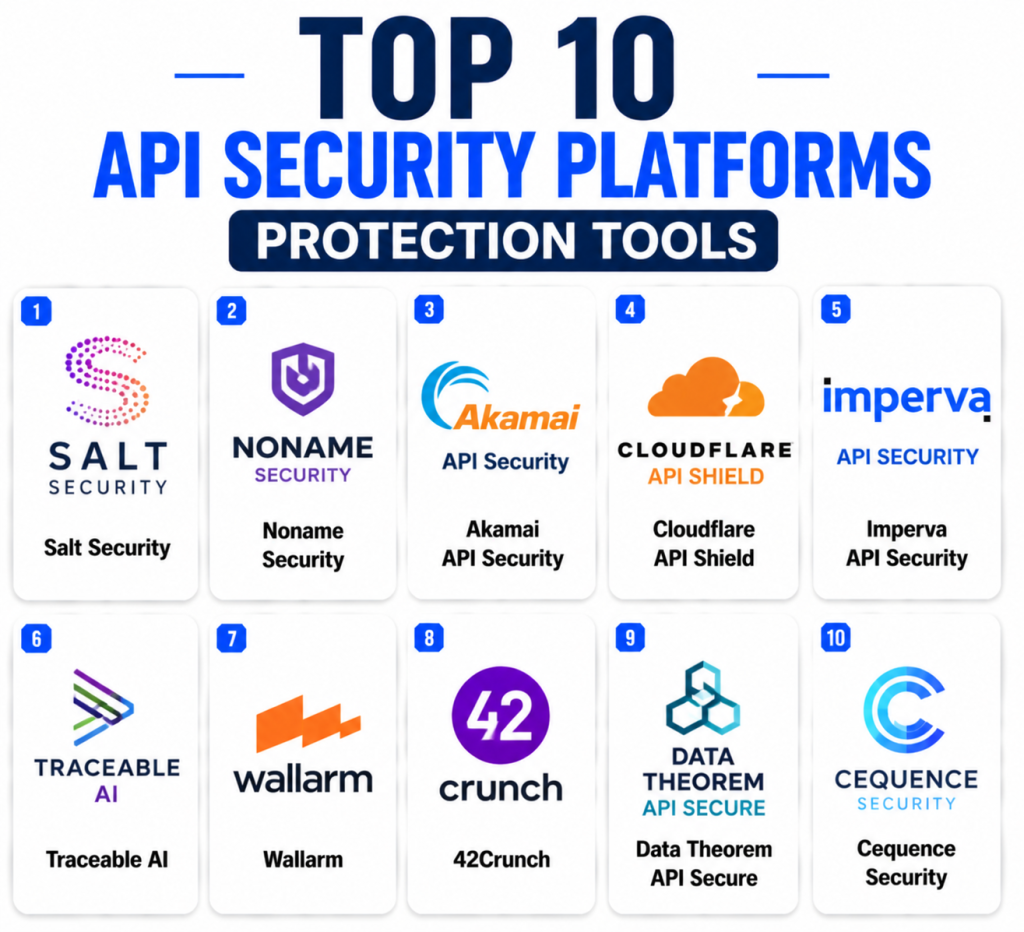
Top 10 API Security Platforms Protection Tools
1 — Salt Security
Short description: Salt Security is a dedicated API security platform focused on API discovery, posture management, and runtime threat protection. It helps organizations identify APIs, understand normal behavior, detect sensitive data exposure, and spot attacks that target business logic. The platform is especially useful for enterprises with large API estates and fast-moving development teams. Salt is designed to help security teams protect APIs without relying only on signature-based rules. It is a strong fit for organizations that need deep visibility into production API behavior. Teams with complex API ecosystems can use it to reduce blind spots and improve API risk management.
Key Features
- API discovery and inventory
- Shadow and zombie API detection
- Runtime API threat detection
- Sensitive data exposure insights
- Behavioral analytics
- API posture management
- Integration with security workflows
Pros
- Strong dedicated API security focus
- Good fit for large API environments
- Useful for detecting business logic abuse
Cons
- May be more than small teams need
- Requires production traffic visibility for full value
- Pricing details are often Varies / N/A
Platforms / Deployment
Cloud / Hybrid
Security & Compliance
SSO/SAML, RBAC, encryption, and audit logging are commonly expected in enterprise deployments. Specific certifications should be verified directly with the vendor.
Integrations & Ecosystem
Salt Security fits into API, cloud, and security operations workflows. It is useful for teams that want API risk insights connected to existing monitoring and response processes.
- API gateways
- Cloud platforms
- SIEM tools
- Ticketing systems
- DevSecOps workflows
- Security dashboards
Support & Community
Salt Security provides enterprise-focused documentation, onboarding, and support. Community visibility is strongest among API security and enterprise AppSec teams.
2 — Noname Security
Short description: Noname Security is an API security platform designed to help organizations discover APIs, analyze risk, test APIs, and detect attacks. It supports API posture management and helps teams identify misconfigurations, exposed sensitive data, authentication issues, and shadow APIs. The platform is useful for enterprises with large API portfolios across internal, external, partner, and cloud environments. Noname is often considered by teams that want API security coverage across development and production. Its value comes from combining discovery, testing, and runtime visibility. It is a strong choice for mature security teams managing complex API ecosystems.
Key Features
- API discovery
- API posture management
- Runtime monitoring
- API security testing
- Sensitive data detection
- Misconfiguration identification
- Security workflow integrations
Pros
- Broad API security coverage
- Useful for both testing and production monitoring
- Good fit for enterprise API governance
Cons
- May require careful deployment planning
- Can be complex for smaller teams
- Full value depends on integration quality
Platforms / Deployment
Cloud / Hybrid
Security & Compliance
SSO/SAML, RBAC, audit logs, and encryption are commonly expected. Specific compliance certifications should be verified directly with the vendor.
Integrations & Ecosystem
Noname Security integrates with API management, cloud, DevSecOps, and SOC workflows to help teams connect API findings with action.
- API gateways
- CI/CD tools
- SIEM platforms
- Cloud services
- Jira
- Security operations workflows
Support & Community
Enterprise support, onboarding guidance, and documentation are typically available. Community strength is more enterprise-focused than open-source-focused.
3 — Akamai API Security
Short description: Akamai API Security helps organizations protect APIs as part of a broader web application and API security strategy. It is designed for companies that need API discovery, risk analysis, abuse detection, and runtime protection across high-traffic digital environments. Akamai is especially relevant for organizations already using its edge, CDN, WAF, bot management, or security capabilities. The platform can help detect shadow APIs, authentication risks, sensitive data exposure, and suspicious usage patterns. It is suitable for enterprises with public-facing APIs and large digital attack surfaces. Its strength is combining API security with broad edge security infrastructure.
Key Features
- API discovery and inventory
- Runtime API threat detection
- Abuse and anomaly detection
- Sensitive data visibility
- Shadow API identification
- Edge security integration
- API risk analytics
Pros
- Strong fit for high-traffic enterprises
- Useful edge and web security ecosystem
- Good for public-facing API protection
Cons
- Best suited for organizations with larger security needs
- May feel heavy for small teams
- Some capabilities depend on broader platform adoption
Platforms / Deployment
Cloud / Hybrid
Security & Compliance
SSO/SAML, RBAC, audit logs, encryption, and enterprise access controls are commonly expected. Specific certifications should be verified directly.
Integrations & Ecosystem
Akamai API Security connects well with web security, edge protection, and security operations environments.
- Akamai security ecosystem
- SIEM platforms
- API gateways
- Cloud environments
- Security dashboards
- Incident response workflows
Support & Community
Akamai offers enterprise support, technical documentation, onboarding resources, and professional services for large-scale security programs.
4 — Cloudflare API Shield
Short description: Cloudflare API Shield is part of Cloudflare’s broader application security and connectivity platform. It helps organizations secure APIs through schema validation, mutual TLS, API discovery, rate limiting, authentication-related controls, and traffic protection. The platform is particularly useful for teams already using Cloudflare for CDN, WAF, bot management, or zero trust services. Cloudflare API Shield is well suited for internet-facing APIs that need performance, security, and global edge enforcement. It provides practical protection for modern web and API-driven applications. It is a strong option for SMB, mid-market, and enterprise teams using Cloudflare’s ecosystem.
Key Features
- API schema validation
- API discovery
- Mutual TLS support
- Rate limiting
- WAF and bot protection alignment
- Edge-based enforcement
- API traffic monitoring
Pros
- Strong edge performance and security
- Good fit for Cloudflare users
- Practical API protection features
Cons
- Deep API posture management may require complementary tools
- Best value depends on Cloudflare adoption
- Complex API governance may need additional workflows
Platforms / Deployment
Cloud
Security & Compliance
SSO/SAML, MFA, RBAC, encryption, and audit logs are commonly available across enterprise security platforms. Specific certifications should be verified directly with the vendor.
Integrations & Ecosystem
Cloudflare API Shield integrates naturally with Cloudflare’s broader ecosystem and can support API protection close to users and attackers.
- Cloudflare WAF
- Cloudflare Zero Trust
- API gateways
- SIEM workflows
- Developer workflows
- Cloud environments
Support & Community
Cloudflare has strong documentation, active developer resources, and enterprise support options. Community visibility is high due to broad platform adoption.
5 — Imperva API Security
Short description: Imperva API Security provides API discovery, protection, and monitoring as part of Imperva’s broader application and data security ecosystem. It is suitable for enterprises that need layered protection across web applications, APIs, bots, and sensitive data. The platform helps security teams identify exposed APIs, detect abuse, and reduce risk from misconfigured or vulnerable endpoints. Imperva is often selected by organizations with regulated environments and large web attack surfaces. Its API security capabilities are strongest when combined with WAF, DDoS, and bot defense strategies. It is a practical option for enterprise-grade application protection.
Key Features
- API discovery
- Runtime API protection
- Web application firewall alignment
- Bot and abuse protection
- Sensitive data visibility
- Threat analytics
- Compliance-focused reporting
Pros
- Strong enterprise security ecosystem
- Good fit for regulated industries
- Useful combination of WAF and API protection
Cons
- May require security expertise to configure well
- Premium platform positioning
- Smaller teams may not need the full stack
Platforms / Deployment
Cloud / Hybrid
Security & Compliance
SSO/SAML, MFA, RBAC, audit logging, and encryption are commonly expected. Specific certifications should be verified directly.
Integrations & Ecosystem
Imperva integrates with enterprise security operations, cloud platforms, and application protection workflows.
- SIEM tools
- Cloud services
- WAF workflows
- API gateways
- Security dashboards
- Incident response tools
Support & Community
Imperva provides enterprise documentation, support tiers, onboarding, and technical account guidance for larger customers.
6 — Traceable AI
Short description: Traceable AI is an API security platform focused on API discovery, attack detection, risk prioritization, and behavioral analysis. It is designed for organizations that need to understand how APIs behave across distributed environments. Traceable helps teams detect suspicious activity, identify sensitive data flows, and prioritize API risks based on actual behavior. It is especially relevant for cloud-native teams, microservices environments, and enterprises with complex API traffic. The platform combines security analytics with observability-style visibility. It is a strong fit for teams that want deep runtime API intelligence.
Key Features
- API discovery and mapping
- Behavioral threat detection
- Sensitive data tracking
- Runtime API monitoring
- Risk prioritization
- Attack investigation
- Cloud-native API visibility
Pros
- Strong behavioral analytics approach
- Useful for microservices environments
- Good runtime visibility
Cons
- May need traffic and environment integration planning
- Smaller teams may find it advanced
- Pricing details are Varies / N/A
Platforms / Deployment
Cloud / Hybrid
Security & Compliance
SSO/SAML, RBAC, audit logs, and encryption are commonly expected in enterprise deployments. Specific certifications should be verified directly with the vendor.
Integrations & Ecosystem
Traceable AI connects API security findings with observability, cloud, and security response workflows.
- Kubernetes
- Cloud platforms
- API gateways
- SIEM tools
- DevSecOps workflows
- Security dashboards
Support & Community
Traceable provides enterprise support, onboarding assistance, technical documentation, and implementation guidance.
7 — Wallarm
Short description: Wallarm is an API security and application protection platform that helps organizations secure APIs, microservices, and web applications. It supports API discovery, threat detection, WAF-style protection, and API abuse prevention. Wallarm is suitable for teams that need protection across cloud-native environments, Kubernetes, and modern application stacks. The platform is often considered by organizations that want API security combined with application protection. It can support both security teams and platform teams responsible for high-volume application environments. Wallarm is a strong option for teams seeking flexible API and app protection.
Key Features
- API security monitoring
- WAF and application protection
- API discovery
- Threat detection
- Bot and abuse protection
- Kubernetes support
- Security analytics
Pros
- Good fit for cloud-native environments
- Combines API and application protection
- Flexible deployment options
Cons
- May require tuning for complex traffic
- Advanced governance may need process maturity
- Some features may vary by plan
Platforms / Deployment
Cloud / Self-hosted / Hybrid
Security & Compliance
SSO/SAML, RBAC, audit logs, and encryption are commonly expected. Specific certifications should be verified directly.
Integrations & Ecosystem
Wallarm integrates with modern infrastructure, security, and DevOps workflows.
- Kubernetes
- NGINX
- Cloud platforms
- SIEM tools
- CI/CD workflows
- API gateways
Support & Community
Wallarm provides documentation, support options, and technical resources for cloud-native and API security use cases.
8 — 42Crunch
Short description: 42Crunch is an API security platform with strong focus on API design, testing, and protection using API contracts such as OpenAPI specifications. It helps teams shift API security left by identifying problems during design and development before APIs are deployed. The platform is useful for developers, API architects, DevSecOps teams, and organizations with formal API governance programs. 42Crunch supports API audit, conformance, scanning, and runtime protection workflows. It is especially helpful when teams want to enforce API security standards early. It is a strong choice for specification-driven API security.
Key Features
- OpenAPI security audit
- API contract testing
- API conformance validation
- Shift-left API security
- API scanning
- Runtime protection options
- Developer workflow integration
Pros
- Strong API design-stage security
- Good for OpenAPI-driven teams
- Useful for developer-first governance
Cons
- Best value requires strong API specification practices
- Runtime protection may need complementary tools
- Less focused on broad WAAP use cases
Platforms / Deployment
Cloud / Self-hosted / Hybrid
Security & Compliance
SSO/SAML, RBAC, audit logs, and encryption are commonly expected in enterprise deployments. Specific compliance details should be verified directly.
Integrations & Ecosystem
42Crunch works well with developer, API design, and CI/CD workflows.
- GitHub
- GitLab
- Jenkins
- Azure DevOps
- OpenAPI workflows
- API gateways
Support & Community
42Crunch offers documentation, support options, and resources for API developers, architects, and DevSecOps teams.
9 — Data Theorem API Secure
Short description: Data Theorem API Secure focuses on API discovery, security testing, and continuous protection for modern applications. It helps organizations detect API vulnerabilities, misconfigurations, data exposure, and authentication risks. The platform is useful for teams that need automated API security assessment across web, mobile, cloud, and microservice environments. Data Theorem is especially relevant for organizations with many APIs connected to mobile and cloud applications. It supports continuous AppSec workflows and helps teams reduce API risk over time. It is a strong fit for companies wanting automated API security testing and monitoring.
Key Features
- API discovery
- API vulnerability testing
- Sensitive data exposure detection
- Authentication and authorization risk analysis
- Continuous security monitoring
- Cloud and mobile API coverage
- AppSec workflow support
Pros
- Good API testing and discovery focus
- Useful for mobile and cloud application teams
- Supports continuous security assessment
Cons
- May not replace broader WAAP platforms
- Enterprise fit depends on integration requirements
- Pricing details are Varies / N/A
Platforms / Deployment
Cloud / Hybrid
Security & Compliance
SSO/SAML, RBAC, encryption, and audit logging are commonly expected. Specific certifications should be verified directly.
Integrations & Ecosystem
Data Theorem integrates with AppSec, development, cloud, and security workflows.
- CI/CD tools
- Cloud platforms
- API workflows
- Security dashboards
- Ticketing tools
- Mobile app pipelines
Support & Community
Data Theorem provides vendor support, onboarding resources, and documentation. Community visibility is strongest among AppSec and API security teams.
10 — Cequence Security
Short description: Cequence Security focuses on API protection, bot defense, fraud prevention, and abuse detection for business-critical applications. It is well suited for organizations that need to protect APIs from automated attacks, credential stuffing, scraping, account takeover, and logic abuse. The platform helps teams discover APIs, analyze traffic, and reduce risk from malicious automation. Cequence is especially relevant for financial services, e-commerce, travel, media, and large digital businesses. It combines API security with protection against automated abuse. It is a strong option for teams dealing with high-volume API traffic and fraud-related risks.
Key Features
- API discovery
- API threat protection
- Bot and automation defense
- Fraud and abuse detection
- Behavioral analytics
- Sensitive endpoint protection
- Runtime traffic analysis
Pros
- Strong focus on API abuse and bot attacks
- Good fit for high-traffic digital businesses
- Useful for fraud-prone environments
Cons
- May be more specialized than general API testing tools
- Best suited for organizations with meaningful API traffic
- Requires operational tuning for abuse detection
Platforms / Deployment
Cloud / Hybrid
Security & Compliance
SSO/SAML, RBAC, audit logs, and encryption are commonly expected. Specific compliance certifications should be verified directly.
Integrations & Ecosystem
Cequence connects API security with fraud, bot defense, and security operations workflows.
- API gateways
- SIEM tools
- Web security platforms
- Cloud environments
- Incident response workflows
- Fraud monitoring workflows
Support & Community
Cequence provides enterprise support, onboarding assistance, documentation, and technical guidance for API protection programs.
Comparison Table Top 10
| Tool Name | Best For | Platform(s) Supported | Deployment | Standout Feature | Public Rating |
|---|---|---|---|---|---|
| Salt Security | Enterprise API discovery and runtime protection | Web | Cloud / Hybrid | Behavioral API threat detection | N/A |
| Noname Security | API posture management and testing | Web | Cloud / Hybrid | Broad API security lifecycle coverage | N/A |
| Akamai API Security | High-traffic public APIs | Web | Cloud / Hybrid | Edge-integrated API protection | N/A |
| Cloudflare API Shield | Cloudflare users and internet-facing APIs | Web | Cloud | Edge-based API enforcement | N/A |
| Imperva API Security | Enterprise WAAP and API protection | Web | Cloud / Hybrid | WAF and API security integration | N/A |
| Traceable AI | Runtime API behavior analytics | Web | Cloud / Hybrid | Deep API behavior visibility | N/A |
| Wallarm | Cloud-native API and app protection | Web / Linux | Cloud / Self-hosted / Hybrid | API security with flexible deployment | N/A |
| 42Crunch | OpenAPI-driven security governance | Web | Cloud / Self-hosted / Hybrid | API contract-based security | N/A |
| Data Theorem API Secure | Continuous API security testing | Web | Cloud / Hybrid | API testing and discovery automation | N/A |
| Cequence Security | API abuse and bot protection | Web | Cloud / Hybrid | API fraud and automation defense | N/A |
Evaluation & Scoring of API Security Platforms
| Tool Name | Core 25% | Ease 15% | Integrations 15% | Security 10% | Performance 10% | Support 10% | Value 15% | Weighted Total 0-10 |
| Salt Security | 9.4 | 8.2 | 8.8 | 9.0 | 8.8 | 8.7 | 8.0 | 8.78 |
| Noname Security | 9.2 | 8.0 | 8.8 | 9.0 | 8.7 | 8.6 | 8.0 | 8.67 |
| Akamai API Security | 9.0 | 8.0 | 9.0 | 9.2 | 9.3 | 8.8 | 7.8 | 8.75 |
| Cloudflare API Shield | 8.5 | 8.8 | 8.8 | 8.8 | 9.2 | 8.5 | 8.5 | 8.71 |
| Imperva API Security | 8.9 | 7.8 | 8.7 | 9.2 | 8.8 | 8.8 | 7.8 | 8.55 |
| Traceable AI | 9.0 | 8.1 | 8.6 | 9.0 | 8.8 | 8.5 | 8.0 | 8.61 |
| Wallarm | 8.6 | 8.3 | 8.5 | 8.7 | 8.7 | 8.2 | 8.3 | 8.49 |
| 42Crunch | 8.3 | 8.5 | 8.7 | 8.5 | 8.2 | 8.2 | 8.4 | 8.40 |
| Data Theorem API Secure | 8.5 | 8.2 | 8.3 | 8.6 | 8.4 | 8.2 | 8.1 | 8.36 |
| Cequence Security | 8.7 | 8.0 | 8.5 | 8.9 | 8.8 | 8.4 | 8.0 | 8.50 |
Scores are comparative and should be interpreted as guidance, not absolute truth. A higher total indicates stronger overall balance across API security features, usability, integrations, and value. Dedicated API security tools often score higher on API discovery and runtime analytics, while edge platforms may score higher on performance and traffic enforcement. The right choice depends on API volume, business risk, team maturity, and existing infrastructure.
Which API Security Platform Tool Is Right for You?
Solo / Freelancer
Solo developers and freelancers usually do not need a large enterprise API security platform. A practical approach is to start with secure API design, strong authentication, gateway controls, schema validation, and basic testing. If you use Cloudflare already, API Shield can be a useful option. If your work is OpenAPI-driven, 42Crunch can help validate API security earlier.
SMB
SMBs should prioritize ease of setup, clear reporting, and practical protection. Cloudflare API Shield, Wallarm, 42Crunch, and Data Theorem API Secure can be good fits depending on the API environment. If the business handles sensitive customer data, API discovery and runtime monitoring should be prioritized.
Mid-Market
Mid-market companies usually need both visibility and protection. Salt Security, Noname Security, Traceable AI, Wallarm, and Data Theorem API Secure can help teams discover APIs, detect risky behavior, and improve posture. If the company already uses Cloudflare, Akamai, or Imperva, API security within those ecosystems may reduce tool sprawl.
Enterprise
Enterprises should prioritize API inventory, sensitive data mapping, runtime threat detection, compliance reporting, integration depth, and scalability. Salt Security, Noname Security, Akamai API Security, Imperva API Security, Traceable AI, and Cequence Security are strong candidates. Large organizations should also evaluate deployment models, traffic coverage, and operational workflows.
Budget vs Premium
Budget-conscious teams should start with API gateway controls, schema validation, secure coding practices, and targeted API testing. Premium buyers should look at Salt Security, Noname Security, Akamai, Imperva, Traceable AI, or Cequence for broader enterprise coverage. Cloudflare and Wallarm can offer practical value when they align with existing architecture.
Feature Depth vs Ease of Use
Salt Security, Noname Security, and Traceable AI are strong for deep API discovery and behavioral analytics. Cloudflare API Shield and Wallarm may feel easier for teams that want practical traffic protection. 42Crunch is best for teams that value API contract quality and shift-left governance.
Integrations & Scalability
Enterprises should verify API gateway support, cloud platform integration, SIEM/SOAR workflows, ticketing, CI/CD pipelines, and reporting APIs. Akamai, Cloudflare, Imperva, Salt Security, Noname Security, and Traceable AI are strong options when scale and integrations matter. Teams should test integration quality during a pilot rather than relying only on feature lists.
Security & Compliance Needs
Regulated organizations should prioritize audit logs, RBAC, SSO/SAML, encryption, sensitive data discovery, retention controls, and reporting. Imperva, Akamai, Salt Security, Noname Security, Traceable AI, and Cequence are strong options for security-focused environments. Buyers should verify specific compliance claims directly before purchase.
Frequently Asked Questions FAQs
1. What is an API Security Platform?
An API Security Platform helps organizations discover, monitor, test, and protect APIs from attacks and misuse. It provides visibility into API inventory, sensitive data exposure, authentication risks, and abnormal behavior.
2. How is API security different from a WAF?
A WAF protects web applications mainly through traffic inspection and rule enforcement. API security platforms go deeper into API discovery, schema analysis, sensitive data flow, business logic abuse, and API-specific risk management.
3. Do API gateways replace API security platforms?
No. API gateways help manage routing, authentication, rate limiting, and access control. API security platforms add discovery, risk analysis, threat detection, posture management, and security monitoring across APIs.
4. What pricing models are common for API security tools?
Pricing often depends on API traffic volume, number of APIs, protected applications, deployment type, and enterprise features. If pricing is not publicly clear, treat it as Varies / N/A and request a vendor quote.
5. How long does API security implementation take?
Basic setup can be quick when traffic sources and gateways are easy to connect. Larger environments may require weeks to map APIs, validate ownership, tune alerts, and integrate findings with security workflows.
6. What are common API security mistakes?
Common mistakes include ignoring shadow APIs, relying only on gateways, failing to validate authorization, exposing sensitive data, weak rate limiting, and not monitoring real production behavior.
7. Can API security tools detect business logic attacks?
Some advanced platforms can detect unusual behavior and abuse patterns that may indicate business logic attacks. However, buyers should test this carefully because effectiveness depends on data, context, and tuning.
8. Are API security platforms useful for GraphQL?
Many modern platforms are improving GraphQL support, but coverage varies. Buyers should verify schema handling, introspection risks, query abuse detection, and monitoring capabilities before choosing a tool.
9. Which teams should own API security?
API security is usually shared by AppSec, DevSecOps, platform engineering, API owners, and security operations. Clear ownership is important because API risks often involve both technical and business context.
10. Can small teams use API security tools?
Yes, but small teams should avoid overbuying. They can start with API gateway controls, secure authentication, schema validation, Cloudflare API Shield, 42Crunch, Wallarm, or focused testing before moving to larger platforms.
Conclusion
API Security Platforms are becoming essential because APIs now carry critical business logic, customer data, partner integrations, and application traffic. The best platform depends on your API architecture, traffic volume, existing tools, security maturity, and compliance requirements. Salt Security, Noname Security, Traceable AI, and Data Theorem are strong for dedicated API discovery and risk visibility. Akamai, Cloudflare, Imperva, Wallarm, and Cequence are strong when API protection must connect with broader web, edge, bot, and runtime security. 42Crunch is especially useful for teams that want strong API design-stage governance.There is no single universal winner. Shortlist two or three tools based on your real API environment, run a pilot using actual traffic and API specifications, compare discovery accuracy and alert quality, then validate integrations, reporting, security controls, and operational ownership before making a final decision.
