Introduction
Application Security Testing platforms help teams find, prioritize, and fix security weaknesses in software before attackers exploit them. SAST analyzes source code, bytecode, or binaries to detect insecure patterns early in development, while DAST tests running applications from the outside to identify real-world exploitable issues. Together, they help organizations protect web apps, APIs, microservices, mobile backends, and cloud-native workloads.
Application security testing matters more now because software delivery is faster, applications are more distributed, and security teams must support developers without slowing releases. Modern buyers need platforms that work inside CI/CD pipelines, reduce false positives, support compliance reporting, and provide actionable remediation guidance.
Real-world use cases include secure code review, pre-release vulnerability testing, API security validation, compliance evidence collection, and DevSecOps automation.
Buyers should evaluate language support, scanning depth, CI/CD integration, API testing, false-positive handling, remediation guidance, reporting, scalability, pricing flexibility, and developer experience.
Best for: Application security teams, DevSecOps teams, software engineering leaders, SaaS companies, fintech, healthcare, e-commerce, enterprises, and regulated organizations that need repeatable security testing across many applications.
Not ideal for: Very small websites, static landing pages, or teams with no active software development pipeline. In those cases, basic vulnerability scanning, managed hosting security, or periodic manual testing may be enough.
Key Trends in Application Security Testing SAST DAST Platforms
- AI-assisted remediation is becoming more common, helping developers understand security findings faster and reduce time spent interpreting scanner results.
- Unified AppSec platforms are replacing isolated tools by combining SAST, DAST, SCA, IaC scanning, secrets detection, API testing, and posture management.
- Developer-first security workflows are now a major requirement, with IDE plugins, pull request comments, and CI/CD gates becoming standard.
- API security testing is gaining importance as more business logic moves into REST, GraphQL, and microservice-based architectures.
- Risk-based prioritization is improving, helping teams focus on exploitable, reachable, business-critical issues instead of long vulnerability lists.
- Cloud-native support is expanding across containers, Kubernetes, serverless workloads, and infrastructure-as-code pipelines.
- Compliance reporting automation is becoming important for regulated industries that need audit-ready evidence.
- Shift-left and shift-right testing are being combined, where code scanning, dynamic testing, runtime signals, and production context work together.
- Open-source scanning tools continue to grow, especially for developer teams that need flexible and cost-effective testing.
- Security tool consolidation is increasing as companies look for fewer dashboards, better integrations, and clearer ownership.
How We Selected These Tools Methodology
- Selected tools with strong recognition in application security testing and DevSecOps workflows.
- Prioritized platforms that support SAST, DAST, or broader AppSec testing capabilities.
- Considered enterprise readiness, developer usability, and integration depth.
- Included a mix of enterprise platforms, developer-first tools, and open-source-friendly options.
- Evaluated how well each tool supports CI/CD automation and modern software delivery.
- Considered language, framework, API, and cloud-native coverage.
- Looked for practical security workflow value across SMB, mid-market, and enterprise teams.
- Avoided unsupported claims around certifications, ratings, or pricing where details are not clearly stated.
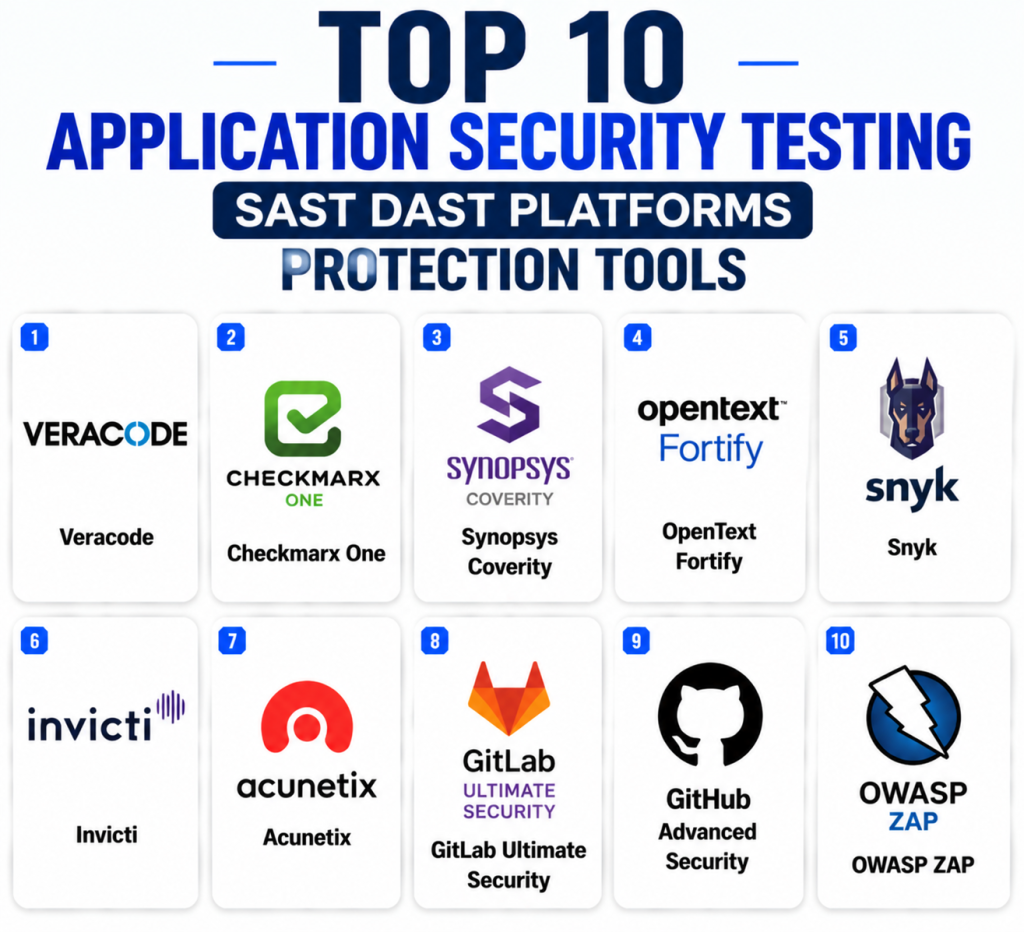
Top 10 Application Security Testing SAST DAST Platforms Protection Tools
1 — Veracode
Short description: Veracode is a widely recognized application security testing platform used by enterprises and growing software teams. It supports secure software development through static analysis, dynamic analysis, software composition analysis, and developer-focused remediation workflows. The platform is designed for teams that need centralized AppSec governance across many applications. It is especially useful for organizations with compliance requirements, distributed engineering teams, and formal security review processes. Veracode helps security leaders manage application risk at scale while giving developers actionable guidance. It is a strong fit for mature DevSecOps programs.
Key Features
- Static application security testing
- Dynamic application security testing
- Software composition analysis
- Developer remediation guidance
- Policy management and reporting
- CI/CD workflow integration
- Application risk tracking
Pros
- Strong enterprise AppSec coverage
- Mature reporting and governance features
- Suitable for large application portfolios
Cons
- May require onboarding effort for complex environments
- Pricing can be less suitable for very small teams
- Best value comes when used as part of a broader AppSec program
Platforms / Deployment
Cloud / Hybrid
Security & Compliance
SSO/SAML, MFA, RBAC, audit logs, and encryption are commonly expected in enterprise deployments. Specific certifications should be verified directly with the vendor.
Integrations & Ecosystem
Veracode integrates with common development, CI/CD, ticketing, and security workflows, making it useful for teams that want application testing inside existing engineering pipelines.
- GitHub
- GitLab
- Jenkins
- Azure DevOps
- Jira
- SIEM workflows
Support & Community
Veracode offers enterprise-focused support, onboarding resources, documentation, and training options. Community strength is strongest among enterprise AppSec and DevSecOps teams.
2 — Checkmarx One
Short description: Checkmarx One is a comprehensive application security testing platform focused on helping teams identify and manage software risk from code to cloud. It includes capabilities across SAST, SCA, IaC security, API security, and application risk management. The platform is well suited for organizations that want a centralized AppSec program with developer workflow integration. Checkmarx is often used by enterprises with large engineering teams and complex application portfolios. Its value comes from combining scanning depth with policy control and remediation support. It is a strong option for security teams that need structured governance.
Key Features
- SAST scanning
- Software composition analysis
- Infrastructure-as-code scanning
- API security testing support
- Developer remediation workflows
- Application risk management
- CI/CD and repository integrations
Pros
- Broad AppSec platform coverage
- Strong developer workflow alignment
- Useful for enterprise security governance
Cons
- Can require tuning to reduce noise
- Implementation may be complex for large portfolios
- Advanced capabilities may require platform familiarity
Platforms / Deployment
Cloud / Hybrid
Security & Compliance
SSO/SAML, RBAC, MFA, audit logs, and encryption are commonly supported in enterprise AppSec platforms. Specific compliance certifications should be verified with the vendor.
Integrations & Ecosystem
Checkmarx integrates with source control, CI/CD, issue tracking, and developer platforms to support secure software delivery.
- GitHub
- GitLab
- Bitbucket
- Jenkins
- Azure DevOps
- Jira
Support & Community
Checkmarx provides enterprise support, technical documentation, onboarding services, and developer education resources. Community visibility is strong in the AppSec market.
3 — Synopsys Coverity
Short description: Synopsys Coverity is a static application security testing solution known for deep code analysis and enterprise-grade software quality and security workflows. It is commonly used in industries where software reliability, code quality, and security are all important. Coverity is especially valuable for large codebases, embedded systems, enterprise applications, and regulated environments. It helps teams detect coding defects, security weaknesses, and maintainability issues earlier in the development lifecycle. The tool is often chosen by organizations that need rigorous analysis and strong governance. It fits well into mature engineering and security programs.
Key Features
- Static code analysis
- Security vulnerability detection
- Code quality analysis
- Broad language support
- Defect tracking
- Developer remediation guidance
- Enterprise reporting
Pros
- Strong code analysis depth
- Useful for complex and large-scale software
- Strong fit for regulated engineering environments
Cons
- May require expert configuration
- Not the simplest option for small teams
- Best suited for mature development processes
Platforms / Deployment
Cloud / Self-hosted / Hybrid
Security & Compliance
RBAC, access controls, audit capabilities, and secure enterprise deployment options are typically expected. Specific certifications should be verified directly.
Integrations & Ecosystem
Coverity works well with enterprise development environments and CI/CD pipelines.
- Jenkins
- GitHub
- GitLab
- Azure DevOps
- Jira
- IDE workflows
Support & Community
Synopsys provides enterprise-grade support, documentation, professional services, and training. Community strength is strongest among enterprise engineering and AppSec teams.
4 — OpenText Fortify
Short description: OpenText Fortify is a long-standing application security testing platform used for static, dynamic, and software security analysis. It is designed for organizations that need scalable AppSec testing, policy enforcement, and centralized vulnerability management. Fortify is commonly used by enterprises, government agencies, and regulated organizations with large application portfolios. It supports secure development workflows and provides visibility across application risk. The platform is especially useful when teams need structured governance and repeatable scanning processes. It remains a strong choice for organizations with mature AppSec requirements.
Key Features
- Static application security testing
- Dynamic application security testing
- Software composition analysis support
- Centralized vulnerability management
- Policy-based security controls
- Developer remediation guidance
- Enterprise reporting
Pros
- Mature enterprise AppSec platform
- Strong governance and reporting
- Broad testing coverage
Cons
- Can be complex to deploy and manage
- May require AppSec expertise
- User experience may feel enterprise-heavy for smaller teams
Platforms / Deployment
Cloud / Self-hosted / Hybrid
Security & Compliance
SSO/SAML, RBAC, audit logs, encryption, and enterprise access controls are commonly expected. Specific compliance details should be verified with the vendor.
Integrations & Ecosystem
Fortify integrates with development pipelines, ticketing systems, repositories, and security operations workflows.
- Jenkins
- GitHub
- GitLab
- Azure DevOps
- Jira
- Security dashboards
Support & Community
OpenText provides enterprise support, documentation, implementation guidance, and professional services. Community presence is strongest in large enterprise and regulated environments.
5 — Snyk
Short description: Snyk is a developer-first security platform that helps teams find and fix vulnerabilities in code, open-source dependencies, containers, and infrastructure as code. While Snyk is especially well known for software composition analysis and developer workflows, it also supports code security testing and broader AppSec use cases. It is popular among cloud-native teams, startups, SMBs, and enterprises that want security embedded into developer workflows. Snyk focuses heavily on usability and actionable remediation. It is a strong fit for teams that want fast adoption and practical developer engagement.
Key Features
- Code security scanning
- Open-source dependency scanning
- Container security
- Infrastructure-as-code scanning
- Developer remediation guidance
- Pull request checks
- CI/CD integrations
Pros
- Strong developer experience
- Easy adoption for modern teams
- Broad cloud-native security coverage
Cons
- Enterprise governance may require careful configuration
- Costs can scale with usage
- DAST depth may not match dedicated DAST platforms
Platforms / Deployment
Cloud / Hybrid
Security & Compliance
SSO/SAML, RBAC, MFA, audit logs, and encryption are commonly available in enterprise plans. Specific certifications should be verified with the vendor.
Integrations & Ecosystem
Snyk has a broad developer ecosystem and integrates naturally with modern repositories and CI/CD pipelines.
- GitHub
- GitLab
- Bitbucket
- Jenkins
- Azure DevOps
- Docker workflows
Support & Community
Snyk has strong documentation, developer education resources, active community visibility, and commercial support tiers.
6 — Invicti
Short description: Invicti is a dynamic application security testing platform focused on web application and API vulnerability scanning. It helps security teams identify exploitable vulnerabilities in running applications and provides evidence-based findings to reduce false positives. Invicti is well suited for teams that need automated DAST coverage across many websites, web applications, and APIs. It is commonly used by security teams, managed service providers, and organizations with large web attack surfaces. The platform focuses on automation, accuracy, and scalable web security testing. It is a strong choice when DAST depth is the priority.
Key Features
- Dynamic application security testing
- Web application vulnerability scanning
- API security testing
- Proof-based scanning
- Authentication support
- Scheduled scanning
- Reporting and remediation guidance
Pros
- Strong DAST specialization
- Useful for web application portfolios
- Evidence-based findings help reduce noise
Cons
- Less focused on SAST than full AppSec platforms
- Requires proper authentication setup for deep testing
- May need tuning for complex applications
Platforms / Deployment
Cloud / Self-hosted / Hybrid
Security & Compliance
RBAC, SSO/SAML, audit logs, and encryption are commonly expected in enterprise deployments. Specific certifications should be verified directly.
Integrations & Ecosystem
Invicti integrates with security operations, issue tracking, and CI/CD workflows.
- Jira
- GitHub
- GitLab
- Jenkins
- Azure DevOps
- SIEM workflows
Support & Community
Invicti provides documentation, onboarding resources, enterprise support, and technical guidance for scanner configuration.
7 — Acunetix
Short description: Acunetix is a web vulnerability scanning and DAST platform focused on detecting security issues in websites, web applications, and APIs. It is often used by SMBs, mid-market companies, security consultants, and internal security teams. Acunetix helps teams scan for common vulnerabilities, misconfigurations, weak authentication patterns, and exposed application risks. Its value is strongest for organizations that need practical web application scanning without building a large AppSec program. The platform is known for accessible setup and clear scanning workflows. It is a good option for teams focused primarily on dynamic testing.
Key Features
- Web vulnerability scanning
- DAST scanning
- API scanning support
- Authentication testing
- Scheduled scans
- Vulnerability reporting
- Remediation guidance
Pros
- Good usability for smaller teams
- Strong web application scanning focus
- Practical reporting workflows
Cons
- Less complete than broader AppSec platforms
- SAST capabilities are not its primary focus
- Complex applications may need careful scan configuration
Platforms / Deployment
Cloud / Self-hosted / Hybrid
Security & Compliance
RBAC, access controls, audit logs, and encryption are commonly expected. Specific compliance claims should be verified directly.
Integrations & Ecosystem
Acunetix integrates with development and issue-tracking workflows to help teams manage vulnerability remediation.
- Jira
- GitHub
- GitLab
- Jenkins
- Azure DevOps
- API workflows
Support & Community
Acunetix provides documentation, commercial support, and practical onboarding resources. Community presence is strongest among web security practitioners.
8 — GitLab Ultimate Security
Short description: GitLab Ultimate includes application security testing capabilities directly inside the GitLab DevSecOps platform. It supports secure development workflows by bringing SAST, DAST, dependency scanning, container scanning, secrets detection, and IaC scanning into CI/CD pipelines. It is ideal for teams already using GitLab for source control, CI/CD, and software delivery. The main advantage is workflow consolidation because developers can see security findings inside the same platform where code is built and deployed. It is useful for organizations that want fewer disconnected tools. GitLab is especially strong for DevSecOps pipeline automation.
Key Features
- SAST scanning
- DAST scanning
- Dependency scanning
- Container scanning
- Secret detection
- CI/CD security gates
- Vulnerability management dashboard
Pros
- Security built into DevOps workflows
- Strong fit for GitLab users
- Reduces tool fragmentation
Cons
- Best value depends on GitLab adoption
- May not replace specialized enterprise AppSec platforms
- Requires pipeline configuration discipline
Platforms / Deployment
Cloud / Self-hosted / Hybrid
Security & Compliance
SSO/SAML, MFA, RBAC, audit logs, and encryption are commonly supported depending on deployment and plan. Specific certifications should be verified directly.
Integrations & Ecosystem
GitLab integrates naturally with its built-in DevSecOps ecosystem and also connects with external tools.
- GitLab CI/CD
- Kubernetes
- Container registries
- Jira
- Cloud platforms
- Security dashboards
Support & Community
GitLab has strong documentation, active community resources, enterprise support, and a large DevOps user base.
9 — GitHub Advanced Security
Short description: GitHub Advanced Security brings security testing into GitHub-based development workflows. It includes code scanning, secret scanning, and dependency security features designed to help developers identify and fix issues early. For teams already building software on GitHub, it provides a natural way to integrate security into pull requests and repositories. It is especially useful for developer-first organizations that want security feedback close to the code. While it may not replace every dedicated DAST or enterprise AppSec platform, it offers strong shift-left capabilities. It is a practical option for modern engineering teams.
Key Features
- Code scanning
- Secret scanning
- Dependency vulnerability alerts
- Pull request security feedback
- Security overview dashboards
- Developer workflow integration
- Repository-level security insights
Pros
- Excellent fit for GitHub users
- Strong developer adoption potential
- Security feedback appears close to the code
Cons
- DAST coverage may require additional tools
- Best suited for GitHub-centric teams
- Enterprise governance may need complementary tooling
Platforms / Deployment
Cloud / Self-hosted / Hybrid
Security & Compliance
SSO/SAML, MFA, RBAC, audit logs, and encryption are commonly available in enterprise GitHub environments. Specific certifications should be verified directly.
Integrations & Ecosystem
GitHub Advanced Security works deeply within GitHub workflows and supports broader developer ecosystem integrations.
- GitHub Actions
- Pull requests
- CodeQL
- Dependabot
- Security dashboards
- CI/CD workflows
Support & Community
GitHub has extensive documentation, large community adoption, and enterprise support options. Developer community strength is very high.
10 — OWASP ZAP
Short description: OWASP ZAP is a widely used open-source dynamic application security testing tool for finding vulnerabilities in web applications. It is popular among developers, security testers, students, consultants, and organizations that need a flexible DAST option without commercial licensing costs. ZAP can be used manually or automated inside CI/CD pipelines. It is especially useful for learning, baseline scanning, and integrating security checks into development workflows. While it may require more manual tuning than commercial scanners, its flexibility and community strength make it valuable. It is a strong choice for budget-conscious and technically capable teams.
Key Features
- Open-source DAST scanning
- Web application vulnerability testing
- Proxy-based manual testing
- Automated baseline scans
- API testing support
- CI/CD integration options
- Extensible add-ons
Pros
- Free and open source
- Strong learning and testing value
- Flexible for technical teams
Cons
- Requires security knowledge to use effectively
- Reporting and governance are less polished than enterprise tools
- May need tuning for production-scale programs
Platforms / Deployment
Windows / macOS / Linux / Self-hosted
Security & Compliance
Not publicly stated
Integrations & Ecosystem
OWASP ZAP has a strong open-source ecosystem and can be integrated into developer and testing workflows.
- CI/CD pipelines
- Docker workflows
- API testing workflows
- Manual penetration testing
- Custom scripts
- Open-source add-ons
Support & Community
Community support is strong through OWASP and open-source contributors. Commercial-style onboarding and dedicated support are not the main model.
Comparison Table Top 10
| Tool Name | Best For | Platform(s) Supported | Deployment | Standout Feature | Public Rating |
|---|---|---|---|---|---|
| Veracode | Enterprise AppSec programs | Web | Cloud / Hybrid | Broad SAST and DAST governance | N/A |
| Checkmarx One | DevSecOps and enterprise code security | Web | Cloud / Hybrid | Unified AppSec platform | N/A |
| Synopsys Coverity | Deep static code analysis | Web / Windows / Linux | Cloud / Self-hosted / Hybrid | Advanced code analysis depth | N/A |
| OpenText Fortify | Large regulated organizations | Web / Windows / Linux | Cloud / Self-hosted / Hybrid | Mature enterprise AppSec testing | N/A |
| Snyk | Developer-first cloud-native teams | Web | Cloud / Hybrid | Developer-friendly remediation | N/A |
| Invicti | Web application DAST | Web | Cloud / Self-hosted / Hybrid | Proof-based dynamic scanning | N/A |
| Acunetix | SMB and mid-market web scanning | Web | Cloud / Self-hosted / Hybrid | Accessible DAST workflows | N/A |
| GitLab Ultimate Security | GitLab-based DevSecOps teams | Web / Linux | Cloud / Self-hosted / Hybrid | Built-in CI/CD security testing | N/A |
| GitHub Advanced Security | GitHub-based engineering teams | Web | Cloud / Self-hosted / Hybrid | Code scanning inside repositories | N/A |
| OWASP ZAP | Open-source DAST testing | Windows / macOS / Linux | Self-hosted | Free and flexible web scanning | N/A |
Evaluation & Scoring of Application Security Testing Platforms
| Tool Name | Core 25% | Ease 15% | Integrations 15% | Security 10% | Performance 10% | Support 10% | Value 15% | Weighted Total 0-10 |
| Veracode | 9.3 | 8.2 | 8.8 | 9.0 | 8.7 | 9.0 | 8.0 | 8.72 |
| Checkmarx One | 9.2 | 8.0 | 9.0 | 9.0 | 8.6 | 8.8 | 8.0 | 8.67 |
| Synopsys Coverity | 9.0 | 7.6 | 8.5 | 8.8 | 8.8 | 8.7 | 7.8 | 8.45 |
| OpenText Fortify | 9.1 | 7.5 | 8.6 | 9.0 | 8.5 | 8.8 | 7.7 | 8.45 |
| Snyk | 8.7 | 9.2 | 9.2 | 8.5 | 8.6 | 8.5 | 8.4 | 8.75 |
| Invicti | 8.8 | 8.5 | 8.4 | 8.5 | 8.7 | 8.3 | 8.2 | 8.53 |
| Acunetix | 8.3 | 8.8 | 8.0 | 8.2 | 8.5 | 8.0 | 8.5 | 8.37 |
| GitLab Ultimate Security | 8.5 | 8.8 | 9.3 | 8.7 | 8.5 | 8.4 | 8.3 | 8.66 |
| GitHub Advanced Security | 8.3 | 9.0 | 9.2 | 8.7 | 8.7 | 8.5 | 8.4 | 8.65 |
| OWASP ZAP | 7.5 | 7.2 | 7.8 | 7.0 | 7.8 | 7.5 | 9.5 | 7.83 |
These scores are comparative and should not be treated as universal rankings. A platform with a lower total may still be the right fit if it matches your environment, budget, and technical maturity. Enterprise buyers should weigh governance, reporting, and scale more heavily. Developer-first teams may prioritize usability, pull request integration, and fast remediation workflows. Open-source teams may accept more manual effort in exchange for flexibility and lower cost.
Which Application Security Testing Tool Is Right for You?
Solo / Freelancer
Solo developers and freelancers usually do not need a full enterprise AppSec platform. OWASP ZAP is a practical starting point for dynamic testing, while GitHub Advanced Security or Snyk can help if the project already lives in modern developer workflows. The key is to keep scanning simple, affordable, and repeatable.
SMB
SMBs should prioritize ease of use, fast onboarding, and clear remediation guidance. Snyk, Acunetix, GitHub Advanced Security, and GitLab Ultimate Security are strong options depending on the team’s existing toolchain. If the business has customer-facing web applications, adding DAST coverage with Acunetix or Invicti can be valuable.
Mid-Market
Mid-market companies often need a balance of developer adoption and centralized governance. Checkmarx One, Veracode, Snyk, GitLab Ultimate Security, and Invicti can all work well depending on application complexity. Teams should focus on CI/CD integrations, policy controls, reporting, and manageable false-positive rates.
Enterprise
Enterprises should prioritize portfolio visibility, policy management, compliance reporting, integration depth, and scalability. Veracode, Checkmarx One, OpenText Fortify, and Synopsys Coverity are strong enterprise-focused options. Large organizations may also combine these with GitHub, GitLab, Snyk, or DAST-specific platforms.
Budget vs Premium
Budget-conscious teams can start with OWASP ZAP, GitHub-native security features, or focused SMB-friendly scanners. Premium buyers should consider Veracode, Checkmarx, Fortify, Coverity, Invicti, or Snyk depending on whether the main requirement is governance, code analysis depth, dynamic scanning, or developer experience.
Feature Depth vs Ease of Use
For deep enterprise testing, Veracode, Checkmarx, Fortify, and Coverity provide mature capabilities. For easier developer adoption, Snyk, GitHub Advanced Security, GitLab Ultimate Security, and Acunetix may feel more accessible. The right choice depends on whether the organization values depth, simplicity, or workflow consolidation.
Integrations & Scalability
Teams already using GitHub or GitLab should strongly consider built-in security capabilities because adoption is easier. Enterprises with mixed repositories, multiple CI/CD systems, and many application teams may need Veracode, Checkmarx, Fortify, or Snyk for broader integration coverage and centralized management.
Security & Compliance Needs
Highly regulated organizations should focus on audit logs, RBAC, SSO, policy management, reporting, and evidence collection. Veracode, Checkmarx, Fortify, and Coverity are strong candidates for governance-heavy environments. Smaller teams should still verify access controls, encryption, and reporting before selecting a platform.
Frequently Asked Questions FAQs
1. What is the difference between SAST and DAST?
SAST checks application code before the application runs, helping developers find insecure coding patterns early. DAST tests a running application from the outside, identifying vulnerabilities that may be exploitable in real-world conditions.
2. Do companies need both SAST and DAST?
Most mature security programs benefit from both. SAST helps find issues early in development, while DAST validates security from an attacker-like perspective after the application is running.
3. How much do application security testing platforms cost?
Pricing varies widely based on number of applications, users, scan volume, deployment type, and platform modules. If pricing is not publicly clear, buyers should treat it as Varies / N/A and request a vendor quote.
4. How long does onboarding usually take?
Simple tools can be adopted in days, especially when integrated with GitHub or GitLab. Enterprise platforms may take weeks or months depending on application count, policy setup, authentication, reporting, and team training.
5. What are common mistakes when choosing SAST or DAST tools?
Common mistakes include choosing tools without developer input, ignoring false-positive management, failing to test CI/CD integration, and buying broad platforms without a clear remediation workflow.
6. Can SAST and DAST replace penetration testing?
No. Automated testing improves coverage and consistency, but manual penetration testing is still useful for complex business logic, chained attacks, authentication flaws, and creative attacker behavior.
7. Are open-source tools enough for application security testing?
Open-source tools like OWASP ZAP can be very useful, especially for technical teams. However, larger organizations may need commercial reporting, governance, support, scalability, and compliance features.
8. Which tool is best for developer-first teams?
Snyk, GitHub Advanced Security, and GitLab Ultimate Security are strong developer-first options. They work close to repositories, pull requests, and CI/CD pipelines, which improves adoption.
9. Which tool is best for enterprise governance?
Veracode, Checkmarx One, OpenText Fortify, and Synopsys Coverity are strong choices for governance-heavy environments. They are better suited for large application portfolios and formal AppSec programs.
10. How should teams reduce false positives?
Teams should tune policies, prioritize high-confidence findings, map vulnerabilities to reachable code, and use developer feedback loops. Good onboarding and scanning configuration are critical for long-term success.
Conclusion
Application Security Testing platforms are now a core part of modern software security because they help teams detect vulnerabilities earlier, validate running applications, and build safer release pipelines. SAST and DAST are strongest when used together, supported by developer-friendly workflows, CI/CD automation, clear remediation guidance, and governance controls. Veracode, Checkmarx, Fortify, and Coverity are strong for enterprise AppSec programs, while Snyk, GitHub Advanced Security, and GitLab Ultimate Security are attractive for developer-first teams. Invicti and Acunetix are practical choices when dynamic web application testing is the main priority, and OWASP ZAP remains a valuable open-source option.The best tool depends on your application portfolio, team size, budget, compliance needs, and existing development workflow. Start by shortlisting two or three platforms that match your environment, run a pilot on real applications, compare scan accuracy and developer experience, then validate integrations, reporting, access controls, and remediation workflows before making a final decision.
