Introduction
Browser-based SSO (Single Sign-On) portals are identity access systems that allow users to log in once through a secure web portal and access multiple applications without re-entering credentials. In simple terms, these tools act as a centralized login gateway for all SaaS apps, internal systems, and cloud platforms used by an organization.
These platforms have become critical as businesses adopt remote work, SaaS-heavy environments, and Zero Trust security models. Instead of managing dozens or hundreds of passwords, users authenticate through a single browser-based portal that enforces identity verification, security policies, and access control.
Common real-world use cases include:
- Centralized access to SaaS applications through a secure dashboard
- Secure login for remote employees and distributed teams
- Enforcing multi-factor authentication across all business apps
- Reducing password fatigue and credential reuse risks
- Controlling third-party application access in enterprise environments
Buyers should evaluate authentication strength, integration coverage, user lifecycle management, security policies, MFA capabilities, directory support, scalability, compliance readiness, and ease of deployment.
Best for: IT administrators, security teams, enterprises, SaaS-driven companies, hybrid workforces, and organizations with large application ecosystems.
Not ideal for: Very small businesses with minimal application usage or organizations that only need basic password storage.
Key Trends in Browser-based SSO Portals
- Shift toward passwordless authentication using biometrics and passkeys
- AI-driven anomaly detection for login behavior analysis
- Zero Trust architecture integration across identity platforms
- Increased adoption of adaptive and risk-based authentication
- Consolidation of identity, access, and device management systems
- Browser-native secure access replacing legacy VPN models
- Stronger integration with cloud SaaS ecosystems
- Automated user provisioning and de-provisioning workflows
- Identity governance combined with SSO portals
- Growing focus on API-driven identity orchestration
How We Selected These Tools (Methodology)
- Market adoption across enterprise identity ecosystems
- Strength of SSO and authentication capabilities
- Breadth of SaaS and enterprise application integrations
- Security controls such as MFA, RBAC, and encryption
- Support for browser-based portal experience
- Scalability across small to enterprise environments
- Identity governance and lifecycle management features
- Reliability, performance, and uptime stability
- Compatibility with Zero Trust and modern security frameworks
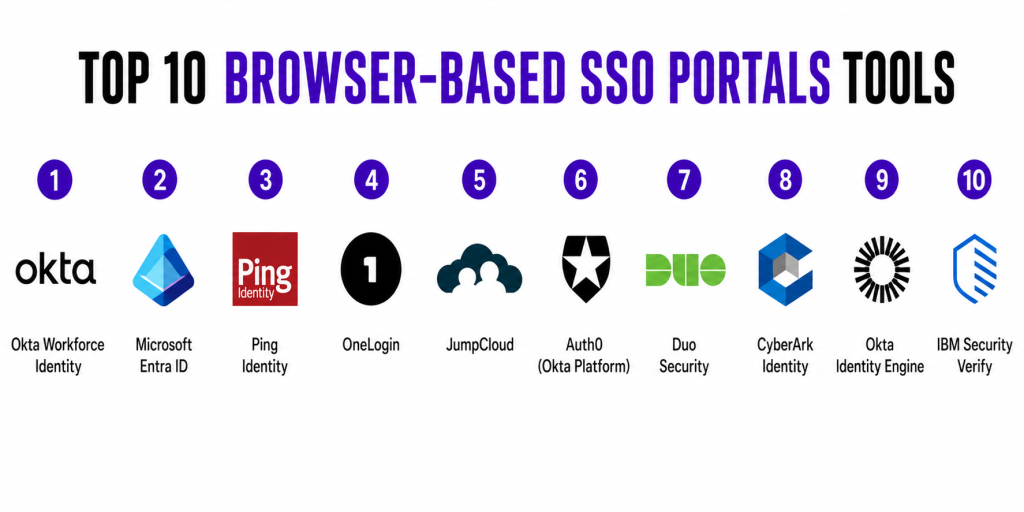
Top 10 Browser-based SSO Portals Tools
1 — Okta Workforce Identity
Short description:
Okta Workforce Identity is a widely used browser-based SSO platform that provides centralized access to SaaS applications. It allows users to authenticate once and access multiple applications securely through a unified portal. The platform supports adaptive authentication, MFA, and lifecycle management. It is commonly used in enterprises with large SaaS ecosystems. Okta helps reduce password-related risks and improves access control visibility. It is suitable for organizations requiring scalable identity management across cloud environments.
Key Features
- Browser-based SSO portal for SaaS applications
- Adaptive multi-factor authentication
- User lifecycle automation
- Universal directory support
- Access policy management
- Context-aware authentication
- Large SaaS integration catalog
Pros
- Strong SaaS integration ecosystem
- Easy user experience for employees
- Vendor-neutral identity management
Cons
- Pricing can increase with scale
- Advanced features require configuration
- Complex environments need careful setup
Platforms / Deployment
- Web
- Cloud
Security & Compliance
Supports SSO, MFA, RBAC, audit logs, encryption, and adaptive authentication. Compliance certifications vary by configuration and deployment.
Integrations & Ecosystem
Okta integrates with thousands of SaaS applications and enterprise systems.
- Microsoft 365
- Google Workspace
- Salesforce
- Workday
- Slack
- ServiceNow
Support & Community
Strong documentation, enterprise support, and large identity management ecosystem.
2 — Microsoft Entra ID
Short description:
Microsoft Entra ID is a browser-based identity platform that provides secure SSO access to Microsoft and third-party applications. It enables users to log in once and access enterprise systems through a centralized portal. It is widely used in Microsoft-centric organizations. The platform supports conditional access and identity protection. It is suitable for enterprises using hybrid or cloud environments. It helps enforce secure authentication policies across applications.
Key Features
- Centralized SSO access portal
- Conditional access policies
- MFA authentication support
- Identity protection features
- Privileged access management
- Application access control
- Hybrid identity support
Pros
- Strong Microsoft ecosystem integration
- Highly scalable identity platform
- Advanced security controls
Cons
- Complex configuration for beginners
- Best value in Microsoft environments
- Advanced features require setup effort
Platforms / Deployment
- Web
- Cloud
- Hybrid
Security & Compliance
Supports MFA, SSO, RBAC, audit logs, encryption, and conditional access policies.
Integrations & Ecosystem
- Microsoft 365
- Azure services
- Enterprise SaaS apps
- Security tools
- APIs
- Third-party identity systems
Support & Community
Strong enterprise support and extensive documentation ecosystem.
3 — Ping Identity
Short description:
Ping Identity provides browser-based SSO and identity federation solutions for complex enterprise environments. It enables secure access to applications through a centralized login portal. The platform supports hybrid identity infrastructures and API-based authentication. It is widely used in large organizations with complex security requirements. Ping Identity is suitable for enterprises requiring flexible identity architecture. It focuses on secure authentication and access management.
Key Features
- Browser-based SSO portal
- Identity federation support
- MFA authentication
- API identity security
- Risk-based authentication
- Hybrid identity support
- Access policy management
Pros
- Strong identity federation capabilities
- Flexible deployment options
- Suitable for complex environments
Cons
- Requires technical expertise
- Setup can be complex
- Not ideal for small organizations
Platforms / Deployment
- Web
- Cloud
- Hybrid
Security & Compliance
Supports SSO, MFA, RBAC, encryption, and audit logging.
Integrations & Ecosystem
- SaaS applications
- APIs
- Enterprise directories
- Cloud platforms
- Security tools
Support & Community
Enterprise support and professional services available.
4 — OneLogin
Short description:
OneLogin provides a browser-based SSO portal that simplifies access to SaaS applications. It allows employees to log in once and access multiple tools securely. The platform is designed for mid-market and enterprise users. It supports adaptive authentication and directory integration. OneLogin is suitable for organizations looking for practical identity management. It helps improve SaaS access control and user experience.
Key Features
- SSO portal for SaaS apps
- Multi-factor authentication
- User provisioning automation
- Directory integration
- Adaptive authentication
- Access policy controls
- SaaS app catalog
Pros
- Easy deployment
- Good SaaS integration support
- User-friendly interface
Cons
- Limited advanced governance
- Not ideal for very complex enterprises
- Some features require upgrades
Platforms / Deployment
- Web
- Cloud
Security & Compliance
Supports MFA, SSO, RBAC, encryption, and audit logs.
Integrations & Ecosystem
- Microsoft 365
- Google Workspace
- Salesforce
- Workday
- Slack
Support & Community
Standard enterprise support and documentation.
5 — JumpCloud
Short description:
JumpCloud is a browser-based SSO and directory platform that helps organizations manage identity and access across applications and devices. It provides a unified login portal for SaaS tools and enterprise systems. The platform supports cross-platform environments including Windows, macOS, and Linux. It is widely used by SMB and mid-market organizations. JumpCloud simplifies identity management without relying on traditional on-prem directories. It is suitable for cloud-first organizations.
Key Features
- Cloud-based SSO portal
- Cross-platform directory services
- MFA authentication
- Device management integration
- User lifecycle management
- Access policy enforcement
- SaaS application integration
Pros
- Simple deployment
- Strong cross-platform support
- Good SMB-friendly solution
Cons
- Limited enterprise governance depth
- Not as feature-rich as larger platforms
- May require add-ons for advanced use
Platforms / Deployment
- Web
- Cloud
Security & Compliance
Supports MFA, SSO, RBAC, encryption, and audit logs.
Integrations & Ecosystem
- Google Workspace
- Microsoft 365
- AWS
- Slack
- GitHub
Support & Community
Good documentation and SMB-focused support resources.
6 — Auth0 (Okta Platform)
Short description:
Auth0 provides a flexible identity platform that includes browser-based SSO capabilities for applications and enterprises. It allows developers and organizations to build secure login portals for SaaS and web applications. The platform supports authentication, authorization, and identity customization. It is widely used in developer-driven environments. Auth0 is suitable for companies needing flexible identity workflows. It enables secure SSO integration across applications.
Key Features
- Custom SSO login portal
- Identity federation
- MFA authentication
- Role-based access control
- API authentication support
- Social login integration
- Flexible identity workflows
Pros
- Highly customizable identity platform
- Developer-friendly
- Strong authentication flexibility
Cons
- Requires development expertise
- Can be complex for non-technical teams
- Pricing scales with usage
Platforms / Deployment
- Web
- Cloud
Security & Compliance
Supports SSO, MFA, RBAC, encryption, and secure authentication flows.
Integrations & Ecosystem
- SaaS applications
- APIs
- Cloud platforms
- Identity providers
- Developer frameworks
Support & Community
Strong developer documentation and community support.
7 — Duo Security
Short description:
Duo Security provides browser-based SSO access with strong multi-factor authentication and identity verification. It helps organizations secure application access through a centralized login experience. The platform is widely used for MFA-first identity protection. It supports secure authentication across SaaS applications. Duo is suitable for organizations focused on strong login security. It integrates well with enterprise systems.
Key Features
- SSO login portal
- Multi-factor authentication
- Device trust verification
- Access policy controls
- Application security integration
- User authentication monitoring
- Risk-based access
Pros
- Strong MFA capabilities
- Simple user experience
- Reliable authentication security
Cons
- Limited identity governance features
- Not a full IAM platform
- Advanced features require integration
Platforms / Deployment
- Web
- Cloud
Security & Compliance
Supports MFA, SSO, RBAC, encryption, and audit logs.
Integrations & Ecosystem
- Microsoft environments
- SaaS applications
- VPN systems
- Security platforms
- APIs
Support & Community
Good documentation and enterprise support options.
8 — CyberArk Identity
Short description:
CyberArk Identity provides secure browser-based SSO access combined with privileged access management capabilities. It helps organizations control access to sensitive applications and systems. The platform is widely used in regulated industries. It supports secure authentication and identity governance. CyberArk Identity is suitable for enterprises with high-security requirements. It helps reduce identity-based attack risks.
Key Features
- SSO access portal
- Privileged access controls
- MFA authentication
- Identity governance features
- Secure session management
- Application access policies
- Risk-based authentication
Pros
- Strong security posture
- Good for privileged access scenarios
- Enterprise-grade identity controls
Cons
- Complex implementation
- Higher operational overhead
- Requires security expertise
Platforms / Deployment
- Web
- Cloud
- Hybrid
Security & Compliance
Supports MFA, SSO, RBAC, encryption, audit logs, and privileged access controls.
Integrations & Ecosystem
- Enterprise SaaS apps
- Cloud platforms
- Security tools
- Identity providers
- APIs
Support & Community
Strong enterprise support and security-focused documentation.
9 — Okta Identity Engine
Short description:
Okta Identity Engine is a flexible identity framework that supports advanced browser-based SSO experiences. It enables organizations to customize authentication flows and access policies. The platform supports modern identity requirements including adaptive authentication. It is widely used in enterprise SaaS environments. It helps deliver secure and seamless login experiences. It is suitable for organizations with complex identity needs.
Key Features
- Custom SSO workflows
- Adaptive authentication
- MFA integration
- Identity orchestration
- Policy-based access control
- API-driven identity flows
- SaaS integration support
Pros
- Highly flexible authentication system
- Strong SaaS compatibility
- Modern identity architecture
Cons
- Requires configuration effort
- Can be complex for beginners
- Pricing scales with usage
Platforms / Deployment
- Web
- Cloud
Security & Compliance
Supports SSO, MFA, RBAC, encryption, and audit logging.
Integrations & Ecosystem
- SaaS platforms
- Enterprise applications
- APIs
- Cloud environments
- Identity systems
Support & Community
Strong enterprise support and documentation ecosystem.
10 — IBM Security Verify
Short description:
IBM Security Verify provides browser-based SSO and identity management for enterprise environments. It helps organizations manage authentication and access across applications. The platform supports hybrid and cloud identity systems. It is widely used in large enterprises with complex IT infrastructure. IBM Security Verify helps improve identity governance and security control. It is suitable for organizations requiring enterprise-grade identity solutions.
Key Features
- SSO login portal
- Identity governance tools
- MFA authentication
- Access policy management
- Lifecycle management
- Risk-based authentication
- Application integration
Pros
- Strong enterprise identity capabilities
- Good hybrid environment support
- Reliable security controls
Cons
- Complex setup process
- Requires enterprise expertise
- Not lightweight for small teams
Platforms / Deployment
- Web
- Cloud
- Hybrid
Security & Compliance
Supports MFA, SSO, RBAC, encryption, audit logs, and identity governance controls.
Integrations & Ecosystem
- IBM security suite
- Enterprise SaaS applications
- Cloud platforms
- APIs
- Identity providers
Support & Community
Enterprise-level support and documentation.
Comparison Table
| Tool Name | Best For | Platforms | Deployment | Standout Feature | Public Rating |
|---|---|---|---|---|---|
| Okta Workforce Identity | SaaS access management | Web | Cloud | Large SaaS ecosystem | N/A |
| Microsoft Entra ID | Microsoft environments | Web | Cloud/Hybrid | Conditional access | N/A |
| Ping Identity | Complex enterprises | Web | Cloud/Hybrid | Identity federation | N/A |
| OneLogin | Mid-market IAM | Web | Cloud | Easy SSO portal | N/A |
| JumpCloud | SMB identity management | Web | Cloud | Cross-platform directory | N/A |
| Auth0 | Developer identity | Web | Cloud | Custom login flows | N/A |
| Duo Security | MFA-first security | Web | Cloud | Strong authentication | N/A |
| CyberArk Identity | Privileged security | Web | Cloud/Hybrid | Privileged access control | N/A |
| Okta Identity Engine | Advanced identity flows | Web | Cloud | Flexible authentication | N/A |
| IBM Security Verify | Enterprise IAM | Web | Cloud/Hybrid | Identity governance | N/A |
Evaluation & Scoring of Browser-based SSO Portals
| Tool Name | Core (25%) | Ease (15%) | Integrations (15%) | Security (10%) | Performance (10%) | Support (10%) | Value (15%) | Total |
|---|---|---|---|---|---|---|---|---|
| Okta Workforce Identity | 9.4 | 9.0 | 9.5 | 9.2 | 9.2 | 9.0 | 8.7 | 9.1 |
| Microsoft Entra ID | 9.5 | 8.5 | 9.6 | 9.4 | 9.3 | 9.0 | 8.8 | 9.1 |
| Ping Identity | 9.0 | 8.2 | 9.0 | 9.2 | 9.0 | 8.8 | 8.4 | 8.8 |
| CyberArk Identity | 9.2 | 8.0 | 8.8 | 9.6 | 9.1 | 9.0 | 8.2 | 8.8 |
| IBM Security Verify | 8.9 | 8.0 | 8.7 | 9.1 | 8.9 | 8.8 | 8.3 | 8.6 |
| Auth0 | 8.8 | 8.5 | 9.0 | 9.0 | 8.8 | 8.6 | 8.5 | 8.7 |
| Duo Security | 8.7 | 8.8 | 8.6 | 9.3 | 9.0 | 8.7 | 8.4 | 8.7 |
| OneLogin | 8.5 | 8.8 | 8.4 | 8.8 | 8.6 | 8.5 | 8.6 | 8.6 |
| JumpCloud | 8.4 | 8.9 | 8.2 | 8.7 | 8.5 | 8.4 | 8.8 | 8.5 |
| Okta Identity Engine | 9.1 | 8.7 | 9.3 | 9.2 | 9.0 | 8.8 | 8.5 | 8.9 |
These scores are comparative and based on usability, identity depth, integration strength, and enterprise readiness.
Which Browser-based SSO Portal Tool Is Right for You?
Solo / Freelancer
JumpCloud is the most practical option for lightweight identity and access management.
SMB
OneLogin, JumpCloud, and Duo Security offer simple and effective SSO and MFA solutions.
Mid-Market
Okta, Auth0, and Ping Identity provide strong balance between flexibility and scalability.
Enterprise
Microsoft Entra ID, CyberArk Identity, IBM Security Verify, and Okta are strong enterprise choices.
Budget vs Premium
- Budget: JumpCloud, Duo Security
- Mid-range: OneLogin, Auth0
- Premium: Okta, Microsoft Entra ID, CyberArk
Feature Depth vs Ease of Use
- Deep identity control: CyberArk, IBM Security Verify
- Easy adoption: JumpCloud, Duo Security
- Balanced: Okta, OneLogin
Integrations & Scalability
Okta and Microsoft Entra ID provide the strongest ecosystem scalability.
Security & Compliance Needs
CyberArk Identity and IBM Security Verify are best for high-security and regulated environments.
Frequently Asked Questions
1. What is a browser-based SSO portal?
It is a centralized login system that allows users to access multiple applications through one authentication point.
It removes the need for multiple passwords.
It improves security and user experience.
It is widely used in enterprise environments.
2. How does SSO improve security?
SSO reduces password reuse across systems.
It centralizes authentication controls.
It enables MFA enforcement across all apps.
It reduces phishing and credential theft risks.
3. Are SSO portals safe?
Yes, they are widely used in enterprise security systems.
They rely on encryption and authentication protocols.
Security depends on proper configuration.
MFA significantly improves safety.
4. Can SSO work with SaaS applications?
Yes, most modern SaaS apps support SSO integration.
They use standards like SAML and OAuth.
SSO simplifies user login experience.
It is a core feature of identity platforms.
5. What is the difference between SSO and IAM?
SSO is a login mechanism.
IAM is a broader identity management system.
IAM includes access control and governance.
SSO is a component of IAM.
6. Do SSO tools support MFA?
Yes, most platforms include MFA support.
It adds extra security during login.
MFA reduces account compromise risks.
It is a standard feature.
7. How long does SSO implementation take?
It depends on application complexity.
Simple setups take days or weeks.
Enterprise setups may take longer.
Integration planning affects timelines.
8. What are common mistakes in SSO deployment?
Poor configuration of authentication policies is common.
Ignoring legacy application compatibility is another issue.
Weak MFA setup reduces security.
Lack of monitoring creates risks.
9. Can SSO integrate with existing directories?
Yes, most platforms integrate with directories.
They support Active Directory and LDAP.
This helps unify user identity management.
It simplifies onboarding and offboarding.
10. What alternatives exist to SSO?
Password managers are a basic alternative.
Traditional login systems are still used in small setups.
VPN-based access is another method.
However, SSO is more secure and scalable.
Conclusion
Browser-based SSO portals are a critical part of modern identity security systems, enabling secure, centralized access to applications across cloud and enterprise environments. They reduce password fatigue, improve security, and simplify IT management.The best tool depends on organizational size, security requirements, integration needs, and budget. Okta and Microsoft Entra ID lead enterprise adoption, while JumpCloud and OneLogin serve SMB and mid-market needs effectively.
